A brown stain on the chimney breast, wallpaper lifting from the plaster, or paint that bubbles and flakes: the usual assumption is that the roof is leaking. Sometimes it is. But a chimney breast can be damp for at least three different reasons, and the cure for one does nothing for another. Repairing the flashing will not fix condensation, and treating the plaster will not stop rain coming down the flue.
The breast is a vulnerable place. It is a column of brick running from the fireplace up through the house, with the stack on the roof at the top. Part of it is inside the warm house, part of it is in the cold loft, and the top is open to the sky. Water can arrive from the roof, from the air in the room, or out of the brick itself.
This guide describes each cause, how to tell them apart from the signs, and what puts each right. It belongs with the rest of our chimney repairs advice, and it assumes you will photograph the stain and the stack before anyone starts work.
Three causes, and how to tell them apart
Start by noting when the damp appears and how it behaves. The pattern tells you more than the stain itself.
Rain from above
Damp that appears or spreads after heavy or prolonged rain, and dries out in a dry spell, suggests water entering the stack. The stain often has a tide mark with a darker edge. It may be higher on the breast, or even in the ceiling beside it, and it can show in the loft first.
Condensation
Damp that is present in cold weather whether or not it has rained, that is worse on cold mornings, and that appears on a cold outside wall, suggests condensation. The surface is cold, warm moist air from the room meets it, and the water vapour turns to droplets. Mould speckles on the paint are common.
Salts
A stain that returns after the cause of the damp has been cured, that is brown or yellow, and that darkens in humid weather without any rain, suggests salts in the plaster. They come from soot and combustion products absorbed by the brick over many years. They draw moisture out of the air, which keeps the area damp.
More than one at once
The causes often overlap. A leaking flashing can wet a breast that is also suffering condensation, and old salts then make it worse. Do not assume one cause explains everything.
Take dated photographs, and note the weather, the temperature and whether the heating was on. Over two or three weeks, a pattern emerges that no single visit can show.
Rain through the stack
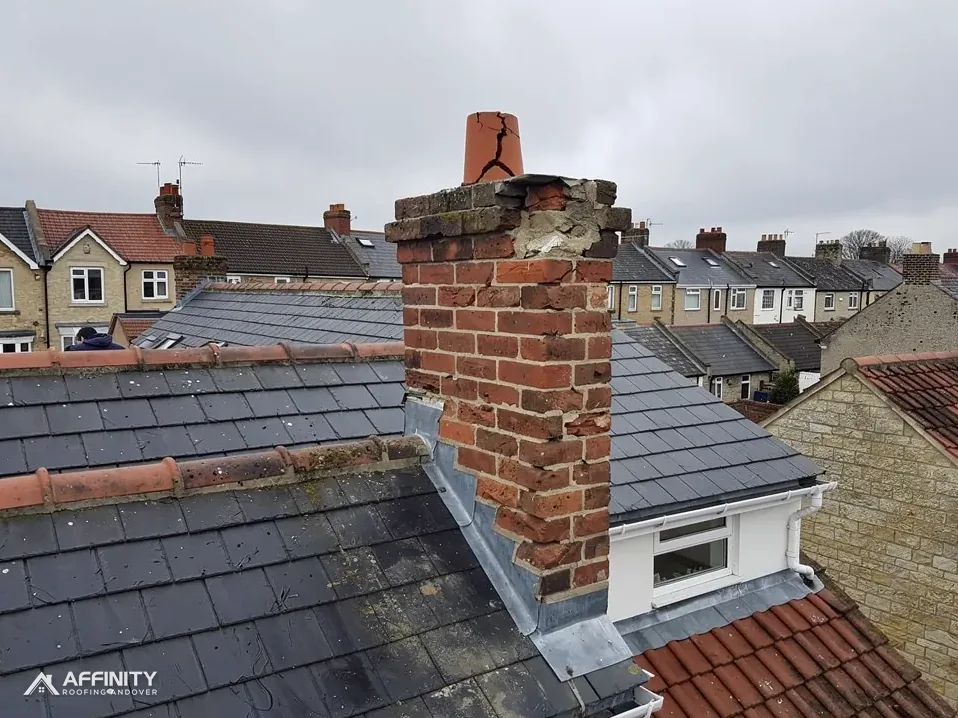
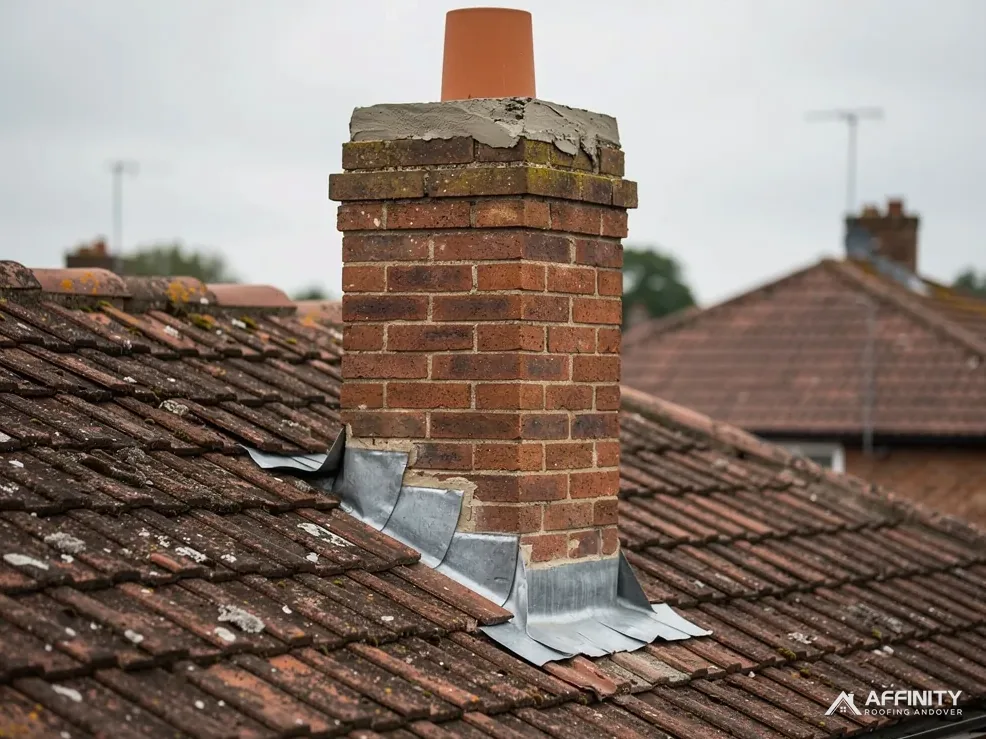
The stack rises clear of the slope on every side, and rain gets in at its weak points. Four are common, and a surveyor checks each from top to bottom.
The flaunching and pots
The sloping mortar at the top, called flaunching, sheds water away from the flues. If it has cracked, rain runs down beside the pots and into the stack. A cracked pot does the same. Our guide to chimney flaunching describes the repair.
The pointing
Open or crumbling joints let rain into the brick, which then carries it down the stack. Repointing in a mortar that suits the brick puts that right, and paint or sealant over the joints is no substitute for it.
Brick faces
Where brick faces have flaked away, the brick soaks up water like a sponge. A stack with widespread spalling may need rebuilding instead of repair.
The flashing at the roof
At the junction of stack and slope, lead flashings keep rain out of the joint. If they have lifted, split or been pulled away by movement, rain runs down the side of the stack into the loft or the breast. A lead flashing can last for over 80 years, according to MyJobQuote, so age alone does not condemn one, while a patch of sealant over a gap is not a repair.
Keep an eye on the loft after rain. A tide mark on the brick where it passes through the roof space points to the stack above.
Condensation and cold flues
Condensation forms when warm, moist air touches a cold surface. A chimney breast on an outside wall can be one of the coldest surfaces in a room, particularly if the flue is open to the cold outside or full of cold air.
Why the flue matters
An unused flue is a tall shaft of cold air. If it is open at the top and blocked at the fireplace, the breast is chilled by the flue behind it. If it is sealed at both ends, the trapped air goes still and damp. Either way the surface of the breast in the room is cold enough for condensation to form.
Everyday moisture
Cooking, washing, drying clothes indoors and breathing all add moisture to the air of the house. A room that is not ventilated, or that is heated unevenly, gives that moisture a place to settle. A breast in a bedroom is a common target.
Managing moisture
BS 5250:2021, current at BSI, is the standard that deals with moisture in buildings. Practical steps include extraction in kitchens and bathrooms, steady background heat, opening windows briefly rather than leaving the room sealed, and keeping air moving in an unused flue.
A damp patch that comes and goes with the weather and the heating, and shows no tide mark, is more likely condensation than a leak.
If you cap a flue to stop rain, ventilate it too, as our guide to chimney capping and ventilation explains.
Salts left by soot and old fires
Fireplaces leave a residue. Over decades, soot and combustion products soak into the brick and plaster of a breast, and the salts they contain stay there long after the last fire. Those salts attract moisture, which is why a breast can feel damp even when it is not being rained on.
What it looks like
The typical sign is a brown or yellow stain, sometimes with a powdery white crust, that bleeds through fresh paint or lining paper and keeps coming back. The stain is often widest at the height of the original fireplace or along the line of the flue.
Cure the water first
Salts only cause trouble when there is moisture to dissolve them. Find and stop the water entry, whether it is rain through the stack or a lack of ventilation, then let the wall dry. Painting over the stain before it has dried only sends it back through.
Treating the plaster
Once the wall is dry, the affected plaster may need to be hacked off and renewed, with a lining that blocks the salts. That is a plasterer's job, not a roofer's, though a roofer can tell you whether the stack above is the source.
Do not rush
The order matters: stop the water, let it dry, then treat the surface. A fresh coat of paint over a damp, salt-laden wall wastes the money and hides the evidence you need to find the cause.
Keep photographs of the stain before and after the repair.
Ventilation of the flue and the roof space
Air movement is the common thread between condensation and salts. Where air can circulate, moisture leaves. Where it cannot, moisture stays and settles.
In the flue
A disused flue needs a way for air to move through. A vented cap on the pot, a grille low down in the room, or both, keep the air changing. Closing the flue at the top and the bottom together is the combination to avoid. Do not close a grille because it feels draughty.
In the loft
Where the chimney passes through a cold loft, the roof space has its own ventilation needs. Marley gives the eaves vent for a cold roof under a non-breathable underlay as 25 mm where the pitch is 15 degrees or less, and 10 mm on steeper pitches. With a breather underlay over a well-sealed ceiling, the 3 mm of incidental ventilation at the eaves can suffice if third-party certification supports it.
Insulation and the eaves
Insulation pushed into the eaves can block the air path. If you top up the loft insulation, keep it clear of the eaves. Check that nothing is stored against the chimney in the loft, where it traps damp air.
Ask the roofer
A thorough survey takes in the stack, the loft and the ventilation, not just the part you can see. If the breast is damp and the loft is stuffy, ask what airflow the roof was designed to have, and photograph the vents.
Flashings, back gutters and the join at the roofline
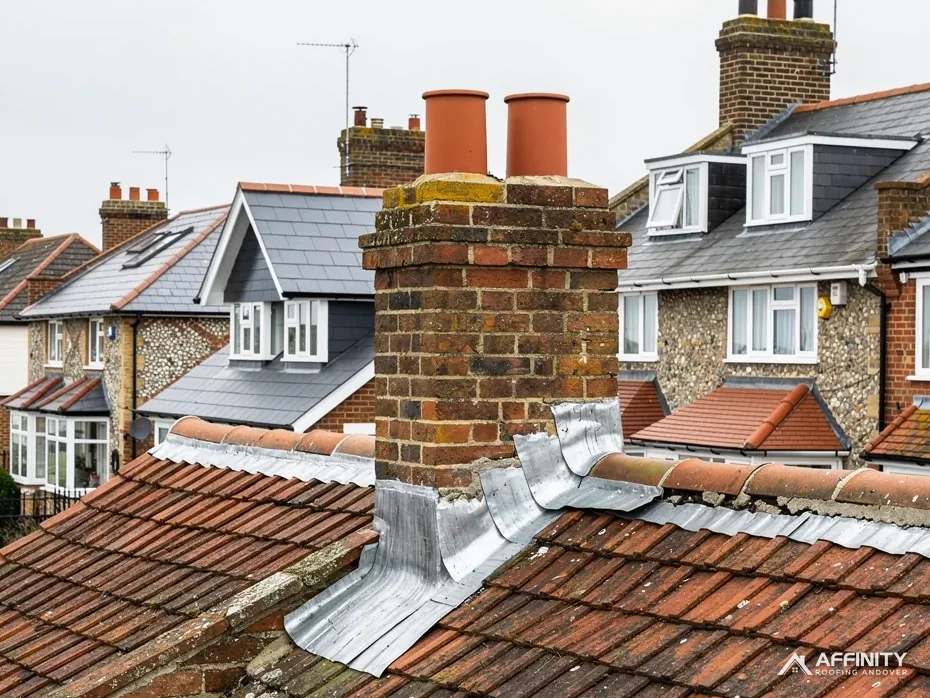
Where the chimney leaves the roof, the joint is sealed by lead flashings. They are among the first things to check for a leak, and easy to overlook, because they are small and often hidden by moss.
The parts of a chimney flashing
A well-built chimney has a lead apron at the front, step flashings along the sides, where the lead is cut into the brick joints and steps up with the slope, and a back gutter or tray behind the stack, which carries water around it. The Royston lead brochure lists codes 4, 5 and 6 for flashings, with codes 7 and 8 kept for gutters and dormers. Lead sheet roofs follow BS 6915, to which Approved Document C refers.
How they fail
Lead can split along a fold, lift where the fixings have loosened or be torn by movement of the stack. The mortar that holds the top edge in the brick joint may crumble. Sealant smeared over the gap may hold for a season and then let go.
Cost context
MyJobQuote (September 2026) puts full chimney leadwork between £350 and £920, with the scaffold a deciding factor. Treat that as a national guide, not as our price.
Checking the join
A roofer can often tell by looking, and can confirm with a controlled water test: wetting each part in turn and watching the loft. Photographs show the lead and the stack joints.
Our answer on a chimney leaking in heavy rain goes into the signs.