The short answer
There is no automatic rule that settles it, and the answer usually comes from what the two owners agree in writing, based on what each flue serves and who benefits from the repair. Where agreement fails, a party wall surveyor can settle it under the Party Wall etc. Act 1996. Settle the split before anyone books work, and keep it on paper. This is general information, not legal advice.
How a shared stack works
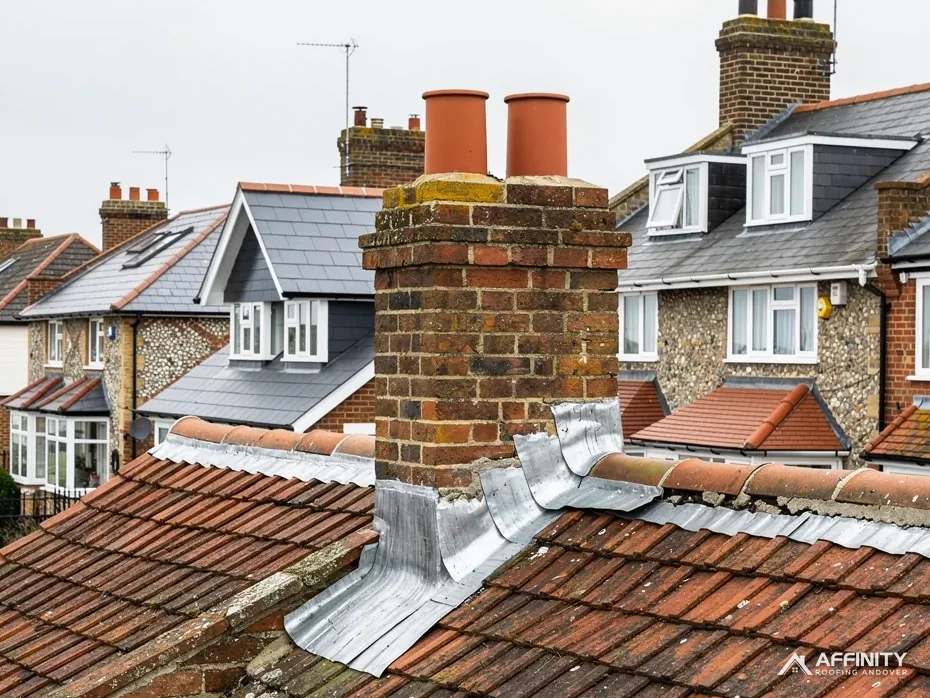
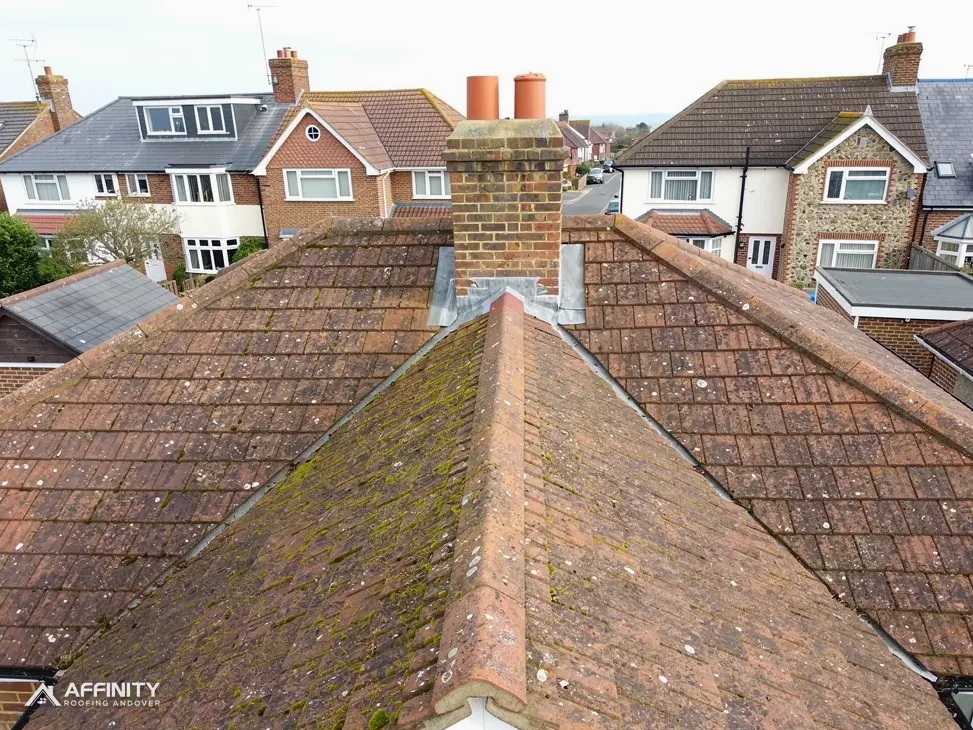
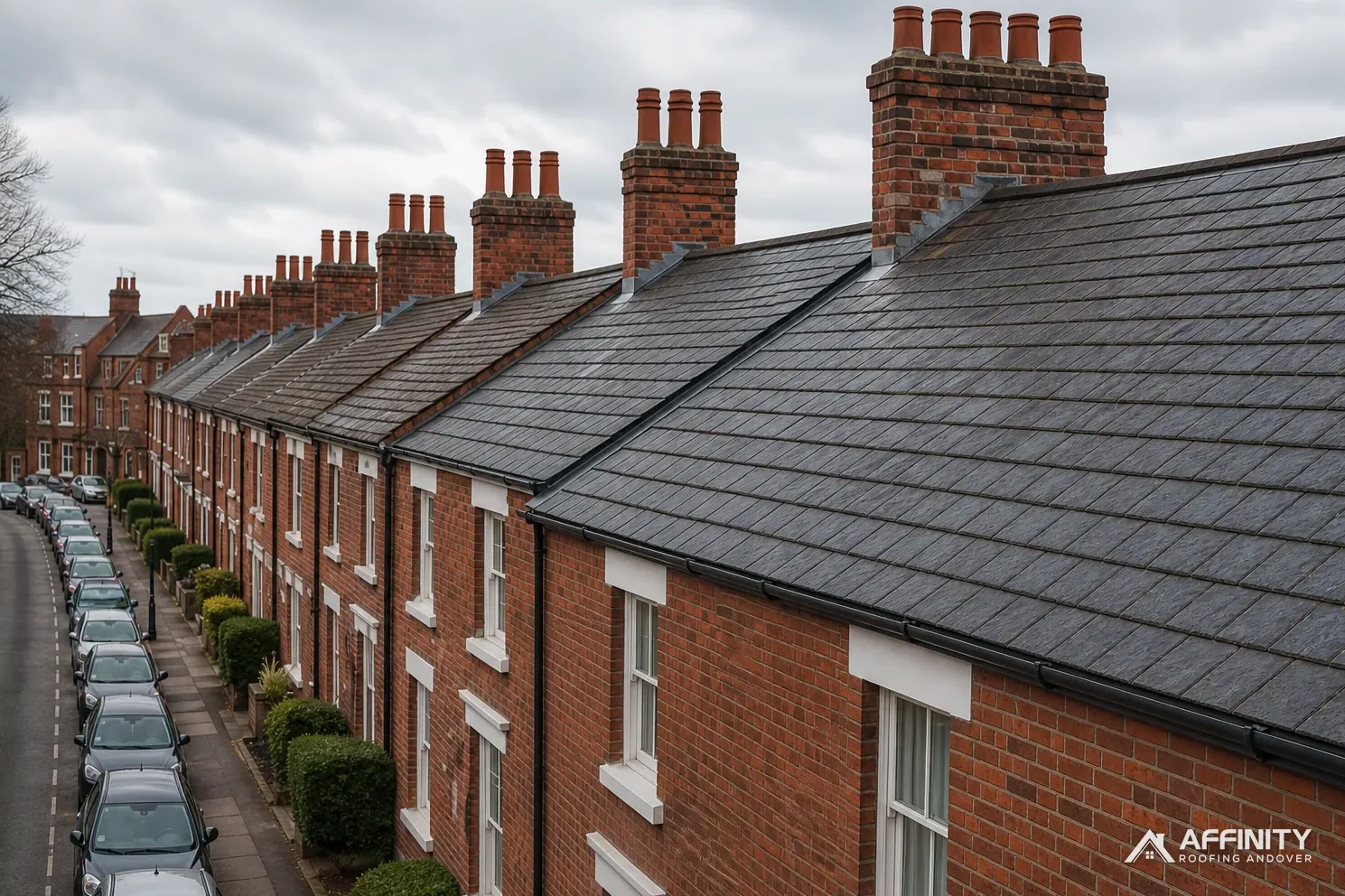
In terraced and semi-detached houses a single chimney stack often rises from the dividing wall, with flues from both homes running up inside it. From the roof it looks like one structure, and in a sense it is: one set of bricks, one flaunching on top, one run of lead where it meets each roof slope.
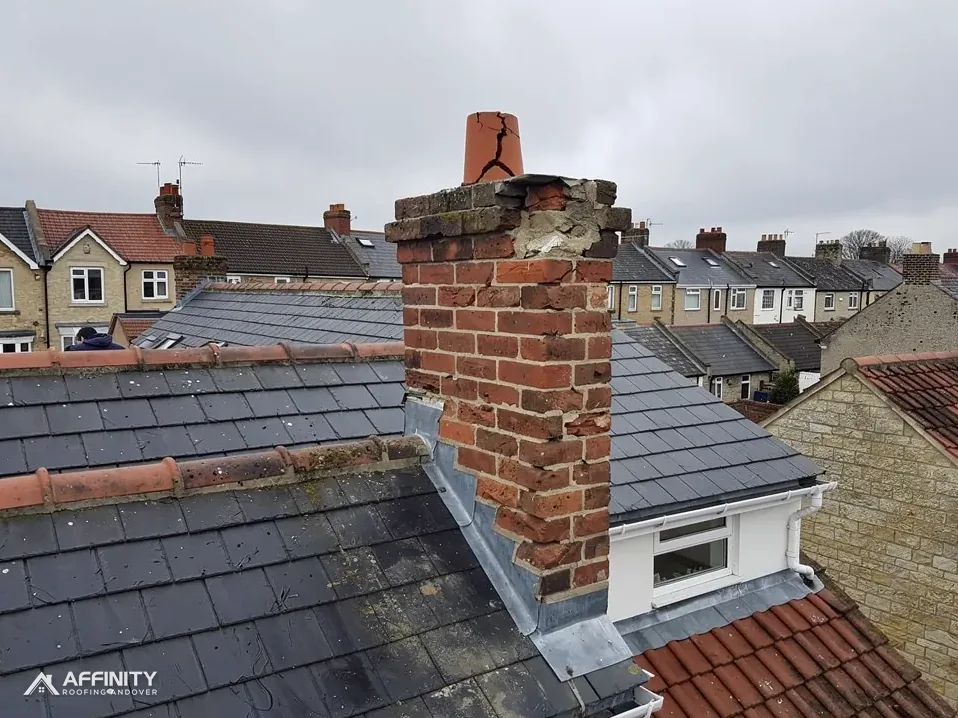
That makes repair a shared matter. A crack, a loose pot or a failed flashing on the shared stack can let water into either house, and the person who first notices it may not be the person whose side is worse. A leaking stack may even show as damp in a chimney breast on one side only, while the fault sits at the top of both.
The roof covering near the stack can differ from house to house, which is another reason to look at it as a whole. One side may have been re-roofed and the other not, and the junction between them is where lead is most likely to have failed.
Our survey treats the shared stack as one object and records each face, the top and the lead on each slope, so the owners have the same picture. That helps discussion because nobody is arguing from different evidence.
Agreement between the two owners
Costs are usually settled by agreement. Where a repair benefits both homes equally, such as new flaunching or repointing the whole stack, an even split is the natural starting point. Where one house alone is served by a defect, or one side has an unused flue and the other a working one, the split may be different. That choice is for the two of you.
What matters is that the agreement is written down before the work. A short email exchange is a start: who will arrange the work, what is covered, how the cost is divided and when it is paid. A verbal arrangement leaves both sides vulnerable if either of them sells, or if the repair reveals more than was expected.
It also helps to agree on one contractor and one written price. Two separate repairs on one stack, done at different times, mean paying for access twice and risk mismatched work at the join.
If the repair is routine, with no change to the structure, it is usually a matter of goodwill and a shared bill. If one owner wants to alter or remove the stack, the law becomes more specific, as the next section shows. Our page on chimney repair responsibility goes further.
Party wall basics
The Party Wall etc. Act 1996 applies to work on a wall shared between two owners. Section 2(2)(g) lets an owner cut away a chimney breast or flue that projects from a party wall, and section 3(2)(a) sets a lead time of two months for the notice. A plain repair to a shared stack, such as repointing, is a different category from cutting into the wall, and may not need a formal notice, but removing or altering the stack and breast does.
GOV.UK states that silence from next door is no agreement, and that a surveyor must be appointed where the owners remain apart. The surveyor's award sets out how and when the work goes ahead.
The Act has a route for owners who agree: written consent takes the place of the formal dispute process. That is why a written agreement is so useful. It can serve both as your split of the bill and as evidence of consent.
If you want the longer version, our answer on the party wall notice for a chimney breast explains the notice and its timing.
Using a surveyor, and how we help
If you and your neighbour cannot agree, a party wall surveyor is the person to bring in. They are independent of builders and roofers, and their role is to settle rights between owners. You may appoint one between you or one each. Ask them to confirm the position in writing, rather than relying on either owner's recollection.
Our part is the roof. We survey the stack, photograph each face and lead run, and describe what each defect is and where it sits. That description is neutral, and it lets your surveyor and your neighbour see the evidence. Where the fault is on one side only, the pictures show it.
We then give one written price for the repair. Because a shared stack has two owners, the total can be divided between them in whatever way you agree, and that agreement is yours to settle. We do not take sides, and we will not start until we know which owner is instructing us and that the other has been told.
Access is part of the job too. Poles may have to stand on one plot to reach the other roof, so make sure both owners are content before the scaffold goes up. Our chimney repairs page lists the repairs we carry out on stacks.