A chimney stack is brick and mortar standing in the open, on top of a house, in every kind of weather. It is built to last, and many stacks do last for a century or more. But no stack is permanent, and sooner or later the mortar softens, the brick spalls, the structure moves, or the stack takes on a lean.
Repairing a stack is nearly always cheaper than rebuilding it, so a good roofer starts with repair. Repointing, a new flaunching, replacement pots and renewed flashings put right a surprising number of tired stacks. Rebuilding is justified only when the brickwork itself has failed, and mending it would be money spent on something that will not hold.
This guide describes how to tell the two apart, what a rebuild involves above the roofline, why scaffolding is part of the job, and how the brick, the mortar and the flashings are matched or renewed. It belongs with our wider chimney repairs advice. A rebuild is a different job from taking a stack down, which our guide to removing a chimney stack covers.
Signs that a stack needs more than repair
Look at the stack from the garden with binoculars. A rebuild is on the cards when the problem is in the structure of the stack, not just its surface.
Structural signs
A stack that leans, or has bowed to one side, has moved. Stepped or diagonal cracks running through the brick and the mortar mean the structure is shifting. Bricks that have come loose, a missing corner, or sections that sound hollow all point the same way. If you can see daylight through a joint, or a pot that has moved on its bed, the problem is more than surface wear.
Surface decay
Brick faces that crumble and flake, called spalling, are a warning when it is widespread. A little is normal on an old stack. If large areas have lost their faces, or the mortar between the bricks can be scraped out with a fingernail, repointing may not hold, because there is nothing sound to point against.
Repeated repairs
A stack that has been repointed more than once and is failing again, or one with patches in mismatched mortar, may have deeper trouble. A rebuild is the better choice than another round of patching.
Inside the house
Persistent damp on the chimney breast, with salts or staining, can mean water is working through the stack. It does not prove a rebuild is needed, because flashings and flaunching are common culprits. A survey tells you which.
Never climb to look. Take photographs from the ground and ask a roofer to survey from a safe platform.
What a rebuild covers above the roofline
A rebuild means taking the stack down to sound brickwork and building it up again. The usual extent is from a few courses above the roof to the full height, depending on where the sound brick begins.
Recording the stack first
Before anything comes down, a good roofer records the stack: how many flues, the size and shape, the pattern of the brickwork, the corbelling or any decoration, the number and type of pots. Photographs and measurements let the new stack match the old, which matters on an older house where the chimney is part of the street.
Taking it down
The stack is dismantled course by course from the top, and the bricks are sorted. Sound bricks that can be reused are cleaned and set aside, and those that are spoiled are replaced. The flues are protected from debris, and the roof is protected where material falls.
Building it up
The stack is rebuilt in mortar that suits the brick, with the flue linings checked or renewed, the corbelling restored, and a sloped flaunching and the pots set at the top. The lead flashings that tie the stack to the roof are renewed as part of the work, since they would otherwise be disturbed and need relaying.
Below the roofline
If the weakness extends below the roof, into the loft or the breast, the rebuild may go lower. A survey in the loft shows how far down the problem goes.
Ask your roofer how far down the rebuild will go, and why.
Scaffold, access and the licence
A rebuild cannot be done from a ladder. The stack is dismantled and rebuilt piece by piece, and the roofer needs a proper platform around it, with a safe way to carry materials up and debris down.
The scaffold is part of the job
A scaffold, usually to the eaves with a platform at the stack, adds a good deal to the price. The quote should say whether it is included, and for how long it will stand. Longer stays cost more, and a rebuild may need the scaffold for several days.
Who deals with the licence
Where the scaffold needs space on the pavement or the road, the highway authority has to consent under section 169 of the Highways Act 1980. In Andover, as across Test Valley, Hampshire County Council holds that role, and its page says the application comes from the scaffolding company, lodged at least ten working days ahead. Wiltshire Council and West Berkshire Council give the same instruction on their own pages. Elsewhere, ask who applies.
Why the date can slip
Ask your roofer who is lodging the application and what start date it allows. The licence lead time is a common reason for a booked date to move, and it is easier to plan for than to explain to a neighbour.
Scaffold on your own land
A scaffold that stands wholly inside your boundary involves no highway consent at all, though it still needs to be safe, tied in and clear of neighbours' property. If a neighbour's garden is the only way in, ask permission well before the start.
Brick, mortar and matching the old stack
A rebuilt stack that does not match the original looks wrong from the street, and on an older house it can look wrong for decades. The bricks, the bond and the mortar all contribute.
The bricks
If the original bricks are sound, they are reused. Where replacements are needed, the roofer looks for reclaimed bricks of the same size, colour and texture, or new ones that match closely. A brick that is much harder than its neighbours can cause trouble, because the softer bricks and the mortar take the movement.
The mortar
The mortar should be compatible with the brick. On a period stack, a softer, lime-based mortar usually suits old brick better than hard cement. Our guide to repointing with lime or cement mortar explains the reasoning.
The finish
Joints should be finished to match the original profile. A flush joint, a struck joint and a recessed joint look different from the street. Photographs taken before the stack comes down show what the original looked like.
Pots and flaunching
The pots are reused if sound or replaced to match. A new flaunching is formed at the top. If you want the stack to look the same as before, say so at the start, and ask for the match to be written into the quote.
On a listed building or in a conservation area, ask the council before changing the brick, bond or height of a stack. Class C permitted development excludes chimneys.
Lead flashings and the join to the roof
The joint between stack and slope is sealed with lead flashings. They are renewed in a rebuild, because the stack is the thing they are attached to and they cannot be reused after it is taken apart.
Why the flashing matters
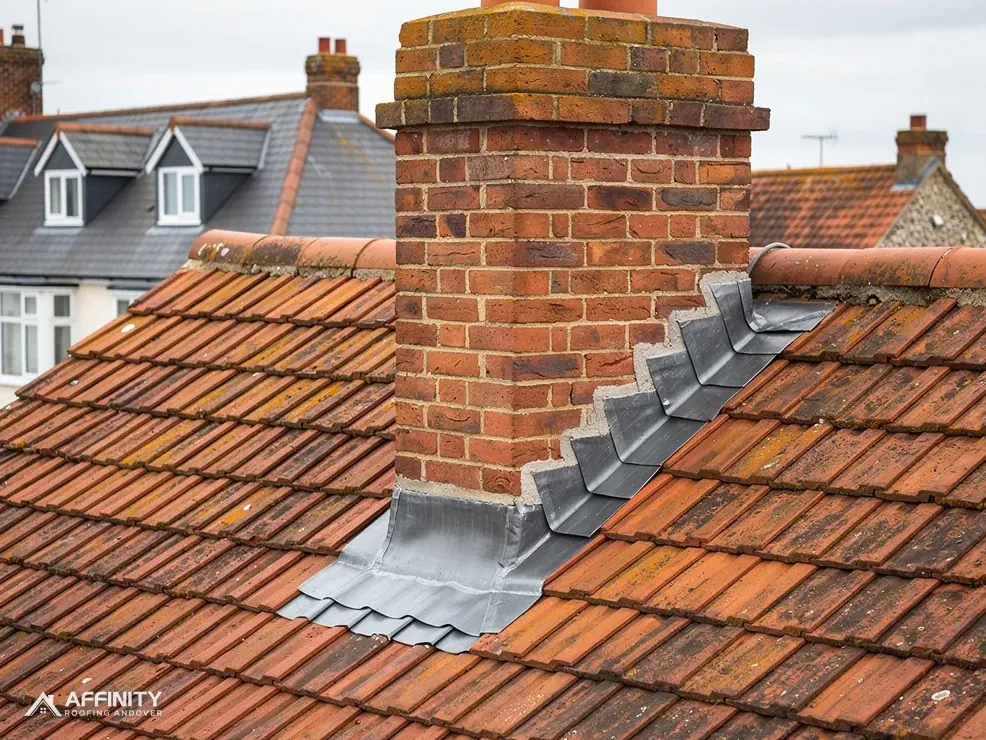
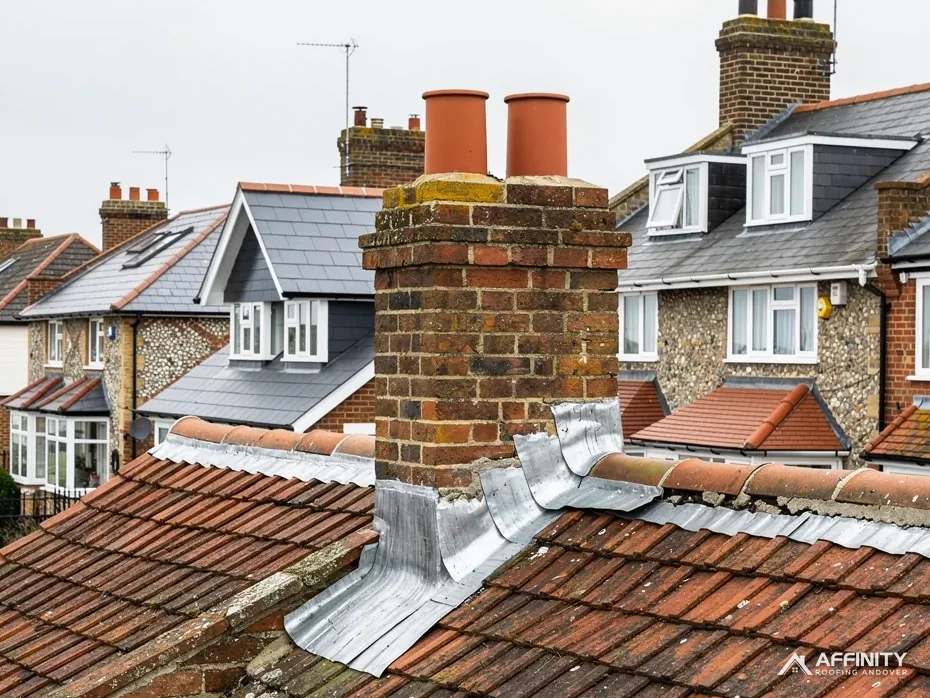
The flashing is one leak point on a chimney. Even a perfect new stack will let water in if the flashing is poorly formed. The lead is dressed over the roof covering at the sides and front, and tucked into the brick joints, with a gutter or tray at the back where the stack meets the slope.
Lead codes
Lead sheet comes in codes that set its thickness. Code 4 and code 5 are listed for flashings, and heavier codes for gutters and flat areas. For lead sheet roofs, Approved Document C refers to BS 6915. Lead flashing can last for over 80 years, according to MyJobQuote, and that figure is a lower bound rather than a promise.
No sealant shortcuts
A bead of sealant over a failing joint is a short-term measure. A proper lead flashing is cut, dressed and fixed with the stack joints raked out to receive it. Our guide on chimney lead flashing covers the detail.
Cost context
MyJobQuote (September 2026) gives full chimney leadwork as between £350 and £920, depending on the scaffold. It is a general UK guide rather than our own figure.
Ask for photographs of the finished flashing from the roof, so you can see each part.
Planning, neighbours and wildlife
A rebuild can raise questions beyond the brickwork. Most can be answered before work starts.
Planning and consent
Class C permitted development, which covers roof alterations on a house, excludes chimneys, so a like-for-like rebuild is a repair, and a change to height or appearance is judged separately. A listed home needs listed building consent for alterations that change its character. In a conservation area, ask Test Valley Borough Council whether an Article 4 direction applies to your street, because the answer is specific to the address.
Shared stacks
A stack that serves two houses is shared. A rebuild touches your neighbour's flues and roof, so tell them early, and ask a party wall surveyor if you are unsure whether the Party Wall etc. Act 1996 applies. Party wall questions do not go to building control.
Nests and roosts
Birds nest in stacks, and bats can roost in roof spaces near them. Section 1 of the Wildlife and Countryside Act 1981 applies to anyone who intentionally destroys or damages a nest while it is in use, so the work waits for the birds to leave. If a survey finds signs of bats, take specialist advice before work starts.
Insurance
If a storm brought the stack down, tell your insurer first, make the area safe and keep photographs and receipts, as in our guide on the roof insurance claim process.
Ask for the scope, the scaffold and the flashing to be named in one written total.