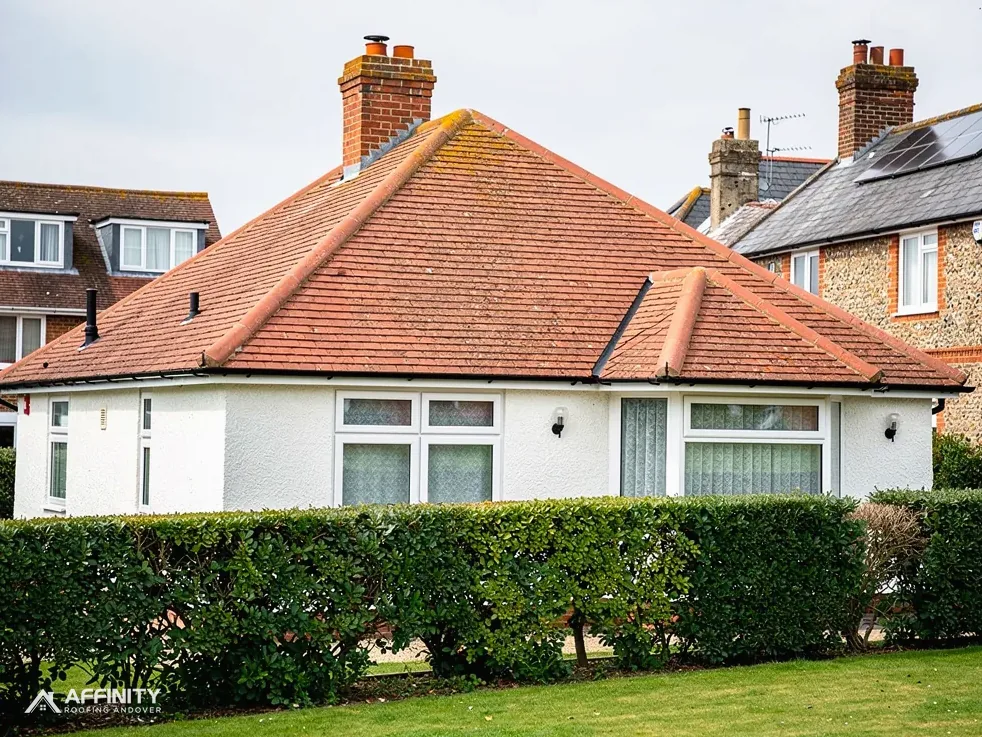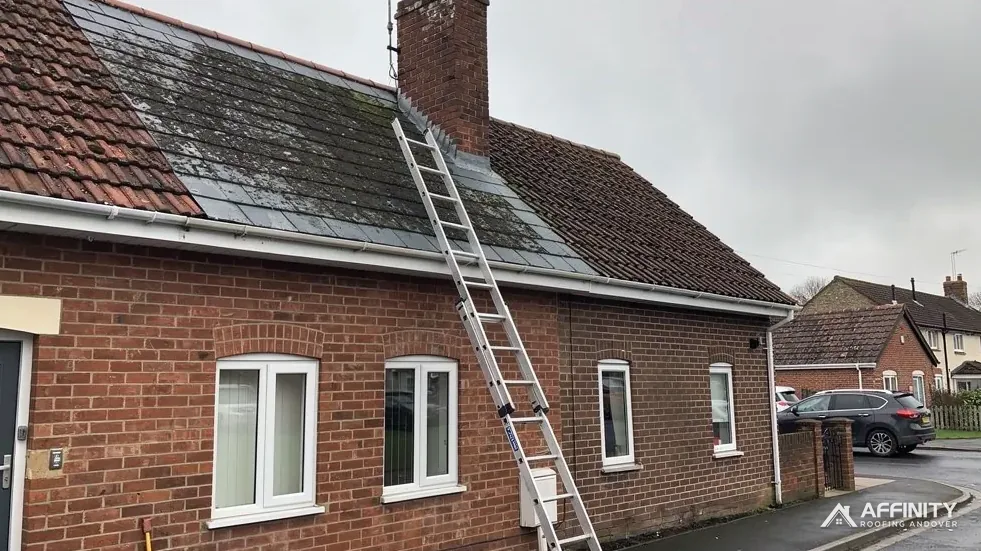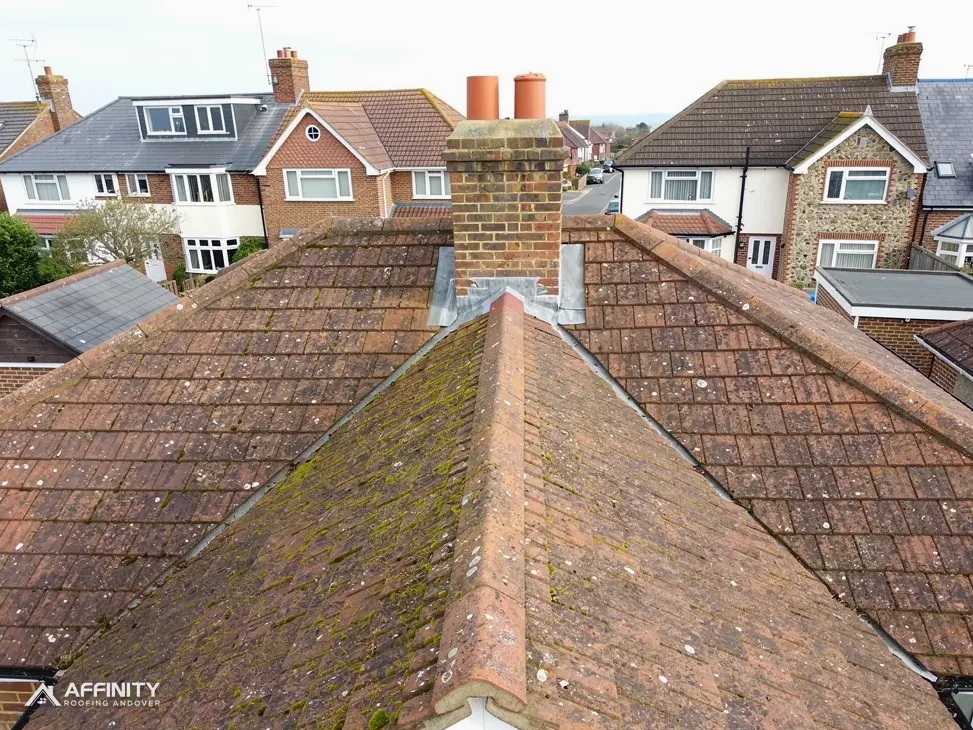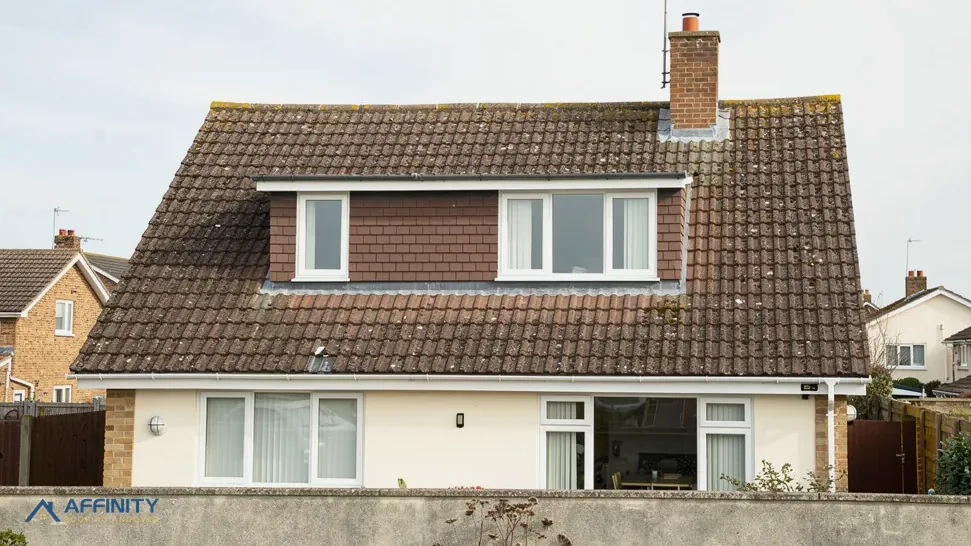
A slipped concrete tile is easy to spot from the garden. It sits lower than its neighbours, or leaves a gap where it has gone, or lies cracked on the lawn after a blow. It is just as easy to patch, and many roofers will replace it in minutes. The harder question is why it moved, because if the cause is still there, the next tile will follow.
Interlocking concrete tiles are held to the roof by a combination of weight, interlock with their neighbours, and fixings: nails through the tile into the batten, and clips in some courses and positions. When the fixings fail, the interlock and the weight are not always enough on their own. The underlay beneath, and the pitch of the roof, play a part as well.
This post goes through the usual reasons concrete tiles slip, what the British Standard says about fixing, and how to decide whether a few tiles need refixing or the whole slope needs covering again. It does not say anything about what any particular street or estate is roofed with, because that is something only a survey of the roof in question can tell you.
How a concrete tile is held in place
An interlocking concrete tile is a large, profiled tile with a channel down each side that locks into its neighbour. Every tile hangs on a timber batten by a lug on its back, which catches the batten's upper edge. Tiles are laid in overlapping rows from the eaves up, each row covering the head of the one below.
The tile is kept from sliding by three things at once. Its own weight presses it down onto the batten. The side interlock ties it to the tiles beside it. And fixings, which are galvanised or stainless nails driven through a hole in the tile into the batten, and metal clips that grip the tile's edge, pin it down against uplift and slipping.
The governing document is BS 5534, the code of practice for slating and tiling pitched roofs; the edition in force is BS 5534:2014+A2:2018. Paragraph 6.8 of Approved Document C, the moisture guidance, adds that every tile and sheet needs fixing in a way that suits it. What counts as appropriate depends on the tile, the pitch and the roof's position, and the maker's own fixing data sheet sets out the pattern.
That means a roof where only some tiles are nailed is not necessarily a faulty one, but a roof where no tiles are fixed at all probably is. A survey lifts a few tiles to see what holds them, and we photograph the result.
For more on the tile itself, see our guide to interlocking roof tiles. The ridge and hip tiles at the top follow their own fixing rules, which we cover in our post on dry ridge and mortar.
Nails that corrode and clips that let go
A tile can slip because its fixing has failed. A nail can rust through where it passes into the batten, or its head can corrode until the tile is no longer pinned. On an older roof, nails that were not galvanised may have rusted over the years, and the tile becomes loose within its hole.
Clips fail in a different way. A clip that grips the edge of the tile can spring, bend or corrode, and a tile that was pinned only at its side lets go in a gust. A clip that was never fitted does the same job by absence.
Timber plays a part too. If the batten has gone soft from damp, or split along the line of the nail, the nail loses its grip even though the nail itself is sound. A tile slipping along one line across the roof often points to a batten that has failed, not a series of separate nail failures. Our guide to whether roof battens need replacing explains how to check.
From the garden, the signs are these. Tiles sitting lower than their row. Tiles that rock when pushed from a ladder, which a roofer will check. A line of tiles along the same course that all look slightly out of place. Tiles that have slid down together, leaving a gap higher up.
After a storm, the cause may be wind lifting a tile whose fixings were already weak. The wind is the trigger, but the fixing is the fault. The Financial Ombudsman asks, in storm claims, whether the roof was already in poor condition, so photographs of earlier condition help.
A few lifted tiles around the slip show which of these applies, and the nail, the clip and the batten get photographed.
Underlay that has perished
Beneath the tiles lies the underlay, a membrane stretched over the rafters. It acts as a back-up barrier, catching wind-driven rain and condensation that slips past the tiles and leading it towards the gutter. It does not hold a tile on, but it matters to a slipping roof in two ways.
First, when the underlay has perished, rain that gets under a displaced tile has no barrier. The batten beneath soaks, softens and loses its grip on the nails, and the next tile loosens. A slipped tile and a damp batten feed each other.
Second, perished underlay hides the true state of the roof. A single slipped tile may be the only visible sign of a membrane that is torn or rotted over a wide area. Replacing the tile alone would put the same fault back.
Marley and others make clear that underlay types differ. HR underlay is non-breathable and needs eaves ventilation, and low-resistance breather underlay behaves differently, so a replacement has to be chosen to suit the roof's ventilation. Our guide to breathable membrane against roofing felt explains the choice.
At the eaves, the underlay must reach the gutter, and a tear there lets water onto the batten and the fascia. When we lift tiles for a repair, we look at the underlay around the hole and photograph it.
If the underlay is sound, a repair is straightforward. If it is brittle, split or missing, the repair becomes a larger question, and the answer may be to strip a slope, renew the underlay and battens and re-lay the tiles, reusing the sound ones.
That is a decision to make with photographs in front of you, not from the ground.
Pitch, profile and the main field of tiles
Pitch means how steeply the roof slopes. Every tile profile has a minimum pitch below which it should not be laid, because at low angles water can be driven up and under the laps. Marley publishes the figures: 15° for its smooth Mendip, 22.5° for its smooth Double Roman, 35° for its plain concrete tile and 17.5° for Edgemere, among others. Always check the product data sheet, since these differ by tile and range.
A roof can be laid on the wrong tile for its pitch from the start, or its pitch can be altered later. A porch, a lean-to or a low extension roof is a place to look for a tile that is too shallow for its slope. Tiles on such a roof are more likely to let water under the laps and to slip as the batten behind them rots.
The main field of the roof, meaning the plain area of tiles between the eaves and the ridge, relies on the fixing pattern for its resistance to wind. BS 5534 asks for mechanical fixing, and that means nails or clips and not weight alone. The mortar question concerns the ridge and hip tiles, which is a separate matter from the main field. Mortar is not banned, and BS 5534 is not the law.
When a roofer says tiles are slipping because of wind, ask whether the tiles are properly fixed for the pitch and the position. A tile that is nailed and clipped to the maker's pattern is hard for a gust to move.
If you notice slipping on a shallow roof, say so when you ring, so we can check the pitch.
How long concrete tiles last, and what slips mean
Slipping is often a fixing problem, not a sign that the tiles have reached the end of their lives. The sources disagree on how long concrete tiles last, so we quote both. Marley estimates around 60 years for its roof tiles, and says that this figure is not a guarantee or warranty. HomeBuilding (Sep 2025) gives plain concrete tiles a life of 40 to 50 years.
Either way, the tile itself usually outlasts the parts that hold it. Concrete tiles do weather: they fade, they gather moss and lichen, and the surface roughens. Those are cosmetic matters. The faults that let water in tend to be elsewhere, in the fixings, battens, underlay, ridge and flashings.
A scatter of slipped tiles across several slopes, on a roof with old nails, brittle underlay and rotted battens, tells you the roof is coming to the end of its working life as a system, even if the tiles look fine. A single slipped tile on an otherwise sound slope tells you almost nothing about the roof's age.
That is why the survey counts for more than the roof's age. We look at the fixings in several places, lift a few tiles to see the battens and the underlay, and photograph what we find. You then see for yourself whether it is a spot repair or a bigger job.
Do not assume an older estate roof is nearing replacement because of its age, or a newer one is trouble-free. The roof in front of you is the only evidence that counts.
When patching stops working
Where the fault is confined and the roof beneath is sound, a repair is sensible. Putting back a few tiles and re-fixing a short run costs comparatively little: Which? (November 2025) gives £75 to £400, excluding VAT, for one to six standard tiles, and MyJobQuote (Oct 2026) says about £215 for five.
The signs that patching has stopped working are these.
- You have had the same slope repaired more than once in a short time.
- Tiles keep slipping in new places, not the same place.
- The battens are soft or split when the tiles are lifted.
- The underlay is torn, brittle or missing beneath the repair.
- Nails are rusted through along a whole course.
When two or more of those are true, the cost of repeated visits starts to approach the cost of doing the slope properly. That means stripping the tiles from the slope, renewing the underlay and battens where they have failed, and re-laying the tiles with proper fixings, reusing those that are sound.
A larger re-cover brings Building Regulations into play whenever the new covering is 15 per cent heavier or more. Under Class C, re-covering a house is normally permitted development, but a listing or a conservation-area setting is worth a call to Test Valley Borough Council first.
We photograph each stage, explain what we find in plain words and price the repair or the re-cover as one written total. If a patch is the honest answer, that is what the report says. Start with our pitched roofing page.