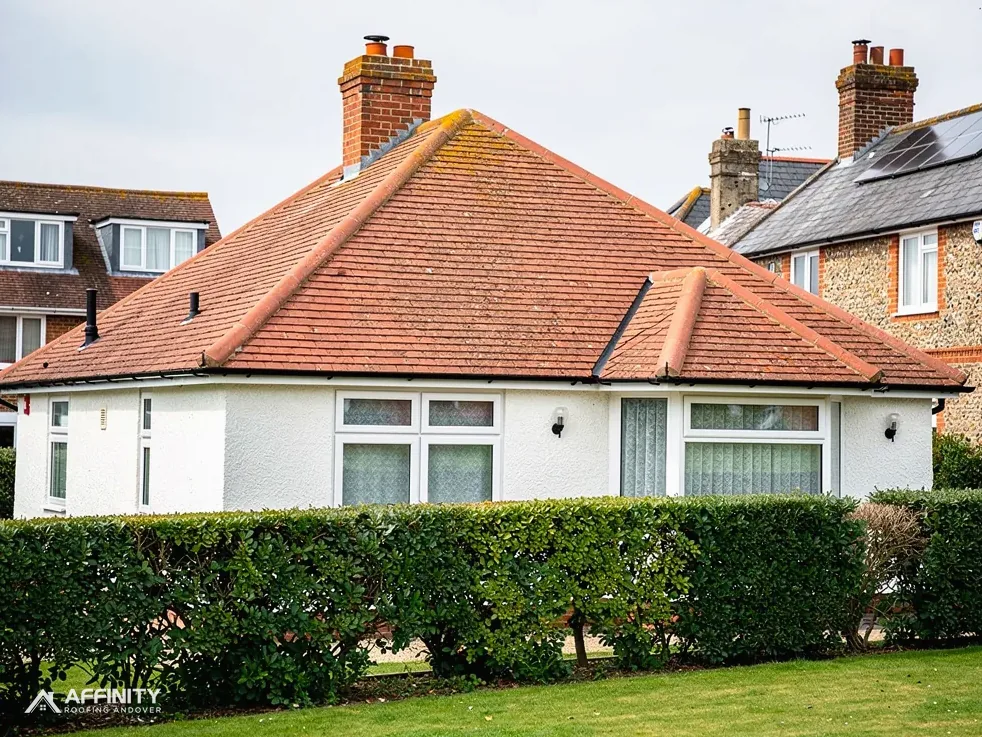
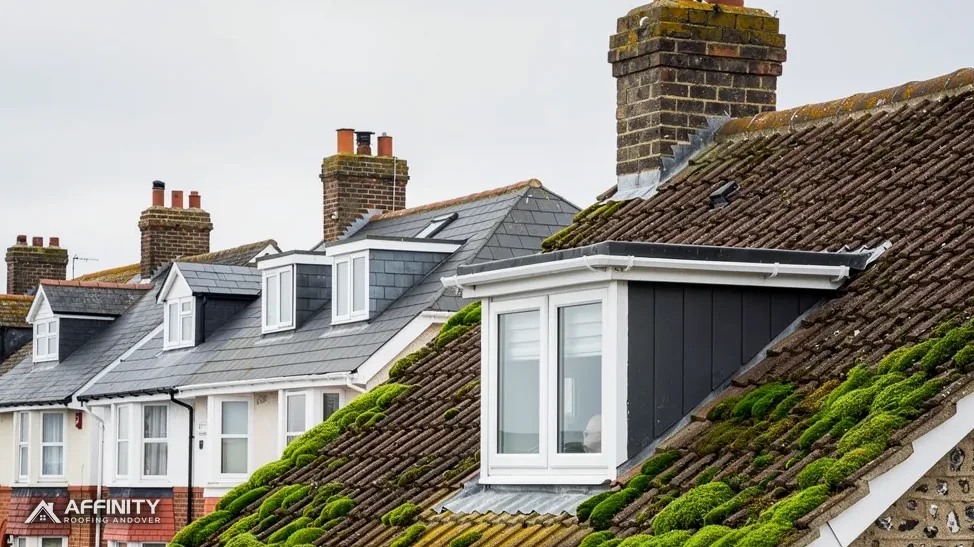
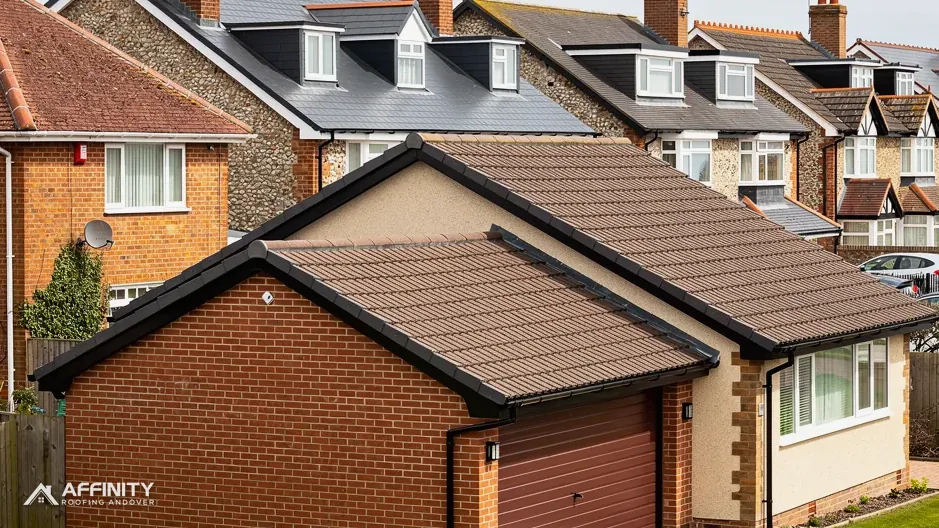
Look along an ordinary suburban street and you will find roofs covered in broad, profiled tiles with interlocking channels down each side. These are interlocking tiles, usually made of concrete, and they offer something the small plain tile cannot. A single interlocking tile covers the area of many plain tiles, so a roof goes on faster and needs fewer pieces.
The name describes how they work. Each tile has a rebate or channel on its side edge that engages with the next tile along the course, forming a continuous barrier across the slope. The overlap between rows is smaller than on a plain tile roof, which is why the tile can be laid at a lower pitch and why a roof of this kind weighs and costs differently.
This guide explains how interlocking tiles differ from plain ones, which minimum pitches a maker publishes, how the tiles are fixed and clipped, what tends to fail, what lifespan to expect and what a repair involves on a house around Andover.
Single-lap and double-lap: the basic difference
Roof tiles overlap in one of two ways, and the difference explains most of what follows.
Double-lap
Plain tiles are laid double-lap. Each course sits under the next two courses up, so any point is shielded by at least two thicknesses of tile. The small size of the tile and the deep overlap give high protection, but the roof takes a great many tiles and a lot of labour.
Single-lap
Interlocking tiles are laid single-lap. A row overlaps the one below by a shorter distance, and the side channels do the work that the second layer does on a plain roof. Only one thickness of tile covers most of the roof, with the sealing done by the shape of the profile. That is why the tile is designed to the data sheet's specification of pitch, headlap and side lap, and why the maker's laying instructions matter.
What it means in practice
A single-lap roof needs far fewer tiles and goes on more quickly, and it also leaves a cleaner, more regular surface from the road, with long straight lines across the slope. It also depends on the tile's shape being right and the fixings being secure, because there is less margin for a disturbed tile. If one lifts, the water has fewer layers to meet. Our guide to types of roof tiles sets plain, interlocking and pantile roofs next to one another.
Profiles and the pitch each one needs
Interlocking tiles come in a family of profiles. The shape changes how much water the tile sheds and how shallow the roof can be.
The common profiles
A Double Roman tile has two broad, shallow curves with a flat section between them. A Mendip or Wessex has a rolled profile. A Modern-Duo or Edgemere has a flatter face. A pantile, in clay, has a single S-shaped wave. The shape is for looks as much as water, so two tiles that look alike from the road can differ in the pitch they need.
Marley's minimum pitches
For concrete, Marley gives these minimums: Edgemere 17.5°, Modern-Duo 17.5° (smooth), Double Roman 22.5° (smooth), Mendip 15° (smooth) and Mendip 12.5°, Ludlow Major 22.5° (smooth), Ludlow Plus 22.5°, Wessex 15°, Anglia 25° (smooth) and Ashmore 22.5°. The Plain concrete tile is 35°, and the Lincoln clay pantile is 15°. These are examples from one maker.
Why the data sheet rules
The minimum pitch is for the exact tile, and some sheets give a higher figure for exposed sites. Below the minimum, the maker no longer backs the tile against driven rain, whatever fixing is used. The sheet also states the headlap and side lap the tile needs.
Low pitches
Because some interlocking tiles work down to 12.5° or 15°, they are often used on low extension roofs and porches where a plain tile could not go. Below the minimum, the answer is not a better fixing but a different covering: a membrane, metal or lead, depending on the roof. Extension roofs often hit this limit.
Fixing, nailing and clipping
With a single layer of tile, every fixing counts. A loose interlocking tile can lift in a gust and take its neighbours with it.
Nails and clips
Tiles hang from battens by a head lug and are fixed through the head with a nail, with a clip at the side or tail where the design needs one. The specification sets how many tiles are fixed and which ones. Tiles at the edges, the verge, the ridge and the eaves take extra security, because wind pressure is greatest there. The relevant code is BS 5534:2014+A2:2018, though Marley points out that installing to it is not a legal requirement.
Why clips matter
A clip holds the tail of the tile down so wind cannot lift it. Without clips, a tile that relies on its own weight and a single nail has little defence against a strong gust. Our answer on roof tile clips explains what they do and when they are required.
Ridges, hips and verges
Ridge and hip tiles were traditionally bedded in mortar. Marley reports that, since BS 5534 was revised in 2014, ridge and hip tiles can no longer rely on mortar alone, and BS 8612:2018 now covers dry-fixed systems. Mortar bedding survives as a traditional finish, alongside a mechanical fix.
Wind
Where tiles lift in wind, the fixings are the first thing to check, ahead of the tile itself. Exposed gables, the lower edge of a long slope and the verge are where gusts get purchase, and where a missing clip does the most harm. A survey looks at those places first, then works inwards across the slope, tapping tiles lightly to find any that have lost their hold.
How interlocking tile roofs usually fail
A roof of concrete interlocking tiles is hard-wearing, and failures tend to follow a few patterns.
Fixings give out
Nails corrode over the years, and clips can fatigue or come off. A tile held by a single failing nail slips or lifts in wind. Sometimes a whole row has been fixed too lightly from the start, and the faults appear together after a storm.
Cracked and broken tiles
Tiles crack from foot traffic, falling branches or poor handling during earlier work, such as an aerial fitted by someone who stood on the slope or a gutter cleaned from a ladder leaned against the tile edge. A cracked tile may keep out rain for a while but weakens quickly, and a hairline crack that you cannot see from the ground can open with the first hard frost. A cracked tile is best replaced early, before the break spreads.
Surface wear
Concrete tiles are coloured on their surface in many ranges, and exposure wears the coat down over decades, leaving the grey mix showing through. The tile is still sound, but the roof looks tired. Moss gathers in the channels and holds damp. Marley does not recommend using high-powered jets on tile.
Mortar and pointing
Where ridges and verges are bedded in mortar, the mortar cracks and falls out, and the tiles it held shift. A leak at the edge of an interlocking roof can start there.
Underlay and battens
Under the tiles, perished underlay and rotted battens are hidden faults that no outside inspection finds. A survey from the loft shows them.
How long interlocking tiles are expected to last
Lifespans are typical ranges and not guarantees. A roof's real life depends on the tile, the fixing and the care it has had.
The published figures
Marley's expectation for its roof tiles is about 60 years, with the caveat that it offers no guarantee or warranty of longevity. HomeBuilding gives plain concrete tiles and Double Roman tiles 40 to 50 years each (Sep 2025). The two sources differ, so both are quoted, and the lower figure is the cautious planning number. The 60-year floor quoted for clay does not carry over to concrete. For comparison, HomeBuilding gives fibre cement tiles 30 to 40 years.
What shortens the life
Poor fixing, hard foot traffic, leaves and moss left to build up, and failed ridge mortar all take years off. A tile that is well fixed and kept clear can outlast the lower end of the range.
What a lifespan tells you
If the roof is approaching the bottom of its range and faults are multiplying, replacement is worth pricing. If it is younger and the problems are local, repair is usually better value. The survey weighs the two with photographs of both.
Our answer on roof tiles lifting in wind covers that fault on its own.
A note on re-roofs
A roof reaching the end of its range is not necessarily unsafe, only more likely to need frequent attention. Ask for a survey before the faults start to multiply, because a planned re-roof is calmer and usually easier to price than one forced by a storm.
Repairing and replacing interlocking tiles
Repairs are simpler on an interlocking roof than a plain one, with one caveat: a tile that interlocks with its neighbours cannot always be slid out without disturbing them.
Single tile replacement
A broken tile is lifted, the clip or nail released, and a matching tile slotted into the gap and fixed. The difficulty is that the side channels sit under the tile next door, so the neighbouring tiles must be lifted slightly, which is why careful hands matter on an old roof where tiles have bedded down. A small repair of up to six standard tiles is put at £75 to £400, ex VAT, by Which? (Nov 2025).
Matching
Interlocking tiles are made to a profile and weathered over time. A new tile of the same profile is a close match, but it will look new for a while. Where the profile is no longer made, a salvaged tile or a close alternative can be used, provided the lap and pitch suit. Our pitched roofing page covers the wider range of repairs.
When to replace the roof
If nails are failing across whole slopes, battens are soft, or underlay is perished, patching tiles is poor value. The roof is stripped, the timber and membrane renewed and the tiles relaid or replaced. A new covering heavier by 15 per cent or more brings in Building Regulations approval and a structural check.
The survey
We lift tiles at the eaves and in the worst area, photograph the fixings and battens, and send you the pictures with one written price.