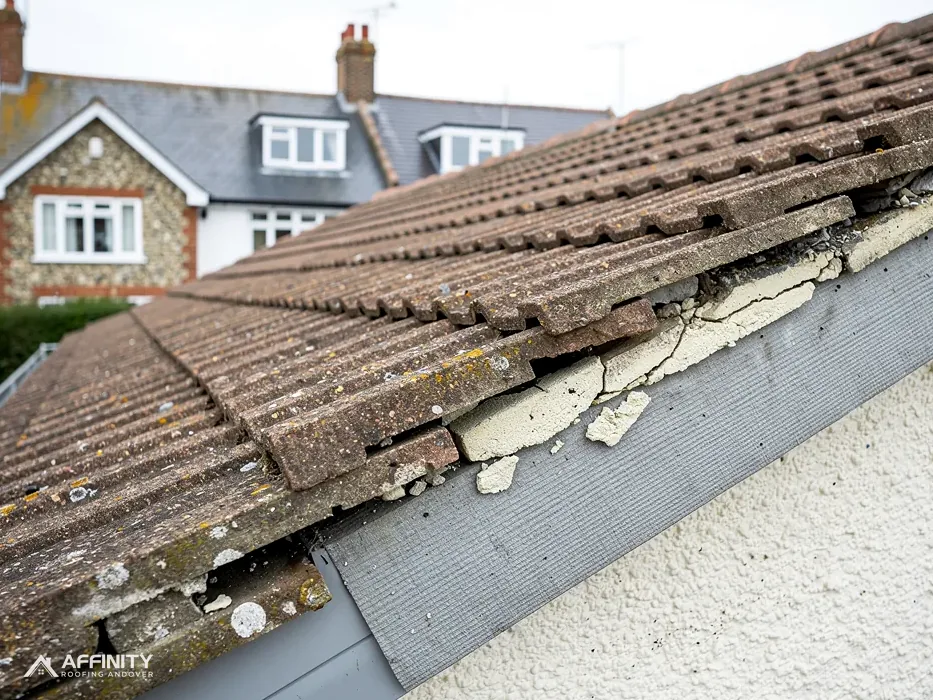
The ridge is the horizontal crest of a pitched roof, finished with curved or angled capping tiles. Where two slopes meet at a sloping outside corner, the hips carry the same kind of tile. Along the sloping gable edge runs the verge. For generations all three were set in a bed of sand and cement, and plenty of older houses still show it.
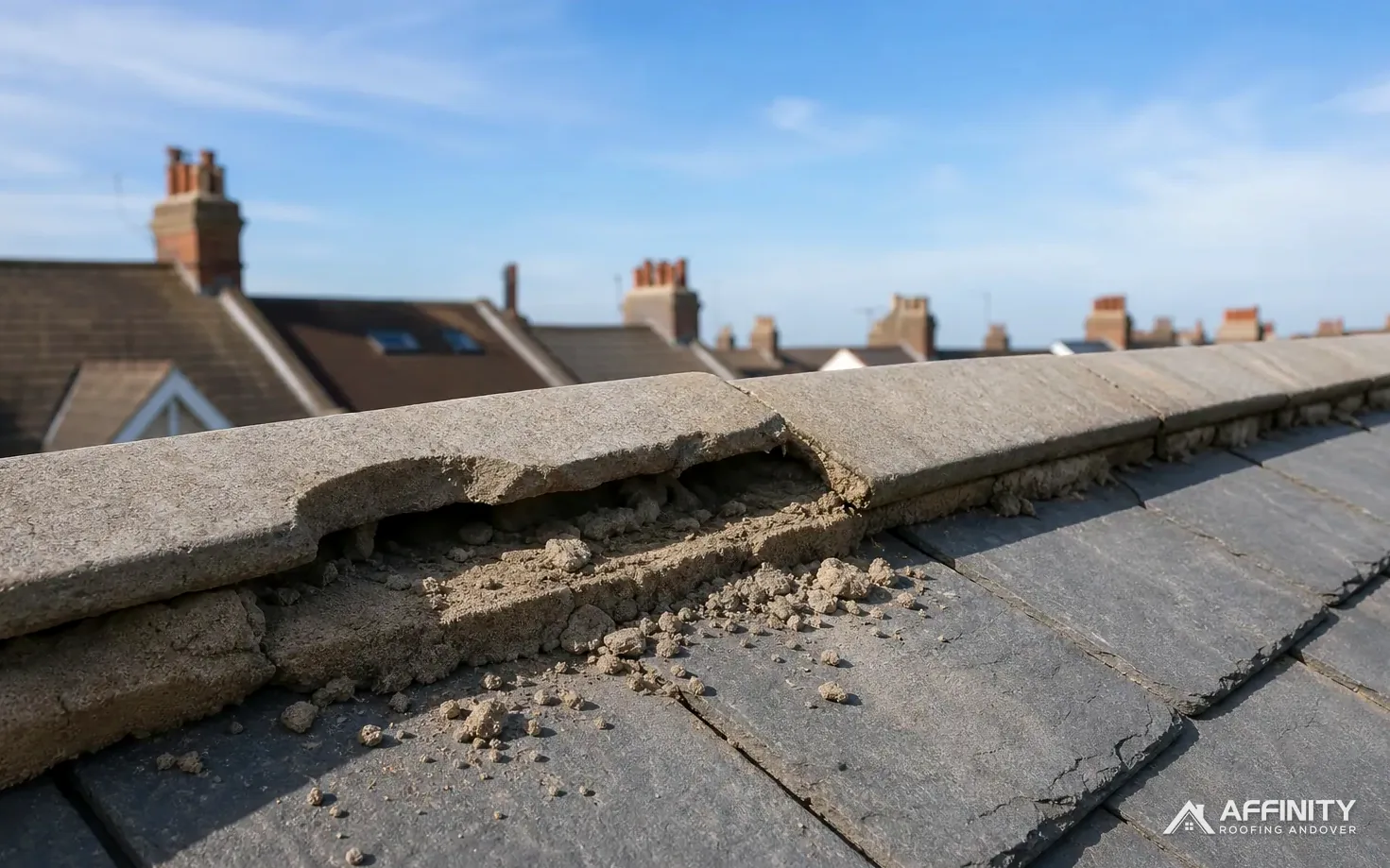
Cracked, crumbling or missing mortar along a ridge is a familiar sight. Once the bedding lets go, wind can lift the capping, and a tile held by nothing but that strip of mortar can slide off. That is the reason a revised British Standard changed the way ridge and hip tiles are fixed, and the reason dry-fix systems have become common.
This post explains the two standards, BS 5534 and BS 8612, in plain terms. It says what they require and what they do not, because there is a good deal of loose talk about both. It then walks through the choice between re-bedding in mortar, fixing mechanically and fitting a dry system, and covers how a dry ridge can be added to a roof that has none.
What the two standards actually say
BS 5534 is the code of practice that sets out how pitched roofs are slated and tiled, and how vertical cladding is fixed. The current edition is BS 5534:2014+A2:2018. It covers how tiles and slates are laid and fixed, and the ridge, hip and verge fall within it.
The point that matters to homeowners is this. According to Marley, the 2014 revision spelled out that mortar by itself, judged on how well it resists being pulled apart, is not something ridge and hip tiles can depend on. In plain words, a tile held only by mortar, with no clip or screw, is not what the standard has in mind. Each ridge and hip tile is meant to be fixed mechanically as well, with a clip, a screw or a similar fixing.
BS 8612 is a different document. Its 2018 edition is current, and it sets the requirements that dry systems for ridge, hip and verge must meet. Marley calls it the test specification for those dry-fix products. A dry system that has been tested to BS 8612 has met a set of performance requirements. That is a statement about the product, not a promise about your roof.
Neither standard is a statute. Marley is clear that fitting to BS 5534 is not a legal requirement. A roofer who tells you that you are breaking the law by keeping mortar is overstating it. Equally, a roofer who ignores the standard is leaving the ridge dependent on something the standard says not to rely on.
So the useful question for any quote is not whether the roof is legal. It is whether each tile will be held by something other than mortar, and what evidence the product has that it performs.
Is mortar banned? No, and here is the nuance
A common claim is that mortar ridges are banned, and it is wrong. Nothing in the standards or in law prohibits bedding ridge tiles in mortar. What the revised BS 5534 changed was the expectation that mortar would do all the holding.
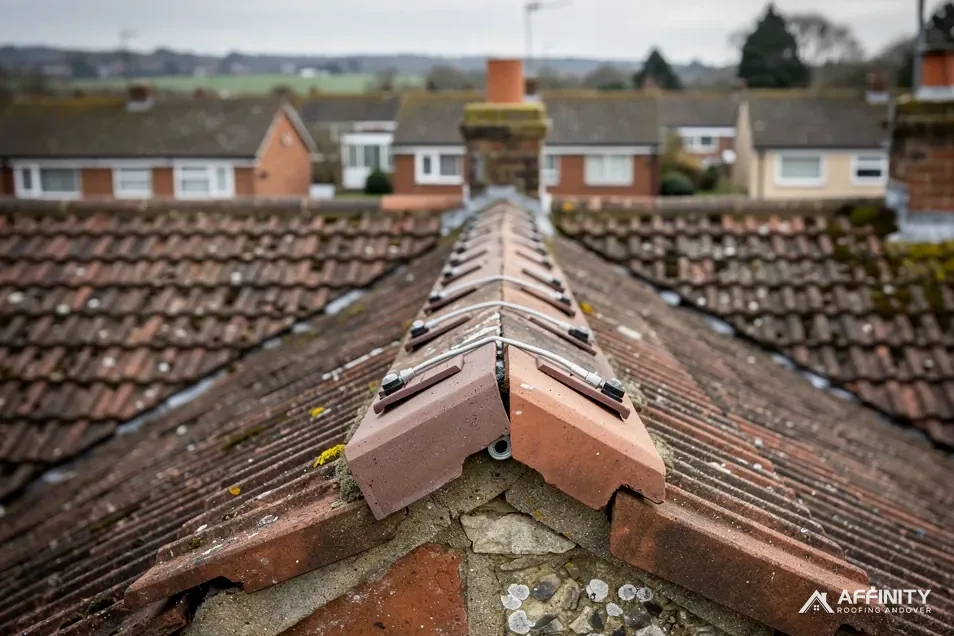
That leaves three workable options for a ridge. You can re-bed the tiles in fresh mortar and add mechanical fixings so each tile is held independently. You can fit a dry-fix system, which uses a batten, clips, roll-out underlay strip and dry caps in place of mortar. Or you can combine the two, using dry-fix for the main run and a small amount of mortar at awkward junctions.
Mortar still has a good record on the right roof. It matches the look of an older house, it is easy for any competent roofer to repair, and a well-bedded ridge with the right sand and cement mix can last a long time. Its weakness is that it shrinks, cracks and lets go, and so it needs inspecting from time to time.
Dry-fix does not rot or crack, and it does not require wet trades on the roof. It does need the right system for the tile profile, since manufacturers make parts for particular tiles. A mismatched kit can sit badly and let rain in at the ends.
What to ask about mortar
Ask whether the mortar will be backed by mechanical fixings, and how each tile is held if the wind gets under it. A good answer names the fixings and the method.
You can read more in our guide to BS 5534 and ridge tiles.
How dry ridge works and what it costs
A dry ridge system replaces the mortar bed with a set of manufactured parts. A ridge batten is fixed along the top of the roof. Dry ridge units or a ridge roll are laid in, and the capping tiles are fixed down with clips or screws through to the batten. Because no mortar is used, the ridge can be laid in any weather that suits roof work, and it does not crack as the building moves.
Whether the ridge also needs to let damp air out of the roof space turns on the build of the roof and the type of underlay beneath the tiles, which your roofer ought to be able to tell you.
On price, two cost guides give typical UK ranges, and they measure different things, so we name both. Which? (November 2025) gives £80 to £300, excluding VAT, for fitting a replacement ridge tile. MyJobQuote (Oct 2026) says replacing ridge tiles falls between £225 and £550. A dry verge system, MyJobQuote (Oct 2026) says, usually falls between £500 and £2,000.
Neither guide gives a price for your roof. The length of the ridge, how many hips and verges there are, the height and access, and whether a scaffold is needed all move the total. We price after a survey, and the written quote is one total for the job. Our dry ridge and verge page explains what we do.
A loose or missing ridge tile is a repair worth doing promptly, because it opens the top of the roof to the weather.
Adding dry ridge to an existing roof
You do not need a new roof to get a dry ridge. Retrofitting is routine. First the old capping is lifted and the bedding cleaned away, then the new system goes in its place. The existing tiles are often reused, which keeps the colour and the look of the house.
The first check is the condition of what lies beneath. A ridge line sits on the top course of tiles and on the timber that carries them, and if the wall plate, the ridge board or the top battens are rotten, a new ridge on top will not last. We lift a few tiles, look at the timber and photograph it, so you can see the state of the structure before you decide.
The second check is the profile. The fixings and parts must suit your tiles, and some older concrete and clay profiles are not served well by off-the-shelf kits. If so, we tell you, and the answer may be a mortar ridge with mechanical fixings.
The third is the roof's edges. If the verge is also tired, doing both together spares you a second visit and a second scaffold. A dry verge replaces the mortar under the end tiles with a continuous cloak strip and clips. We have a separate guide to ridge tile re-bedding for roofs where mortar stays.
Retrofitting a dry ridge changes little that a passer-by would notice. On a listed building, or in a conservation area, ask the council first, because the ridge line is part of the building's character.
Spotting trouble from the ground
Much of a ridge's condition shows from the garden path. Binoculars help, but they are not needed. Choose a spot where the whole line shows against the sky.
Look for a ridge that dips or waves instead of running straight. A wavy ridge can mean the supporting timber has moved or the tiles have shifted. Look for pale gaps between tiles where the mortar has dropped out, and for a dark line of moss or staining under the ridge that shows water is getting past it. Check the lawn and the path after a gale: fragments of mortar or a whole ridge tile on the ground are plain evidence.
Inside, a stain on the ceiling directly beneath the ridge, or daylight at the top of the loft, tells the same story from the other side. Do not go onto the roof to check. A roof is a dangerous place for anyone without proper access equipment.
The rule is that a loose ridge tile should not wait, because a tile that falls can injure someone and the exposed bedding lets water into the roof. If you can see one, restrict access to the area below it and arrange for it to be looked at. Our guide to the signs of loose ridge tiles lists more.
After a bad storm, check your insurance policy. Wording on storm damage is for each policy to define, and the Financial Ombudsman explains how it looks at the question. Keep photographs and receipts for any make-safe work.
Cement smeared across a crack only hides the fault. It hides the problem, and the water can still get in another way.
Choosing between the options for your roof
There is no single right answer, and anyone who says there is has not seen your roof. These points decide it in practice.
- Condition of the old bedding: if it is sound and the ridge is straight, a mechanical-fixed re-bed may be enough.
- Tile profile: a dry system must be made for it, otherwise the ends will not seal.
- Look of the house: older roofs in conservation areas may be best served by mortar with clips.
- Wind: a ridge tile held by more than mortar is harder for a gust to lift.
- Maintenance: dry-fix needs less upkeep, while mortar needs a look every so often.
- Budget and access: a long, high ridge costs more whichever method you choose.
Whatever you pick, insist on mechanical fixing for every ridge and hip tile, and ask for photographs of the work as it goes on. When the job is done the ridge should run straight, the ends neat and the waste cleared away.
If your roof is a newer one, it may already have a dry system. A visual check will not tell you, but a close look from the roof will, and it is one of the questions we answer on a survey.
The repair should suit the roof you have. A re-bed may do, and if the ridge is past saving, the photographs will show why, before any price is agreed.
Whichever route suits your roof, ask for the fixing method in writing and file the photographs alongside the deeds.