Ask a search engine for chimney help in Andover and the results are mostly sweeps. That makes sense for a blocked or sooty flue, but it leaves a lot of homeowners ringing a sweep about a problem that sits above the roof, where a sweep has no reason to go.
The split is simple once you picture the chimney in two parts. The flue is the passage inside, which carries smoke from a fire or boiler out of the house. A sweep cleans it and looks along it. The stack is the brickwork you can see above the roof, together with the pots on top, the mortar cap that holds them and the lead that seals the join to the tiles. Those are building and roofing jobs.
This post sorts the common chimney problems into the two piles, explains what each part is called, and describes what a roofer checks from the outside. It also covers the cases where both trades are needed, and the consents that apply to some chimney work in Andover and the Test Valley.
Two halves of one chimney
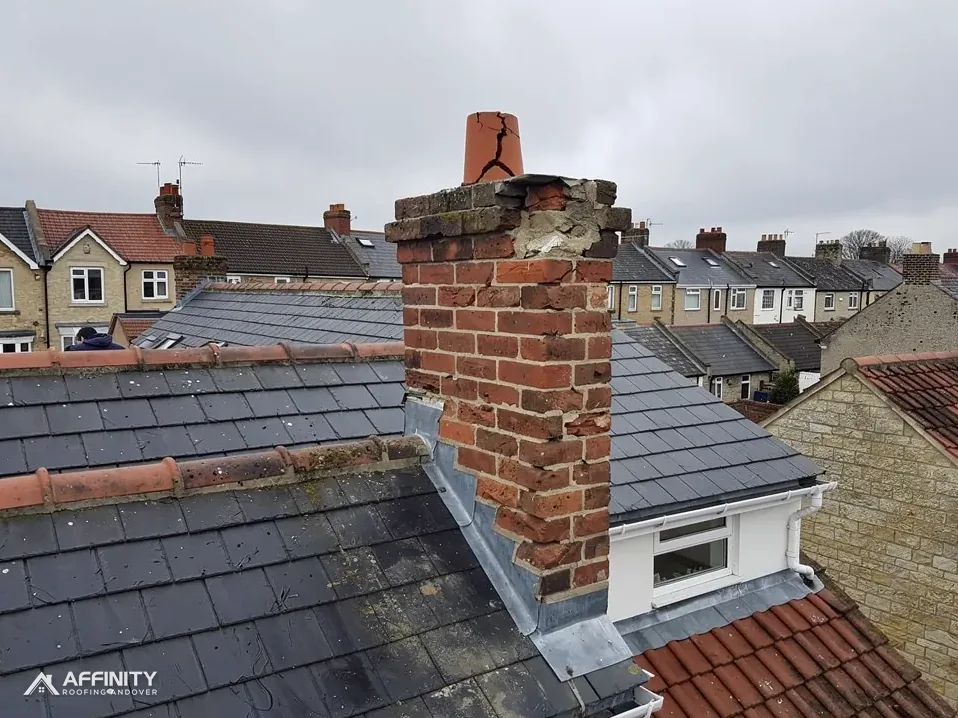
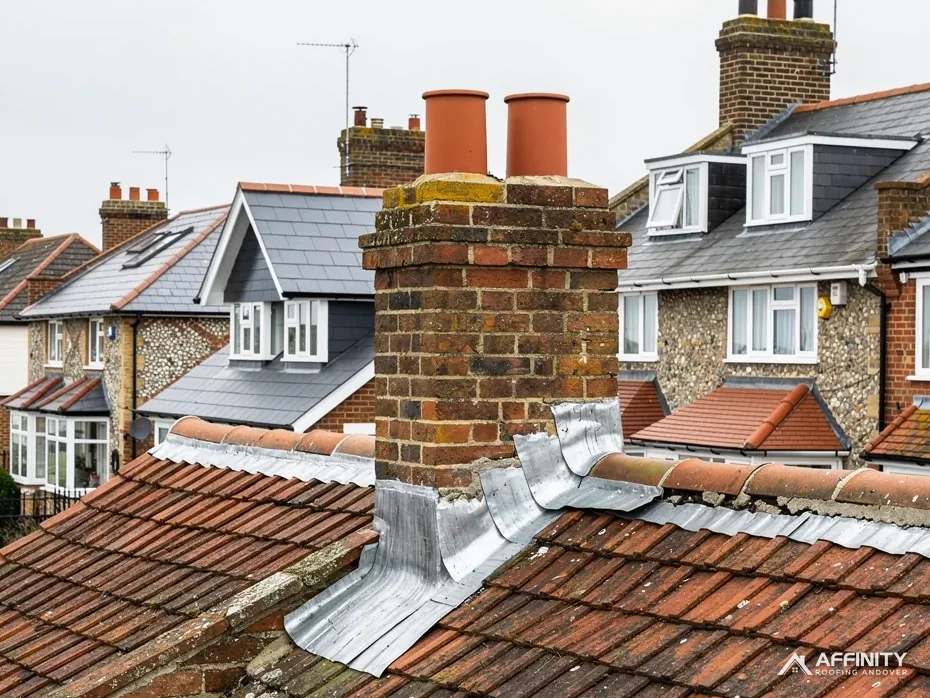
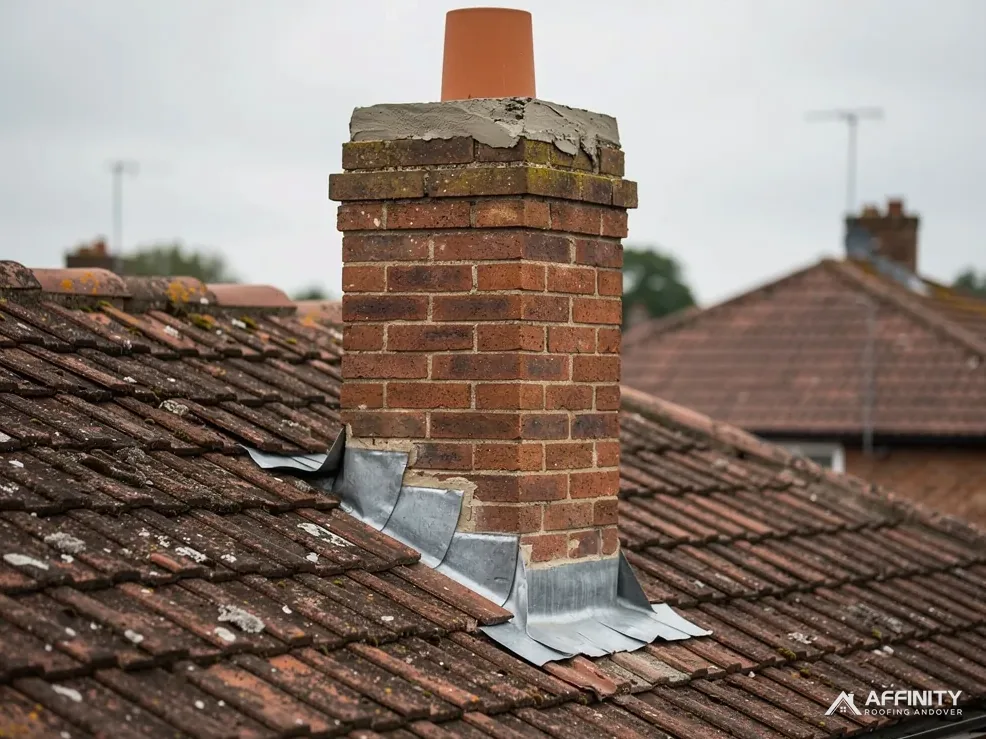
Start with the words, because most confusion comes from them. The flue is the lined passage that runs up inside the chimney. The stack is the part that stands proud of the roof. The pot is the clay or metal pipe on top that finishes the flue, and the flaunching is the sloping band of mortar that holds the pot in place and sheds rain off the top of the stack. The flashing is the strip of lead, usually, that seals the junction between the stack and the tiles around it.
A sweep works inside the flue. Brushing out soot and deposits is the trade's core job, and a sweep can tell you whether the passage is open and in what state it is in. Nobody sweeping a flue is expected to climb onto the roof and re-lay a flaunching.
A roofer works on everything the weather touches. That is the brickwork of the stack above the roof, the mortar joints between its bricks, the flaunching, the pot, the lead flashing and the tiles or slates that meet them. Rain gets into a house through those parts, not through the flue.
Two sets of problems follow from that split. Smoke, soot, a smell of burning or a fire that will not draw point to the inside. A stain on the ceiling, damp on the chimney breast or crumbling mortar that you can see from the garden points to the outside. Some problems show both signs together, and we come to those further down.
If you are unsure which side your problem is on, describe what you can see and where. A good roofer will say plainly if the job is a sweep's.
What a sweep is the right call for
Call a sweep when the trouble is inside the passage. A fire that smokes back into the room, soot falling into the grate, a flue that has not been used for a long time and needs to be opened before you light it, a stove being fitted into an old opening: these are flue questions. So is anything to do with whether the flue is drawing properly or whether it has been blocked from the top.
A blocked flue can come from soot or fallen debris, and it can also come from something that has built a home at the top. The wildlife law turns on intent: under the Wildlife and Countryside Act 1981 section 1, harming an active wild bird's nest is an offence where it is done intentionally, whether the nest is damaged or destroyed. A nest in a pot is a reason to stop and take advice before anyone clears it.
A sweep can usually see the lower part of the stack from the inside with a camera or a light, and will often spot a cracked liner or a leaning pot. That is a useful finding, and it is the point at which the job passes across to a roofer. A sweep's report about the passage is not a substitute for looking at the stack from the roof.
If you have a solid fuel appliance, a sweep is the person to ask about when the flue needs attention. We stay on the outside of the house, where the weather does the damage.
What belongs to a roofer
Call a roofer when the problem is visible from outside or shows as water inside. These are the usual ones.
- Mortar between the bricks has crumbled, washed out or cracked, and can be pushed in with a finger.
- The flaunching has a crack, or has come away from the pot, so the pot rocks or the rain runs down beside it.
- The lead flashing at the base of the stack has lifted, split or pulled out of the mortar joint, or has been replaced with a smear of sealant.
- A pot is missing, cracked or sitting at an angle.
- The stack leans, or the brickwork has bulged or spalled, which means the face has flaked off.
- Tiles around the stack have slipped or broken.
None of these is a flue problem, and a sweep will not mend any of them. Each one lets water into the structure, and a chimney stack takes in a great deal of rain because it is the highest and most open part of the house.
The repairs are matched to the fault. Loose mortar joints are raked out and repointed. A cracked flaunching is broken off and re-laid. Flashings are cut in to the mortar joints and dressed over the tiles. A leaning or crumbling stack may need to be taken down to a sound level and rebuilt, which is a bigger job and a different conversation. We photograph each part we find on your roof, explain what it means in plain words, and price the whole job as one written total after the survey.
For more on the repairs themselves, see our chimney repairs service and our guides to chimney flaunching and chimney pot replacement.
Damp on the chimney breast: which problem is it?
The chimney breast is the part of the chimney that projects into a room, below the ceiling. Damp that appears on it is one of the most confusing chimney symptoms, because the cause can be on the outside, in the flue or in the room itself.
Signs it comes from the stack
If the stain is on the breast or the ceiling beside it and gets worse after rain, suspect the outside. The usual routes are failed flashing, a cracked flaunching, open mortar joints or a pot that no longer sheds water. In those cases water runs down inside the brickwork and shows up where it meets the room.
Signs it comes from the flue
A brown, tar-like stain that appears on the breast and has a smell of smoke or soot is a different matter. That is something coming through from the flue, and it is a sweep's question first. A capped, unused flue with no ventilation can also leave a chimney breast damp from condensation, a point we cover in our guide to a damp chimney breast.
Signs it is neither
Some patches come from a cold room, a leaking gutter or a nearby pipe. A roofer cannot cure those by touching the chimney.
The way to tell the difference is to look from outside after rain, check the lead and the mortar from the roof, and then check the flue from inside. We photograph what we find on your own stack so you can see where the water is getting in. If the evidence points to the flue, we tell you and send you back to a sweep with a clearer question to ask.
Jobs that need both trades
Some chimney jobs cannot be finished by one trade alone. Knowing the order saves time and money, and saves doing the same work twice.
A stove fitted into an old fireplace is the usual example. The flue needs to be assessed and lined or cleaned from the inside, and the stack needs to be sound at the top. A leaning stack that a sweep has noticed from inside needs a roofer or builder to look at the brickwork. A pot or cap that has to come off to clear a blockage needs to go back with proper flaunching, not a handful of loose mortar.
Where a stack has to come down and be rebuilt, the sweep's work is best left until afterwards. There is no point cleaning a flue that will be disturbed when the top of the chimney is taken apart, and any liner is easier to check once the brickwork is open. If you are planning to stop using a chimney altogether, ask whoever caps it about ventilation of the flue.
When the job is a roofer's from start to finish, such as new lead flashing or re-laying flaunching, there is nothing for a sweep to add. When it is a sweep's from start to finish, such as clearing soot, we leave it to them. Where it is both, the best approach is a single conversation: tell each trade what the other has found, and ask the roofer to photograph the stack from above so the sweep knows what is up there.
That kind of shared picture is exactly why we photograph a stack before we quote.
Consents, cost and old Andover chimneys
Most repair work on a chimney stack does not need a consent of its own, but three situations do. If your house is listed, altering its character means applying for listed building consent, and a chimney is a feature that matters on an old house. Andover has a conservation area, with a boundary the council draws, so check with Test Valley Borough Council's planning team before changing anything visible. Ask the council whether an Article 4 direction applies to your street.
Removing a breast inside the house is another matter. The Planning Portal is clear that Building Regulations approval applies to taking out a chimney breast, which is structural. A party wall is another point: if the breast sits in the wall between your house and next door, the Party Wall etc. Act 1996 section 2(2)(g) covers cutting one away, and section 3(2)(a) sets a notice period of at least two months ahead of the work. Party wall questions go to a party wall surveyor, not to building control.
On cost, MyJobQuote (Sep 2026) gives a typical UK range of £350 to £920 for all the lead around a chimney, and puts much of the spread down to scaffolding. It puts chimney breast removal at between £1,200 and £3,500 (Aug 2026). Lead flashing can last for over 80 years, MyJobQuote notes, which is a lower bound. There is more on flashing in our guide to chimney lead flashing.
Once we have surveyed, a written quote follows, with one total price for all the work.