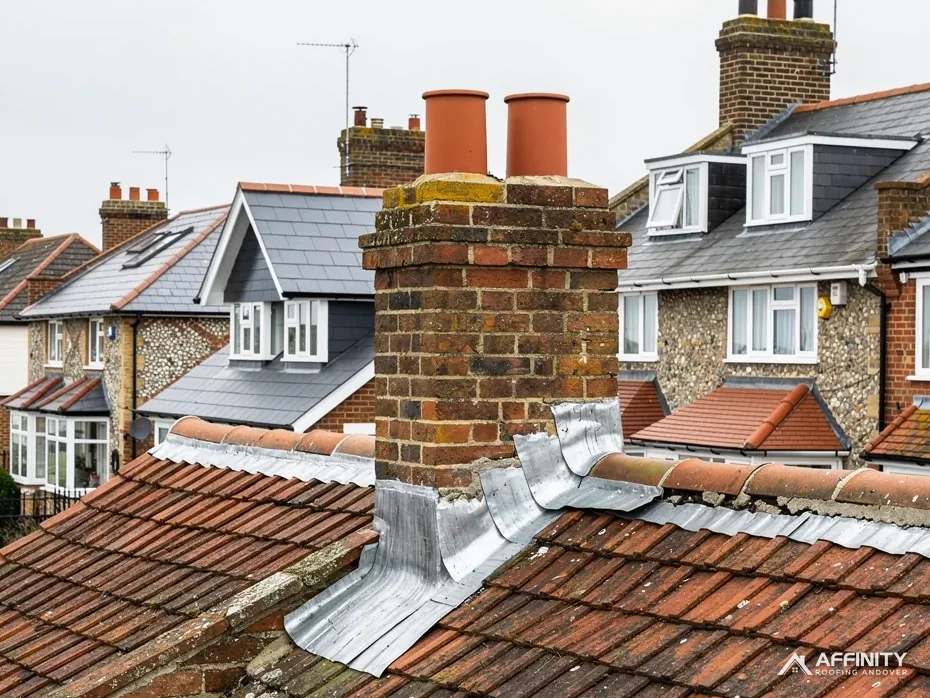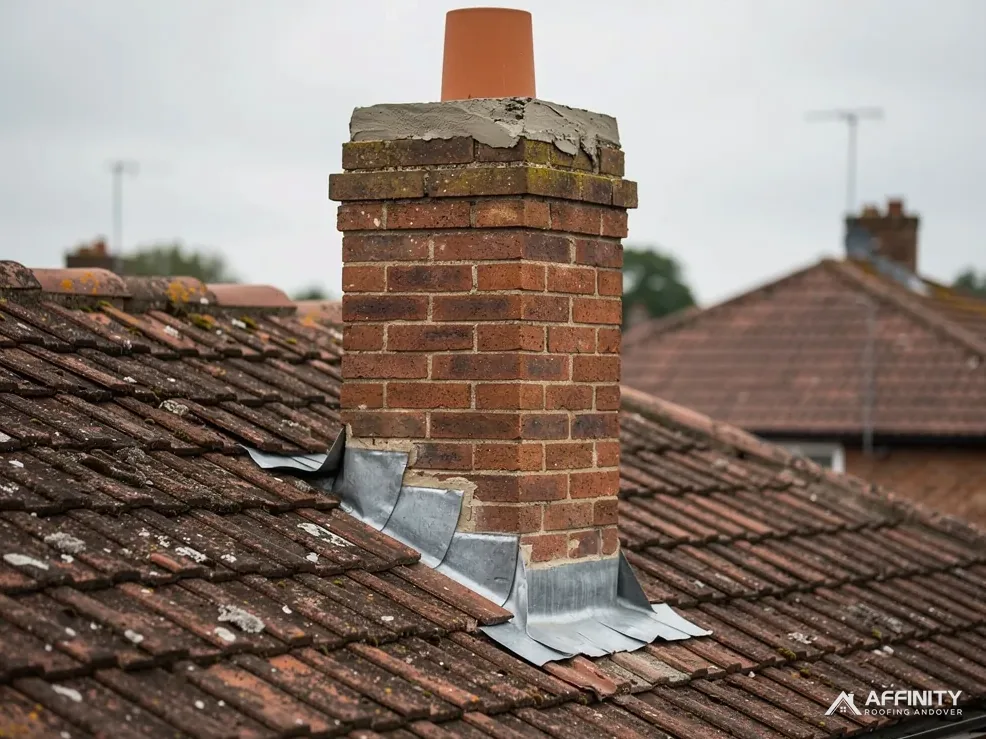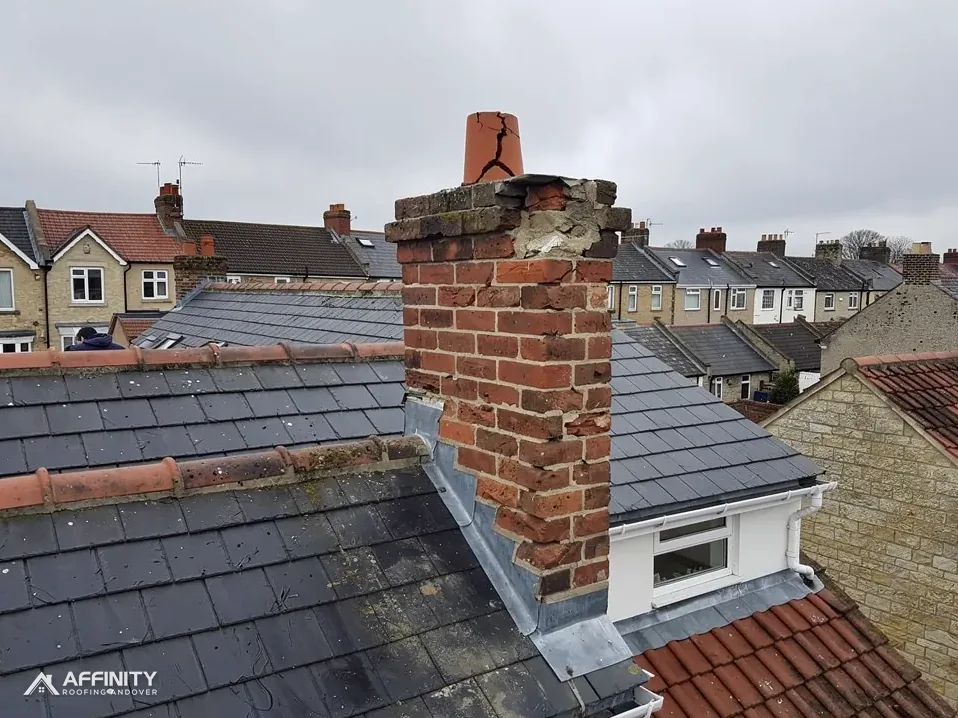
Ask three roofers what a chimney repair costs and you may hear three very different answers. That is not always because one of them is wrong. A chimney is the most variable job on a roof. One stack needs a small patch of flaunching and nothing more. The next needs new pointing from top to bottom, a pair of replacement pots and lead flashings all round. And the house next door may have a stack that has to come down altogether.
On top of that sits the access. A chimney crowns the building, and getting to it safely usually means a scaffold. On many jobs the scaffold costs as much as the repair, and it is the first thing that changes when a house is taller, narrower or on a busier road.
This guide sets out the typical UK ranges from national cost guides for the jobs that have one, explains why scaffold dominates, shows how repointing and rebuilds are priced, and tells you what a good quote should contain. Those ranges are never an Affinity Roofing Andover price. For the full set of chimney work, see our chimney repairs hub.
Why every chimney job is priced after a survey
A chimney is not a standard product. Two stacks of the same height can differ in the number of flues, the state of the brickwork, the condition of the pots and flaunching, and the lead flashing at the base. A fair price depends on all of these, and none of them can be judged from the pavement.
What a survey looks at
A roofer surveys the stack from a safe platform and from inside the loft. The result is a set of photographs of each fault and a plain description of the repair. From that, one written total can be given. A price quoted over the phone, before anyone has seen the stack, is a guess.
The common jobs
Chimney work covers flaunching, pot replacement, capping, repointing, lead flashings, removing a breast and rebuilding a stack. Each has its own page on this site, and each is priced on the stack in front of the roofer. Repointing, rebuilding and capping depend most on the height, the number of flues and the access.
Why a range is only a guide
National cost guides publish typical ranges, and they are useful for scale. They cannot know whether your stack is on a bungalow or a three-storey terrace, or whether the brick is sound. Use them to check that a quote is in a sensible region, and rely on the survey for the actual figure.
The same caution applies to a figure quoted by a neighbour. Their stack, their scaffold and their access were not yours, so treat it as an anecdote, not a benchmark. A written quote for your own chimney is the only number that matters.
If a quote gives only a single line with no description of the scope, ask what it covers before you compare it with another.
The published typical UK figures
Only some chimney jobs have a published national range that can be quoted fairly. Those that do are shown below, with the guide and the date. They are typical UK ranges, not Affinity Roofing Andover prices.
| Job | Typical UK range | Guide |
|---|---|---|
| Chimney breast removal | £1,200 to £3,500 | MyJobQuote, August 2026 |
| Full chimney leadwork, scaffold dependent | £350 to £920 | MyJobQuote, September 2026 |
| Full roof valley replacement | around £540 | MyJobQuote, September 2026 |
| Replacing one to six standard tiles, excluding VAT | £75 to £400 per job | Which?, November 2025 |
Reading the table
The breast removal range covers taking the breast out of the room and supporting what remains, and is not the cost of taking down the stack above. The leadwork range is for flashings on a whole chimney, and MyJobQuote makes the point that it depends on the scaffold. The valley and tile figures are roof jobs that often come up beside a chimney visit.
What the table leaves out
It leaves out the repairs whose price depends too much on the stack to quote fairly: repointing, rebuilding, capping and pot replacement. For those, the survey decides.
Our guide to chimney breast removal goes into the breast figure in detail.
Why scaffold dominates the bill
A chimney rises above the ridge or the edge of the roof, beyond what a ladder can safely reach. Almost every job beyond a quick look means putting up a scaffold, and on a small job the scaffold can be a large share of the total.
What drives the scaffold cost
The height and width of the house, the number of elevations that must be covered, how long the scaffold has to stand, and whether it sits on your land or on the highway all affect it. A narrow terrace with the stack on the party wall is a different proposition from a detached house with a front lawn.
The licence on the highway
Scaffold that takes up pavement or road space falls under section 169 of the Highways Act 1980, and the highway authority's licence has its own fee. Hampshire County Council charges £211.90 for the first two weeks and £72 for each further two weeks, expects the application ten working days before the start, and says the scaffolding company applies on the customer's behalf.
Making the scaffold earn its keep
If you are paying for scaffold anyway, have the roofer inspect the entire stack and the roof around it. A flaunching, a pot, the pointing and the flashing can all be done in one visit. A second scaffold in a year or two for the next fault costs far more than a slightly longer first visit.
Ask in writing whether the scaffold is included, and for how many weeks. A longer stay costs more, so a job that is ready to start the day the scaffold goes up saves money.
How repointing, capping and rebuilds are priced
These three are priced from the survey, because the stack decides the work.
Repointing
The cost of repointing depends on the height of the stack, the number of flues and faces, how much mortar has to be raked out, the type of mortar chosen and the access. A short single stack and a tall stack with six pots are different jobs. Lime mortar takes more care than cement and may suit an older stack better, and our guide to chimney repointing with lime or cement mortar explains the choice.
Capping and pots
A cap is a small item. What matters is the pot beneath it, the flaunching and the number of flues. If the pots or the flaunching need work first, those are part of the same price.
Rebuilds
A rebuild is the largest chimney job. It involves dismantling the stack, sorting the brick, rebuilding it with a matching mortar, new flashings and flaunching, and the scaffold for several days. The cost grows with the height of the rebuild and the quality of the match. Because it is the most variable of the jobs, a survey and a written total are essential. Ask for the rebuild height to be stated, such as down to the roofline or to a named course, so that nobody argues later about how far the work went.
What the written price should say
It should name the extent of the work, say how far down the stack the work goes, and say whether the scaffold, VAT and waste are included. Anything a roofer finds during the work and wants to add should be agreed in writing, with a photograph, before it is done.
Reading a quote and comparing like with like
Citizens Advice advises collecting written quotes from at least 3 traders before you choose one. That is easy advice to follow if the quotes describe the same job. For chimney work they often do not, because one roofer prices a patch and another a full repoint.
One total price
A good quote gives one written total for the whole job. You do not need a list of separate sums to judge it, but you do need to know what it covers. Ask whether it includes the scaffold, the pots and flaunching, the lead flashing, the removal of waste and VAT.
VAT
The standard rate is 20%. A VAT-registered roofer must add it to a domestic job, so check whether a quoted figure includes it. Which? figures are quoted excluding VAT, so a published range and a quote may not be like for like.
The cheap quote
If one quote is far below the others, ask what it leaves out. A chimney quoted without scaffold is not a cheaper job, it is an incomplete price. A roofer who proposes to work from a ladder at the stack is proposing something unsafe.
Photographs and dates
The quote should come with photographs of the faults and a start date. Keep them together. If anything changes on site, the photographs show what was found and what the cost would be.
For the wider question of how to compare firms, see our guide to choosing a roofer.
Keeping chimney costs under control
Chimney costs are seldom avoidable, but they are often manageable. A few habits keep a small repair from turning into a large one.
Fix the small things early
A cracked flaunching, a loose pot or a failing flashing costs little to put right, and a lot if rain reaches the stack through several winters, so a prompt visit pays for itself. Check the stack from the garden twice a year, and book a survey when something changes.
Do the work together
If the roof needs attention as well, have the chimney done in the same visit. One scaffold serves both, and the roofer can see how the stack and the roof meet.
Choose the right repair
Do not accept sealant as a permanent answer. A roofer who offers a smear of sealant on a failing joint is selling short-term cover. A proper repair is rarely much dearer and lasts for years.
Avoid the doorstep
A stranger on the doorstep offering a chimney repair for a fixed sum, with no survey and no photographs, is a warning sign. Read our guide on spotting a dodgy roofer before you agree to anything.
Plan for the next job
Ask the roofer what condition the rest of the stack is in and what is likely to need attention soon. That lets you plan, and avoids a surprise scaffold next year.
Keep the survey photographs with your house papers. They record the work carried out and anything deferred, and they will help whoever looks at the stack next, including a buyer's surveyor if you sell.