The short answer
Often, yes. A ridge sits at the highest point of the roof and a verge runs down the gable edge, so a ladder alone rarely gives a safe, stable place to work. A low roof may manage with a roof ladder. Anything taller usually needs scaffolding, and where that scaffold covers a road or pavement, a licence under Highways Act 1980 s169 comes first.
Why the ridge calls for a platform
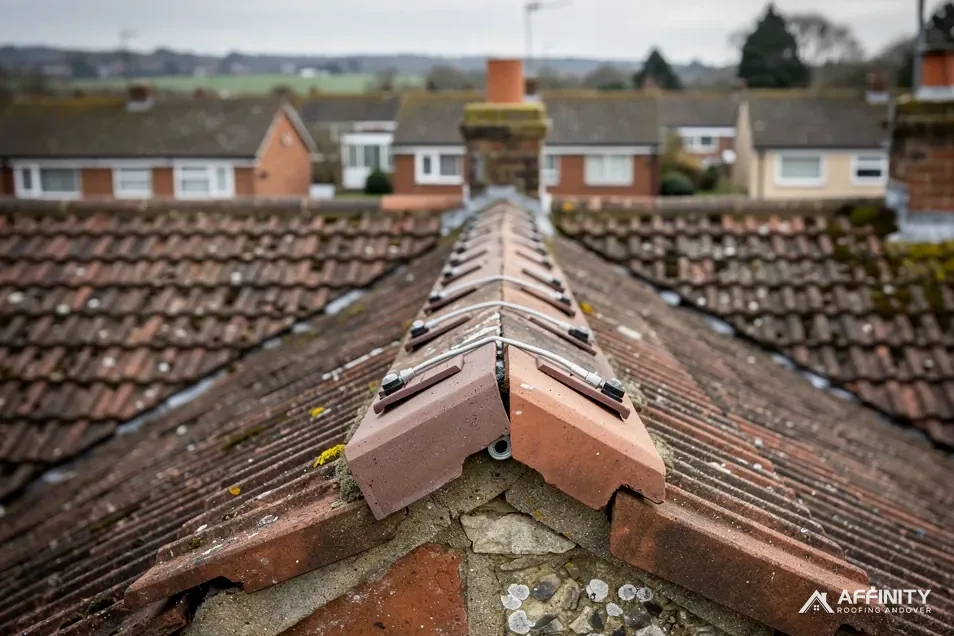
The ridge is the cap of curved tiles on the crest of the roof. The verge is the slanting edge that finishes the roof beside a gable wall. Both are high, both sit at an edge, and both are slippery in the wet.
Working on them means leaning, lifting and kneeling at height. A ladder against the wall reaches the eaves, not the apex, and a ladder leaned on tiles can crack them. A roof ladder, with a hook over the ridge, spreads weight on boards and suits small jobs on low roofs, such as a porch or a single-storey extension.
For a two-storey house, or for work along a whole ridge, a scaffold gives a level platform, edge protection and a place to stack tiles. It is the safer option for the people working and for anyone below.
That is why we ask about height and access first. A tower scaffold may serve for a short stretch. A full scaffold is needed when the line is long, the roof steep, or both gable ends need work, and it also gives a safe place to stack tiles and the old bedding. Our dry ridge and verge page covers the jobs themselves.
Gable ends and verges
A gable end is where verge work usually needs the most access. The scaffold has to reach the roof edge and the underside of the verge tiles, and the ground below must take the weight of the poles.
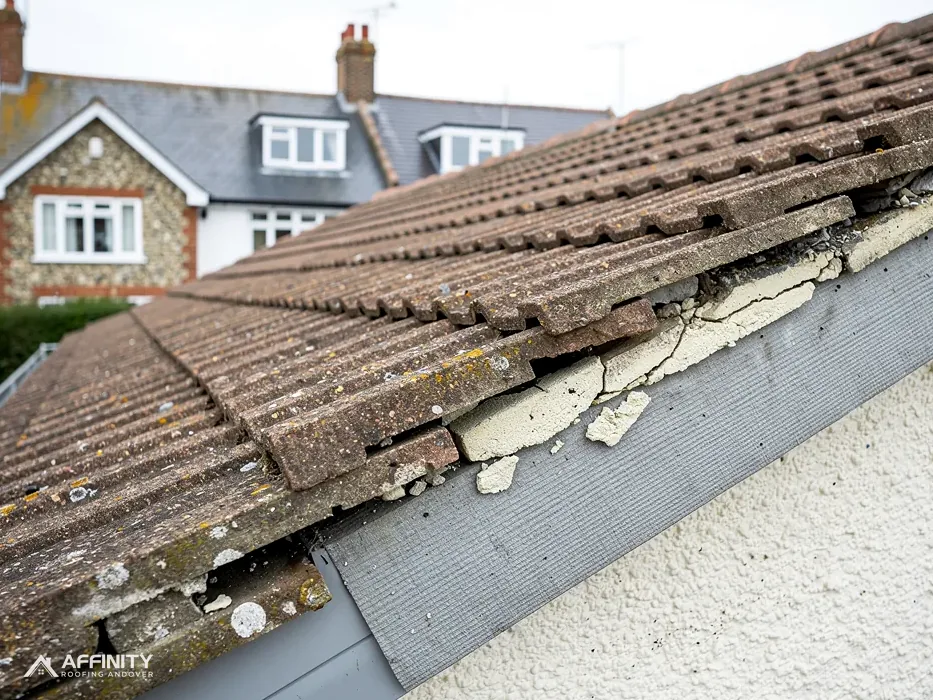
The verge tiles are bedded or clipped along the roof edge and sit over the undercloak, the strip that carries them out past the wall. Repairing them means working right at the edge, where there is nothing to lean on. That is why edge protection on a scaffold is worth having even for a short repair. Our answer on the verge undercloak shows what sits under those tiles.
Both ends of a ridge meet a verge, so ridge work and verge work often share one scaffold, and it makes sense to do both while it is up. Looking at the verge during a ridge survey costs little and may save putting a scaffold up a second time. Where a gable edge shows loose tiles or missing end caps, the repair can be added to the same visit.
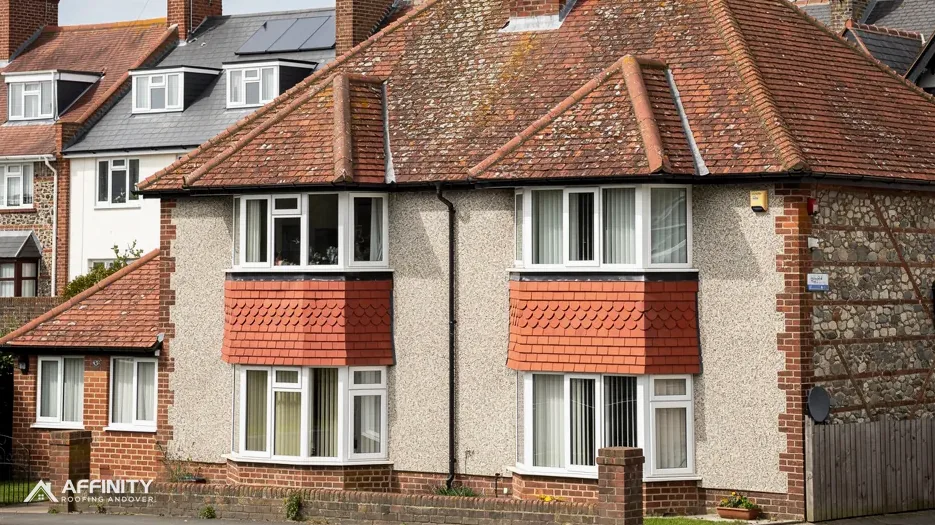
Where the house sits close to a boundary, a neighbour's drive or a narrow path, the scaffold's footprint has to be planned. That is a discussion for the survey, not for the day.
The licence for scaffolding on the road
The licensing rule sits in Highways Act 1980 s169: scaffolding that obstructs a highway needs the consent of the highway authority. Who that is depends on the address. For the Hampshire districts of Test Valley, Basingstoke and Deane, Winchester, New Forest, Eastleigh, East Hampshire and Hart it is Hampshire County Council, because the district councils hand out no scaffold licences.
Hampshire County Council states that scaffolding companies apply for it on behalf of their customers. Hampshire County Council charges £211.90 when the application goes in, which covers the first 2 weeks, then £72 for every further 2 weeks, and it does not offer extensions. Since a ridge job can be planned to fit inside that window, the order of work matters.
Wiltshire Council is the authority for Wiltshire addresses. Wiltshire Council directs the firm that supplies the scaffold to use the MiPermit portal, and every licence there runs for 28 days. The Wiltshire fee changes with the amount of notice given, which is another reason to settle dates early.
A private road needs no licence, according to Hampshire. In other areas, who applies is asked at the outset and the lead time is built into the plan, so that no date slips.
What it adds to the price
Access can be a big item in the cost of a ridge job. It turns on the height, the length to be covered, how long the scaffold stays up, any licence fee and how awkward the ground is. The written quote after the survey folds it into one total price.
You can keep the cost down in sensible ways. Doing ridge and verge work in one visit, along with any gutter or fascia work that needs the same access, uses the scaffold once. Settling a date early gives the licence time to come through. Agreeing the order of work with the scaffolder also helps, because the platform can be struck the day the last tile is fixed.
When you collect other quotes, check whether each includes VAT and scaffolding, since a quote that leaves them out cannot be set beside one that has them.
MyJobQuote's October 2026 guide puts a ridge at £225 to £550 and a dry verge system at £500 to £2,000, as typical UK ranges. Which? lists a new ridge tile at £80 to £300 excluding VAT. Those figures describe the roofing work, and access sits on top of them.