Mortar crumbs in the gutter, a hairline crack along the ridge or a tile that wobbles when pushed do not automatically mean a new ridge. If the tiles themselves are sound and the line is straight, the lightest sensible repair may be to lift them, clean them and bed them again.
The detail that matters is what holds them down. Marley's reading of the 2014 revision of BS 5534 is that mortar by itself should not be trusted to resist a pull on ridge and hip tiles. So a modern re-bed keeps the mortar for its sealing and its traditional look, and adds mechanical fixings that do the real holding. Mortar alone, the way the roof was probably first built, is no longer the standard.
This guide describes how a re-bed with fixings is done, how to judge whether your ridge qualifies, what happens to the old tiles and the signs that a switch to dry-fix is the better choice. It belongs to our dry ridge and dry verge service pages.
Mortar that is still doing its job
Not all mortar failure is equal. Some is cosmetic, and some means the tiles are about to move. Telling them apart takes a close look and a bit of handling.
Signs that a re-bed is enough
The ridge tiles sit in a straight line without dips. They are whole, with no cracks across the barrel of the tile or chips at the ends. When pressed gently they do not rock. The mortar has fine cracks or has lost some surface, but there is still solid bedding under the tiles and it has not come away in lumps. The roof tiles below the ridge are firm, and the timber beneath is dry.
Signs it is not
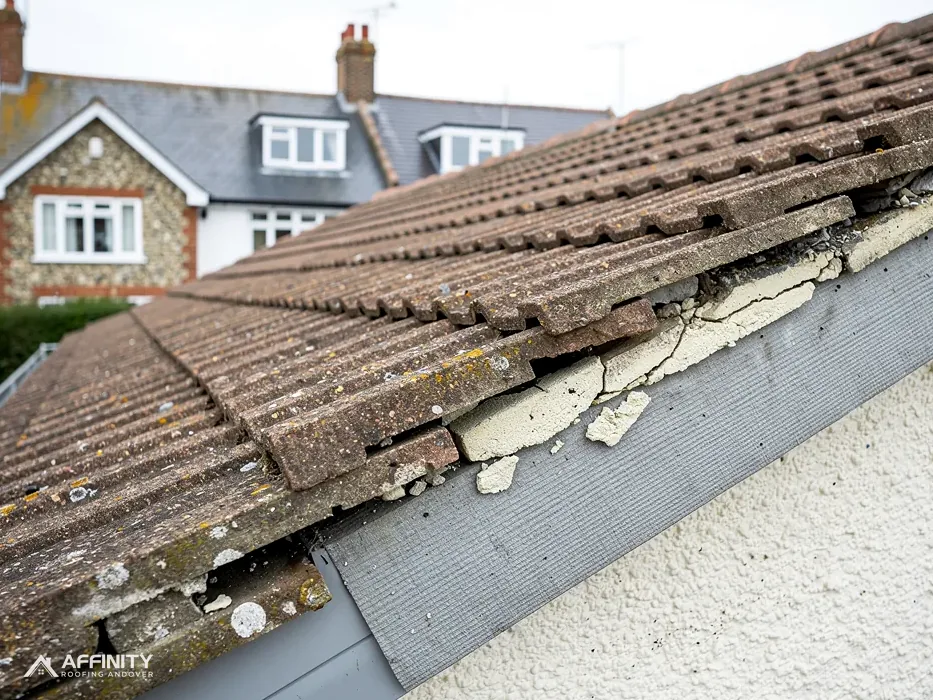
Large gaps beneath the tiles, mortar in the gutters by the handful, ridge tiles that shift under a finger or a line that sags are signs the bed has failed. If the same ridge has been repaired more than once, the repeats suggest the problem is deeper than the mortar. Our guide on the signs that ridge or verge fixings are failing sets out what to look for from the garden. A tile that you can lift with one finger, or a gap where daylight shows from the loft, belongs on the second list.
Why the condition below matters
A ridge bed sits on the top row of roof tiles and the ridge timber. If those are rotten, wet or crooked, a new bed will not last. The survey includes a look into the loft along the ridge for daylight, damp and rot.
What a re-bed with fixings involves
Re-bedding is not a quick patch of mortar. Done properly, it follows a set order, and it takes time because each tile is handled twice.
Lifting and cleaning
The ridge tiles are lifted off one by one and stacked in order so they can go back in the same sequence. The old mortar is chipped off the tiles and from the roof, and any loose tile in the course just below is secured again. The old bed is bagged and taken away, and not left to wash into the gutter.
Fixing the ridge line
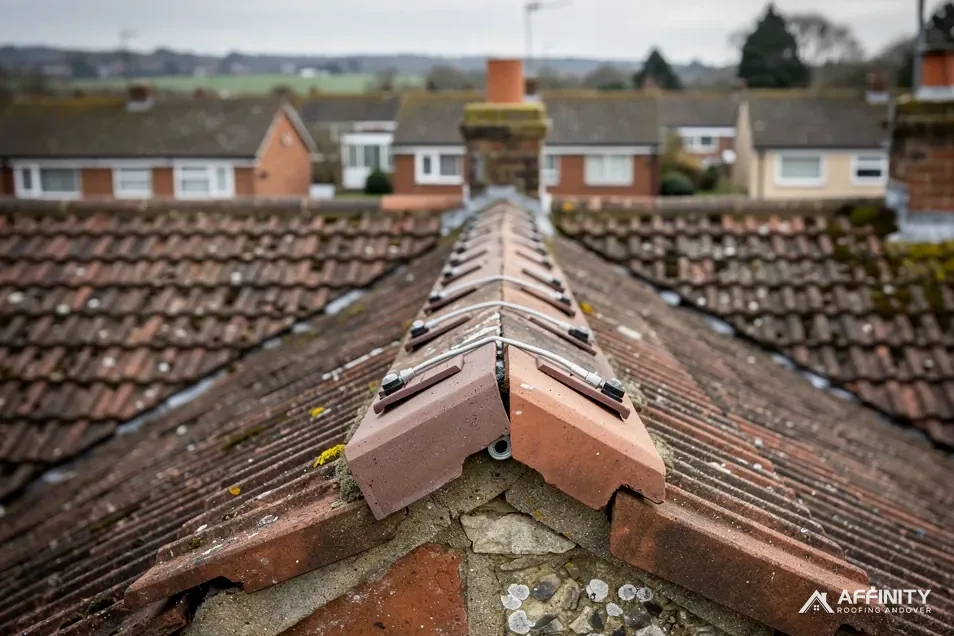
A fresh mortar bed is laid along the ridge. Each tile is set in the bed and tied down with a mechanical fixing, such as a stainless steel screw or bracket into the ridge timber, so the tile is held by metal and not only by mortar. The tiles are checked for line and level as they go.
Pointing and finishing
The joints between the tiles are filled and struck off, and the mortar along the lower edge is smoothed so water runs off it. At the end, the gutters are cleared of any debris from the work.
Colour and appearance
Because the original tiles go back, the roof looks the same as before, with fresh mortar along the line. That is a gain on a roof where appearance matters, such as an older house in a conservation area, where any visible alteration to the roofline calls for care. Our short answer on what mortar mix is used for ridge tiles goes into the bedding material itself.
Mortar plus fixings: what the standard asks
BS 5534:2014+A2:2018 is the standard behind this. Marley points out that the law does not oblige anyone to follow it, and mortar has not been ruled out. What the 2014 revision changed is the weight put on mortar alone, which is now treated as a seal and a bed, not the sole fixing.
What counts as a fixing
A mechanical fixing is something that ties a ridge tile to the roof structure independently of the mortar, such as a stainless screw through a tile into the ridge timber, or a bracket and clip. It is there to hold the tile if the mortar fails, which in a storm it might.
Why wind is the test
Ridge tiles sit at the highest and most exposed point of the roof. Suction from a gust acts on them from above and from the sides, and mortar is weak at resisting a pull. A tile that is only stuck down can lift when the bond is overcome. A tile that is also screwed down has a second line of defence.
What to check on a quote
A re-bed quote should say that the tiles will be mechanically fixed, and what with. If it says only that the ridge will be repointed or re-bedded, ask what is holding the tiles. Our guide to BS 5534 and ridge tiles explains the standard in more detail.
Reusing your existing ridge tiles
Old ridge tiles have value. They match the roof in colour and weathering, and for some tile types, matching replacements are hard to find. Our short answer on whether you can reuse your existing ridge tiles sets out the basics, and this section adds the practical checks.
What makes a tile reusable
A tile is reusable if it is whole, with no through-cracks, chips at the ends that would stop it sitting flat or surface damage that lets water in. Frost damage, where the face of the tile has flaked, rules it out. The inside faces and ends are cleaned of mortar, and the tile is checked for the fixing position.
Swapping the ones that fail
Where a few tiles are cracked, they are replaced with matching ones, from salvage if the profile is old, or new from the maker. The new tiles are mixed along the ridge instead of grouped, so a colour difference does not draw the eye. If the tile profile is out of production, a close match from a reclamation yard is often better than a new tile that does not fit.
Keeping the order
Because tiles weather differently on the north and south slopes, we mark the sequence and refit them in the order they came off. It is a small step that helps the line look consistent when the work is finished.
Waste and breakage
Some breakage is normal when old tiles are lifted. We allow for it and tell you if a larger number than expected fails. Salvaged tiles that match your profile are kept for reuse where we can, and the rest of the debris is taken away with the old mortar.
When to switch from a re-bed to dry-fix
A re-bed is not the right answer on every roof. In some cases, going dry is the better buy, even if the tiles are fine.
The line is wrong
If the ridge has dipped or bowed, because the timber beneath has moved or the top courses have shifted, a mortar bed will only bury the problem. A dry system fixed to a new batten can straighten the line as it goes.
The tiles are failing
If many tiles are cracked, frost-flaked or chipped, a re-bed would reuse poor material. New ridge tiles on a dry system give a longer-lasting result. The same applies where there is no replacement tile of the right profile.
The job keeps coming back
Repeated repairs on the same ridge suggest the bed is not holding for some reason, such as a ridge board that moves or an exposed position. A mechanically fixed dry ridge removes the weakest part, the mortar.
After a storm
When wind has already lifted tiles along the ridge, the survey looks at how far the damage runs. A dry system is often the better route where several tiles went at once, though the insurer decides what a claim covers, and your policy's own storm definition applies.
Comparing the two
Our guide on how much a dry ridge system costs sets the dry route beside the published ranges so you can weigh them.
Survey, consents and cost of a re-bed
A re-bed survey is done from ladders at the gable ends and from the loft. We check the tiles and the bed, look along the ridge against the sky, test the roof tiles below and examine the ridge timber for rot. Photographs of each stretch go to you, so you can check our findings against the images.
Consents
Planning control generally does not reach a repair that keeps the roof's appearance unchanged, since section 55(2)(a) of the 1990 planning Act leaves out work that has no material effect on a building's outward appearance. On a listed building, listed building consent is the route for alterations to the roof, and a conservation area or an Article 4 direction may restrict what changes. In either case, ask the borough council's planners before work begins.
Cost
The ridge is priced on its length, the access and the condition of the tiles. Which? gives £80 to £300 before VAT for a new ridge tile (Nov 2025), and MyJobQuote gives ridge replacement as between £225 and £550 (Oct 2026). Both are typical UK ranges, and neither is a quote for your ridge. The written price follows the survey.
Your next step
If mortar is falling, do not climb up to look. Keep a few crumbs from the gutter, take a photo of the ridge from the garden and ask for a survey.
Aftercare
A re-bedded ridge needs little attention. Look along it from the garden after the first hard winter for fresh cracks, and clear the gutter of debris once or twice a year. If mortar falls again within a short time, tell us at once.