
Roofers in Sparsholt
Church, listed cottages and conservation-area lanes, south-east of Andover
Sparsholt has a Grade II* church, a conservation area and listed cottages. Each roof gets a survey, photographs of the faults and a repair chosen for how it was built.
Sparsholt roofs around the church and the green lanes

Conservation-area lanes
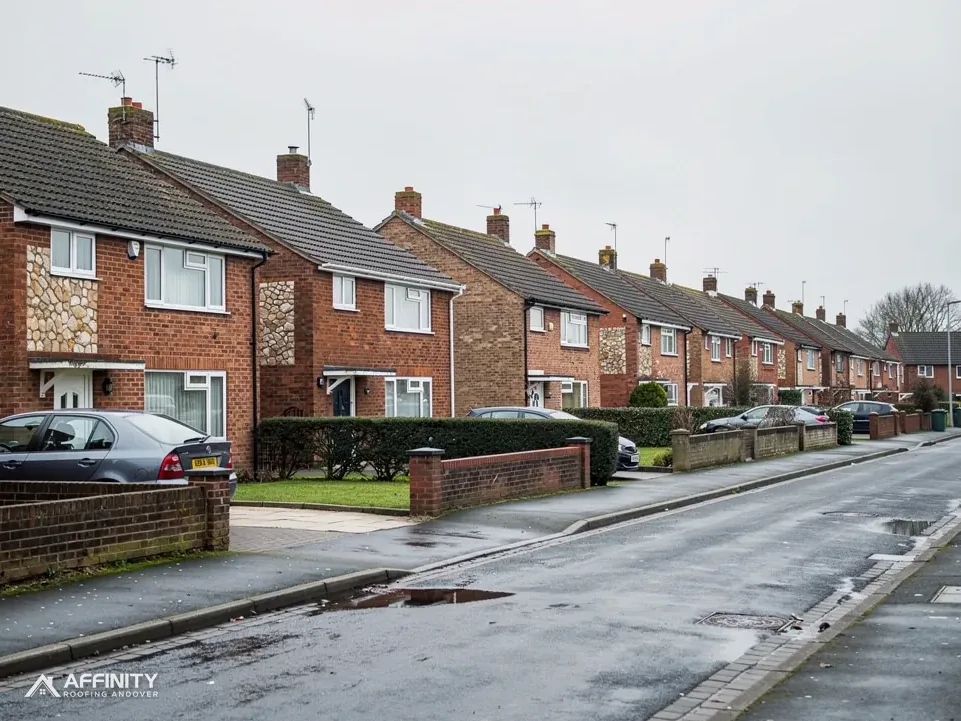
Houses in the lanes near the centre, within the Sparsholt conservation area, where changes to a roof draw extra scrutiny.

The Church of St Stephen
A Grade II* landmark first listed on 27 November 1984, with listed cottages close by that make matching materials matter.

Listed cottages
Thatched Cottage and Corner Cottage are both listed Grade II, so a repair beside them needs care with the roofline.
Sparsholt between Littleton and Hursley
Littleton and South Wonston lie to the north-east, Winchester and Kings Worthy to the east, Hursley to the south and King's Somborne to the west.
- Distance
- 13.8 road miles south-east of Andover
- Planning
- Winchester City Council
- Council
- Winchester City Council and Hampshire County Council
The Sparsholt roof report
Local editionSparsholt, HampshireChurch, cottages and the city council next door
Sparsholt answers to Winchester: whose say a village roof needs, and what we check first
Sparsholt sits 13.8 road miles out from Andover, under another council. This report covers which office has the say over roof work here, how the church and listed cottages shape a repair, and how a scaffold is licensed.
Winchester decides, not Test Valley
Sparsholt lies 13.8 road miles south-east of Andover, and the drive leaves Test Valley behind. The village belongs to Winchester City Council's area. That council decides planning matters affecting roofs here, Hampshire County Council is the county and highway authority, and building control comes from Winchester City Council's own Building Control service. At the 2021 Census the civil parish had 867 usual residents. The village lies outside the South Downs National Park, so the city council, and not the park authority, handles planning for a house here.
That matters on the day a quote is wanted. A roof in Andover is a Test Valley matter, a roof here is a Winchester one, and we never carry the route from one job over to the next. Before a Sparsholt job is booked we find out which office has to be asked, and the answer goes in writing beside the price.
For a re-roof the starting point is the Planning Portal's national test. Where less than 25 per cent of the whole building envelope is affected and less than 50 per cent of the roof, the Planning Portal says an application is not usually required. No re-roofing threshold appears on Winchester's building control page, which leaves the national line in charge. Mending a single patch sits well inside it. The question only arises when a whole slope or more is stripped.
Load is the next test. A new covering that tips the weight up by 15 per cent or more triggers Building Regulations approval, and the Planning Portal suggests that an engineer or surveyor assess the frame first. Light plain tiles replaced by heavy concrete ones is the usual trigger. It is a Building Regulations matter, not a planning one, so the answer comes from building control rather than from the planning team, and we ask the right office the right question.
At the survey visit we raise whatever can be raised in safety, photograph the underlay and the timber battens that hold the tiles, and state clearly whether the job is a repair or a re-roof. For a re-roof, Winchester City Council's Building Control service (01962 840 222 for the council) is asked before the scaffold goes up. A registered building control approver is the private option, and whichever you pick you get the answer in writing, with the photographs behind it, so nothing is left to memory or to a phone call. If the council's reply changes the plan, the price changes with it and you hear before any work starts.
St Stephen's church, thatch history and the conservation area
The middle of Sparsholt is a conservation area: the boundary shown on planning.data.gov.uk lies within about 0.75 km of the village centre. Within its boundary, reshaping a roof or altering the face it turns to the lane is worth raising with Winchester City Council first, before anything is drawn up or ordered. That council also decides whether an Article 4 direction touches your address. Our guide to planning permission for roof work explains where the lines fall, and a straight like-for-like re-covering is a separate matter from a change of shape.
The Church of St Stephen is listed Grade II*, first listed on 27 November 1984 (list entry 1095764). Thatched Cottage (1095759) and Corner Cottage (1095766) are both Grade II. Historic England's list holds 13 listed buildings within about 500 metres of the village centre; wherever you stand in the village, another one is close by. A list entry with the word thatch in its name tells you what the building is called, not what covers its roof today, and we never assume.
In 1908 the Victoria County History described a road in Sparsholt leading "down between thatched and half-timbered cottages to Ham Green". That sketch of the village from a hundred-odd years back shows how the old buildings were made: low eaves, timber frames and steep pitches. If your own roof is thatched, the thatch belongs with a specialist thatcher. Everything else on the rooflines around it, from tiles and slates to lead, chimneys and gutters, is ours, and we are glad to work beside a thatcher on a mixed roofline.
A listed house also needs listed building consent for any change to its character, on top of the ordinary rules. We begin by repairing with the same material, matched in size and colour, and examine the existing covering closely, noting how it is fixed. Then we give Winchester City Council a plain description of the old covering and what we propose, which lets the officer compare the two at a glance. The work waits for the decision. Reclaimed tiles and slates can take a few weeks to find in the right size and tone, so the survey also tells you how long matching stock is likely to take.
A church in use works to rules set by its own denomination, so we never guess the route for St Stephen's or any other church. The parish and its advisers settle that, and a roofer asked to quote simply works within the answer they give.
“In Sparsholt, a roof question starts with Winchester, not Andover.”
Licensing the scaffold on a Sparsholt lane
Scaffolding erected over a public road or pavement counts as being on the highway, and section 169 of the Highways Act 1980 puts it under licence. In Sparsholt the body that grants the licence is Hampshire County Council, not Winchester. Hampshire County Council's licensing page expects the scaffolding firm to submit the application on the customer's behalf, so you never complete the form yourself. We deal with the scaffolder on that, and its cost is carried in the one total you are quoted.
Hampshire County Council wants a gap of 10 clear working days before a licence can start, with no extensions allowed. Hampshire's fee is £211.90 on application for the first 2 weeks, then £72 for each additional 2-week period. The county licenses only the public highway, so a scaffold on your own drive adds nothing in licence fees. That difference can change the whole plan for a job, which is why the survey notes where the ladders and boards will actually stand.
Timing matters most on a listed or conservation-area house. If a consent decision has not yet arrived, we hold off on the licence application, because the county will not extend a licence and a scaffold standing idle still has to be paid for. The start date reaches you only when every permission is in place, so there are no half-promised dates and no scaffold waiting for a signature.
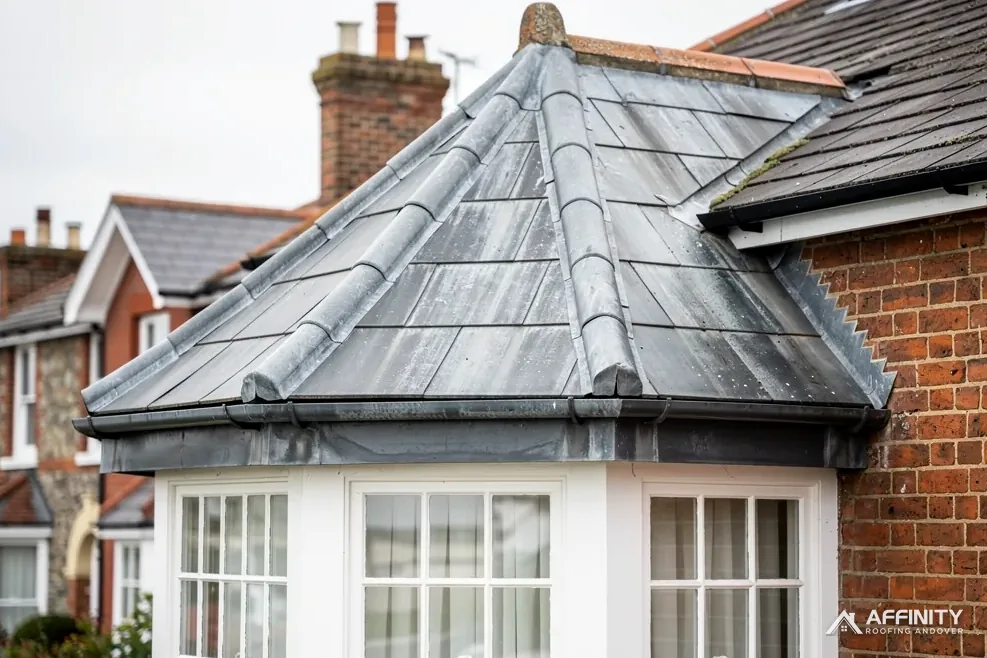
Sparsholt roofs need everyday services, whatever the age of the house. Roof repairs after slipped or cracked tiles come first. Then there are chimney repairs where a stack has lost its flashing (the lead or metal seal where it meets the roof) or its pointing, and pitched roofing where a slope is simply worn out. Whichever it is, you are shown close-up photographs of the fault first, and only then asked to choose the fix and the start day.
Behind it all sits the way we leave a site. Access is set up properly before work begins, waste is cleared away as the job goes on, and each day you are told what was completed and what follows. On a lane with neighbours close by, that routine keeps the whole job calm and the road passable. If rain stops work part-way, the roof is closed up and made watertight for the night before we leave, and the plan for the next day is set out for you.
Roofing help for Sparsholt streets





Sparsholt roofs: listings, consent and the lane scaffold
Can I re-cover the roof of a house in the Sparsholt conservation area?
Usually. A straight like-for-like re-covering is the simplest case; adding a dormer or otherwise reshaping the roof is treated differently inside the conservation area, and listed building consent is a separate need for a listed house. Check with Winchester City Council's planning team before anything changes in how the roof looks from the lane, and keep what it says with your house papers.
Does a listed cottage near the Church of St Stephen need special tiles?
Often it needs matching ones. Consent is needed for work that changes what makes a listed building special. Our first move is a repair in matching material. We note the size, colour and fixings of what is there and track down reclaimed or matching stock so the new work blends in, which on a lane of old cottages is the part people notice.
Do I arrange the scaffold licence myself in Sparsholt?
Hampshire County Council wants the scaffolding contractor to lodge the application at least 10 clear working days before the start date. Hampshire's fee is £211.90 for the first 2 weeks and £72 for each further 2-week period. We arrange it with the scaffolder; a private drive needs no licence, so we tell you whether one is needed for your house.
What happens if my Sparsholt roof is thatched?
Thatch is a separate craft, so a specialist thatcher should handle it. We deal with the tiles, lead, chimneys and gutters around it. In 1908 the Victoria County History described thatched and half-timbered cottages on a road in Sparsholt, so the village has old building stock. Ask the council about consent before any change to the roof's look, and keep any thatcher's advice with your survey photographs.
Neighbours of Sparsholt
Ask for a survey in Sparsholt
Give us the address and a snapshot, and we will survey, ask Winchester about consent and write one price.
10-year workmanship guarantee, in writing.