
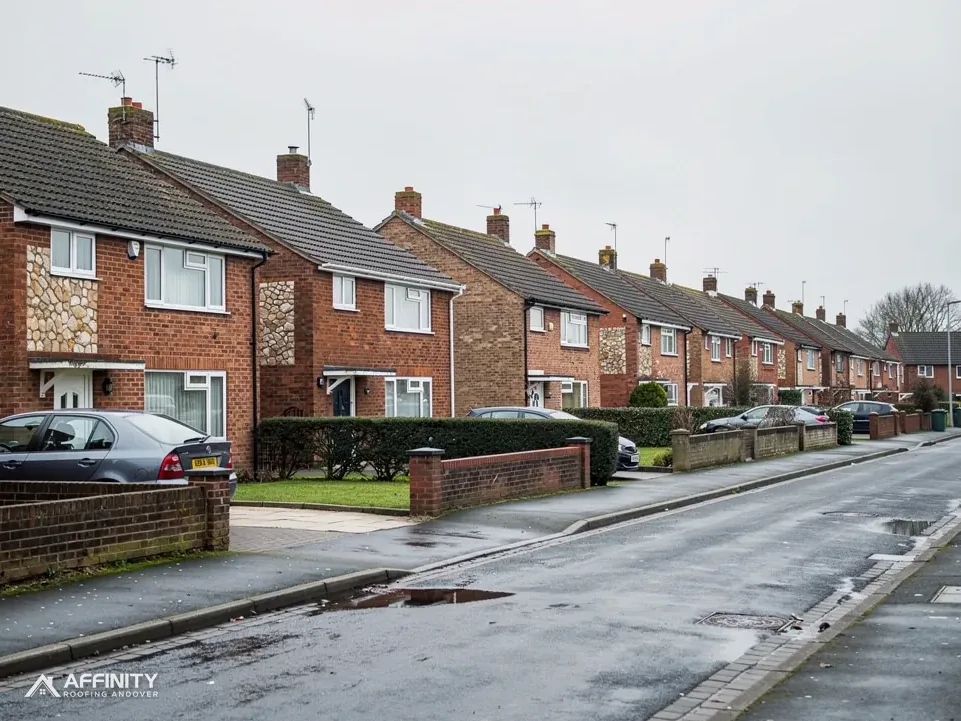
Roofers in Shrewton
A village of 26 listed buildings and two Grade II* churches
Shrewton has 26 listed buildings near its centre, two of them Grade II* churches, and a centre mapped in Flood Zone 3. Each roof is looked at before a price.
Shrewton roofs, from the churches to the farms

Two Grade II* churches
Two churches listed Grade II* on 18 February 1958: St Mary, and St Mary the Virgin.

Barns and farm buildings
The barn at Maddington Farm, listed Grade II, and the working outbuildings that surround old farmhouses.

Houses in Flood Zone 3
Homes in the middle of the village, where the Environment Agency maps Flood Zone 3 and drainage matters.
Shrewton on the western Plain edge
Larkhill, Durrington, Amesbury and Bulford lie to the east, and Netheravon to the north-east. South Newton is south, Codford is west and West Lavington north-west.
- Distance
- 21.7 road miles west of Andover
- Planning
- Wiltshire Council
The Shrewton roof report
Local editionShrewton, WiltshireTwo churches, a barn and a Wiltshire council
Two Grade II* churches, one council: what shapes a roof job at Shrewton
Shrewton lies 21.7 road miles from Andover, heading west, within Wiltshire. Next come who decides on a roof, how consent differs between churches of different denominations, and what a Flood Zone 3 centre and a 28-day licence do to a job.
Wiltshire Council, start to finish
Shrewton is a Wiltshire village, and Wiltshire Council is a unitary authority. The council that makes planning decisions for a roof here also licenses scaffolding on the highway and runs the Building Control service, so one set of offices answers every question. At the 2021 Census the parish had 1,883 usual residents.
Building control is run by the council itself. Its contact page gives 0300 456 0113 for booking inspections, making payments and getting support, from Monday to Friday, 9am to 4:30pm. The service sits at Monkton Park in Chippenham, so a Shrewton re-roof that needs a check goes to Wiltshire Council's own service. That keeps the route short: one council for the planning, the road and the inspection.
Neighbours often learn of roof work from the scaffold itself. A note through each door the week before, with the dates and a phone number, keeps the street friendly.
What needs checking depends on what the job does. Replacing a few slates is upkeep. Re-covering a full slope can bring in building control if enough of the roof is touched, and swapping a light covering for a much heavier one certainly does. We put the specific job to the Building Control service and give you the answer in its own words, not ours. A phone call before the work is cheaper than a notice after it.
Planning is the second question. Wiltshire Council's planners decide whether a change of covering, shape or opening needs permission, and whether an Article 4 direction applies to a Shrewton address. That question goes to the council, with your address, before any figure is quoted, and the reply sits beside the survey pictures.
Directions can be made or changed, so the answer is checked for each job rather than carried over from the last one.
If you prefer a registered building control approver to the council's own service, that private route runs under a registration regime in force since 6 April 2024, and our survey notes go wherever you choose.
Weight can turn a simple re-cover into a regulated job. A covering heavier than the old one by 15 per cent needs approval, and structure is checked before the work starts, which matters on a roof of thin natural slate that is being swapped for something denser. The Building Control service would rather hear about it beforehand. A barn converted to a house is another case: a roof that once kept hay dry now has to insulate and ventilate living space. Ventilation and insulation then come into the building control question.
Churches, a barn and a crowded heritage list
The National Heritage List records 26 listed buildings within about 500 metres of the centre of Shrewton. Two are Grade II* churches, listed as St Mary (1023959) and St Mary the Virgin (1023996), both first listed on 18 February 1958. The Barn at Maddington Farm is Grade II (1023960). With entries that numerous, the list is read for the house and its neighbours alike. We read the list before we quote, so no consent question appears halfway through the work.
A church roof follows a different consent route from a house, and the route depends on the denomination and use.
St Mary's on the High Street holds Church of England services, so the faculty system covers its roof. St Mary's at Maddington is a redundant church cared for by the Churches Conservation Trust, so its roof needs listed building consent, as would a Quaker or Unitarian meeting house. For any other chapel, tell us the denomination and the use when booking. The survey is then written to match the route, with the photographs an adviser or a council officer will want to see.
For listed houses and barns, the route is listed building consent, needed before works that change special character. A barn conversion, a new roof window or a change of tile can all alter that character. Our guide to listed building roof repairs sets out the steps, and Wiltshire Council's planning team decides.
Barns have their own demands: large roof areas, long timbers and a frame that has moved over generations of use. We survey from a tower or the scaffold, check the purlins and wall plates, and record the sheeting or tile. Old sheet roofing that might contain asbestos cement is identified before it is disturbed.
Orcheston is the nearest conservation area, within about 2.5 km of Shrewton, and that says nothing on whether your own house sits in one. Wiltshire Council's map answers that, street by street, and the survey file records what it shows for your Shrewton address, with the date it was checked and the name of the area, if any, that covers it. Inside an area, appearance rules bite harder, and a new colour or material needs the council's view first. Outside one, a like-for-like re-cover on an unlisted house is usually a matter for building control alone.
A survey of a barn or a farmhouse roof records the timber as well as the covering. Wall plates that have gone soft, rafters that have moved and purlins that have sagged all show on the inside, and the photographs come with a brief note on what each means for the repair.
“Shrewton has 26 listed neighbours, and the right consent route depends on the building's use.”
Source: Historic England, NHLE radius query for Shrewton
Flood Zone 3 centre and a 28-day licence
Environment Agency maps put the centre of Shrewton in Flood Zone 3. A roof does not alter that, but it sends rain to the ground, and where that water goes matters. Downpipes should end at a working gully or soakaway, and a gutter run that drips onto a wall wets the foundations instead. Each downpipe is traced to its outlet at the survey, and any that is choked is photographed.
Where scaffolding must occupy the highway, Wiltshire Council issues a licence through its MiPermit portal. As Wiltshire Council puts it, whoever supplies the scaffolding applies through MiPermit, and each site needs a single licence. Wiltshire Council's fee turns on the notice given: £143.80 when notice exceeds 3 working days, £164.70 when it falls short. All licence types are valid for 28 days, and the licence is for the highway, not for ground inside the property.
Hoarding is licensed independently of the scaffold, and a bay marked in the road must be suspended as well. Where marked bays sit outside a house, that last point decides whether the scaffold can go where the roof needs it. We look at the street at the survey and say what will be needed, before the scaffold is requested.
The 28-day limit shapes the programme. A repair that takes a week sits comfortably inside it, whereas a complete re-roof of a big barn or house may use most of the month. We plan the sequence so the roof is made watertight early, and the roofline is finished while the scaffold still stands, since returning later would mean a second licence and a second fee. Slow deliveries are the usual enemy of a 28-day limit, so deliveries are confirmed before the licence starts.
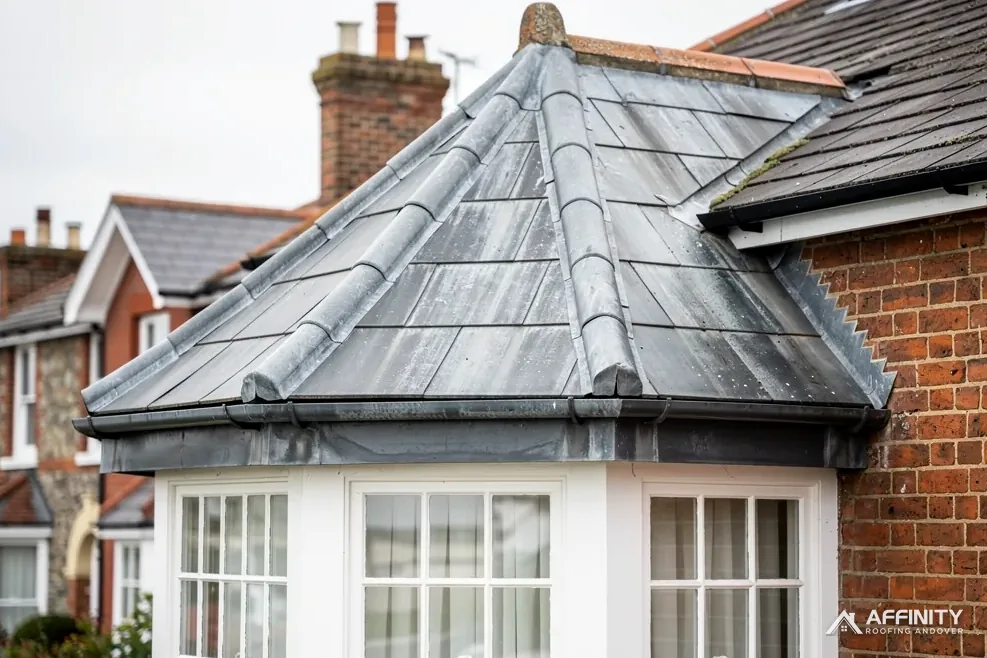
Shrewton roofs get the services the survey calls for. Roof repairs deal with slipped tiles, split slates and torn flashings, lead roofing covers the valleys, flashings and abutments on older roofs, and chimney repairs look after stack pointing, flaunching and flashings.
When a leak is active, making the roof safe comes first. Dated pictures from the visit, and a written note of what was found, are useful to your insurer, who decides the claim. A farm building or barn with a wet floor beneath its roof is made safe first in the same way, since stored goods and machinery do not forgive a delay.
Gutters and downpipes finish the job. On older houses a section that has pulled away from its bracket pours water onto a wall that was never meant to take it.
Tiles, flat roofs and gutters in Shrewton





Shrewton roofs: churches, barns and the licence
Which consent route covers a Shrewton church roof repair?
It depends on the denomination and use. St Mary's on the High Street holds Church of England services, so it goes through the faculty system. St Mary's at Maddington is a redundant church cared for by the Churches Conservation Trust, so it needs listed building consent. A Quaker or Unitarian building would need consent too.
Can the Maddington Farm barn roof be re-covered?
The barn is listed Grade II, so a change of covering that alters its special character needs listed building consent from Wiltshire Council. Like-for-like repair opens the discussion, and the council's planners decide the rest. We survey the timbers as well as the covering, and identify any asbestos-cement sheeting before it is touched, because breaking it up changes the rules.
What period does a Shrewton scaffold licence cover?
Every Wiltshire Council licence type is valid for 28 days, bought through the MiPermit portal by the scaffolding supplier. Wiltshire Council's fee is £143.80 when notice exceeds 3 working days and £164.70 when it does not. Hoarding takes a licence of its own, and any bay marked in the road must be suspended. A scaffold on private land needs none.
Does the Flood Zone 3 centre of Shrewton change how a roof is repaired?
The covering is repaired as usual, but drainage gets extra care. Environment Agency maps put the village centre in Flood Zone 3, so gutters, downpipes and gullies should take roof water well away from the walls. At the survey we follow each downpipe, and any outlet that is blocked or broken is photographed, so you can see it.
Shrewton's neighbours east and west
Shrewton roofs: surveyed, then priced
Send an address and a roof photo. Denomination and listing are checked first, then one total price follows.
10-year workmanship guarantee, in writing.