
Roofers in Durrington
A Grade II* church, listed cottages and a village of 8,447
Seventeen listed buildings stand within about 500 metres of Durrington's centre, a Grade II* church among them. A survey with photographs of the faults precedes every price.
Durrington roofs, from All Saints to the cottages

Church of All Saints
Grade II* listed (1131017) since 18 February 1958; a Church of England church, so faculty rules govern its roof.

Church Cottage
Listed Grade II (1131018) since 10 October 1988, so a repair matches the covering already there, tile for tile.

Hollyhurst and neighbours
Hollyhurst is also Grade II, one of 17 listed buildings within about 500 m of the centre of Durrington.
Durrington north of Amesbury
Netheravon lies to the north, Tidworth to the north-east, Bulford to the south-east, Amesbury to the south, Larkhill to the west and Shipton Bellinger to the east.
- Distance
- 16 road miles west of Andover
- Planning
- Wiltshire Council
The Durrington roof report
Local editionDurrington, WiltshireListings, roof windows and insulation
Durrington roofs: seventeen listings, roof windows in a conservation area and what goes under the tiles
Durrington sits in Wiltshire, 16 road miles out to the west of Andover. Inside: who has authority over a roof here, how the church and the listed cottages shape a repair, and what to ask before insulation or foam goes into a loft.
A village of 8,447 and its single council
Durrington, in Wiltshire and 16 road miles west of Andover, had 8,447 usual residents in the parish at the 2021 Census. Wiltshire Council handles planning, runs its own Building Control service and licenses scaffolds on the public highway. Wiltshire Building Control sits at Monkton Park, Chippenham, and its line is 0300 456 0113 on weekdays from 9am to 4:30pm. One council, three offices, and we know which to ring for which question.
The national guidance for a re-roof turns on two numbers. At or above 25 per cent of the whole building envelope, or 50 per cent of the roof, building control is normally expected to be asked. Below both, it normally is not. Wiltshire names no figure of its own, so a single slope renewed is comfortably inside the limits and a full re-roof is not. The Planning Portal publishes the test, and we apply it house by house.
Two other changes catch people out, and both need Building Regulations approval: a covering 15 per cent or more heavier, and one whose behaviour in a fire would differ greatly, as the Planning Portal sets out. Replacing a light covering with a heavy one, or fitting an unusual sheet material, is how a straightforward re-roof acquires paperwork.
If you would rather not use the council, a registered building control approver can inspect instead, provided they are on the register that began in April 2024. We tell you which route a job needs before the price is set, and the approver or the council then signs the work off once it is done.
The survey itself is the same everywhere. We start at ground level, using binoculars or a pole camera on the full roof for dips and sags, then go close, slope by slope. The ridge is the crest where two slopes meet, a hip runs down an outside corner and a valley is the inside angle between slopes; the report uses each plainly. We climb or use a pole camera, lift what can safely be lifted, and photograph every fault with a short note beside it. The report says whether a repair, a larger repair or a re-roof is the right call, and why. The council's reply, if one was needed, is filed in one folder with the photographs, so nothing depends on memory.
It helps to have three things ready for the survey: the age of the house, any earlier roof work, and any letters from the council or an insurer. With those to hand the survey can skip questions that have already been answered, and the report can refer back to them.
All Saints, Church Cottage and conservation-area roof windows
Historic England's list holds 17 listed buildings within about 500 metres of the centre of Durrington. All Saints' church is Grade II* listed (list entry 1131017, first listed on 18 February 1958). Church Cottage is Grade II (1131018, first listed on 10 October 1988) and so is Hollyhurst (1131020). All Saints holds its own Church of England services, according to the parish's entry on A Church Near You, so its roof work needs a faculty rather than listed building consent.
Durrington has its own conservation area, which the council's map shows within about 0.75 km of the village centre, while Bulford's lies further to the south-east. Altering what the road sees of a roof, or changing its shape, is worth raising with Wiltshire Council, and whether an Article 4 direction covers your address, the same team can tell you.
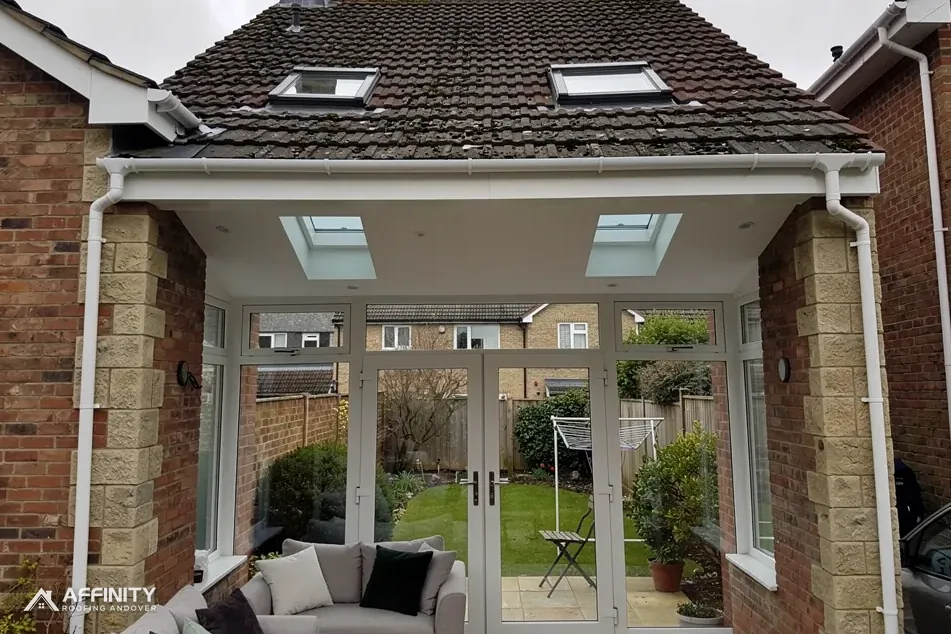
Roof windows are the most visible change a house can make on a roof slope, so they deserve a paragraph. In a conservation area a roof window on the street face is a question for the council. For the specification, a roof window takes the window figure under Approved Document L, 1.4 W/(m²·K) (or Band B on the Window Energy Rating scale), while rooflights are held to 2.2. Skylights and roof windows are fitted with new flashings and a check on the opening in the rafters.
A listed house needs listed building consent for any change touching its special character, roof windows included. We begin with the smallest change that will solve the problem, photograph the covering closely and write a short note to go with the pictures. A house beside the churchyard gets a scaffold plan that keeps boards and sheeting off walls and monuments, with the boundary noted in the survey.
Reclaimed tiles and slates arrive weathered and blend with an old roof, which new ones take years to do. Finding the right ones takes time, and the survey says how long. Conservation area boundaries are drawn street by street, so Wiltshire Council's map is the place to confirm whether your own house falls inside, and the safe course is to ask before changing how the roof looks.
A roof window that forms part of a loft conversion brings more Building Regulations with it. A loft conversion on a two-storey house usually needs a protected stair, though Approved Document B also allows alternatives, and escape windows count only for storeys within 4.5 m of the ground. That approval is separate from the roof window itself.
“Before foam goes into a Durrington loft, ask the mortgage lender, not just the installer.”
Insulation, spray foam and the questions to ask first
Many roof jobs end in the loft, because a leak, a new covering or a conversion raises the question of insulation. The government's Part L rules set 0.16 W/(m²·K) as the target when a roof is renovated, where that is feasible, and the 2026 edition applies from 24 March 2027. When a roof is renovated, insulation is a Building Regulations matter, not just a comfort choice, so the survey records it before any material is bought.
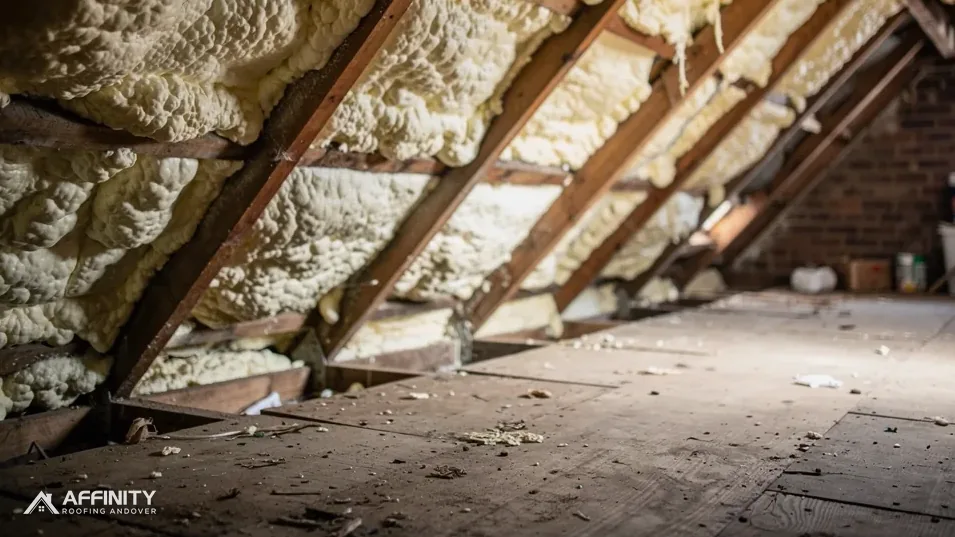
Spray foam needs more caution. RICS reported in March 2023 that some lenders, equity release providers among them, had concerns about spray foam, and its consumer guide advises owners to put the question to their mortgage provider. The guide adds that foam conceals the roof timbers from view and inspection, and that poorly fitted insulation can harm ventilation and lead to moisture damage.
As for spraying foam onto a roof that leaks, the Energy Saving Trust is blunt: it does not recommend it. If your loft already has foam and a buyer or lender has raised it, spray foam insulation removal starts with a survey, and any decision about removal is yours to make once the facts are on the table.
Energy-saving materials installed between 1 May 2023 and 31 March 2027 are zero-rated for VAT, reverting to the reduced 5 per cent rate from 1 April 2027. The standard rate is 20 per cent, and when quotes are compared, VAT and scaffolding should be checked for. No national grant pays for a new roof, though ECO4 runs until 31 December 2026 and Warm Homes: Local Grant covers insulation for qualifying households.
For the scaffold, Wiltshire Council is the licensing body. Wiltshire Council charges £143.80, or £164.70 with less than three working days' warning, and a licence runs for 28 days. We plan the job inside that period and flag it at the survey if the programme runs close to the limit, so nothing is a surprise on the day, and the plan is shared with you.
Ventilation matters once insulation goes in. For a cold roof with non-breathable (HR) underlay, Marley recommends 25 mm of ventilation at the eaves on pitches up to 15 degrees and 10 mm above that, and a loft hatch needs an effective draught seal (Approved Document C). Where the underlay breathes and the ceiling is well sealed, 3 mm of incidental eaves ventilation can serve instead, where third-party certification allows. The HSE's advice for anything built or refurbished before 2000 is to assume asbestos may be present, and soffit boards, which can be asbestos insulating board, get checked first.
Repairs and re-roofs across Durrington




Durrington roofs: the church, roof windows and loft foam
Is the Church of All Saints in Durrington repaired under listed building consent?
No. All Saints is an Anglican parish church with services of its own, as A Church Near You shows, so a faculty, not listed building consent, governs its roof works. A roofer asked to price it works within whatever the faculty allows and starts only once permission is in hand.
Do roof windows need a particular U-value in Durrington?
Under Approved Document L a roof window takes the window figure, 1.4 W/(m²·K) (or Band B on the Window Energy Rating scale), while rooflights are held to 2.2. In the conservation area a roof window on the street face is also a planning question for Wiltshire Council. We check both before ordering.
Can spray foam in the loft stop a house sale?
It can raise questions. RICS's March 2023 release reported worries among some lenders, equity release among them, and its guide tells you to check your mortgage provider's lending policy before any foam goes in. Foam also hides the roof timbers from inspection. The first step is a survey, and removal is a decision for you once you know the facts.
What is the licence period for scaffolding in Durrington?
Wiltshire Council says its licences are valid for 28 days, charging £143.80, or £164.70 when less than three working days' notice is given. The scaffold supplier lodges on MiPermit, and we handle the arrangement. Wholly private land is outside it, and hoarding, where used, carries its own licence, which the survey flags.
Durrington and the villages near it
Get your Durrington roof surveyed
Give the road and a photo to start, and we will survey, find the consent route and write one price.
10-year workmanship guarantee, in writing.