
Roofers in Upper Chute
Roof work inside the North Wessex Downs, among Upper Chute's listed cottages
All of Upper Chute lies within the North Wessex Downs National Landscape, with a conservation area and 11 listed buildings close to its centre. We survey every roof first.
Upper Chute roofs on the downs

Listed cottages by the church
Yew Tree Cottage, 66 Forest Lane and Well House, each listed Grade II, with repairs chosen to suit old roofs.

Church of St Nicholas
A Grade II church first listed on 13 June 1988, whose own roof work runs through the faculty system.

Houses in the conservation area
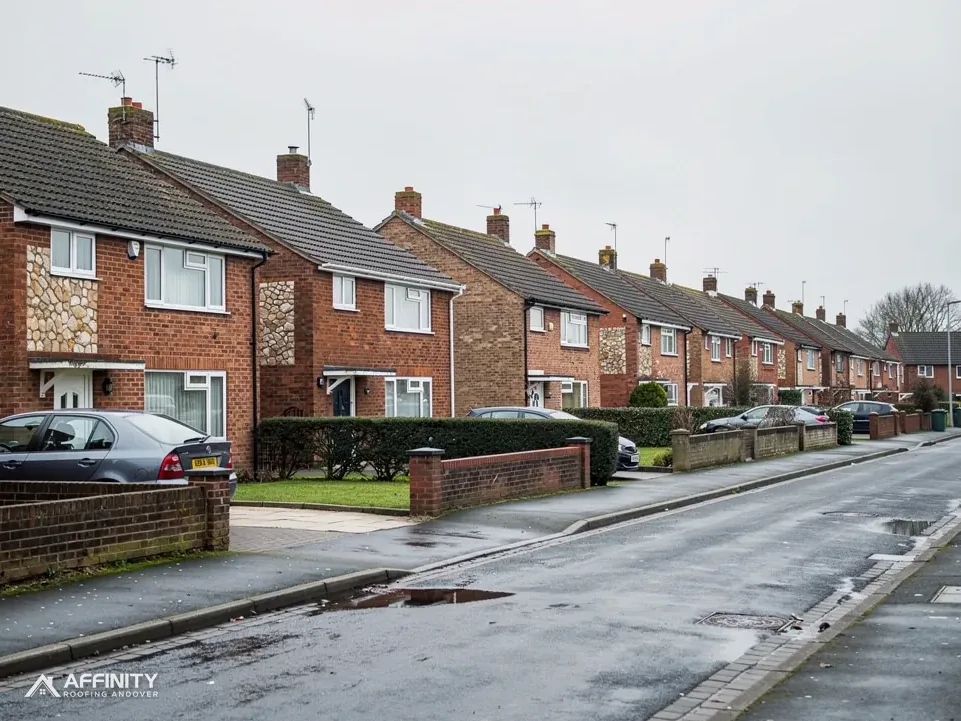
Homes inside the Upper Chute conservation area and the National Landscape, where the council hears about any visible change first.
Upper Chute above Ludgershall and Collingbourne Ducis
Ludgershall lies south-west of Upper Chute, Collingbourne Ducis west, Appleshaw south and Hatherden south-east, with Perham Down further south-west. Roof jobs in all of them are open to us.
- Distance
- 8.7 road miles north-west of Andover
- Planning
- Wiltshire Council
The Upper Chute roof report
Local editionUpper Chute, WiltshireThe downs designation and a Wiltshire rulebook
Upper Chute roofs: wholly inside the North Wessex Downs, answerable to Wiltshire Council
Upper Chute lies entirely within the North Wessex Downs National Landscape, with its own conservation area and a cluster of Grade II cottages around a Grade II church. This report explains what the designation does and does not change for a roof.
What the downs designation does to a roof
Upper Chute sits inside the North Wessex Downs National Landscape, which was known until recently as an AONB, and the whole stretch of ground around the village lies within that boundary. An owner's first question is whether that alters who gives permission for a roof, and the short answer is that it does not.
The downs partnership acts as an adviser. It has no statutory planning powers, and the primary role in planning stays with the local council, with Natural England holding a statutory consultee's role. In plain terms, the partnership can comment on an application but cannot approve or refuse one. For Upper Chute that makes Wiltshire Council the body that grants or refuses, and the partnership is not a second permission you must chase before work can begin.
Where the designation bites is on appearance, and it bites at the point of change. A change that reshapes a roof, a new dormer perhaps, is held to stricter rules within a National Landscape, as it is in a conservation area. A mend that keeps the roof looking as it does, or a re-covering in a matching material, gets the same treatment as anywhere else in Wiltshire, with no extra form. Our planning permission for roof work guide shows where the lines fall.
Upper Chute also has a conservation area, which lies within about 0.75 km of the village centre. A house can therefore sit inside both designations at once. Neither calls for a separate application where a repair leaves the roof's look untouched, but both are good reasons to ask the council before an alteration is priced.
Article 4 is a question for Wiltshire Council as well. Whether a direction reaches your street is for the council to say, which is why the question goes to it, with your address, before we quote for a change in a roof's appearance. The reply goes into your file beside the survey photographs, where you can find it later.
A downland survey is the same careful work as anywhere. We note what the roof is covered with, how it is fixed and how it has weathered. Colour and texture matter more where the setting is protected, so we hold samples against the existing roof in daylight before we propose a match.
When the evidence supports it, we search for reclaimed slate or tile before suggesting new. One mismatched slope can be seen from a long way across open country, and a roof that sits quietly in the land is part of what the designation protects.
Eleven listed buildings and one church
Historic England's list records 11 listed buildings within about 500 metres of the centre of Upper Chute. Whether or not your own house is listed, a neighbour on that list can matter where a scaffold stands. Yew Tree Cottage (list entry 1035935), 66 Forest Lane (1035936) and Well House (1035937) are each Grade II.
The Church of St Nicholas is Grade II as well (1035940, first listed 13 June 1988). As an Anglican church in use for worship, it falls under the Church of England's faculty system, which takes the place of listed building consent for its own fabric. Its faculty comes from the diocese's consistory court, Upper Chute's St Nicholas included. A house beside the churchyard is judged under the usual rules, with listing added only if that house is on the list.
For a listed cottage, anything that affects the building's character needs listed building consent, on top of the usual planning requirements. The application goes to Wiltshire Council. Paperwork for the council comprises slope photographs, a plain note on the existing covering and a brief statement of what would change, because an officer judges only what is on the page.
Matching repair comes first and is usually the easiest case to put to the council. A lifted ridge, a slipped slate or a worn flashing can often be put right with the same material in the same place. A bolder change, a different covering across a whole slope for example, goes to the council first and waits for its reply.
Chimneys on older cottages deserve particular care. Where a stack's pointing has crumbled or its flashing has lifted, water gets into the wall below. The work begins with a close look from a safe position and pictures of the brick, the mortar and the lead. Our chimney repairs page explains what the job involves.
When a repair meets a listed roof, we settle the plan with you before anything is ordered, including who approaches the council and when. You see the proposal in writing. While a consent decision is pending nothing starts, and nothing is ordered that the decision might rule out. Slate in the right size may be slow to source, so that search goes on beside the paperwork.
The same discipline helps unlisted neighbours. A survey record of a listed cottage's slates shows size, colour and fixing, and that record is useful when the house next door needs the same repair, because the sourcing work has already been done.
“On the downs the council decides: Wiltshire Council, not the landscape partnership, answers for an Upper Chute roof.”
A Wiltshire licence for scaffold on the lanes
Wiltshire Council grants the licences for scaffold on the public highway, and its page says one is needed on any part of the highway. Wiltshire Council's page leaves the application to whoever supplies the scaffold, through its MiPermit portal, and asks for public liability insurance of £5 million, matched by any company working on the scaffold itself. We arrange all of this with the scaffolder.
Putting scaffold up without a licence costs more. Wiltshire Council says a late fee of £292.50 applies, so the licence is secured before the first pole goes in. Upper Chute lanes are narrow in places, and a scaffold that takes half the road is far easier to live with when the dates are fixed in advance and the neighbours know.
A roof here may be reachable from private land, such as a yard, a drive or a garden. Scaffold wholly on private ground sits outside the highway licence. We check which case applies on the first visit, because the answer shapes the programme, and we tell you at once if the council's permission will be part of the job.
Building control is run by Wiltshire Council's own service from Monkton Park, Chippenham, on 0300 456 0113, with a registered building control approver as the private alternative. A re-cover affecting under 25 per cent of the building envelope and under 50 per cent of the roof seldom calls for an application, though added weight of 15% or more does.
Upper Chute roofs need straightforward services. Slipped tiles and failed flashings are covered by roof repairs. Slate roofing suits older cottages where natural slates have slipped or cracked. Whole slopes needing fresh battens, underlay and covering at once count as pitched roof work, and the survey shows which you have.
Every job starts from a roof visit and a set of pictures. One written price follows, covering the licence, the scaffold and the waste taken away. You see the roof as we saw it before you agree to anything, and every step has a date set out in plain words.
Gutters and the eaves line get the same attention. A downpipe that discharges against a cottage wall can undo a good roof repair, so we check outlets, brackets and falls, and the wall below, as part of every visit. Where work is needed, it is added to the same written price, and you are told what it involves.
Lead at the chimney and abutments is checked on the same visit, since a lifted flashing lets rain into the wall below.
Services for roofs in Upper Chute






Upper Chute roofs: downs, church and licence
Does living inside the North Wessex Downs change how an Upper Chute roof is repaired?
Not where the repair keeps the present appearance of the roof. The partnership only advises, and Wiltshire Council stays the planning authority. A change in shape meets tighter rules inside the designation and the conservation area, so we ask the council before pricing anything that alters the visible roof, and pass its reply to you.
Is the Church of St Nicholas subject to listed building consent?
No. The church is listed Grade II and in Anglican worship use, so roof works need a faculty from the diocese's consistory court, St Nicholas being no exception. A listed house nearby, such as Yew Tree Cottage, needs listed building consent from Wiltshire Council for work touching its character. Which route applies is confirmed first.
What if scaffold goes up on an Upper Chute lane without a licence?
Wiltshire Council says a late fee of £292.50 applies to unlicensed scaffold on the public highway. Wiltshire Council's rules leave the application to whoever supplies the scaffold, via its MiPermit portal, and we make sure the licence exists before work starts. A scaffold wholly inside a yard or drive is outside the highway licence.
Do I need building control for a new covering on my Upper Chute house?
It depends on the size of the job. The Planning Portal's test is under 25 per cent of the building envelope and under 50 per cent of the roof. A covering weighing 15 per cent or more above the existing roof brings Building Regulations approval, with a structural check. Wiltshire Council's building control, or a registered approver, handles it.
Book a visit to your Upper Chute roof
Pass us the address with one clear photograph. We survey, then return a single written price with the consent route explained.
10-year workmanship guarantee, in writing.