
Roofers in Colden Common
Manor House and Malt House streets at the South Downs edge
Colden Common has seven listed buildings near its centre, and the South Downs National Park reaches the area around it. Every roof is examined before a price is set.
Colden Common roofs, from the Manor House outwards

Homes at the Park's edge
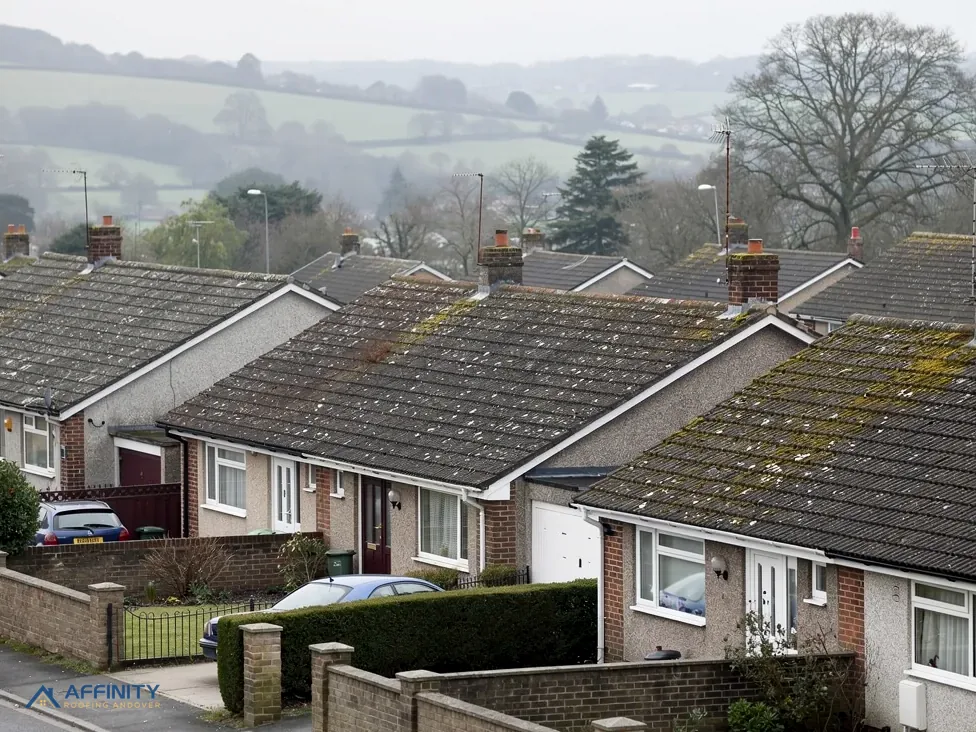
Houses at the edge of the village where part of the South Downs National Park reaches into the surrounding area.

Manor House and Malt House
Two Grade II listed buildings first listed on 27 November 1984, with King Charles Cottage also listed Grade II.

Everyday village homes
Family houses, porches and extensions across a parish of 4,304 residents, each repaired to suit its own roof.
Colden Common among its Itchen-side neighbours
Twyford lies to the north and Otterbourne to the west. Allbrook is to the south-west, Bishopstoke and Fair Oak to the south, and Owslebury to the east.
- Distance
- 21.5 road miles south-east of Andover
- Planning
- Winchester City Council
- Council
- Winchester City Council and Hampshire County Council
The Colden Common roof report
Local editionColden Common, HampshireThe South Downs edge and Winchester's desk
On the South Downs edge: who decides a Colden Common roof, and what to do after a storm
Colden Common is 21.5 road miles from Andover, near the border of the South Downs National Park. Below: which authority handles a roof application, what seven listed neighbours change, and the steps to take when weather damages a roof.
Winchester's desk, with the National Park at the edge
Colden Common is in Winchester district, and Winchester City Council is the local planning authority for the village centre. Hampshire County Council looks after the road. Nearby, though, the South Downs National Park reaches the edge of the area: the centre of the village lies outside the Park, with about 35 per cent of a 1.5 km square around it inside. For a house near the boundary, the address decides which authority applies.
The rule inside the Park is straightforward. The South Downs National Park Authority is the local planning authority for every part of the Park. Three district councils, Winchester among them, have permission to complete planning work on its behalf, and are called host authorities. Winchester City Council therefore processes most applications for Park addresses in its district, while some cases are called in to the Authority's own team at Midhurst.
A National Park authority deals with planning only. Building control stays with the district council, so a Colden Common roof inside the Park or outside it goes to Winchester City Council's own Building Control service. Its page lists building regulations, fire safety, pre-application consultation, and dangerous structures and demolition among its functions, and the telephone number for Building Control is 01962 848 176.
At the 2021 Census the parish had 4,304 usual residents. Some of their homes will stand near the Park line. We find out where each address sits on the first visit, by reading the boundary map beside the property, because a postcode is a weak guide where a boundary runs through fields and gardens.
If your address is inside the Park, the application route changes but the roof does not. A leak at a hip is mended the same way on either side of the line. What differs is who needs to see the paperwork when a change of appearance is proposed, so we separate the repair from the application at the survey and tell you which parts of the job need nobody's permission at all.
Whether an Article 4 direction applies to your street is for Winchester City Council to say. We put the question with your address before we price anything that would change a roof's appearance, and we keep the answer with the survey notes.
Inside a National Park there are no permitted-development dormers, so a change of roof shape needs an application. Our guide to listed building roof repairs covers the consent side for older houses, and repairs in the same material carry on as normal.
The Manor House, the Malt House and seven listed neighbours
The National Heritage List records 7 listed buildings within about 500 metres of the centre of Colden Common. The Manor House is listed Grade II (list entry 1095818, first listed on 27 November 1984), and the Malt House is Grade II with the same listing date (1095855). King Charles Cottage is also Grade II (1156574). Seven entries in a village of this size means any job near the middle may touch a protected roof.
For a listed house, a change of kind in the covering, a different roof shape or a new opening needs listed building consent before work begins. The route is not complicated, but it takes time, and the scaffold booking waits for the answer. Repairs in the same material start the conversation with the planners, who decide each case on its merits.
For a listed or protected roof the survey begins with a tape measure. Tile and slate sizes, the lap, the pitch and the type of fixing are recorded slope by slope, and each is photographed with something in frame to show scale. Those figures let a supplier quote for a true match and give the planners an exact record of the roof as it stands.
Old tiles that are sound are worth saving. They can be lifted with care, sorted into good, doubtful and broken, and relaid with new ones filling the gaps on the slope that cannot be seen from the street.
A listed name such as the Malt House says nothing certain about the roof above it, and the list entry, not the name, is what the planners work from. Whatever a building's past use, we look at the structure before we price the covering, and the timbers are photographed beside the tiles.
Twyford is the closest conservation area to Colden Common, and it belongs to a separate village. Winchester City Council's own map settles any single address, and we read it for your street before any tile is quoted. If your house does fall inside one, the roof's appearance from the street meets a stricter test, and a call to the council comes before the order for tiles.
When listed or protected houses are involved, we leave time in the programme. Consent decisions can take weeks, and reclaimed slate or tile to match an old roof may need to be found, collected and checked for size. We would rather tell you the real timetable on the first visit than a hopeful one that slips.
“At the South Downs edge, Colden Common roof applications are handled by Winchester.”
After a storm: steps to take and the Hampshire licence
When weather damages a roof, the order matters. First call the insurer. Then stop further damage with a temporary repair, and hold on to photographs and receipts. What counts as a storm is set by the wording of your own policy, and the Financial Ombudsman Service, on 0800 023 4567, can look at a refused claim. Your insurer decides the claim, and dated pictures help it do so.
We make a leaking roof safe, with a temporary cover where needed, and describe in writing what is damaged. The most helpful pictures are the whole roof from the ground, each damaged area close up, and the inside of the loft where water came in. We take them during the visit and send them with the written description, so you can pass both to your insurer. A tarpaulin is a stopgap, and the proper fix follows once the cause is understood.
When a repair needs scaffolding on the highway, Hampshire County Council issues the licence and charges £211.90 on application for the first 2 weeks and £72 for each additional 2-week period. A wait of 10 clear working days comes before the start, and no extensions are given. In an emergency, a roof ladder, or a tower kept on your own land, may do the temporary work, since private ground needs no licence.
The jobs that follow a storm are the familiar ones: roof repairs to replace blown tiles and torn flashings, pitched roofing where a slope has been stripped, and guttering, soffits and fascias where wind has pulled boards away. Each starts with the camera on the roof, which also gives the insurer something firm to read. Where ridge mortar has failed along its length, a dry-fix ridge is worth weighing against re-bedding.
A roof that has been patched twice in a year may be telling you something. We point it out when the photographs show it, and set out the choice between another repair and a re-cover, without pressure either way.
None of this needs a storm to begin. A quiet autumn visit to clear valleys and check ridge tiles costs less than a winter emergency, and the survey notes then show what is likely to give way first.
Gutters suffer in the same weather. Wind lifts fascia boards and strips brackets, and leaves clog outlets, so the roofline gets a full run-along on any storm visit. A gutter that has dropped at one end spills over the masonry, and the mark it leaves can pass for a roof leak, which is why we look at both before deciding which is at fault.
What we can do for your Colden Common roof






Colden Common roofs: the Park edge, listings and storms
Is my Colden Common house inside the South Downs National Park?
The village centre is outside it, but about 35 per cent of the area around the centre is inside, so addresses near the edge vary. Check the boundary map with your address. Inside the Park the National Park Authority is the planning authority, with Winchester City Council processing most applications for it. We read the map at the survey.
What counts as storm damage for a Colden Common roof claim?
The wording of your own policy decides. According to the Financial Ombudsman Service, violent winds, usually with rain, hail or snow, can count, and so can rain, hail or snow alone. Call the insurer first, stop further damage with a temporary repair, and keep photographs and receipts. The Ombudsman is on 0800 023 4567 if a claim is refused.
Can the Manor House or Malt House roofs be repaired without consent?
Both are listed Grade II, and listed building consent is needed for works that change special character, such as a different covering. Repairs in the same material are where discussion with Winchester City Council's planning team starts. Ask before changing colour, material or shape, and put the council's reply in your roof folder.
Who checks building regulations for a Colden Common re-roof?
Winchester City Council's own Building Control service, even for addresses inside the South Downs National Park, because National Park authorities deal with planning only. Building Control's own line is 01962 848 176. A new covering that adds 15 per cent or more in weight needs approval, with the structure checked beforehand.
Itchen-side villages near Colden Common
Have your Colden Common roof read first
Book with an address and photo. Park and listing position are checked first, then you receive a single written total.
10-year workmanship guarantee, in writing.