
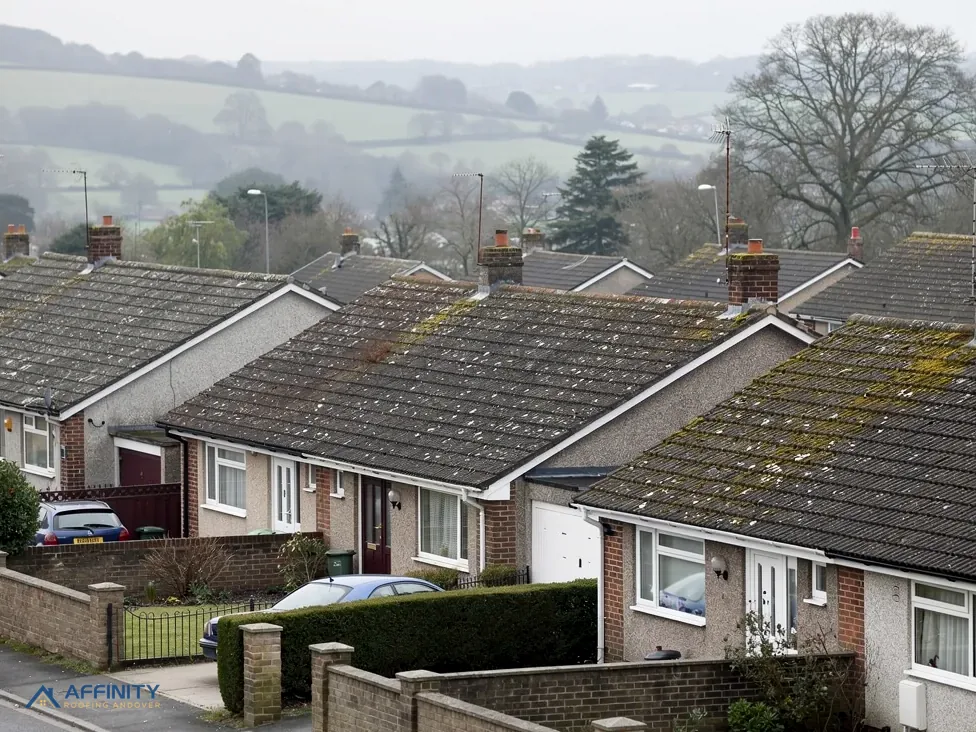
Roofers in Codford
A Grade II* church, old cottages and outbuilding roofs in Cranborne Chase
Codford has 26 listed buildings within 500 metres of its centre, and the whole village is inside the Cranborne Chase National Landscape. Each roof is surveyed before it is priced.
Codford roofs, from St Peter's to Manor House Cottage

St Peter's and churchyard neighbours
St Peter's is Grade II*, which sets the standard for roofs close to it.

Manor House Cottage
Manor House Cottage, Stable Cottage and The Old Rectory are all Grade II, so roofs nearby are matched.

Barns, sheds and outbuildings
Village barns and sheds whose sheet roofs need careful handling, because some older sheets are asbestos cement.
Codford between Dinton and Shrewton
Dinton lies to the south-east, Shrewton to the east, Fovant to the south and West Lavington to the north. Each of these places lies within our working area.
- Distance
- 28.5 road miles west of Andover
- Planning
- Wiltshire Council
The Codford roof report
Local editionCodford, WiltshireCranborne Chase, Wiltshire and old sheet roofs
Cranborne Chase advises and Wiltshire Council decides: what that means for a Codford roof
Codford lies wholly inside the Cranborne Chase National Landscape yet answers to Wiltshire Council for every roof decision. This report sets out the council's roles, the listed church and cottages, and the care that old outbuilding roofs need.
Cranborne Chase advises and Wiltshire Council decides
Codford parish had 856 usual residents at the 2021 Census, and every part of the village lies within the Cranborne Chase National Landscape, formerly the Cranborne Chase and West Wiltshire Downs AONB. The designation is an advisory one. Wiltshire Council remains the local planning authority, which means it decides applications, whatever the landscape's own views. The same council runs its Building Control service from Monkton Park, Chippenham, and licenses scaffold on the highway.
An owner therefore has a single door to knock on. Wiltshire Building Control's telephone number is 0300 456 0113, and the same council's planning team handles anything that changes how a roof looks. Altering a roof's shape meets closer limits inside a National Landscape, so a new dormer deserves a conversation before drawings are made. Our guide to planning permission for roof work sets out the limits.
For a re-covering, the Planning Portal's test is the one to use. An owner who stays under 25 per cent of the building envelope and under 50 per cent of the roof need not normally apply to building control. A replacement that weighs 15 per cent or more above the old covering needs Building Regulations approval, and the Planning Portal says an engineer or surveyor should assess the roof first. Wiltshire has not published a different threshold.
At the survey we sort what is repair from what is replacement. A repair puts back what was there, tile for tile. Replacement strips a slope, and with it come the questions about weight, insulation and approval. You may use a registered building control approver for the inspection if you prefer, and the choice is set out beside the price so you can compare the routes and make it yourself.
None of this has to be difficult. A photograph of the roof, the address and a few minutes with the council's website are usually enough to place a job on the right path, and that is what the first stage of our work provides.
A few Codford owners will have a conservatory or porch roof to think about. The Planning Portal is plain about a replacement: any new roof on a conservatory has to meet building regulations, so that it stays sound in structure, efficient with energy and properly ventilated, which means a solid roof on an old conservatory is not a simple swap. Tell us at survey if a glazed roof is part of the plan, and we will say which route it takes before a price is written.
St Peter's, the cottages and the Sherrington conservation area
Historic England's list shows 26 listed buildings within 500 metres of the centre of Codford. St Peter's church is Grade II* (list entry 1036461, first listed on 11 September 1968). Manor House Cottage (1036466), Stable Cottage (1036467) and The Old Rectory (1181074) are all Grade II. With 856 residents in the parish, the roof you are repairing is likely to sit near a protected one.
The Sherrington conservation area lies within about 0.75 kilometres of the middle of Codford, on a boundary Wiltshire Council supplies to the national planning data. Within a conservation area, anything that changes the visible roof is worth mentioning to the council's planning team before work starts. Ask the same team whether an Article 4 direction applies to your address; the council holds the answer.
Because St Peter's remains an Anglican place of worship, its roof sits under the faculty system, granted by the diocese's consistory court; the council's listed building consent is not the route. A listed house or cottage is different. Listed building consent is needed for any alteration that affects its character, and it is a separate application from planning. We aim at repairs that match what is there and we describe them in plain words, with photographs, to the council's officer.
The Environment Agency's Flood Map for Planning shows Flood Zone 3 within about 250 metres of the centre of Codford. That says nothing about any one street or house, yet blocked outlets are among the easiest faults to cure, so gutters, hoppers and downpipes are checked early.
One practical point on old buildings: the roof you can see is rarely the whole story. Underneath, battens may have been replaced in sections, and underlay may be missing from one slope and torn on another. We lift a few tiles where it is safe, photograph what is there, and show you.
Old tiled and slated roofs in the countryside can also shelter wildlife. Section 1 of the Wildlife and Countryside Act 1981 makes it an offence for anyone to intentionally take, damage or destroy an active nest, and every bat species and its roosts are fully protected. Under the Habitats Regulations, harm to a roost is an offence whether or not it was meant. We look for droppings, entry gaps and staining on every rural survey, and stop to take advice if we find any, because a short pause is far cheaper than a stopped job.
“In Codford the Cranborne Chase designation advises, and Wiltshire Council decides every roof question.”
Old sheet roofs, gutters and a late-fee warning
Farm and garden outbuildings around Codford may wear sheet roofs, and some older sheets are asbestos cement. HSE guidance A14 treats asbestos cement roofing as fragile, so no one should walk on it without fragile-roof precautions in place. Anything put up before the year 2000 is presumed to contain asbestos until a test shows otherwise, and careful removal without breaking the sheets is a non-licensed task.
Identifying the sheet therefore comes before pricing it. Our flat roofing and roof repairs start from what is really there, not from what a barn is assumed to carry. When a sheet needs a specialist, the survey says so in plain terms. Rainwater goods matter on such buildings too: Brett Martin gives a fall of 1 mm for every 600 mm of gutter, and a gutter laid flat or backwards holds water that rots the fascia and floods the footing.
Lean-to and flat roofs on outbuildings are judged on their falls. BS 6229:2025 keeps a finished minimum of 1:80 for general areas and internal gutters, and IKO advises designing for 1:40 so that settlement does not leave puddles. We measure what is there and photograph where water stands, because ponding is the clearest sign that a covering will fail before its time. A lean-to that drains onto a neighbour's land or back against its own wall is worth correcting early, since both end in damp walls and awkward conversations.
The roofline completes the picture, since rot in a fascia board or a soffit panel usually means a leak somewhere above it.
Scaffolding that occupies the carriageway needs permission under section 169 of the Highways Act 1980. Wiltshire Council issues it, and its MiPermit portal is where the firm supplying the scaffolding applies. Wiltshire Council charges £143.80 for an application with more than three working days to spare and £164.70 for a later one, and every licence lasts 28 days. If scaffold goes up without a licence, a late fee of £292.50 applies, so the dates are fixed first.
Wiltshire Council wants proof of £5 million public liability insurance from the scaffolders and any other firm on the frame. Scaffold on private ground, such as a yard or a field edge, needs no licence, and an outbuilding set back from the road can often be reached that way. What the scaffold costs is part of the single written price.
House roofs get the usual attention: repairs for slipped tiles and ridges, pitched roofing for full re-covering, and the roofline of gutters, fascias and soffits where water first enters. Each begins with the same survey and photographs.
Which service does your Codford roof need?



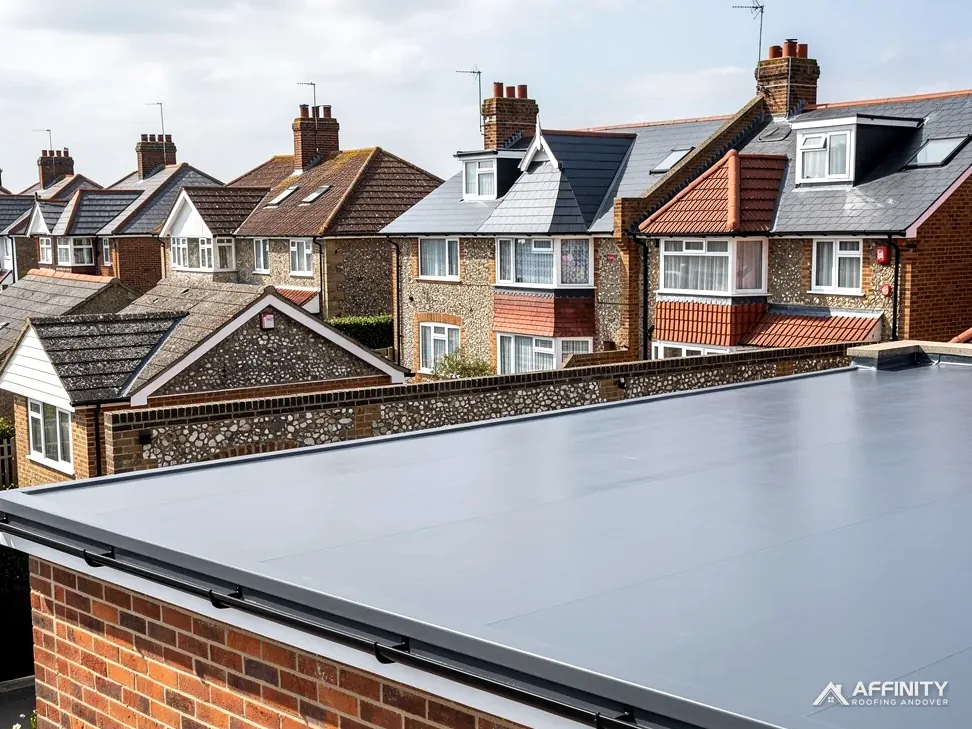


Codford roofs: the National Landscape, sheets and the late fee
Does the Cranborne Chase designation stop me re-roofing a Codford house?
No. The National Landscape is advisory, and Wiltshire Council decides applications. A like-for-like repair or re-covering is judged much as elsewhere in the county. A new dormer faces stricter limits here, both in the National Landscape and in the conservation area, so put it to the council's planning team before drawings are commissioned or material ordered.
How do I handle an old garage or barn roof with sheets in Codford?
Treat it as asbestos until tested. HSE guidance A14 treats an asbestos cement roof as fragile, and a building put up before 2000 is presumed to contain asbestos. Careful removal without breaking the sheets is non-licensed work, whereas substantial breakage makes it notifiable. We identify the sheet at survey and say plainly whether a specialist should take over.
What happens if scaffold goes up on a Codford lane without a licence?
Wiltshire Council applies a late fee of £292.50 where scaffold goes up unlicensed. Wiltshire Council's normal charge is £143.80 for an application over three working days early and £164.70 for a later one, and each licence lasts 28 days. Wiltshire Council has the scaffolding firm apply through MiPermit, and we plan the dates so the licence comes first.
Which council inspects a Codford re-roof?
Wiltshire Council, through its own Building Control service, on 0300 456 0113. A registered building control approver may do the job privately instead. The Planning Portal's test is below 25 per cent of the building envelope and below 50 per cent of the roof, though a covering at least 15 per cent heavier needs approval as well, so both are checked before anything is booked.
Ask for a Codford roof survey before you plan
Send us the address and a photograph of the roof. A survey, consent check and single price will follow.
10-year workmanship guarantee, in writing.