
Roofers in Broughton
Roof repairs in Broughton, where 60 listings crowd the village centre
Broughton has 60 listed buildings within about 500 metres of its centre, with three of its houses and the church at Grade II*. We survey every roof and photograph it before pricing.
Broughton roofs, church to manor house

Parish church of St Mary
A Grade II* church first listed on 29 May 1957, with its own roof works routed through the faculty system.

Broughton Manor House
One of three Grade II* houses, with The Old Rectory and The Lindens, where surveys run slower.

Homes in the conservation area
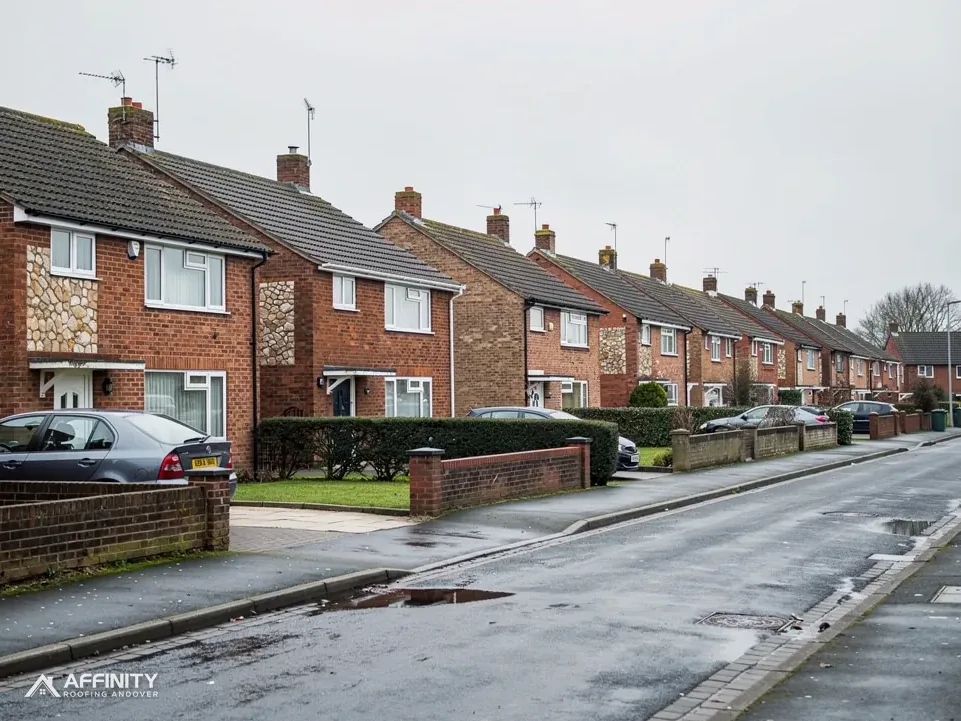
Houses inside the Broughton conservation area, where changes to how a roof looks go to the council first.
Broughton south of Nether Wallop
Nether Wallop lies north of Broughton, Over Wallop north-west, Stockbridge north-east and King's Somborne east. Lockerley is south. We carry out roof work across all of them.
- Distance
- 11.6 road miles south-west of Andover
- Planning
- Test Valley Borough Council
- Council
- Test Valley Borough Council and Hampshire County Council
The Broughton roof report
Local editionBroughton, HampshireSixty listings and four Grade II* houses
Broughton roofs: sixty listings around one village centre, and how a repair is cleared
Broughton has 1,091 residents and 60 listed buildings within about 500 metres of its centre, among them a Grade II* church, manor house, old rectory and The Lindens. Here is how consent works for a roof in a village like that.
Sixty listings within a short stroll
Historic England's list names 60 listed buildings within about 500 metres of the centre of Broughton. At the 2021 Census the parish had 1,091 usual residents. That is roughly one listed building for every eighteen people, a dense record for a village of this size. An unlisted roof here almost always has a listed neighbour.
Among them are four Grade II* entries. The church of St Mary (list entry 1093875, first listed 29 May 1957) is one. The Old Rectory (1093854), Broughton Manor House (1166844) and The Lindens (1339070) are three houses at the same level. Roofs on houses of that standing tend to be old and complicated, and we survey them slowly.
A listed house needs listed building consent from Test Valley Borough Council for work that affects its character. The consent runs alongside any planning or building control the job needs and does not replace them. We prepare the pack from photographs of each slope, a description of what covers it now and a note of the repair proposed.
The parish church is a different case. The Church of England's faculty system governs works to a church in use, through a faculty from the diocese's consistory court for Broughton's church. If your own house backs onto the churchyard, the faculty route does not apply to your roof, which is judged under the ordinary rules plus any listing your house carries.
The Broughton conservation area lies within about 0.75 km of the village centre, its line drawn by Test Valley Borough Council. A job that changes how a roof looks should be put to the council before pricing. Whether an Article 4 direction applies to your house is the council's answer to give, and we ask for it in writing.
With so many listed roofs close together, matching materials becomes a local skill. The tiles on one cottage differ in size and tone from those on the next, and the survey records both. A match that suits your house is chosen against its neighbours, not just against a sample card.
Our planning permission for roof work guide sets out the national position, and the council's reply supplies the local detail.
For an owner, the practical meaning is that surprises are worth heading off early. A short call to the council before a job is priced costs nothing and often saves weeks. We make that call as part of the survey, note the officer's answer and pass it to you in writing, whether the answer is yes, no or it depends.
Three manor-scale roofs and how they are read
Broughton Manor House, The Old Rectory and The Lindens are listed Grade II*, and a survey of any of them is planned around the roof itself. Where such a roof is large, with several slopes, valleys where one roof meets another, and more than one chimney. A fault at one valley can show as a stain in a room that seems far away, so we trace water from the stain upward.
We begin outside, from ladders or a tower on private ground, and photograph every slope, ridge and verge. Then we go into the loft where access allows. Timber that has been damp shows dark staining and soft patches, daylight at the eaves shows gaps, and the underside of the covering shows whether the underlay is intact.
For a house of this standing, the aim is to keep as much original fabric as is sound. Slates and tiles that can be saved are re-fixed, individual units that have failed are replaced with reclaimed stock of the same size and tone, and nothing is changed in material or appearance without the council's written agreement.
Reclaimed stock takes time. A particular size of handmade clay tile, or a Welsh slate of an older gauge, may take weeks to source. We start the search at the survey, in parallel with the consent paperwork, and tell you if the nearest match is not close enough to be worth using.
Lead is common on manor-scale roofs, in valleys, behind chimneys and along abutments. Lead flashing can last for over 80 years (MyJobQuote), and a failure is often a split or a lifted edge and not a total loss. A repair is preferred where it can be done properly. Our chimney repairs page covers the stacks.
Planning decisions in Broughton belong to Test Valley Borough Council, and Hampshire County Council licenses scaffold on the highway. For building control the phrase is your building control body: local authority building control or a registered building control approver, regulated since 6 April 2024. We settle which before the scaffold is booked.
The Planning Portal's national test for re-covering, under 25 per cent of the envelope and under 50 per cent of the roof, is checked slope by slope, and any increase of 15 per cent or more in covering weight triggers approval and a structural check.
A roof of this scale also carries gutters, hoppers and downpipes that are listed with the building or at least part of its character. Replacing cast iron with plastic can change how a house looks as much as a new tile, so rainwater goods are surveyed with the same care as the covering.
“Broughton has 60 listed buildings within 500 metres of its centre, each one named on the national list.”
Source: Historic England list entries within 500 metres
Scaffold, standards and the Broughton work we price
Where a Broughton house fronts a public road, scaffold on the carriageway or pavement is licensed by Hampshire County Council under section 169 of the Highways Act 1980. Test Valley, as a district, issues none. Hampshire County Council wants its licence applicants to be scaffolding companies acting for their customers, so the form never reaches you.
Hampshire County Council sets requirements for those firms: public liability insurance of £10 million, a design to BS EN 12810/12811 or NASC guidance TG20:13, a plan at 1:500 and proposals for signing and guarding. Hampshire County Council allows no tacit consent. Hampshire County Council's fee is £211.90 for the first 2 weeks and £72 for each further 2 weeks, with ten clear working days needed between lodging and start.
On a heavily listed job, order matters. A Hampshire licence cannot be extended, so while listed building consent is still being decided the licence request is held back; scaffold left standing is paid for whether or not work is happening. Once both permissions are in, you receive the start date.
Several Broughton houses are set back, and for those scaffold can stand on private ground, where no highway licence is needed. A manor house with its own drive and grounds is a clear example. We check access on the first visit and tell you which case applies.
Broughton's roofs need the everyday services. Roof repairs deal with slipped tiles, cracked ridge pieces and failed flashings. Guttering, soffits and fascias handle the eaves, where water leaves the roof. Whole slopes needing new battens, underlay and covering are pitched roof work.
Sound roofs are left alone. If a survey shows that a roof has years in it, that is what you are told, with a recommendation to revisit in time instead of a repair that is not needed. The photographs support the finding, and you can show them to anyone you like.
One written total follows every survey, including scaffold, licence, the work and waste removal, and the consent route is named with it.
Deliveries to a village lane need planning. Tiles, battens and a skip arrive by lorry, so we agree beforehand where each will stand, keep a route clear for walkers and tell the neighbours when the scaffold goes up and comes down.
Birds also have a say. If a nest is found in use during the work, we stop in that area and explain the next step, because the law protects an active nest. Bats are a stricter matter, and any sign of them in a loft or under a ridge is reported to you at once, before anything is disturbed.






Broughton roofs: manor, rectory and church
How are repairs to The Old Rectory roof in Broughton cleared?
The Old Rectory is listed Grade II*, so work affecting its character needs listed building consent from Test Valley Borough Council. We photograph every slope, inspect the loft timbers and propose the smallest repair that will hold, using reclaimed material where needed. The proposal is written out for the council before any scaffold is booked.
Is Broughton Manor House treated differently from other listed homes?
The consent route is the same, listed building consent from Test Valley Borough Council, but the survey is slower. Manor-scale roofs have many slopes, valleys and stacks, and lead work that must be repaired properly. We allow more time and more photographs, and the search for matching materials starts straight away.
What public liability cover must a scaffolder hold in Broughton?
Hampshire County Council says scaffolding companies must hold public liability insurance of £10 million and build to BS EN 12810/12811 or NASC guidance TG20:13, with a 1:500 plan and signing and guarding proposals. Hampshire County Council also applies no tacit consent. We arrange the licence through the scaffolder, and the cost sits in your price.
Does the faculty system cover my roof next to Broughton church?
No. The church of St Mary is listed Grade II* and used for Church of England worship, so its own roof works go through the faculty system. A house beside the churchyard follows the council's ordinary rules, plus listed building consent if the house is listed. We confirm which applies before the survey, and write it down.
Ask for help with your Broughton roof
Send the address and a photograph. We survey, speak to the council if needed, then return one written price.
10-year workmanship guarantee, in writing.