The short answer
A slate roof is capped at the top with ridge pieces made of clay or of slate, chosen to suit the look of the roof. Whichever is used, the ridge must be held down mechanically. Since the 2014 revision of BS 5534, mortar alone is no longer relied upon, so the pieces are clipped or screwed to the roof and bedded in a way that lets it breathe.
Clay or slate: choosing the cap
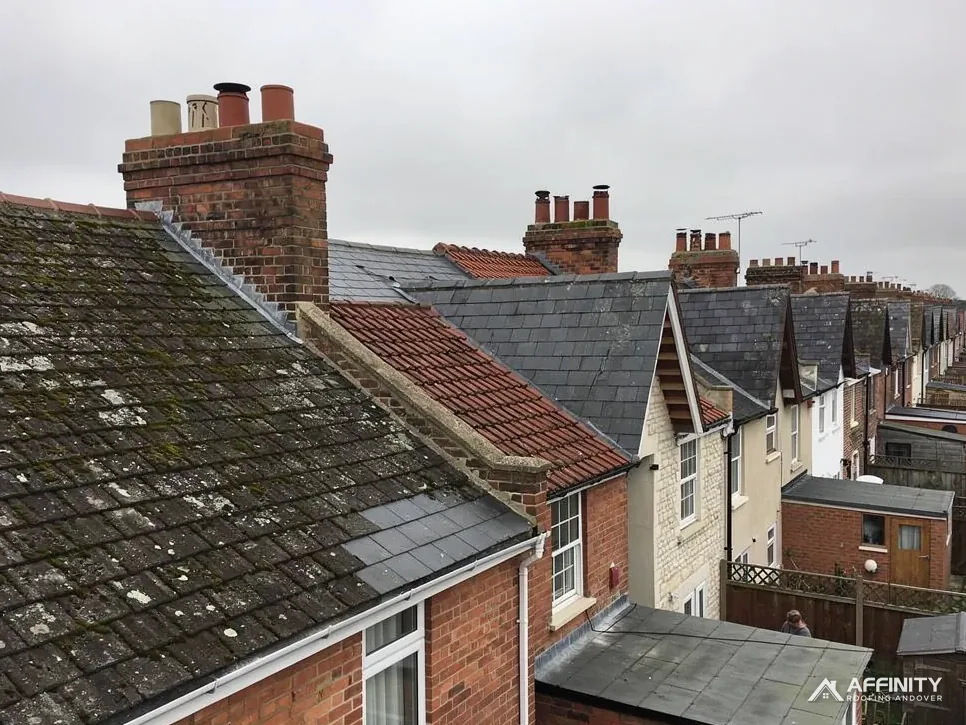
The ridge is the horizontal line where two slopes of the roof meet at the top. Slates cannot be bent over it, so a separate capping covers the joint. On a slate roof that capping is usually either a clay ridge tile or a ridge cut and shaped from slate.
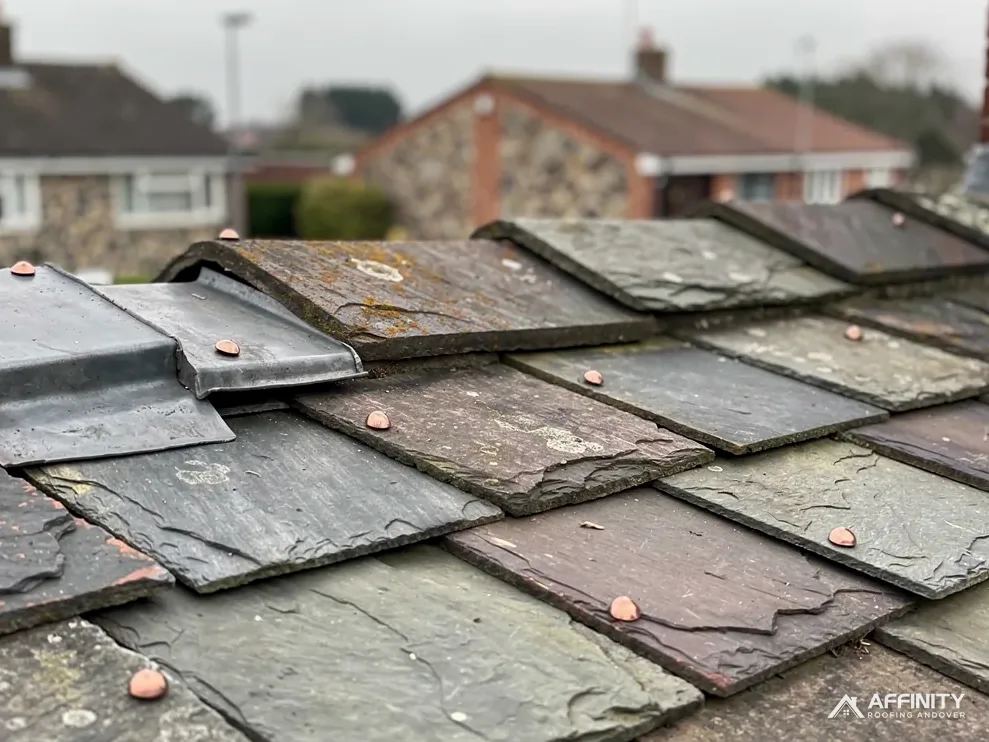
Clay ridge tiles come in a few profiles, such as half-round and angled, and in several colours. They suit many roofs, a slate roof being repaired or re-laid among them. Slate ridges are made from the same stone as the roof, so they blend in completely and give a tidy, formal line. They are more work to cut and fit, and the joints at each end need care.
Neither choice is right or wrong in itself. The best match is the one the roof had originally, or the one that fits the character of the street. A visible mismatch, such as a bright red clay ridge on a dark grey roof, draws the eye and can lower the look of the house.
Our answer on types of ridge tiles shows the profiles side by side, and we match the ridge to the roof at survey.
Why a ridge needs more than mortar
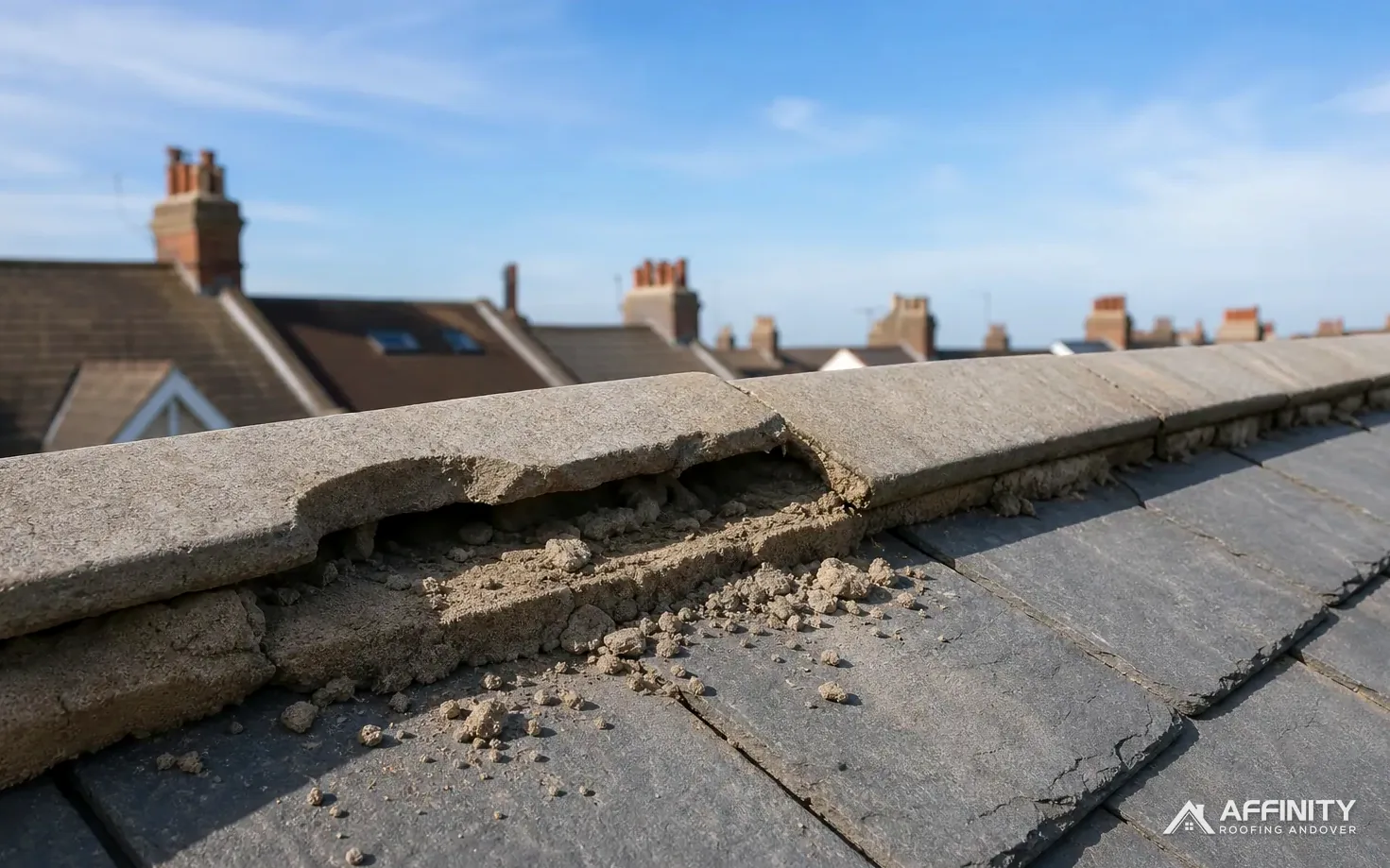
Traditionally a ridge was bedded in a line of mortar and left to the weather. That served for a long time, but mortar cracks and crumbles with frost and movement, and a ridge sitting on failed mortar can slide or lift in a gale. A falling ridge tile is a danger to anyone below.
Marley explains that after the 2014 revision of BS 5534, mortar by itself can't be counted on to hold ridge and hip tiles down. Mortar is not banned. It simply no longer works alone, so the tiles are also secured mechanically with clips, screws or both.
A second standard, BS 8612, is the test specification that dry-fix ridge, hip and verge kits are measured against. Marley adds that working to BS 5534 is no legal duty, though the standard still sets out how the ridge is fixed.
The practical result is simple. If a quote for a new ridge mentions only mortar, ask how the ridge pieces are mechanically fixed. A good answer names the clips or screws and the standard they follow.
Dry ridge on slate
A dry ridge replaces most of the mortar with a system of clips, brackets and a sealed or ventilated roll along the apex. The ridge pieces are fixed to a batten or rail that sits on the roof, and the joints are weathered with a flexible sealing strip, not a ribbon of cement.
The advantages are maintenance and ventilation. There is no mortar to crack, so the ridge needs less attention, and ventilated versions let the roof void breathe at the highest point, which helps move moist air out. Our answer on ventilated dry ridge describes how that works.
The caution is that not every dry system suits every roof. Some are designed for tiles and need adapting for slate, and the supplier's instructions and data sheet decide what is permitted. A dry ridge on a conservation-area slate roof may also raise a question of appearance, since a few systems look different from a bedded ridge.
We choose the system after looking at the roof, and you see the product and its fixings before it goes on. The wider range is described on our dry ridge and verge page.
Repair, replace and what it costs
A ridge problem usually shows up from the ground as a crack or gap in the mortar line, a ridge tile out of line or pieces of mortar on the ground. These are early signs, and a cracked bedding is a repair, not a rebuild. Please keep off the roof to look, because the apex is the one place where a slip has no second chance.
The choice is between re-bedding the existing ridge, which suits sound ridge pieces whose mortar has failed, and replacing it, which suits pieces that are cracked, eroded or the wrong match. In both cases the new fixing should be mechanical.
On cost, the guides give typical UK ranges, not prices. Which? puts a new ridge tile at £80 to £300, ex VAT (Which?, Nov 2025). MyJobQuote gives a ridge replacement as between £225 and £550 (MyJobQuote, Oct 2026). The length of the ridge and the access, such as a scaffold, move the cost.
We photograph the existing ridge and explain what we found. Slate and clay ridges are part of our slate roofing work, and if the whole slope is tired, re-slating a roof is the wider job. A single written total follows the survey.