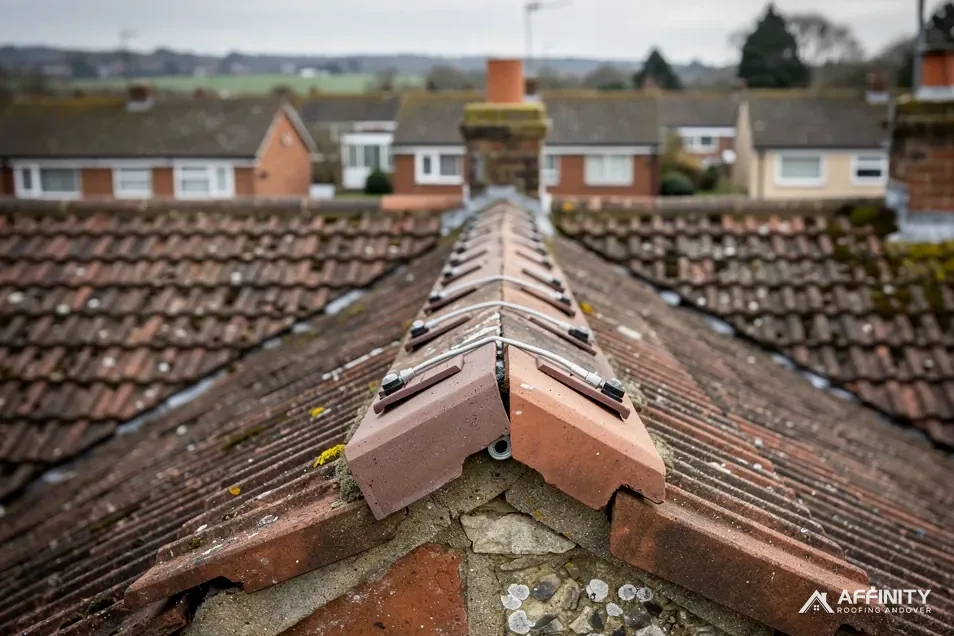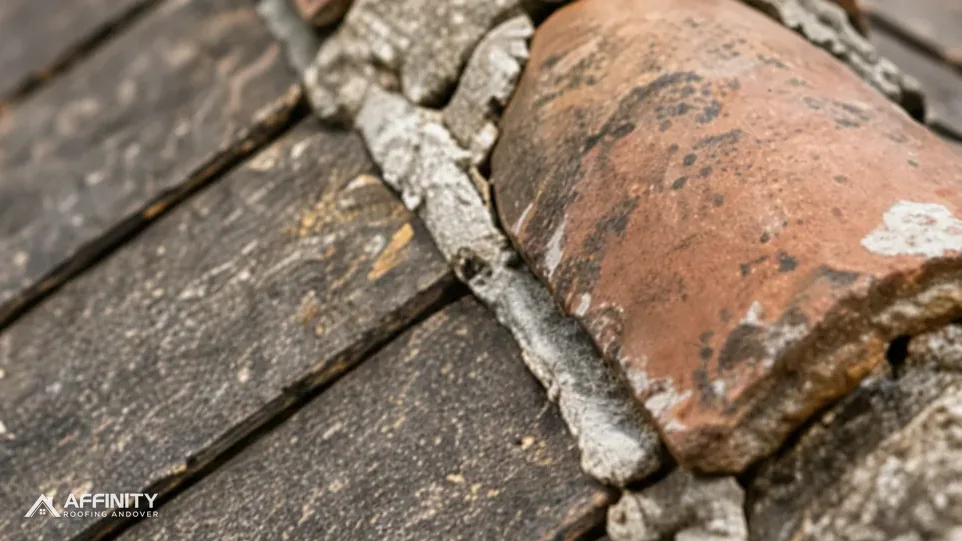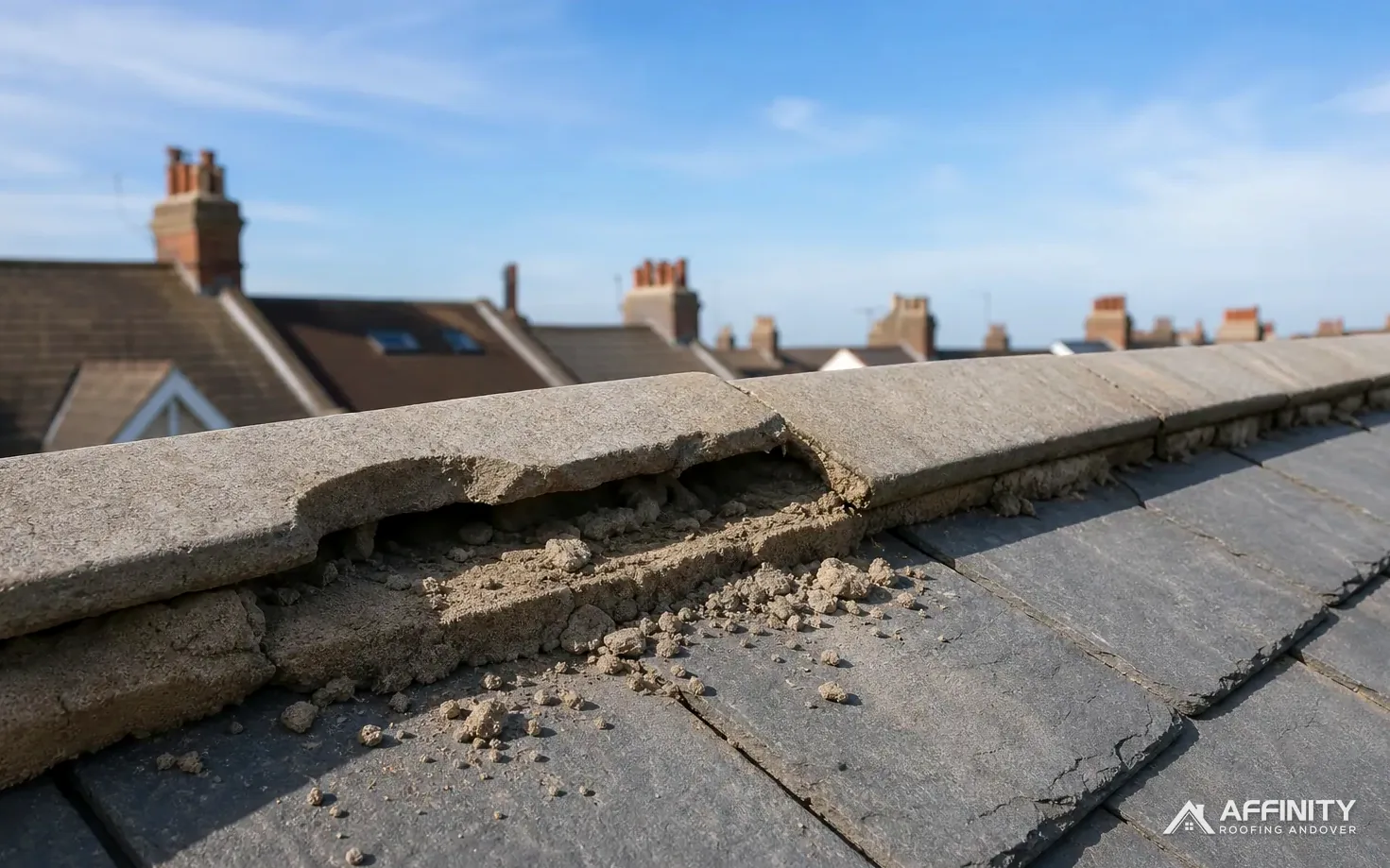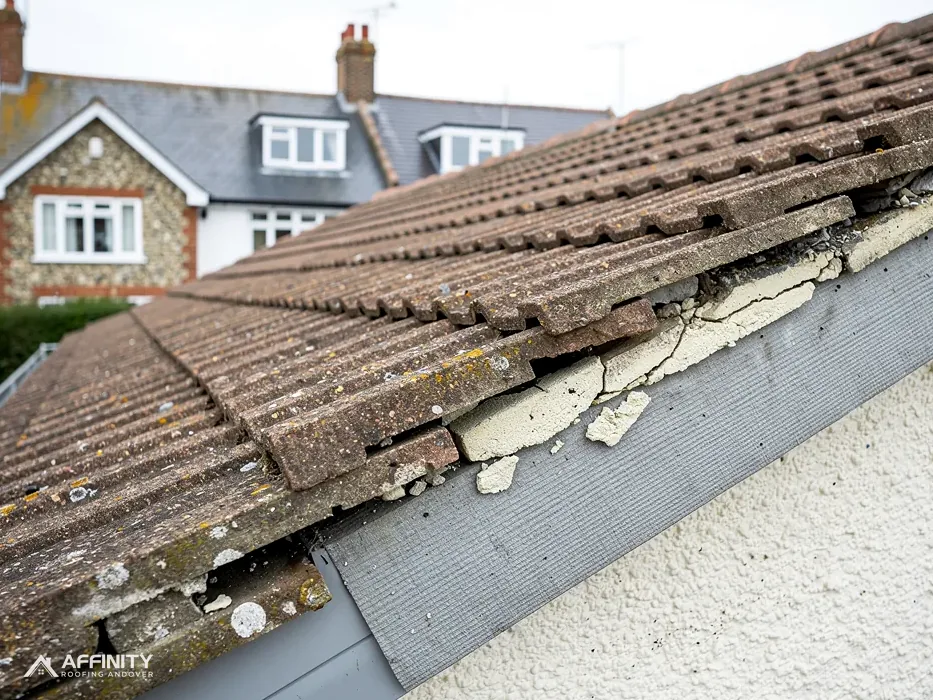
From the street, a ridge is a line. Up close, it is a row of specially shaped tiles that arch or fold over the join between two roof slopes. The shape you see was chosen when the roof was built, and it matters when something needs to be repaired or replaced, because a replacement has to sit on the tiles below and meet its neighbours at both ends.
The names used in builders' merchants and on quotes can be confusing: half-round, angled, third-round, hogsback, crested, bonnet. Some describe the cross-section of the tile, some its decoration and some its use on hips instead of ridges. The material also varies. Clay and concrete ridge tiles both exist, and each comes in colours and finishes meant to go with a particular roof tile.
This guide describes the common profiles, explains how to match one to an existing roof and covers how ridge tiles of any shape are held on. It belongs to our dry ridge and dry verge service pages and is written for owners who need to name what is on the roof.
Half-round: the familiar arch
A half-round ridge tile has a smooth, semicircular cross-section, like a length of pipe split down its middle. It is the shape that comes to mind when a ridge tile is mentioned, and it appears on a very wide range of houses, old and new, in clay and in concrete.
Why it is so widespread
The arch sheds water evenly to both slopes, the shape is simple to make in clay or concrete and it sits comfortably over most roof pitches. Because the underside is a smooth curve, the gap between tile and roof is filled by bedding or by a sealing roll in a dry system.
Variations
Half-round tiles come in different widths, set by the maker to suit its roof tiles. A tile that is too narrow leaves a gap that wind can exploit, and one that is too wide looks heavy. Some have a flat rim, a roll top or a collar at one end to overlap the next tile. In clay, the finish may be smooth, sandfaced or glazed, and the choice affects how the tile weathers.
Joints
Each tile overlaps or butts against the next, and the maker's laying guidance says which way the overlaps should run. The joint is where mortar cracks first, and in a dry system it is where a sleeve or a seal closes the gap. Our short answer on whether you can reuse existing ridge tiles explains why the old ones may be worth keeping.
Angled ridge: two flat faces
An angled ridge tile has two flat faces that meet along a crisp line at the top, like a tent. In section it is an inverted V. The faces are set at an angle chosen to suit the roof slopes it sits on.
Where it appears
It is common on concrete tile roofs, where the flat, regular look suits the flat, regular tiles, and on modern houses where the roofline is meant to look sharp. Angled tiles also come in clay for roofs that want the same crispness.
Angle and pitch
Because the faces are flat, the angle of the tile should suit the pitch of the roof. A tile with the wrong angle sits with a gap on one side, and the gap shows from the ground as a dark line. Makers produce angled ridges for several pitches, and the data sheet says which range each covers. We check the pitch on the survey and match it to the tile.
Ridge and hip
Angled tiles are often used on hips as well as ridges, though a hip needs a finish at its foot and may need a hip iron. The foot of a hip, and the small bracket that anchors it, is the detail covered by our page on dry hip fixing.
Appearance
An angled ridge gives a clean silhouette and makes the roof look tidy. It also casts a sharper shadow line under the tile edge, which is why a mismatched colour stands out more. Moss and lichen gather in the crease on shaded roofs, and a gentle clean in dry weather keeps the line crisp. Marley does not recommend jet washing, so a soft brush and patience do the work.
Third-round, hogsback, crested and bonnet tiles
Beyond the two common shapes, there are profiles chosen for style, for age of the house or for a particular job. They are worth recognising, because replacements are less often in stock.
Third-round
A third-round tile is a shallower arch than a half-round, covering a third of a full circle. It suits lower-pitched roofs and gives a lower, more restrained ridge line.
Hogsback
A hogsback ridge has a curved, gothic-style profile, rising to a gentle peak. It is more common on older and traditional houses, and in clay, and it has a distinctive silhouette that is part of the character of the building.
Crested and decorative
A crested ridge has an ornamental top: a row of cut shapes, pointed teeth or a scalloped edge. Victorian and Edwardian roofs often carry them. They are fragile at the crest, and matching a damaged length can mean looking in reclamation yards or having tiles made.
Bonnet and hip finishes
A bonnet tile is a hip tile with a rounded or stepped end that finishes the bottom of the hip. It sits at the eaves end of the hip and is a prime place for a hip iron.
Why rare shapes matter
Where a roof has a rare profile, the repair should be as careful as the tile is hard to find. Lifting, cleaning and re-bedding the originals is usually better than replacing a run with something that does not match.
Matching the ridge to the roof
A ridge that does not suit the tiles below looks wrong and can perform badly. Three things need to match: the material, the profile and the colour.
Material
Clay ridge tiles usually go with clay roof tiles, concrete with concrete. Mixed pairings are possible, though they weather at different rates and the join between them can look uneven. Natural slate roofs are often finished with clay or stone ridges, and lead or zinc is another traditional choice in some places. Our short answer on whether a dry ridge can go on a clay tile roof sets out how the kits relate to the material.
Profile
The ridge should sit well on the top course of the roof tiles. A tile of the wrong width or angle will leave gaps or rock on its seat. We check the profile against the roof and the maker's catalogue, and we hold the sample against the line before anything is ordered, since a few millimetres of width show as a gap from the ground.
Colour
Weathering changes colour. A new ridge laid on a twenty-year-old roof looks bright for a few seasons. If a long ridge is being replaced, we mix new and reclaimed tiles along the line to soften the change.
Listed and conservation roofs
Where a house is listed, the ridge profile is part of its character, and listed building consent may be needed to change it. In a conservation area, ask Test Valley Borough Council's planning team whether an Article 4 direction applies before the profile is altered.
How each type is held on
The shape of a ridge tile does not decide how it is fixed. The decision is between mortar with mechanical fixings and a dry system, and both can be used with most profiles.
Mortar plus fixings
Each tile sits in a mortar bed for sealing and looks, and is tied down with stainless steel fixings. This is the lighter repair on a ridge with sound tiles, and the best choice for crested or rare tiles that should stay as they are. Marley reads the 2014 revision of BS 5534 as meaning that mortar should not be the only fixing on a ridge or hip.
Dry systems
A dry ridge uses a batten, clips and screws, with a flexible roll under the tiles to seal the gap. Kits are designed for particular profiles, and BS 8612:2018 is the standard they are tested to. A kit for half-round tiles does not suit an angled tile, so the profile must be known before ordering, and the supplier's fitting sheet read before the work starts.
Special shapes in dry-fix
Crested and hogsback tiles can be fixed dry if the kit allows for their shape, though the options are narrower. Some owners keep the decorative tile and fix it with mortar and fixings instead.
The standard
BS 5534:2014+A2:2018 sets the fixing rules for slating and tiling, though Marley notes it is not required by law. Our guide to BS 5534 and ridge tiles explains it in plain English.
Naming what is on your roof
When you ask for a quote, it helps to know what you have. Here is how to describe it.
From the ground
Look at the end of the ridge, where a cap or end tile may show the cross-section. Is it round-topped, peaked or flat? Is it plain or decorated? Are the tiles clay or concrete, red, brown or grey? A photograph of the end of the ridge taken from the garden, with the gable edge in the picture, is often enough.
Clues in paperwork
If you have the original paperwork for the roof, or a survey from when you bought the house, the tile range may be named. The name of the roof tile often tells us which ridge belongs with it.
What the survey adds
On the visit we check the profile, the width and the angle, look for a maker's mark on the underside of a tile and compare against catalogues. If the profile is old or unusual, we explain what the options are, including reclaimed tiles.
Cost
For orientation, a new ridge tile is £80 to £300 before VAT on the Which? survey of Trusted Traders (Nov 2025), and MyJobQuote has ridge replacement at between £225 and £550 (Oct 2026). Both are typical UK ranges, and a rare profile can push a job either way.
Next step
Send a photograph of the ridge end and any gable edge, with a rough date for the house if you have one, and we will help you name the type before a visit.