Nobody wants to be told they need a new roof, and hearing it from a stranger on the doorstep is no reason to believe it. The better question is what the roof itself is saying. Roofs rarely fail overnight. They give warnings: a tile that slides, a stain on a ceiling, a line along the ridge that no longer looks straight.
One warning on its own usually calls for a repair. Several together, spread across the roof, point somewhere else. A single broken tile is bad luck. Twenty tiles slipping across three slopes tells you that the fixings, the battens or the underlay are giving up, and that patching each spot will not stop the next one.
This guide sets out the signs that suggest replacement, how to see them safely from the garden and from inside the loft, and how to weigh a run of repairs against a new roof. It is written to help you ask the right questions, and not to steer you into more work than the roof needs.
Never climb onto the roof to look. A survey does that safely, and the photographs let you see what the surveyor sees.
Slipped, cracked and missing tiles across the roof
Start with the pattern, not the count. Where the damage sits tells you more than how many pieces are affected.
A scatter versus a cluster
A few damaged tiles in one spot often have a local cause: a branch, a gull, a fall from a ladder. A scatter of slipped or cracked tiles across several slopes suggests something is wrong with the whole system under them.
What to look for from the ground
Stand back, with binoculars if you have them, and follow each row. Look for tiles sitting below the line of their neighbours, rows that wander, gaps where a tile has gone, and fragments in the gutter or on the lawn. On a slate roof, look for slates hanging out of line or a darker patch where one has slid.
Surface wear
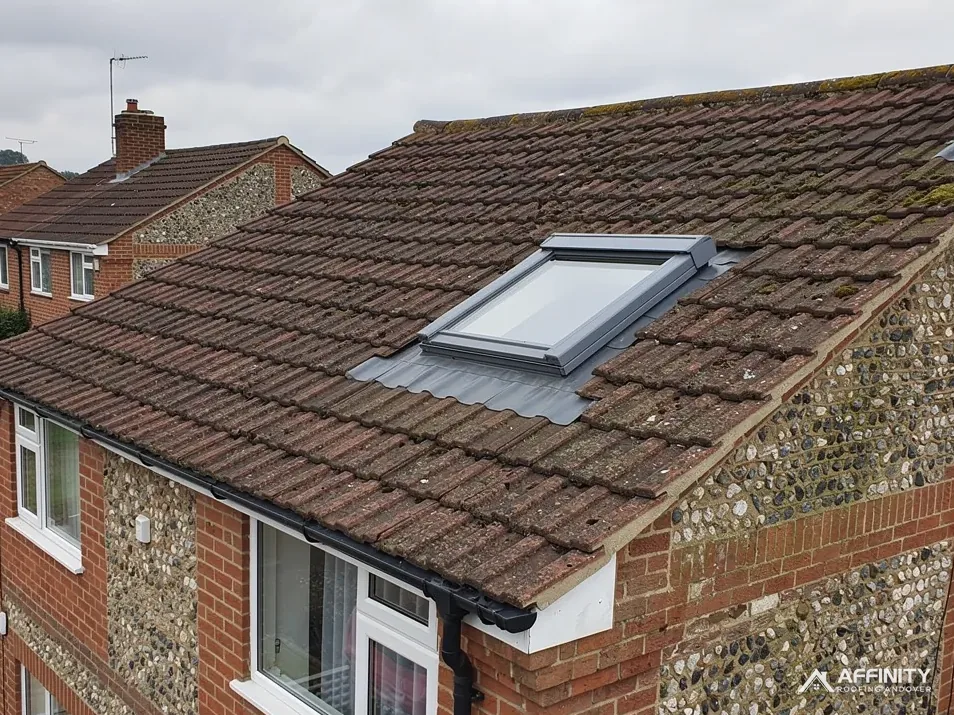
Concrete tiles lose their surface slowly and clay tiles can flake or spall, which means their faces break away. Heavy moss traps moisture and can lift the edges of tiles. These are signs of age, though moss alone is a cleaning matter, not a failure.
Why it matters
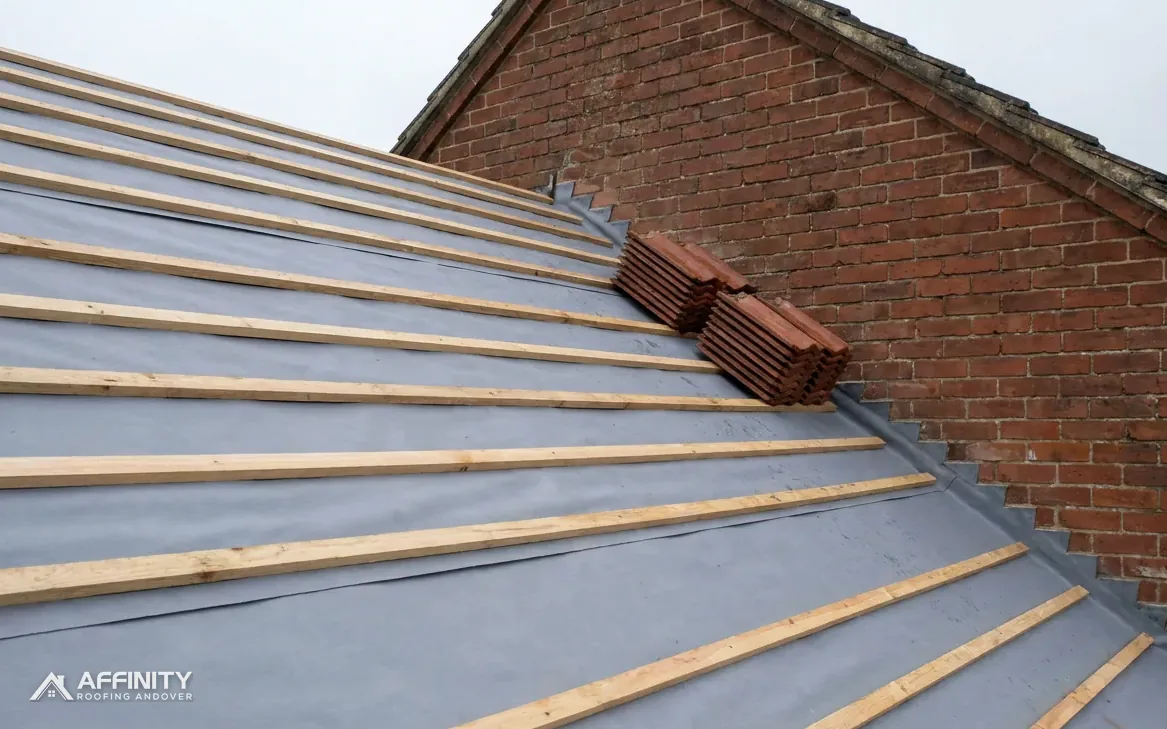
Every tile is held by a nail or clip into a batten, the strip of timber under the covering. When tiles slip across the roof, the fixings are letting go. Re-fixing each tile is possible but time-consuming, and if the battens are also tired the repair does not last.
If you see this pattern, a survey from the scaffold line and from inside the loft is the next step. It separates a roof with a bad corner from a roof at the end of its life.
Daylight, stains and a failed underlay
The underlay is the sheet beneath the battens that catches rain driven past the tiles. It is the roof's second line of defence, and it ages out of sight.
In the loft
Go up with a torch on a bright day, stepping only on boards or joists. Switch the torch off and look for pinpricks of daylight coming through. Light through the covering means gaps. Some light is normal at the ridge or along the gable edge, where gaps are part of the design, so do not read every glimmer as failure. What matters is light coming through the middle of a slope.
Stains and damp
Look for dark patches on the rafters or the back of the felt, wet or crumbling insulation, rusty nail tips and white salt marks. Water stains on the ceilings below, especially in the same place after each downpour, say that rain is getting through.
Brittle or torn underlay
Old felt hardens with age. It cracks at the laps, curls away from the battens and may hang in tatters. Once that has happened, nothing is catching the rain that gets past the tiles, and the timbers beneath begin to take the damp.
Why replacing it means stripping
The underlay lies beneath the battens, which lie beneath the tiles. Renewing it properly means taking the covering off, so a failed underlay across a whole slope is a roof-replacement problem, not a repair.
Our roof repairs page explains what can be fixed without stripping a slope, and where a repair stops being the sensible answer.
Nail sickness and tired battens
Nail sickness is a trade name for a quiet problem. Over decades the nails holding the covering rust, weaken or lose their grip in the timber, and tiles begin to drift.
How it shows
The classic sign is tiles slipping down the slope across several rows, without any obvious cause. You may find nails lying in the gutter or rust-coloured streaks on the lower edge of the tiles. In the loft, nail tips poking through the underside may be corroded.
The battens behind it
Battens can rot, split or have been cut too slim for the load. The first sign outside is often a wandering course or a dip. Inside, probe a batten with a screwdriver: soft or crumbling timber is a warning. Our guide to pitched roofing shows how the grid of timber is built up.
Why re-fixing falls short
A tile can be nailed again, but if the batten will not hold the nail, the repair slips within a season. Where a large part of the roof shows the same sign, the lasting answer is to strip, renew the battens and underlay, and relay sound tiles or lay new ones.
The age test
Published lifespans give a rough yardstick. HomeBuilding puts plain concrete tiles at 40 to 50 years and clay at 60 to 80, with natural slate lasting longer, depending on type (Sep 2025). These are typical ranges, not promises. An old roof at the upper end of them, showing sickness across several slopes, is a strong candidate for replacement.
A fresh covering on old battens is a false economy, and a good survey checks both. It is worth asking, when you read a quote, whether battens and underlay are renewed with the covering, or only the tiles.
Sagging, bowing and other structural signs
Structural signs deserve more attention than cosmetic ones. They suggest the frame carrying the roof is under strain, and a new covering will not cure that on its own.
What sagging looks like
Stand across the road and look along the ridge. It should be straight. A dip in the ridge, a belly in a slope or a wavy line at the eaves suggests the rafters or the purlins, the horizontal beams that support the middle of a slope, are moving. A chimney that seems to lean, or cracks where the roof meets a gable wall, can be related.
Inside the house
Look for ceiling cracks that follow the line of the roof, doors that stick on the top floor and gaps opening between walls and ceilings. These do not always come from the roof, and a surveyor tells the difference.
Causes
A covering heavier than the frame was designed for, long-running leaks that have rotted timbers, removed supports and past alterations can all cause movement. Some old repairs hide the problem rather than fixing it, such as a bolted-on timber that stiffens one rafter and shifts the load onto the next.
What to do
Do not guess. A sagging roof should be inspected by someone qualified to judge the frame. If a structural engineer or surveyor is needed, a good roofer will say so. Replacing the covering on a failing frame without dealing with the frame first is wasted money.
The decision to replace may include timber repairs or new rafters, and the written price reflects that once the survey has found it.
When patching stops making sense
Every repair has a cost, and the question is whether a run of them adds up to more than a replacement. A few published figures show the scale, though none of them is a price for your roof.
What repairs cost nationally
Which? puts a repair of up to six broken or missing standard tiles at £75 to £400, ex VAT (Nov 2025). MyJobQuote puts replacing five roof tiles at around £215 (06/10/26) and an average roof repair at around £650 in 2026. By comparison, full replacement costs run into thousands, as our new roof cost guide sets out.
The tipping point
The honest test has three parts. How often have you had repairs in recent years? Are the faults in different places, or all in one spot? And does the survey find the underlying causes, such as sick nails, tired battens or a failed underlay, across the whole roof? If the answers are often, different places and yes, the repairs are treading water.
Cost of repeating
Each repair visit needs safe access, and that cost comes round again with every visit. Repeated small jobs on a roof that is failing everywhere leave it no better, and the money goes without fixing the cause.
When a repair is the right answer
If the damage is local, the roof still has plenty of life and the survey finds the rest sound, repair is the better buy. The survey notes say so plainly, and the written price covers only what the roof needs.
The same test applies to replacing part of a roof, where one slope fails and the rest has years left.
Getting a survey that settles it
A proper survey turns suspicion into evidence. It also protects you from two kinds of bad advice: a quick patch on a roof that needs more, and a full replacement on a roof that needs less.
What the survey should include
A good survey looks at the covering on every slope, the ridge, hips, valleys and verges, the flashings, the gutters and the roofline. It also looks inside the loft at the underlay, battens, rafters and insulation. It measures the pitch, notes the age and the type of covering, and records access for scaffolding.
Photographs
You should receive photographs of what was found, labelled so you can tell where each was taken. They are the basis of the discussion and of the quote, and they help when you ask other firms to comment.
The written price
What follows the survey is one written total for the work the roof needs. Citizens Advice recommends collecting at least 3 written quotes, so keep the photographs to show the other firms.
If the roof is leaking now
Stop the water first with a temporary repair, then plan the longer-term work once the weather allows. Our guide to timing a replacement covers the calendar side.
Cold callers
Be wary of anyone who knocks to say your roof is in a bad way. Ask them to put it in writing, with photographs of your own roof, and take the time you need.
If the survey says you need a new roof, the roof replacement page explains the choices ahead.