The short answer
No single number holds for every house. The days follow the roof's area and complexity, the covering going on, the count of slopes, what the old roof hides, how the scaffold is set up and the weather. We set out a programme after the survey and tell you what happens each day, so the plan rests on your roof and not an average.
What moves the programme
Four factors start it. First comes the roof itself: its area, the number of slopes, and features such as dormers, hips, valleys and chimneys, each of which needs its own detailing. A plain gable and a roof with five junctions are not the same programme.
The second is the covering. Fixing small plain tiles, large interlocking concrete tiles and natural slate each follow their own pace, and a covering with special flashings or lead work adds time at the junctions.
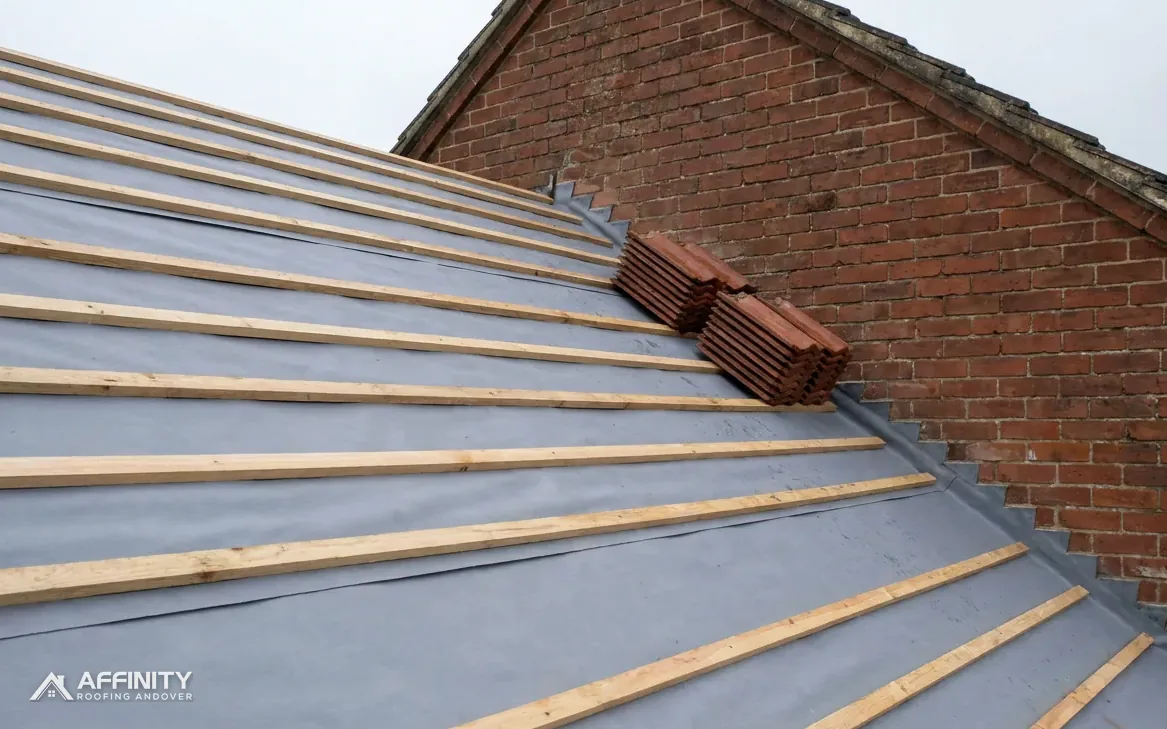
Third is what lies underneath. The old roof only shows its condition once it is stripped. Rafters, battens (the thin timber strips fixed across the rafters) and the underlay beneath them may be sound, or may need repair first, and that cannot be known with certainty from the ground.
Last is the weather. A roof is open to the sky while it is stripped, so work is paced around rain and wind. Whatever has been stripped is sheeted over before the crew leaves, and we would rather lose an afternoon than leave a slope open.
Scaffold up, scaffold down
Time on the roof is only part of the programme, because the scaffold goes up before the stripping starts and comes down after the last tile is bedded in. Those are separate visits by the scaffolder, and they sit either side of the roofers' days.
Scaffolding that takes up road or pavement space has to be licensed by the highway authority before it goes up. Hampshire County Council wants a gap of 10 clear working days from application to start, and says its applicants are the scaffolding companies acting for homeowners. West Berkshire Council wants no fewer than 10 working days. So a re-roof's start date can hinge on the licence as much as on the roofer.
Hampshire County Council also says it does not offer extensions, and it charges by two-week period, so an overrun on the highway is worth planning for. That is one reason a programme should be realistic from the start.
A scaffold wholly on your own land is a different case, with no licence involved. Where one is needed, we sort it out with the scaffolder.
A written programme in place of a guess
Quoting a firm figure from the pavement would be guesswork, and guesswork serves nobody when the first slope comes off and the battens turn out soft. A promise of speed can also push a crew to rush the details that keep a roof dry: the junctions, the flashings and the fixings.
What we offer instead is a plan. At the survey we photograph the roof and write the scope and covering into one total price. Before the job we tell you the order of work: when the scaffold goes up, which slope comes off first, when the roof is dried in and when the scaffolder returns. If the stripping finds something extra, we show you the pictures and agree the change in writing before it goes ahead.
Each day you get a short update on progress and the next step. Waste is taken away as the work proceeds, the site is left tidy each evening, and you are never left guessing why a day was lost.
The roof replacement process lays out the order in full, and our answer on rain during roof replacement covers what happens when the weather turns.
Planning your own side of it
A few things on your side keep the programme steady. Clear the loft of anything valuable or fragile, because stripping a roof sends dust and vibration through the space below. Park elsewhere and shift patio furniture clear of the walls where scaffold poles and skips are due. Tell your neighbours what is coming, since a scaffold can pass in front of their windows, and some may need to know about noise.
If anyone at home works from the house, or needs quiet during the day, tell us before the programme is set. We can usually order the work to suit, and the order of work is easier to plan with you than for you.
Do not choose a date by the calendar alone. The licence period, the lead time for materials and the weather all feed in. If a firm offers a start date before it has seen the roof, ask what it is based on.
Our guide on living in the house during a roof replacement goes through the day-to-day side, and the roof replacement page sets out what the whole job involves.