Few people want to move out for a roof job, and few need to. A re-roof happens outside the walls, in stages, and the rooms below stay in use unless something unexpected turns up. That said, you will hear it. Boots on the scaffold, tiles being stacked and the rattle of old battens coming off are not subtle, and the house will shake slightly when heavy things land.
The questions worth asking are practical ones. How loud will it be, and for how long? What happens to the dust that falls through the ceiling? Can I still reach the loft, or the cupboard under the stairs, while the job goes on? And what stops the rain from coming in at night, when the crew has gone home and half the roof is new?
There is also a legal side that homeowners rarely hear about: under the construction safety rules a private householder's duties usually pass to the roofer, which affects how a firm plans and records its work.
This guide answers those questions in order, then looks at the situations where moving out for a few days is the sensible choice.
What staying put really means day to day
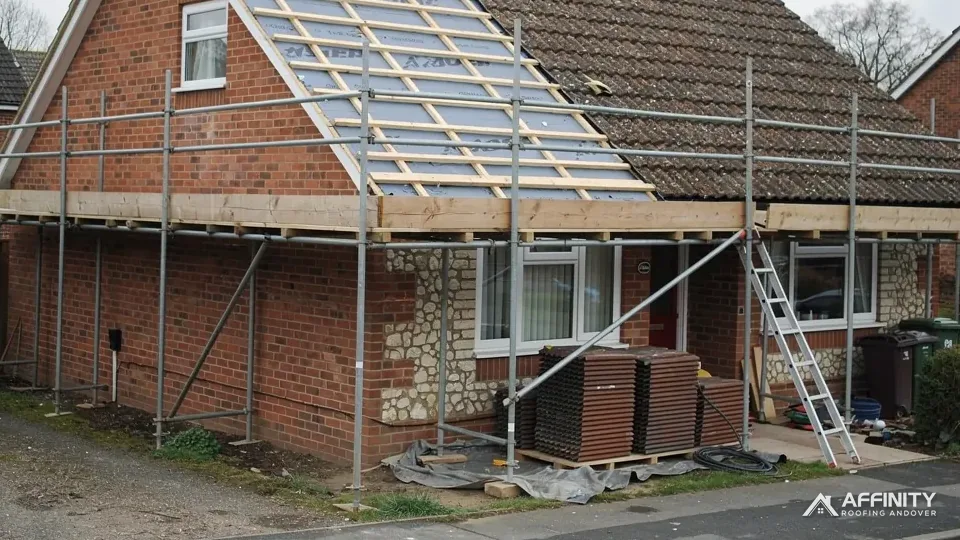
For a standard house with a pitched roof, a re-roof runs through a sequence. Scaffold goes up, the old covering is stripped slope by slope, the roof is dried in, and the new covering follows. You live under all of it, so it helps to know what each day will feel like.
The first day or two
The scaffold is the noisiest and most intrusive part, because lengths of tube and boards are carried round the house and clattered into place. After that, stripping is steady and loud, with an occasional crash as debris lands in a chute or skip. Expect the front of the house to be busiest, since that is where materials arrive and waste leaves.
The middle of the job
When new battens and underlay go on, the noise softens to hammering and nail guns. Tiles being lifted to the roof add a rhythmic background. Conversations in rooms under the work can be difficult, and telephone calls are worse.
The last stage
Ridge and hip work, lead flashings and the tidy-up are quieter, though cutting slate or tile with a saw is loud for a short time.
Plan around the loudest days. If you work from home, take a laptop to a library or a friend's house on stripping day. If you have a baby, a night-shift worker or a pet that is easily frightened, decide in advance where they will be. The firm should be able to tell you which days are the noisy ones, and the answer should come from the programme, not a guess. If the stripping day clashes with an exam, an appointment or a night shift, say so when the date is being chosen, because moving it by a few days costs nothing at that stage.
Dust, debris and the loft underneath
Every roof strip shakes loose dust, old mortar, insect remains and sometimes insulation fibres. Some of it finds its way into the rooms below, and the way the loft is handled decides how much.
Clearing the loft
Anything stored in the loft needs to be moved, wrapped or covered before work starts. Stored boxes, luggage and old furniture will otherwise collect a layer of grit. If you cannot clear it, say so at the survey and we agree what can be covered in place.
Ceilings and light fittings
Vibration can crack old plaster ceilings and loosen heavy light fittings. Take down pictures and mirrors on walls directly under the roof, and be aware that wardrobe tops and shelves can collect fine dust through ceiling joints.
Loft hatches and access
The hatch is sealed or covered during stripping so that dust does not drop through the opening. You will not have access to the loft while the roof is open, and you should not go up for anything unless the crew says it is safe.
If the house is old
HSE's advice is to assume asbestos could be present in any building that was put up, or last refurbished, before the year 2000. The soffits of some houses contain asbestos insulating board, which is the reason they are checked first, and sprayed or loose material in a loft is another thing to report. If the survey or the strip turns up something suspect, work in that area stops and the material is handled by the correct route.
Everything else is a matter of tidiness: dust sheets, chutes to the skip and a daily sweep. Windows on the sheltered side can stay open for air, but shut the ones nearest the work.
Keeping rain out once the crew leaves
This is the question that worries owners most, and it has a straightforward answer. A roof strip is planned so that no area is open when the crew leaves.
Working in sections
The roof is divided into areas that can be stripped, felted and battened in a working day or two, whatever the weather is doing. The crew opens only what it can protect, which keeps the amount of uncovered roof small. A hipped roof, which slopes on all four sides, is usually taken in four stages, and a plain gable roof in two.
The temporary skin
Once the old covering is off, a membrane goes down across the rafters, and in broken weather a tarpaulin goes over the top, weighted and tied so that wind cannot lift it. The new underlay and battens then form a watertight layer of their own, even before a single tile is laid.
The forecast
A sensible firm reads the forecast for the week and opens less roof when rain or wind is due. If conditions turn unexpectedly, the crew stops stripping and covers up first. On some days nothing is stripped at all.
Your part
Check the loft and the ceilings each evening, and tell the crew in the morning if anything looks different. A damp patch spotted on day one is easy to deal with. One found a week later is not.
For the full order of work, from survey to sign-off, see what happens during a roof replacement. For the weather side of timing, choosing a time of year covers it.
The scaffold, the drive and the front door
A scaffold changes how you use the outside of the house for as long as it stands, and a few small things are worth settling early.
Getting in and out
The scaffold normally runs close to walls, so side gates, back doors and some windows are blocked or narrowed. You can still reach the front door, but ask where the scaffold boards will sit and whether any exit is lost. Keep fire escape routes in mind if you have an upstairs bedroom with a window onto the scaffold.
Parking and skips
A skip or waste chute needs space close to the building. If the drive will be taken up, plan where the cars go. If the skip must stand on the road, ask who arranges permission, since the highway authority controls that.
Security and neighbours
Ladders are removed or boxed when work stops, and boards at the lower level are normally lifted so that the scaffold is not an easy way in. Tell your neighbours in advance: they will hear it too, and the scaffold may touch their boundary. Dates posted through their letterbox are usually appreciated and head off complaints later.
The licence
Where scaffold blocks the pavement or road, s169 of the Highways Act 1980 calls for a licence. For Hampshire addresses the licensing body is Hampshire County Council, and its own page makes the scaffolder the applicant, with 10 clear working days needed ahead of the start. A scaffold inside your boundary is outside the rule. Ask any firm who applies and whether the fee is in the price.
Finally, give the crew a place to put kit overnight, and tell them where the outside tap and a socket are, if you are happy for them to be used.
Who holds the safety duties on a home job
Roofing counts as construction work, so the 2015 CDM Regulations (Construction, Design and Management) apply to it. Homeowners tend to assume this is a big-site matter. It is not, but the rules treat a private householder very differently from a commercial client.
What the rules say about you
In HSE's terms, a domestic client is a private person who commissions construction work on their own home or a relative's, and not as part of a business. Regulation 7(1) then hands the householder's duties across to the contractor. In practice that means the person who runs the job takes on the planning and the safety responsibility, not you.
What the contractor must do
Once a project has several contractors, regulation 5 adds two further appointments, for design and for site management. A job with one contractor, such as a single roofing firm, is covered by regulation 15(5): that contractor prepares a construction phase plan. That plan covers how the work is organised, how the site is kept safe, and what protection applies for occupants.
What it means for staying put
If you are in the house, the plan should deal with you. That includes where people may walk, how the garden and entrance are kept safe, and what the crew does about children, pets and visitors. You may ask to see it.
If a second trade turns up, say an electrician for an extractor or a carpenter for the loft, the project can pass the threshold at which more duties arise. A firm that has thought ahead will tell you before that happens, and will explain who is in charge on site each day.
When it makes sense to stay elsewhere
Staying put is the rule, with a few honest exceptions. Think about leaving for a night or two, or just for the loudest days, if any of these applies to your household.
- Someone in the house is very ill, recovering from surgery, or sensitive to noise and dust
- There is a newborn or a very young child whose sleep matters
- You work from home in a role that needs quiet or video calls
- The loft contains something that cannot be moved or covered
- The survey finds something that must be dealt with carefully, such as suspect asbestos in the soffits or a bat roost
If you do move out
A friend's spare room or a short stay nearby for the stripping days is usually enough. Tell the firm where you can be reached, agree how the crew will get in on the days you are away, and leave a key arrangement so the crew can reach the loft hatch and the main water stopcock.
If you stay
A few preparations make the days easier: clear the loft, take down fragile things from walls, plan the quiet places in the house and agree a daily check-in with the person running the job. A good firm tells you each evening how far the work got and what is planned for tomorrow.
If you are still weighing whether the roof needs doing at all, see our guide to the signs you need a new roof. Our roof replacement page explains the choices before the work begins.