Roofs fail in a limited number of ways, and the same few turn up again and again. A tile slips, a ridge opens, a valley silts up, a flashing lifts, a chimney lets water in, a flat covering splits or a gutter overflows. Each fault has its own cause, its own tell-tale signs and its own repair, and knowing which one you have makes a phone call to a roofer far more useful.
The names can mislead. Trades use words such as nail sickness, flaunching and soakers that can mean little to an owner, and a quote that uses them without explanation is hard to judge. We explain each term the first time it appears and describe the fault in terms of what you can see from the ground or the loft.
This guide takes the common faults in turn: what causes them, how they show, what a repair involves and what national cost guides give as typical UK ranges. For each, it says which of our service hubs covers the work, so you can read further. Prices are third-party figures for scale and are not ours. Your own price follows a survey and arrives as one written total, with photographs of what we found.
Slipped tiles and nail sickness
The first fault here is a tile or slate that has moved. It may sit lower than its neighbours, lie on the ground or leave an open gap.
Why tiles slip
Each tile hangs from a moulded nib that hooks over a timber batten, and often a nail or clip holds it as well. When a nail rusts through or a nib snaps, the tile slides until something stops it. The trade calls the rusting of fixings nail sickness, and it is most noticed on older slate and tile roofs where the original nails have corroded over many decades.
What shows
Look for a tile out of line, a ragged edge to a course, pieces in the gutter and, in the loft, pinpricks of daylight. Binoculars from the lawn will show most of it, and a photograph taken in raking evening light shows more still. Once one tile goes, the ones around it carry extra load and may follow, which is why a repair that seems trivial is better done soon than left for the next gale.
The repair
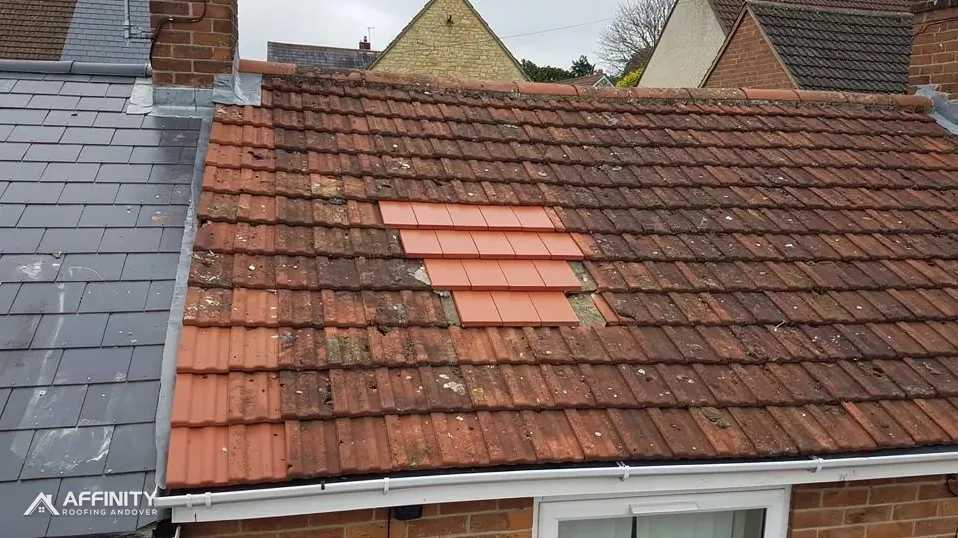
A lone tile is swapped for a matching one, or a sound one taken from a hidden slope, and fixed with a corrosion-resistant nail or clip. Where many fixings have failed, a section of the slope is stripped, the battens checked and the tiles refixed. For a few tiles, Which? gives £75 to £400 before VAT (Nov 2025), while MyJobQuote averages around £215 for about five (Oct 2026).
Where it sits in our service
Pitched roofs are covered on our pitched roofing hub, and the stop-gap advice is in our answer on a slipped roof tile. Slate has its own hub, slate roofing, because slates are fixed and replaced differently.
Ridge and hip tiles
The ridge crowns the roof where two slopes meet, and hips run down its outside corners. Specially shaped capping tiles cover both.
Why they fail
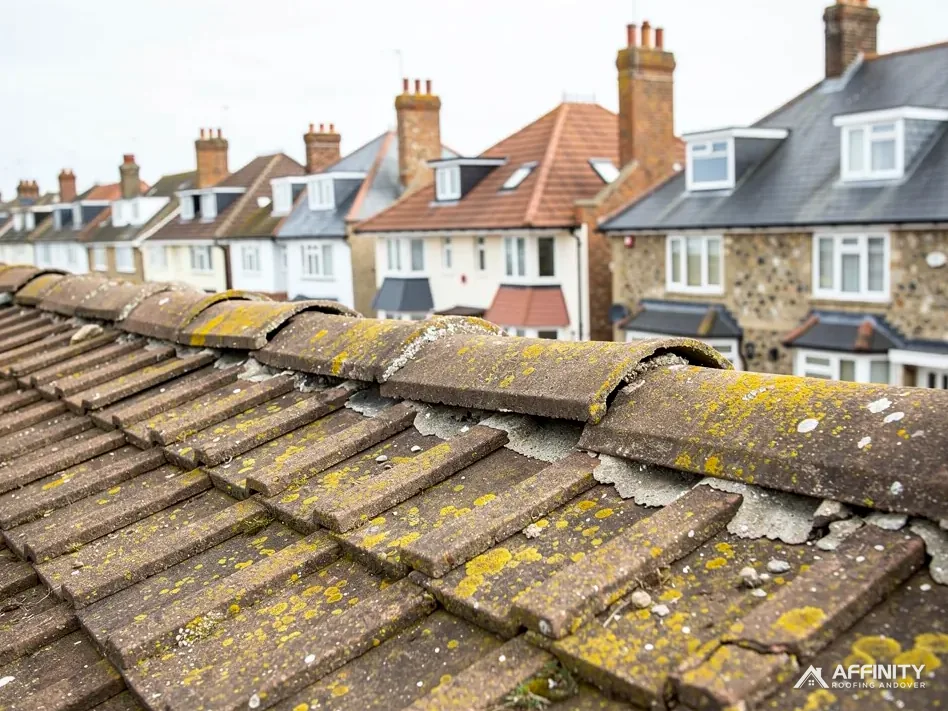
Traditional ridge tiles are bedded in mortar, which cracks and crumbles with weather and movement. Once the bed opens, a tile can shift, rain and wind get into the roof space and pieces drop. Birds and moss often get there first and make it worse, pulling at the bedding and holding water against it.
What the standards say
BS 5534 sets out good practice for slating and tiling, and it is not law. Marley notes that its 2014 revision stopped treating mortar as sufficient by itself for capping. Dry-fix systems, which hold the capping down mechanically, are tested to BS 8612. A like-for-like mortar repair is not banned, though it is no longer relied on alone.
The repair
Loose pieces are lifted, the old bedding cleared and the capping refixed, whether by mortar with mechanical fixings or by a dry-fix system. A single new ridge tile runs £80 to £300 before VAT in the Which? guide (Nov 2025). MyJobQuote's ridge band is £225 to £550 and its dry verge band usually £500 to £2,000 (Oct 2026).
Where it sits in our service
Ridge, hip and verge work sits on the dry ridge and verge hub, along with the verge, which is the sloping edge of the roof where it ends at a gable wall.
Valleys and flashings
These are the joints of a roof, and they leak more often than the flat areas of tile.
Valleys
A valley is the inward-angled channel between two slopes, lined with lead or another metal or built from special tiles. Nowhere else on the roof takes such a concentrated flow. Leaves and moss silt it up, the lining splits along folds and water backs up under the tiles. MyJobQuote gives around £540 for most full roof valley replacements (Sep 2026).
Flashings and soakers
A flashing is a metal strip, usually lead, that seals the roof against a chimney, wall or dormer. Soakers are small pieces of metal that tuck under each tile course along such a joint. Edges lift, sealant dries out and the metal can crack at folds. MyJobQuote puts lead flashing's life at over 80 years, a minimum and no promise, so early failure usually points to the fixing or the support.
Lead sheet weights
Lead is sold in codes. Royston Lead's brochure lists code 4, at 1.80 mm, for soakers and flashings as well as pitched valley gutters, and the heavier codes 5 to 8 for parapets, tapered valleys and larger gutters. The code, and how the lead is supported, matter as much as the metal.
The repair
A small split can be patched. A failed length is replaced, with new lead properly dressed and supported. Full chimney leadwork runs between £350 and £920 in MyJobQuote's guide (Sep 2026), depending heavily on scaffold.
Where it sits in our service
See our lead roofing hub for leadwork in detail.
Why chimneys leak
A chimney is a common source of leaks because it combines several junctions in one place.
Where the water gets in
Water gets in at the flashings round the base, through cracked or absent flaunching (the mortar fillet that holds the pot and seals the top), through open brick joints or down a pot with no cap. Indoors it shows as a stain on the chimney breast or the ceiling nearby, and it is sometimes mistaken for condensation.
What the repair involves
The roofer inspects each junction from a tower or scaffold, because the stack cannot be assessed from the ground. Flashings are re-dressed or replaced, flaunching is renewed and loose pots re-bedded. Where brickwork is failing, repointing or a partial rebuild may be needed, and national cost guides disagree on repointing, so the price follows an inspection.
What a stack tells you
A leaning stack or crumbling mortar is more than a leak risk, since pieces can fall. We treat it as urgent.
Costs and access
Chimney work is often led by access. On a high gable the scaffold can rival the lead or mortar in cost, and a scaffold over the pavement needs the highway authority's licence under the Highways Act 1980.
Where it sits in our service
The chimney repairs hub covers stacks, pots, flaunching and the rest.
Flat-roof splits, blisters and ponding
Flat roofs fail differently from pitched ones. They have no tiles to slip, but they have a membrane that can split, blister or sag.
Why they fail
Felt, EPDM and GRP are the usual coverings. Felt can crack and blister with age. EPDM, a synthetic rubber sheet, can lose adhesion at joints. GRP, glass-reinforced plastic, can crack at movement lines. Water that lies on the roof, known as ponding, hastens each of those, and a roof that ponds is telling you its falls are wrong. Our guide to flat roof ponding looks at the cause. BS 6229:2025, the current code for flat roofs with flexible waterproof coverings, keeps a minimum finished fall of 1:80, and IKO says the design fall should be 1:40.
Typical lives
The sources differ, so we name both. HomeBuilding gives felt 10 to 15 years and Less gives 10 to 20. HomeBuilding gives EPDM 25 to 30 years while Less gives 30 to 50, and GRP is 25 to 30 against 25 to 40. They are typical ranges, not promises.
The repair
A local split can be patched or welded, a blister cut out and sealed, or a small area re-covered. If the whole membrane is tired, a re-cover is the lasting answer. For comparison, Which? gives £1,400 to £3,500 before VAT to cover a 6 m by 3 m garage in new felt (Nov 2025), which shows what a full re-cover can cost against a repair.
Where it sits in our service
See our flat roofing hub for coverings, falls and repairs.
Gutters, fascias and choosing the right route
The roofline is where the roof meets the rain-disposal system, and many apparent roof leaks start there.
Gutters
Blocked, sagging or leaking gutters send water behind the fascia board and into the wall or eaves. Cleaning is cheap: Which? gives £75 to £350, ex VAT (Nov 2025). Replacement is larger, with MyJobQuote at around £1,000 to £1,600 (Oct 2026). Gutters need a slight fall toward the downpipe, and Brett Martin gives 1mm for every 600mm of run, which is too small to see by eye and easy to lose when brackets sag.
Fascias and soffits
Along the eaves, the fascia board carries the gutter and the soffit panel closes the underside of the overhang. Rot, flaking paint and stains show water getting in. Older soffits can be asbestos insulating board, so test before anyone cuts or drills. The guttering, soffits and fascias hub covers this.
Roof windows
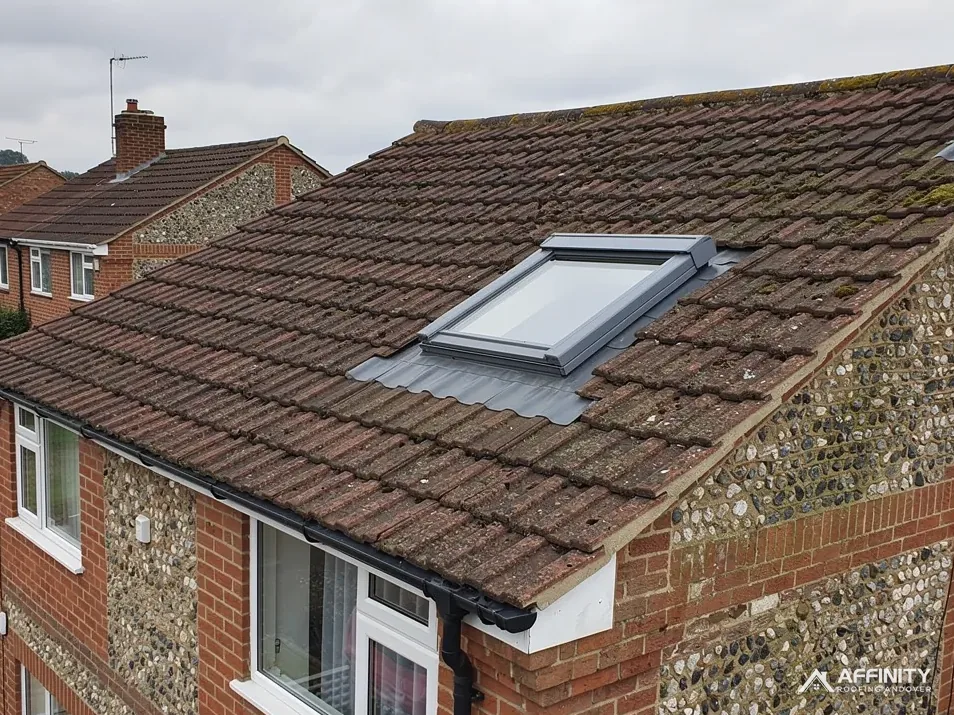
Leaks round roof windows usually come from failed seals or flashings, and they have their own hub, skylights.
Choosing the route
If you know the fault, go to its hub. If you do not, start with a survey: the roofer traces the cause and tells you which applies, with photographs of each place they looked. Our guide on what a roof repair costs gives the wider cost picture, and the roof repairs hub brings the service together.
When repairs add up
Where faults keep appearing on an ageing roof, ask whether a larger job would be better value, and ask to see the evidence for the answer. Our roof replacement hub explains that route.