The short answer
Because a downpour tests weak spots that light rain never reaches. When water arrives faster than a roof can shed it, it backs up behind laps, climbs under flashing, spills over a choked valley or overflows a gutter. A roof that leaks only in a deluge often has one small fault that is easy to miss on a dry day, worth tracing before the next storm.
Water arriving faster than it can leave
A pitched roof is a drainage surface. Every tile or slate sheds water onto the one below, and the whole slope delivers it to the gutter. In light rain the flow is thin and the overlaps keep it moving. In a deluge the film thickens and speeds up, and any hesitation along the route becomes a pool.
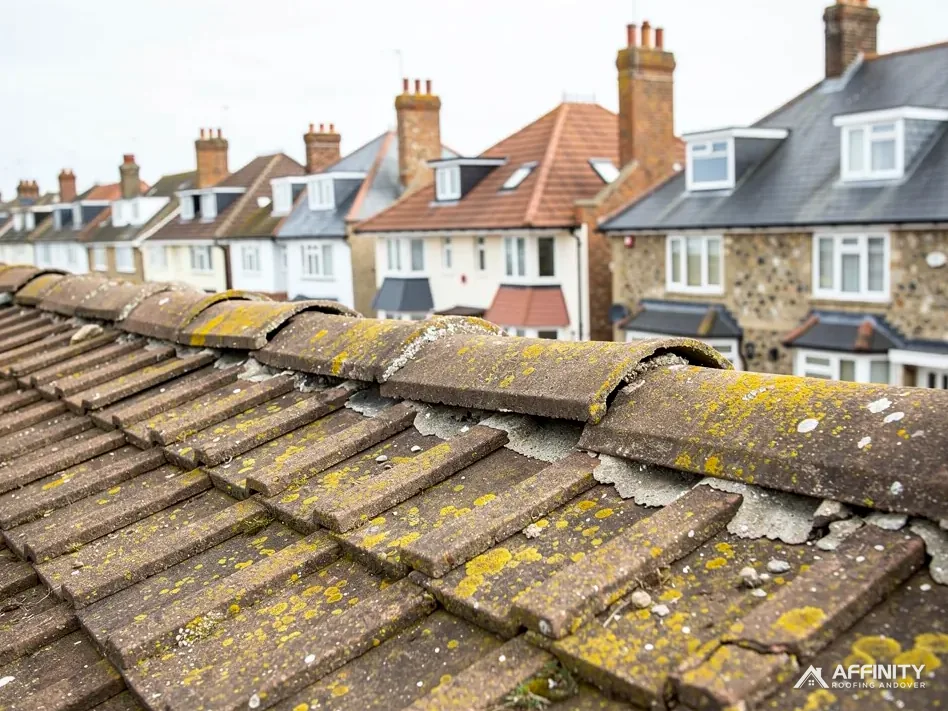
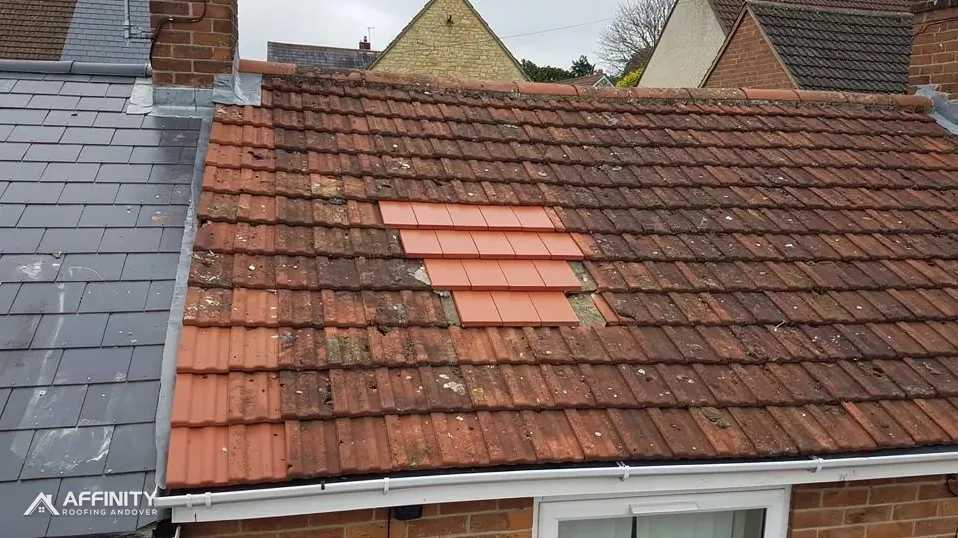
Hesitation happens at obstructions. A moss clump holds a puddle against a lap. A cracked tile gives the stream a shortcut. A debris-choked valley, the internal angle where two slopes meet, sends the flow over its edges instead of down the channel. Each of these is harmless in a drizzle and plainly visible to a loft torch afterwards.
The stain can also mislead. Water that enters at one point often travels along a rafter or the underlay before it drips, so the mark on the ceiling may sit well away from the hole in the roof. That is why a long, careful look beats a quick patch.
Gusty weather adds its own variations, covered in our answer on roof leaks in strong wind.
Low pitch and the limits of a covering
Every covering has a minimum pitch, the shallowest slope it is designed to shed water from. Marley lists 35 degrees for its plain concrete tile, 22.5 degrees for its smooth Double Roman and 15 degrees for its pantile in clay. For natural slate, BS 5534 gives a minimum of 20 degrees. Below those figures, rain has little gravity to carry it off, and a hard downpour can be pushed up and over the laps.
Roofs end up under-pitched in several ways. A porch, an add-on at the back or a rear extension may have been built flatter than the main house. An old covering may have been swapped for a different tile with a higher minimum. Or the roof may simply be a flat one with a fall too shallow to clear a heavy burst.
Always check the product data sheet for the covering actually on the roof, because the figures vary between ranges. A shallow slope with the wrong covering is a design fault, and mending individual tiles will not cure it. The answer may be a different covering or an underlay upgrade, which we discuss with the evidence in hand.
Valleys, gutters and the lead that lines them
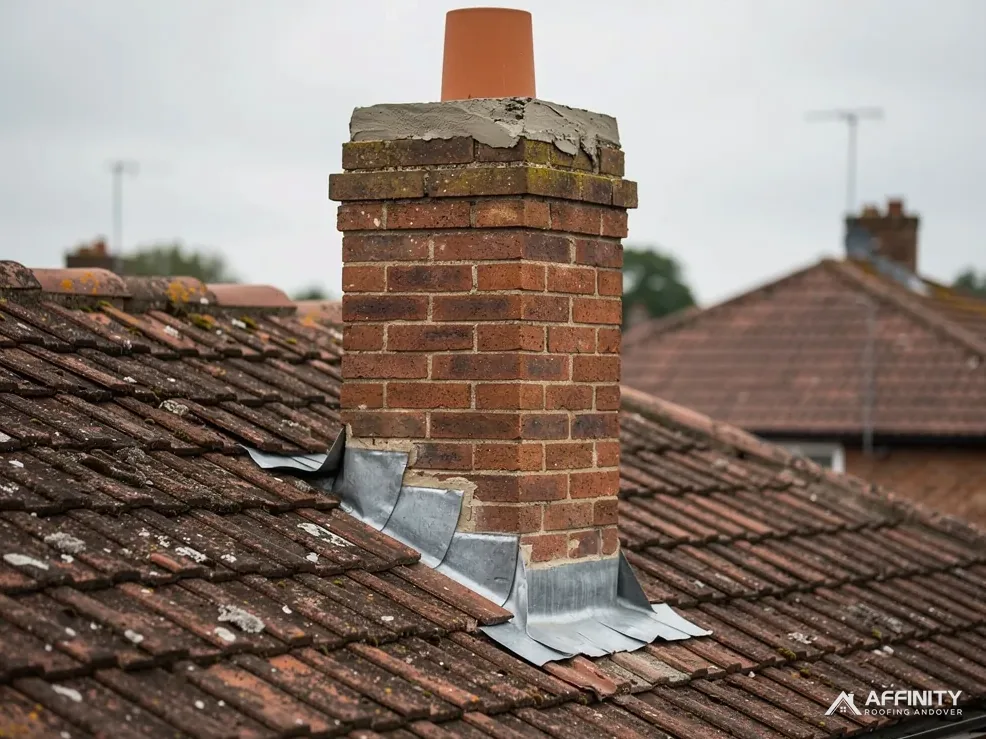
Valleys carry the water of two whole slopes in one channel, so they are the first place a hard shower finds trouble. Many are lined with lead. The Royston Lead brochure lists codes 4 to 8 for pitched valley gutters, with heavier codes standing up better to movement and wear. A lining that has split, lifted or been dressed too shallow lets the surge slip behind its edge.
Gutters matter just as much. Brett Martin gives 1mm of fall for every 600mm of run, which is gentle enough that a sagging bracket or a pile of leaves holds water back. When a gutter fills, the overflow runs down the wall or soaks the fascia and the eaves timbers, and the stain appears inside as if the roof itself leaked.
Clearing debris, resetting a bracket or relaying a section of lead is usually a modest job, provided the timbers beneath are sound. We show you what we find with photographs, so you can see whether the fault is the valley, the gutter or the covering above.
For the wider picture of how leaks are tracked down, see finding a roof leak.
What to note, and when to ring us
Watch the next storm from indoors, not the roof. Note how long it rained before the first drip, which room it appeared in and whether it stopped when the rain eased. A drip that starts quickly suggests an opening near the surface. One that arrives after a long soak points to saturated material, such as old underlay or a soaked batten.
Keep a bowl under the drip and a towel on the floor, and photograph the stain once it has dried so we can see its edge. In the loft, a torch beam sometimes picks out damp timber or a dark trail on the underlay. Please look from the hatch only, and step on the joists, never on the boards between them.
If the same patch has stained more than once, do not wait for the next heavy fall to confirm it. A dry-day survey is more informative than a wet-day panic, and the repair is usually smaller when caught early. Our leak or condensation guide helps you rule out the other common cause, and the range of work is on the roof repairs page.