The short answer
Because wind changes where the rain goes. A gale throws water sideways and up the slope, under overlaps that cope with rain falling straight down. It can also lift a loose tile, a gable edge or a strip of flashing for a moment and let water in. A leak that shows only in wind usually points to a fixing or a junction, not to the whole covering.
Rain that arrives sideways
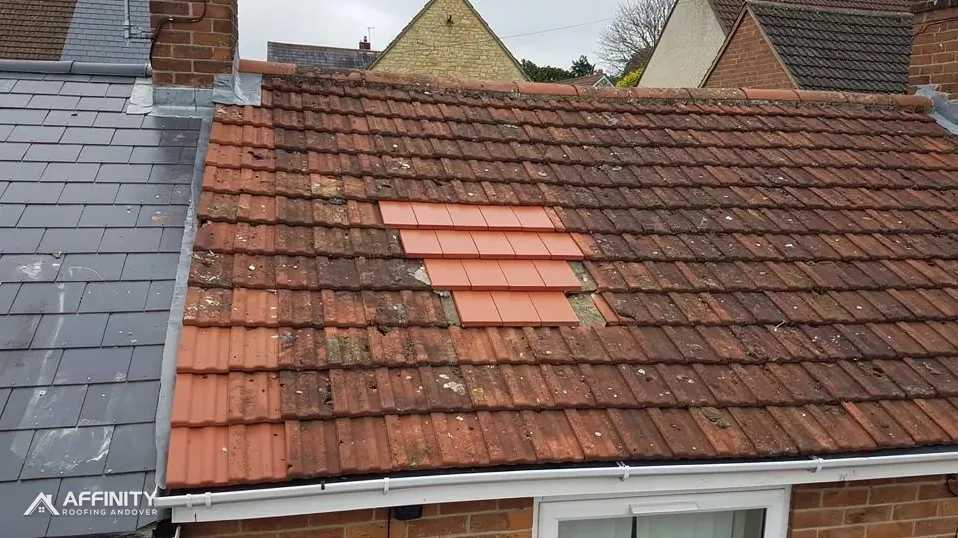
Tiles and slates are laid in courses, each row overlapping the joint beneath it. Rain falling from above runs down the face and off the bottom edge, so the overlap does its job. Wind-driven rain is another matter. It strikes the slope at an angle, and a strong gust can push drops up a tile's face and under the lap, the zone where one row covers the next.
Under the tiles runs the underlay, a sheet laid to stop whatever gets through the laps. On a sound roof it guides that moisture down to the gutter, and you never see it. Where the underlay is torn, perished or badly lapped, a gust can force droplets onward to the loft insulation and the ceiling below.
This is why a gale-only leak often turns up in a room that stays dry all year. The route into the roof has always been there. Ordinary weather simply never pushed water along it.
The same logic applies when the trigger is volume rather than wind, and our answer on leaks that appear only in heavy rain follows that thread.
Lifted tiles, gable edges and ridges
Wind also pulls. Air streaming over a roof creates suction along the edges and on the sheltered slope, and that suction tugs at anything not firmly held down.
The edges are the weakest places. The verge is where the tiles end against a gable wall, and the ridge is the line along the very top, where the slopes join. Both were once bedded in mortar and little else. Marley says the 2014 revision of BS 5534 ended the idea that bedding mortar alone can secure ridge and hip tiles, because mortar cracks with age and a gust finishes it off.
Dry-fix systems tested to BS 8612 hold those edges with clips and fixings instead. BS 5534 guides good practice without binding anyone by law, and a careful roofer follows it regardless.
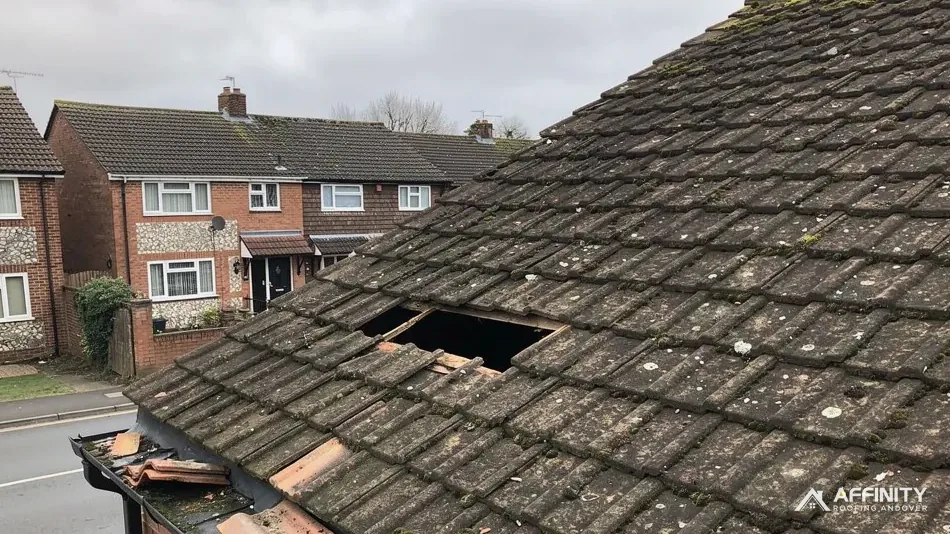
Further down the slope, a tile whose nails have rusted away may sit still on a calm day and lift when the wind gets underneath. Our page on a slipped roof tile explains how that happens, why a single one matters, and what the fix involves.
Flashing and the other joints
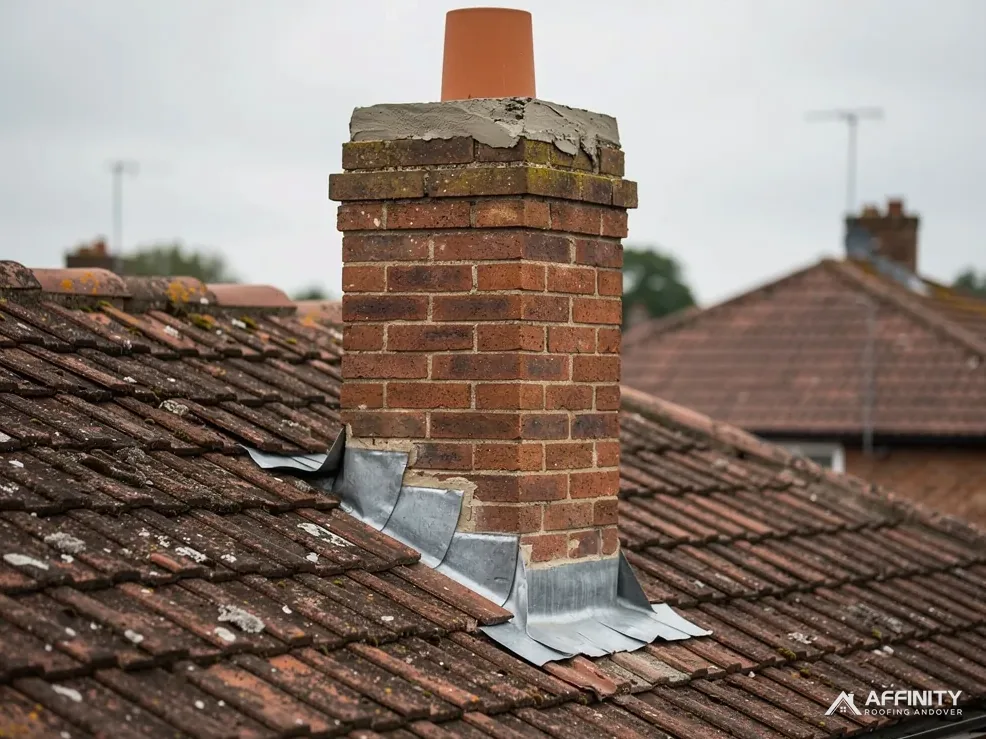
Flashing is sheet metal, usually lead, dressed over the meeting point between a slope and a chimney stack, a side wall or a dormer cheek. Its top edge is tucked into a slot raked out of the brickwork, and that slot is then filled with mortar or sealant. When the filling fails, a narrow slot remains. It stays shut in calm weather and opens just enough in a gust for rain to be blown in.
The Royston Lead brochure lists code 4 and code 5 among the thicknesses used for flashings, and keeps code 3 for soakers, the small folded pieces that sit between tiles and a wall. A thin or lifted strip suffers first. Wind also works at the lower edge, bending it back a little further each time and widening the gap.
These joints sit high and are tricky to inspect from the garden, so a wind-only leak around a chimney or side wall is easily mistaken for a general fault. We examine each joint with the slope in front of us and show you what we find in photographs, instead of guessing from the stain on your ceiling.
What to do during the gale itself
Stay off the roof. Wind makes a wet slope far more dangerous, and what you can spot from a ladder is rarely the full picture. Keep people away from the ground beneath any loose tile or flapping metal, too.
Indoors, put a bowl below the drip and shift furniture out of the way. Make a note of the room, the wall and roughly when the water began, because that pattern helps the diagnosis. A snapshot of the ceiling stain, plus one of any tile that has landed in the garden or on the drive, gives us something to work from at the start.
If you can see a tile missing or lifted from the ground, tell us. A temporary cover may be the right first step, and our guide to a temporary roof repair explains what it does and does not achieve. Pinning down the exact entry point is a job of its own.
Everything we do on leaking roofs is gathered on our roof repairs page, and the survey that starts any job is the same each time.