Ask three roofers for the type of tile on a house and you may hear three different kinds of answer. One names a material, clay or concrete. Another names a shape, plain or pantile. A third gives a brand. They are all describing the same thing from different angles, which is why tile talk confuses people who only want to know what is on the roof.
It helps to hold two questions apart. What is the tile made of? And how does it lie on the roof? Material affects colour, weight, weathering and lifespan. Shape affects how the tile overlaps its neighbours, how steep the roof must be and how the whole roof reads from the pavement. The two combine in the products you see on houses, so there are clay plain tiles, concrete plain tiles, clay pantiles and concrete interlocking tiles, among others.
This guide sorts the main types into a short, practical list, with the published minimum pitches where a maker supplies them, the typical lifespan ranges, and a way of choosing that starts with the house rather than the brochure. Everything here is aimed at a homeowner choosing, repairing or simply trying to name what is on their own roof, and it points to the longer guides when a type deserves more space.
Clay and concrete: the two materials
Almost every roof tile is one or the other, and the choice drives much of how the roof looks and ages.
Clay
Clay tiles are shaped from fired clay. Their colour is part of the material, so it does not fade, and it deepens with age as lichen settles. Handmade clay varies from tile to tile, which gives older roofs their mottled richness. HomeBuilding gives clay tiles 60 to 80 years (Sep 2025), and Marley, quoting the BRE, reports a minimum life expectancy of 60 years for clay. These are typical ranges, not warranties.
Concrete
Concrete tiles are made from sand, cement and colouring, pressed to shape. They are produced in great numbers, are consistent in size and suit modern construction. Marley expects its roof tiles to last for about 60 years, though it says that is not a guarantee, and HomeBuilding gives plain concrete and Double Roman 40 to 50 years. The sources differ, which is why both are named.
Fibre cement
A third, less common material is fibre cement, a thin composite sold as slate-look or tile-look sheets, often chosen where weight or budget rules out natural slate. HomeBuilding gives fibre cement (Eternit-type) tiles 30 to 40 years.
Comparing
Handmade tiles of either material show more variation than machine-made ones, and that variation matters when a repair has to blend. Clay costs more to buy and lays more slowly in plain tile form, and it keeps its colour. Concrete is quicker to lay and costs less, and its colour can wear. Our guide to concrete versus clay roof tiles sets the two side by side.
Plain tiles and the double-lap roof
Plain tiles are the small, rectangular, slightly curved tiles that give many older roofs their fine grain.
How they lie
They are laid in overlapping rows, double-lap, so every spot on the slope has two layers of tile above the underlay. They hang from timber battens by small lugs called nibs, with nails in some rows. The roof needs a lot of tiles, and the labour adds up.
Pitch
Because the tile is small and flat, it wants a steep roof. Marley gives its clay Canterbury a minimum of 40°, Ashdowne 35°, Hawkins 30° and Acme Single Camber 30°, and its concrete Plain tile 35°. The sheet for the specific tile always governs.
Where you see them
They suit steep roofs on period houses, village cottages, outbuildings and cottages, and anywhere the owner wants a close-grained look. They are the standard answer on conservation-area repairs where the original is plain clay.
Peg tiles
An older variant, the peg tile, hangs from the batten on wooden pegs through holes in the tile, not on nibs. It is found on historic roofs and needs particular care when repaired. Our guide to clay plain tile roofs explains how the roofs are laid, lapped and matched.
Maintenance
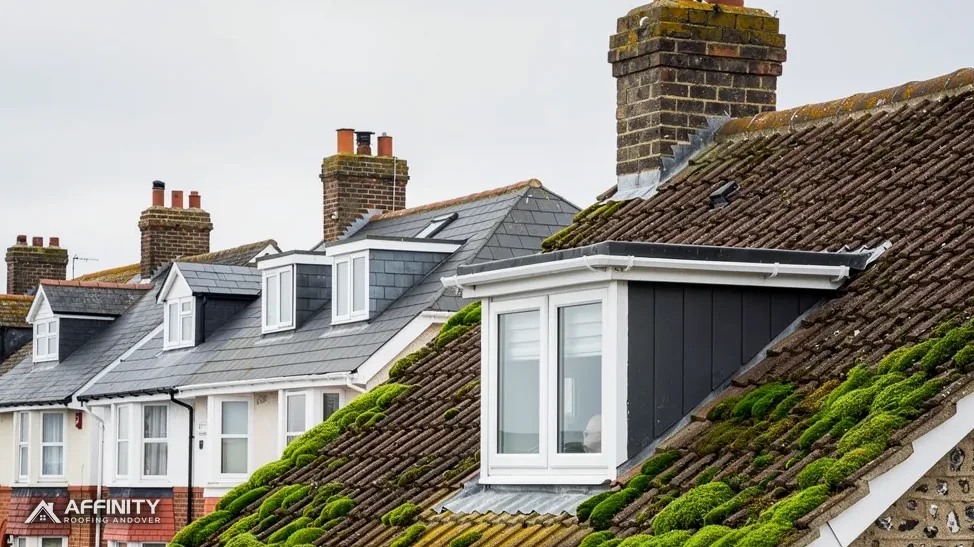
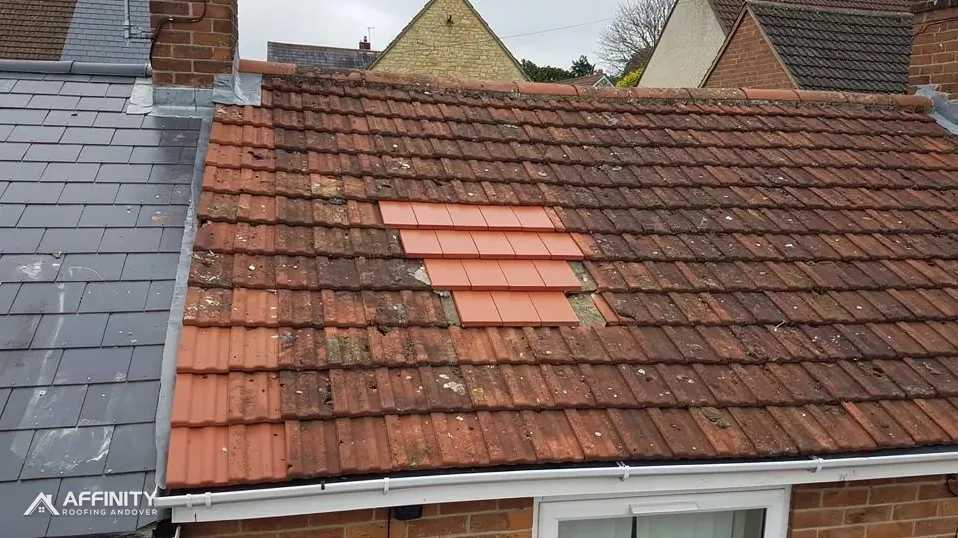
Small tiles mean many joints, and moss collects in them. Cracked nibs and corroded nails are the usual faults, and a slipped tile in a plain roof can often be hooked back or replaced with a salvaged one without disturbing the rest. Plain tile roofs also respond well to routine care: clearing gutters, checking the ridge and watching the verge once a year is usually enough to catch trouble early.
Interlocking tiles: large and quick to lay
Interlocking tiles cover a larger area each and lock to their neighbours along the sides, so the roof goes on faster.
The principle
Each tile has a channel or rebate along its edge that engages with the neighbour. They lie single-lap, with a shorter head overlap than plain tiles, and are nailed or clipped to the battens. A roof needs far fewer pieces than a plain tile roof of the same size.
Profiles and pitch
The family includes the Double Roman, with two shallow rolls and a flat section between, the Mendip and Wessex, with rolled profiles, and the flatter Edgemere and Modern-Duo. Marley's minimum pitches for concrete are Double Roman 22.5° (smooth), Edgemere 17.5°, Modern-Duo 17.5° (smooth), Mendip 15° (smooth) and 12.5° for the Mendip 12.5, Wessex 15° and Anglia 25° (smooth), among others.
Where you see them
They suit modern houses and extensions, garages and porches, and low-pitched roofs where plain tiles cannot go. Our guide to interlocking roof tiles explains the fixing and how these roofs usually fail.
Maintenance
Fixings are the weak point, since one layer of tile carries the load. A walk round the garden after a gale, looking for tiles out of line or lying on the ground, costs nothing and catches a lot. Clips and nails corrode, tiles crack under foot traffic and the surface coat of a concrete tile can wear. The tile itself usually outlasts the fixings.
Pantiles and other profiled clay
The pantile is a clay tile with a single wave, an S-shape in section, which gives a roof a strong ribbed texture.
How it lies
Pantiles overlap along the sides in the curve of the wave, and run in rows with a short head lap. They are hung from battens by a lug and sometimes nailed. The shape sheds water well and gives the roof a rhythm that is quite different from plain tiles.
Pitch
Marley gives its clay Lincoln pantile a minimum pitch of 15°. That is much lower than plain clay tiles, which is why pantiles are used on low-pitched roofs, extensions and outbuildings.
Where you see them
They are still made today. On a period house where the original roof was pantile, matching the shape matters at least as much as matching the colour.
Other profiled clay
A few interlocking clay profiles exist, with side channels like their concrete cousins. They are costlier and are specified where a clay finish is wanted at a low pitch. If you are unsure what you have, turn over a spare tile from the garage or garden, if there is one: the back shows the nibs, lugs or holes that tell the type, and a photograph of both faces is usually enough for a roofer to name it.
Maintenance
Pantile roofs have fewer joints than plain tile ones, which helps keep moss in check, but the lugs break and the ridge details, often bedded in mortar, crack. Our wider pitched roofing page covers the repairs.
Slate-look tiles and natural slate
Some tiles are made to look like slate, and it is worth knowing how they differ from the real thing.
Natural slate
Slate is split from stone. It is thin, hard and very durable. HomeBuilding gives Welsh slate 100 years or more, Spanish natural slate 75 to 100 years and reclaimed Welsh slate 50 to 80 years. BS 5534 indicates a minimum pitch of 20° for natural slate, and the supplier Cupa advises that hook fixings are unsuitable under 25°.
Slate-look alternatives
Fibre cement and other composites are moulded to resemble slate at lower cost and weight. They are not slate, and they have their own lifespan, which for fibre cement HomeBuilding gives as 30 to 40 years. The data sheet states the pitch and fixings, and the two products should never be assumed to behave alike.
Why the distinction matters
Planning authorities often distinguish between natural slate and artificial slate. Basingstoke and Deane's Article 4 areas ask that the roof's original slate or clay be kept, and call artificial slates and concrete tiles an unlikely fit. Check the position with the council for your own address.
Cost context
HomeBuilding's supply-only figures put Welsh slate at about two and a half times Spanish per square metre, with the usual caveat that supply is only part of the cost. Labour is a large share of any slate roof, because each slate is nailed individually and cut to fit at hips, valleys and abutments. Our slate roofing hub covers the material in depth.
Choosing for the house, not the brochure
A brochure shows a tile on a perfect roof in good light. The roof you have is a different thing.
Start with the pitch
The measured pitch of the roof limits the choice before anything else, and a surveyor with a digital level can read it from the loft or the eaves in a minute. Anything below the minimum on the data sheet is out. For an existing roof, the question is usually what was there, and a like-for-like replacement keeps the structure and the look.
Then the structure
A heavier covering than the old needs checking. The Planning Portal links Building Regulations approval to any covering at least 15 per cent heavier than its predecessor, with a structural opinion as the first step.
Then the street
Look at the neighbouring roofs and the character of the road. In a conservation area or on a listed house, consent and Article 4 directions can fix the material, so ask Test Valley Borough Council's planning team before ordering.
Then the budget
Which? gives £7,000 to £21,000, ex VAT, for an entirely new roof on a three-bedroom home (Nov 2025), and other guides differ widely. The covering is one factor among many.
Take a sample outside
View a sample tile on site in daylight, wet and dry, against the walls and windows. Our survey records the pitch and structure first, so the choice that remains is genuinely open, and the written price follows.