The short answer
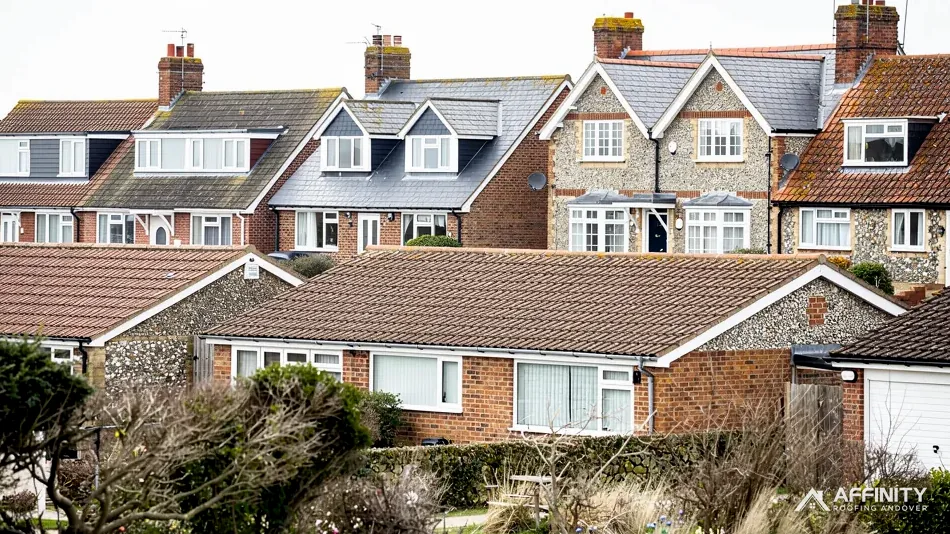
A gable roof has two sloping sides that meet at a ridge, and the ends of the house finish in vertical, triangular walls. A hip roof slopes on all sides, so the ends lean in as well, and the sloping corners where the planes meet are called hips. Gables are edged by verges, hips are capped by hip tiles, and each has its own weak points.
Two shapes, two kinds of edge
On a gable roof, the roof stops at the end wall. That wall carries on upward in a triangle, the gable, to meet the ridge, so you see a wall above the eaves line. The sloping edge where the tiles finish against the gable is the verge. It is often finished with a bargeboard or a neat cut line of tiles, and it is the edge where a gale gets its first grip on the tiles.
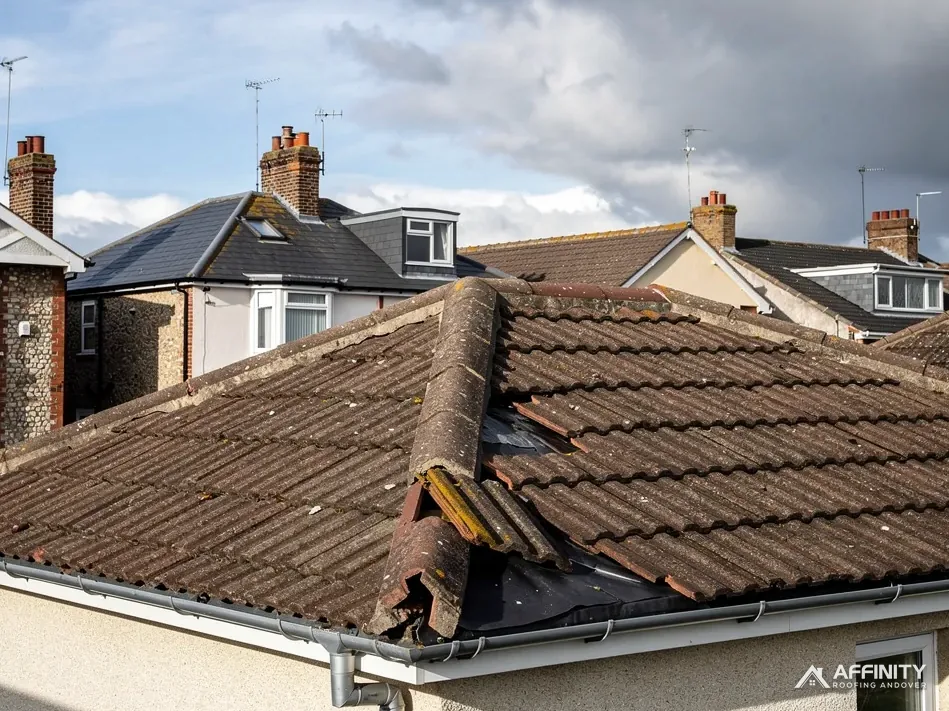
On a hip roof, there is no triangle of wall. The end of the building has a roof slope of its own, tilted inward, and the sloping line where it meets the long side is a hip. The tiles that cap each hip are hip tiles, and the crown, where the hips join the ridge, is a busier detail than a plain gable ridge, with several tiles cut to meet at one point.
Many houses mix both, with a hip at one end and a gable at the other. Where two roofs meet at an inside corner, a valley is formed, which gathers water and needs its own lining. Our page on the parts of a pitched roof names each of these.
Where each shape leaks
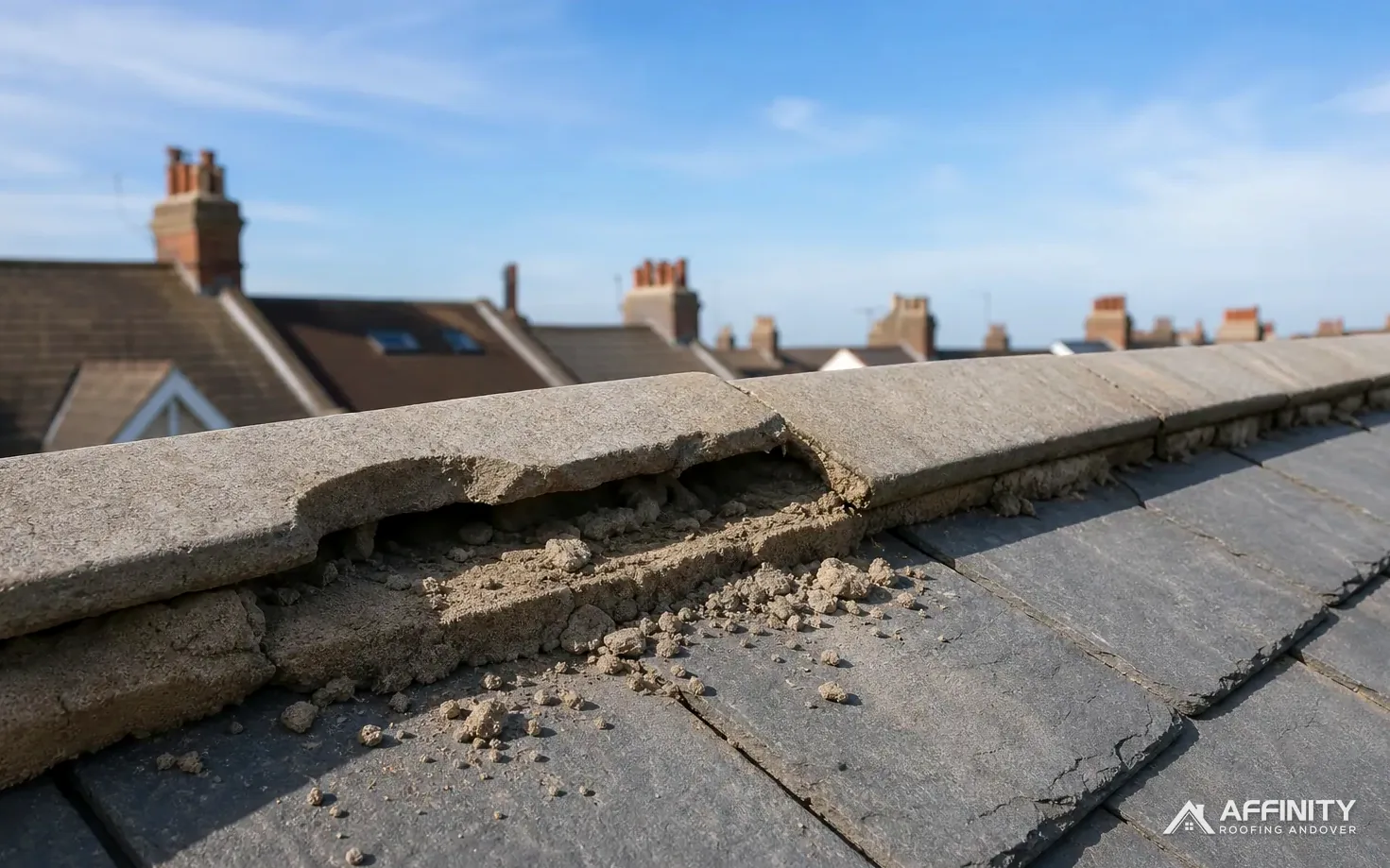
The faults come from the edges. On a gable, the verge is the weak point. Wind lifts at the edge, mortar pointing along the verge weathers and falls out, and the tiles nearest the end can loosen. Where the gable wall rises above the roof, the junction between wall and tiles needs good flashing, and the brickwork above should be sound.
On a hip, the weak point is the hip itself. Each hip tile sits on a bed of mortar or a dry-fix system, and the joints between tiles open as the bed ages. Rain gets into the open joint, and the cut tiles beneath, which are trimmed at an angle to follow the slope, can slip. The point where the hips run into the ridge is where water can collect if the detail is poor.
Neither shape is better than the other. Each is a sound way to roof a house when it is built and kept well, and the faults tend to be local. A gable with a failing verge, or a hip with open joints, can be put right without touching the main field of tiles, so a local fault does not have to become a whole-roof bill.
How hips and verges are fixed
Both edges can be fixed in mortar or in a dry system. The traditional method beds the hip tiles, or the verge tiles, in sand and cement. It looks right on an older house, but Marley points out that BS 5534 was revised in 2014 to make clear that mortar's grip by itself is not something to depend on for ridge and hip tiles. A dry-fix system uses mechanical clips, screws and trays instead, and BS 8612 is the standard its parts are tested to.
BS 5534 is a code of practice, not a statute, and nobody has outlawed mortar. The sensible reading is that a mortar bed alone should not be left as the sole restraint on a tile in a storm. That is why a hip repair today usually adds a mechanical fixing, and why we explain which one we are using.
Our dry ridge and verge page explains the systems, and our answer on roof tile clips covers the fixing of the main field.
Repair, cost and what we look at
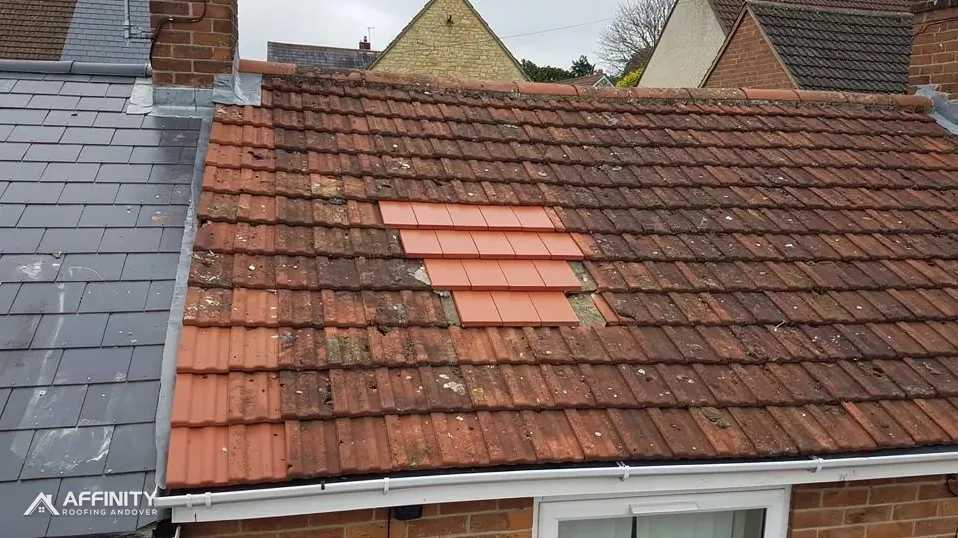
We start with a survey, photographing the verge or hips from a ladder, tower or scaffold, and showing you the joints, the bed and the tiles beneath. If the fault is a lifted tile or a patch of loose mortar, the repair is local, and the sound sections stay as they are. If the whole hip or verge has lost its bed, it is better to relay it with a modern fixing than to patch it every year.
Price depends on the length of hip or verge, the height, the way the roof is reached and the tile type, with one written figure sent after the survey. Old mortar and broken tiles are cleared away as we go, so nothing is left in the gutter or on the ground below. Where the hips are in good order and the trouble is a few tiles, the visit is brief.
For a gable, check the bargeboard and the wall junction as well. For a hip, check the junction at the ridge and any valleys, because those are where trouble tends to hide. Our pitched roofing hub gathers the rest of the tile and ridge topics in one place.