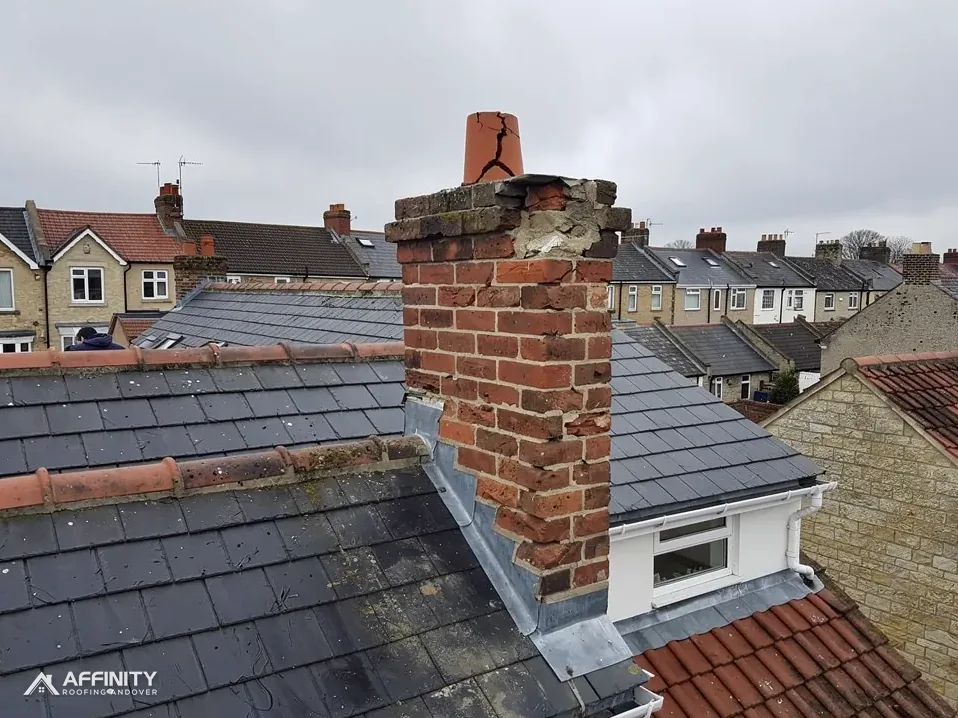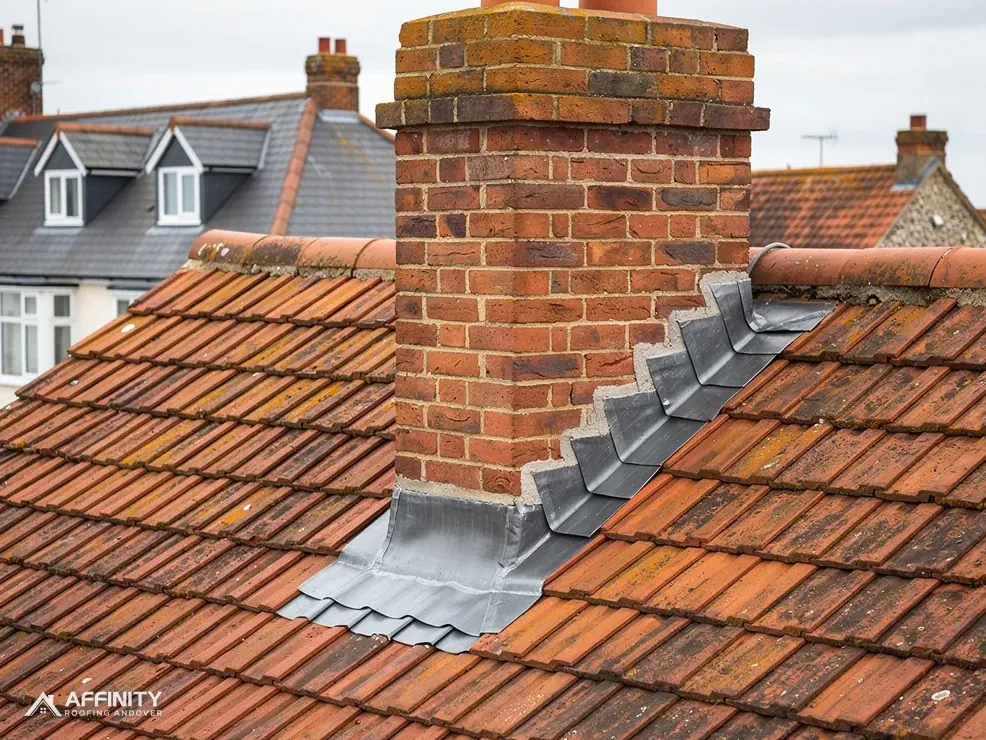
Sheet lead has covered the joints of British roofs for centuries. A flashing is the strip of metal that seals the line where a roof meets something else, such as a chimney stack or a wall. A valley is the gutter formed where two slopes meet. Both are classic lead jobs, and Approved Document C, the moisture chapter of the Building Regulations guidance, refers lead sheet work to BS 6915 (para 6.9).
Even so, owners ask whether something else will do. The reasons vary. Some are weary of a repair that was stolen once already, some are working to a tight budget, and some have a flat roof where a one-piece laminate looks simpler than lead bays and rolls.
The answer depends on the part of the roof, the age of the house and any planning controls on it. This guide sets out the main alternatives to lead, where each one earns its place, what the typical lifespans look like, and the points where we would steer you back to lead. We cover roofs across Andover and the Test Valley, so conservation areas and listed homes come up more than once.
Why lead is the benchmark for flashings
Lead is soft enough to be dressed tightly into brick joints and tile profiles, and it does not need paint or a coating to keep working. Cast lead sheet is sold in codes that match its thickness: code 4 is 1.80 mm and about 20.41 kg per square metre, code 5 is 2.24 mm and 25.40 kg, and code 6 is 2.65 mm and 30.05 kg (Royston Lead's cast-lead brochure). The brochure lists code 4 for soakers and flashings, and codes 5 and 6 for flashings as well as valley gutters.
How long it lasts
In MyJobQuote's guide, lead flashing lasts over 80 years (Sep 2026). Treat that as a floor, not a pledge. HomeBuilding puts a lead flat roof at 60 to 100 years (Sep 2025). No substitute in this guide has a track record anywhere near that length, which is the first thing to weigh.
What an alternative has to match
A flashing must flex as the roof warms and cools, stay sealed against masonry that is never perfectly straight, and shed water for decades without anyone going up to look at it. Lead does this by being dressed, or shaped by hand, into every joint. Anything that replaces it has to manage the same movement, which is why the best alternatives are chosen for a particular detail and not swapped in everywhere.
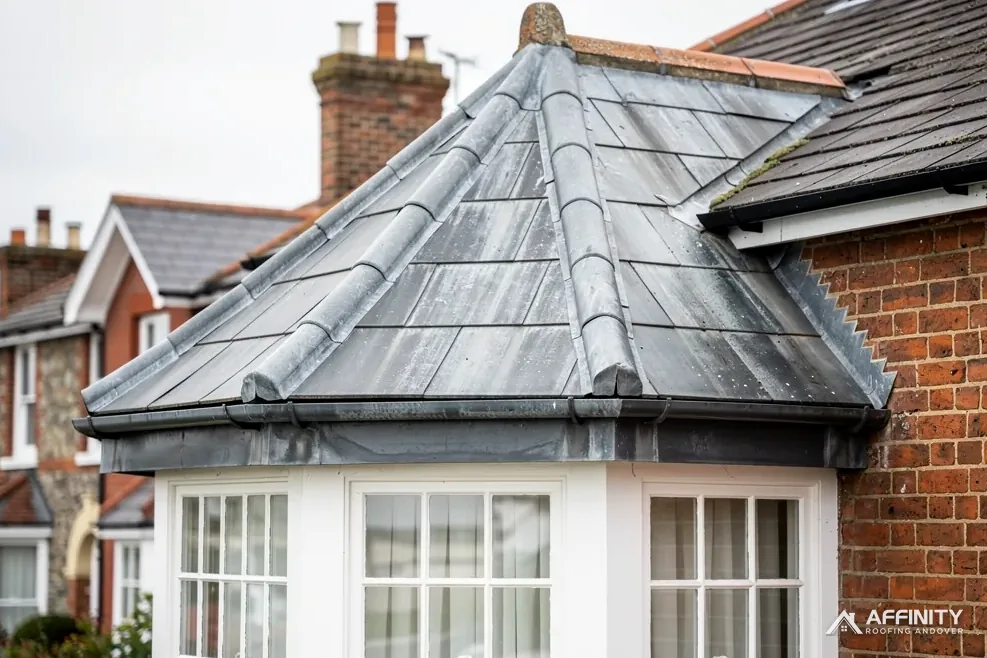
Our page on lead roofing shows what we do with sheet lead on chimneys, valleys, bays and abutments, so the options that follow have something to be measured against. Where a substitute is the better buy for a given detail, the survey notes record that and show you what we found.
Valleys and flat roofs: what else is used
A fair question is whether anything other than lead works in a valley or on a flat roof. Yes, several things do, but each fits some details and not others.
Valleys
A valley carries the runoff of two roof slopes into one narrow channel, and that makes it the busiest drain on the whole roof. Lead is the traditional choice. A moulded GRP valley trough, glass-reinforced plastic formed in a factory to a standard width, is the usual substitute on newer tiled roofs. Once it is bedded and the tiles are cut to it, the trough does not rely on a craftsman's dressing, which is why builders like it. On an older house with irregular tile lengths or a bend in the valley, a factory trough may not follow the geometry, and lead is the better fit.
Flat roofs
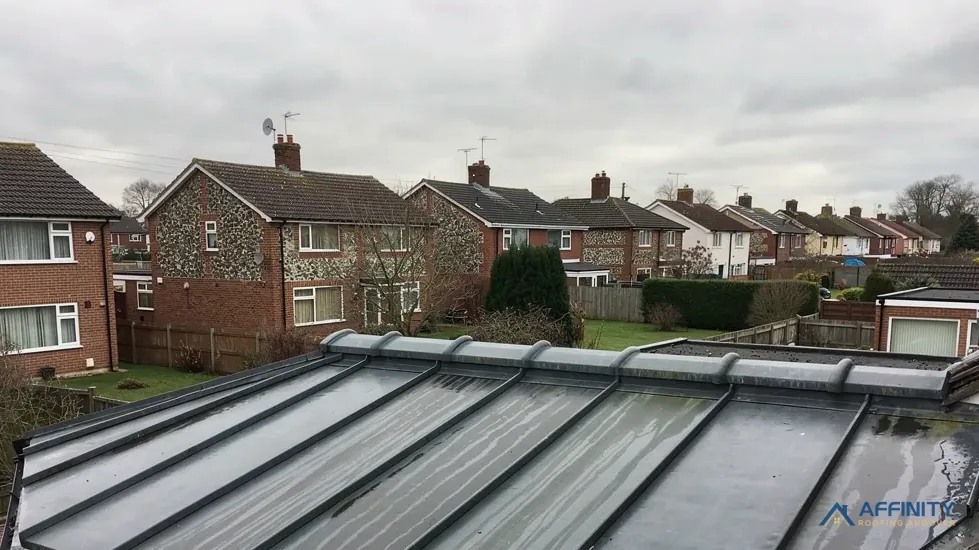
On a flat roof the real alternatives are whole-roof coverings: GRP, EPDM rubber, and torch-on felt. Supply-only figures from HomeBuilding work out per square metre at about £110 for GRP, £105 for EPDM, £65 for felt and £170 for lead (Sep 2025). Those figures show lead as the dearest material, which is why it is kept for small roofs, bay windows, dormers and details where its dressing is the whole point.
Our guide to the lead flat roof explains what a lead roof involves, so you can judge whether a cheaper covering would do the same job on yours. On a roof with a lot of upstands, pipes and rooflights, the extra labour in forming lead around each one can narrow the gap between the two.
GRP: where it works and where it falls short
GRP is a polyester resin laid over glass fibre matting on a timber deck and finished with a topcoat. It cures into one continuous sheet, so there are no joints on the flat itself, which is why it has been popular for garages, dormers and extension roofs.
Typical life
The cost guides disagree. HomeBuilding gives GRP 25 to 30 years (Sep 2025) and Less gives 25 to 40 years (Oct 2026). Both are typical ranges, and a range is no warranty. Lead's lower bound of over 80 years puts GRP at roughly a third of the lifespan or less, so the question is what the roof is for.
Where it suits
GRP suits a simple rectangular deck with a sound structure underneath and a clean upstand where it meets a wall. It copes badly with a deck that moves a lot, because the cured laminate is stiff and can crack along a joint in the boards. Cracking is the usual way a GRP roof ends.
Where it falls short
At a chimney or a pitched abutment, GRP is not a flashing. The usual answer there is lead, or a lead-replacement strip, with the GRP finished to meet it. Using the laminate on a steep face, such as the side of a dormer, is also a poor use of the material because it is hard to lay and finish neatly on a vertical surface, and any join in the cheek is a future entry point for rain.
If you have a flat roof that is failing, the repair-or-replace question matters more than the material, and our flat roofing pages cover it in detail.
Lead-replacement strips and flexible membranes
A small group of manufactured products are sold as direct substitutes for lead flashing. They arrive as rolls or strips that are dressed onto the roof and sealed, and some carry a metal-look surface that is meant to resemble lead. They are the answer people usually mean when they say lead-replacement flashing.
How they are meant to be fitted
Every manufacturer has its own fitting instructions, and the installation depends on following them to the letter. That covers the type of adhesive, the minimum laps, the tuck into the brick joint and the sealing at the top edge. Ask for the maker's data sheet and check whether the product has independent third-party certification, because a product without it has no outside check on its claims.
What the data sheet will not tell you
No data sheet has watched the material for 80 years. These products suit short runs and awkward details, and they are usually chosen for speed and for resisting theft, rather than for lifespan. We would set their life against the sheet-lead figures above with that difference in mind.
Why a substitute is not a repair
A strip dressed over a failed detail does not fix what failed. If the wall is crumbling, the chase has gone, or the old lead has slid down, the new product fails for the same reason. A replacement strip is a decision about the material, not a patch for broken fixing.
BS 6229 is written for flexible membranes on flat roofs. Lead is outside it, which follows BS 6915 through Approved Document C. A substitute fitted to a flat roof is therefore judged against different standards from lead on the same roof.
Conservation areas and listed roofs
Older streets in the town and the villages near it include conservation areas, and some houses are listed. Both can change which materials are acceptable on a roof, and a mistake is expensive to undo.
What the rules say
A conservation area is article 2(3) land under the General Permitted Development Order, and a planning authority can add an Article 4 direction, which withdraws specified permitted development rights across a defined area. Replacing lead like for like does not normally alter a building's appearance, and the Town and Country Planning Act 1990 s55(2)(a) leaves works with no material effect on the external appearance outside the definition of development.
Changing the material is different. A grey laminate where there was lead, or a bright strip on a visible chimney, may change the appearance, so raise it with Test Valley Borough Council's planning team first. Check whether an Article 4 direction applies where you live.
Listed buildings
Works that affect a listed building's character need listed building consent (Planning (Listed Buildings and Conservation Areas) Act 1990 s7). Listed houses keep their permitted development rights under Classes B and C, but the consent rules sit on top. Changing the metal on a listed roof is a consent question, and the answer is nearly always to keep sheet lead. Ask the conservation officer at the council what they would accept before a sample is bought.
We survey the roof first and tell you what we found, so you can put a specific proposal to the council. Where a consent is needed, it comes before any work.
Theft risk, cost and choosing for your roof
Lead has a scrap value, and roofs that have lost it once are often reroofed in something else. Nothing here puts a figure on theft in Andover or the Test Valley, so treat it as a risk to plan for rather than a number.
What reduces the risk
Position matters more than material. A flashing on a back extension behind a gate is harder to reach than one on a front chimney over a garage roof. Where a strip or an alternative is chosen mainly to deter thieves, say so on the survey so that we can weigh it against appearance and life.
How the choice usually goes
For a typical chimney on a house in a conservation area, we would normally keep sheet lead. For an extension valley on a modern tiled roof, a GRP trough is a sensible, less costly choice. For a garage or dormer flat, a whole-roof covering such as GRP or EPDM may serve better than a lead roof. Between them, the details and wall condition decide.
What the price depends on
Material, joint count, height and access all move the figure. Scaffold, where the stack or valley is out of ladder reach, can be a large factor; if it stands on the road or pavement, the highway authority issues a licence under the Highways Act 1980 s169. After a survey we give one written total price, so you can compare materials with the whole job in front of you.
If lead has just been stolen from your roof, see what to do when lead is stolen for the order to work in.