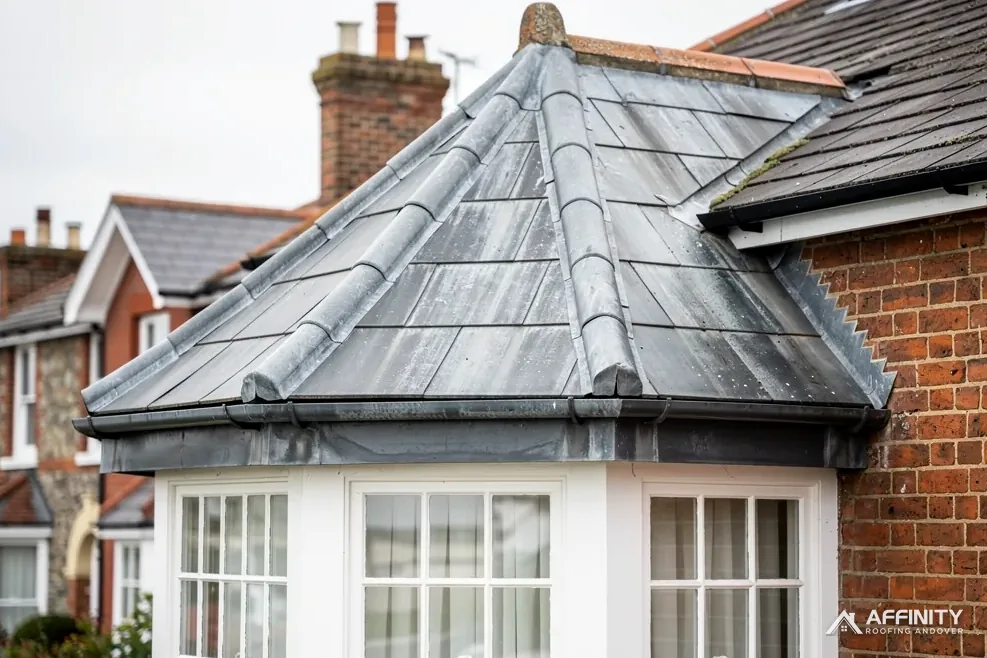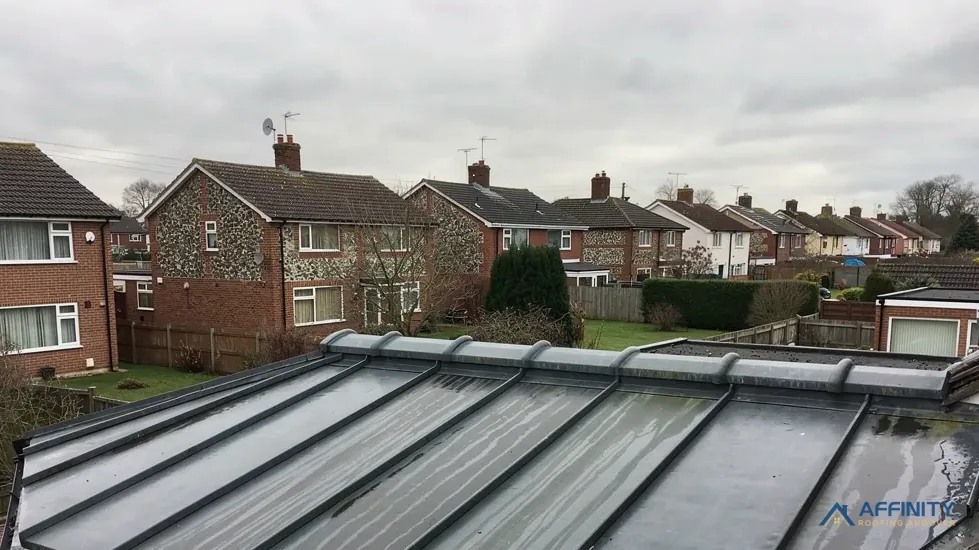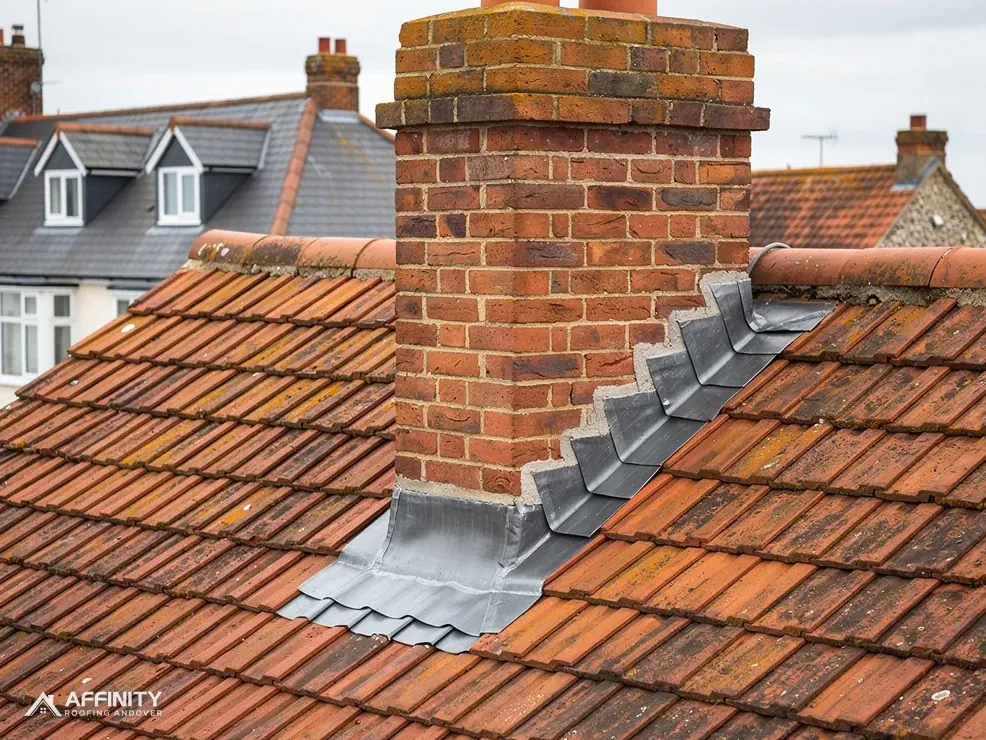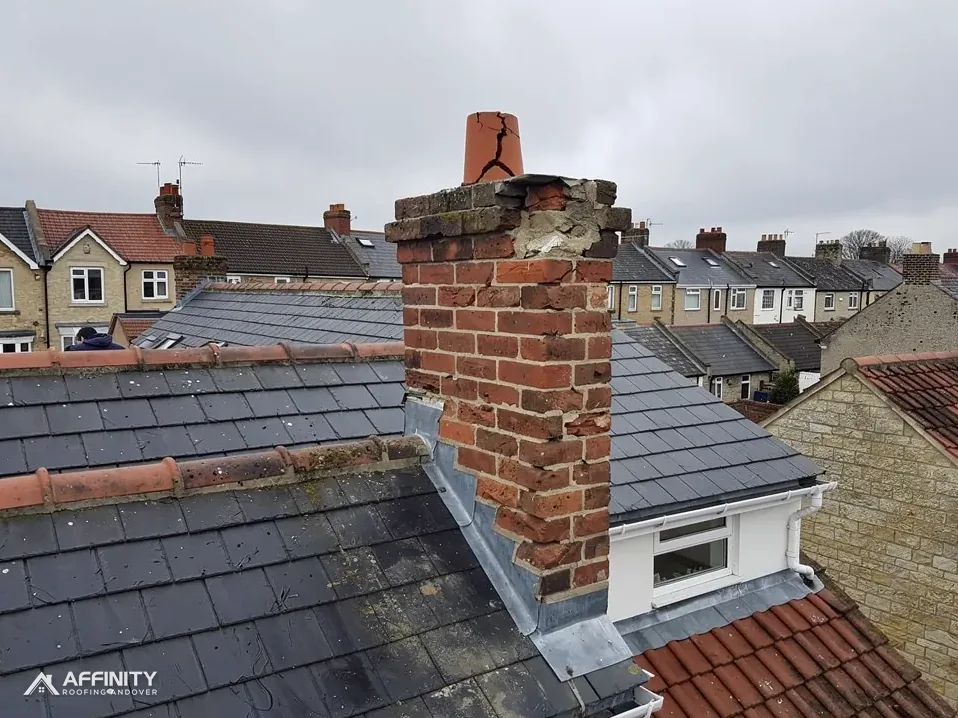
Finding that lead has gone from a roof is a shock, and the order of what you do next matters. Sheet lead covers the joints and edges that keep rain out of a building: flashings round chimneys, valleys between slopes, the covering of small flat roofs and the tops of bay windows. Take it away and the timber and brickwork below are exposed to every shower.
The sequence that works is simple. Keep people off the roof, tell your insurer, stop the water getting in, wait for the insurer before any permanent repair, record everything with photographs, and only then decide what goes back. Doing these in a different order can leave you with damp rafters, a weaker claim and a repair that does not suit the roof.
This guide sets out those steps for a house in Andover or the Test Valley: what to do on the day, what an insurer will expect from you, what a temporary cover involves, and how to choose between new lead and one of the alternatives. Whether a claim succeeds, and how much a policy pays, is for your policy wording and your insurer to decide.
The first steps once you notice lead is gone
Start from the ground and the loft. Do not climb onto the roof. Our lead roofing page explains what that metal does. Thieves may have loosened tiles and left fixings or tools behind, and a slate or tile that looked sound a week ago may not hold your weight today.
Spotting the gaps from outside
Walk round the house and look up. Check the chimney stack, the valleys, every wall that rises above a roof slope and any flat roof visible from a window. Missing lead often shows as bare brick, exposed timber, rolled-back edges or strips lying in a gutter or on the ground. Take note of where it was, because the pattern of the damage tells a roofer what to replace.
Check the loft and ceilings
If there is a loft hatch, look for daylight or damp patches below the area where the lead was. Look at upstairs ceilings for fresh stains. Water that runs in at a chimney can travel along a rafter and show up as a mark several feet from the cause.
Report the theft
Your policy may require you to report a theft to the police, and your insurer may ask for the reference. Check the wording rather than guessing. If water is coming in now, making the roof safe comes ahead of everything else, and the survey follows once it is dry.
Do not accept a repair from anyone who knocks on the door offering to fix the roof while you are still deciding.
Tell your insurer first
Contact your insurer before you arrange any permanent repair. Standard advice for theft and storm claims runs in that order: insurer first, then a temporary repair to protect the house, with photographs and receipts kept throughout. Which? notes that most insurers have 24-hour emergency helplines, which you may find on your policy document.
What to have ready
Your policy number, the date you found the damage, a short description of what is missing and photographs. Ask what the insurer wants in writing and whether it has an approved repairer or will accept a quote from yours. If the insurer asks for a quote, a roofer can provide one after a survey.
Wording matters
Theft and storm are separate headings on most policies, and each has its own conditions. The Financial Ombudsman describes a storm in its own terms and warns that insurers may refuse a claim for gradual damage or wear and tear. If the roof was in poor shape before the incident, expect the insurer to ask about that. Your policy's own definitions decide, so read them rather than relying on a general rule.
No promises
Nobody can promise that a claim will be paid or in what amount. The claim stays yours to run with the insurer; our part is to survey the damage and send you photographs and a written price to pass on. If you have a dispute with your insurer, the Financial Ombudsman Service is free to use and can be reached on 0800 023 4567.
Photographs and records that help
On photographs, the Institution of Structural Engineers says they are vital to a claim because they show the damage as it was. Take them before anything is moved or covered, and again once a temporary cover is on.
What to photograph
From the ground, take wide shots of each elevation to show the overall condition, then closer shots of every place where lead is missing. From the loft, photograph any daylight, damp timber and wet insulation. Inside the house, photograph ceiling stains and anything damaged by water, and date the files as you take them.
Keep the receipts
Hold on to the invoice for any emergency covering or make-safe, along with the date and what was done. The insurer may reimburse reasonable costs for protecting the property if the policy allows. Do not throw away broken tiles or off-cuts of lead until the insurer has seen the pictures or said you can.
Photographs from the repairer
A good roofer photographs the exposed roof on their own survey, showing the bare timber, the state of the chases in the brickwork and any nails or fixings left behind. A chase is the groove in the brickwork that holds the top edge of a flashing. These images explain what has to be replaced and why, and they show the new work in context. Ask for them to be sent to you as files you can forward.
Keep every message and every quote together in one folder, so that nothing has to be chased later.
Temporary protection while you wait
A roof with its lead stripped is not waterproof, and rain can reach rafters and plaster within hours. A temporary cover keeps the damage from growing while the insurer is contacted and the permanent repair is arranged.
What a make-safe involves
A roofer can fix a waterproof sheet or tarpaulin over the exposed area and secure it to timber battens so that wind cannot lift it. At a chimney, the cover goes round the stack and under any tiles that can be lifted. On a flat roof, a sheet is laid across the deck and weighted or fixed at the edges. Each of these is a stop-gap and not a repair.
What to avoid
Do not run sealant over bare brick or timber and hope it holds. A bead of mastic will not keep out rain once the flashing is gone, and it makes the permanent work harder because the new lead needs a clean chase. Our guide to why sealant is not a lead repair covers the problem in detail.
Scaffold and access
Reaching a chimney or valley for anything more than a quick cover needs proper access. A tower that stands on the pavement needs a highways licence, and in Test Valley that comes from Hampshire County Council, which expects the scaffold firm to apply for the customer. The licence takes time to arrange, so a temporary cover is often placed from a ladder or low platform first, with the scaffold booked for the permanent repair.
Replacement options: like for like or something else
Once the roof is dry and the insurer has been told, the real decision is what goes back.
Like-for-like lead
New lead in the same pattern and code is the plainest answer. Royston Lead's cast-lead brochure lists the codes from 3 to 8 by thickness and use, so a roofer can match what was there. On a house in a conservation area or a listed building, putting lead back as it was is usually the least contentious route. Works that affect a listed building's character need listed building consent, so ask the council first if you want to change anything.
Substitutes
Some owners choose a different product after a theft, because lead-replacement strips and GRP carry little scrap value. They have different lifespans and fit different details. Our guide to alternatives to lead flashing sets out where each works. Lead flashing can last over 80 years according to MyJobQuote's guide, which is a figure no substitute has matched in the published guides.
Reducing the chance of a repeat
The location of the lead matters more than the material. Metal at the back of a house, out of sight and not reachable from a low roof, is less exposed than a front chimney above a garage. Locking away ladders and trimming climbing plants helps too. These are practical steps and not a guarantee that thieves will not return.
Check the roof underneath
Thieves often damage tiles, battens and the chase while removing metal. The survey should look at all of it before new lead is dressed over a damaged surface. Battens are the timber strips that tiles hang from, and a cracked one under a new valley will let the lead sag. Lead laid onto a bruised board will crease where it is stepped on.
Costs, quotes and what happens next
Replacing stolen lead is a normal flashing or valley job with some extra repair around it. MyJobQuote gives full chimney leadwork as between £350 and £920, with the scaffold the swing factor (22 September 2026), and a full roof valley replacement at around £540 (7 September 2026). Those are typical UK figures and not a quote for your house. Our page on lead flashing cost explains what moves them.
Asking for a quote your insurer can use
A quote that names the roof parts, the lead code and the scope of the work is easier for an insurer to assess than a bare figure. Ask your roofer to list which faces and sections are covered and whether scaffold and VAT are in the total; GOV.UK gives the standard VAT rate as 20%.
Doorstep traders
Cold callers sometimes target homes where roofs have been damaged. An off-premises contract, which includes one signed in your own home, carries a 14-day cancellation right. A visit you ask for yourself to carry out an urgent repair is excluded by regulation 28(1)(e) of the Consumer Contracts Regulations. Citizens Advice advises getting three written quotes where you can, and its consumer helpline is 0808 223 1133.
Getting started
Our price is one written total, sent after a survey that includes photographs of the exposed roof. It names the lead code, the faces or bays covered and any timber or brick repair that the theft made necessary, so that your insurer, and anyone else who needs to see it, can follow what the figure pays for. If the work has to wait for a decision from the insurer, say so at the survey, and the visit can be planned around the roof staying covered in the meantime.