The short answer
MyJobQuote (Sep 2026) says lead flashing can last for over 80 years. Read that as a lower bound, never a promise for your roof. Many flashings fail far sooner, usually because of a fault that is not the lead itself: crumbling pointing, a wrongly fixed sheet, a thin code or a movement the detail does not allow for.
The figure and how to read it
MyJobQuote's page on replacing leadwork on a chimney, last updated in September 2026, says lead flashing can last for over 80 years. The wording matters. It describes what flashing can reach, not what yours will, and it sets no ceiling. It is a floor for well-made, well-fixed work, and flashings that fail early do so because something around them has gone wrong.
For flat lead roofs, which are a different part of the building, HomeBuilding's range is 60 to 100 years. Neither number is a guarantee for a particular flashing on a particular house, and a warranty period is a different thing from the working life of the metal.
So treat the number as evidence that the material itself is not the weak point. Lead does not rot or rust, and it weathers to a protective grey patina. When a flashing fails at twenty or thirty years, something around it or about its installation has usually gone wrong. Our guide to lead flashing cost explains what the work involves.
We never promise a flashing a given number of years, because the roof around it decides.
What shortens the life of a flashing
Movement is the main enemy. Lead expands in heat and contracts in cold, and if a sheet is too long, pinned too tightly or fixed in the wrong place, it tears along a fold. Poor detailing causes this long before age does. Our answer on why lead splits explains how that happens.
Thickness plays a part. A flashing cut from too thin a sheet fatigues sooner. Royston Lead's brochure lists code 4 and heavier for flashings, and code 3 for soakers only.
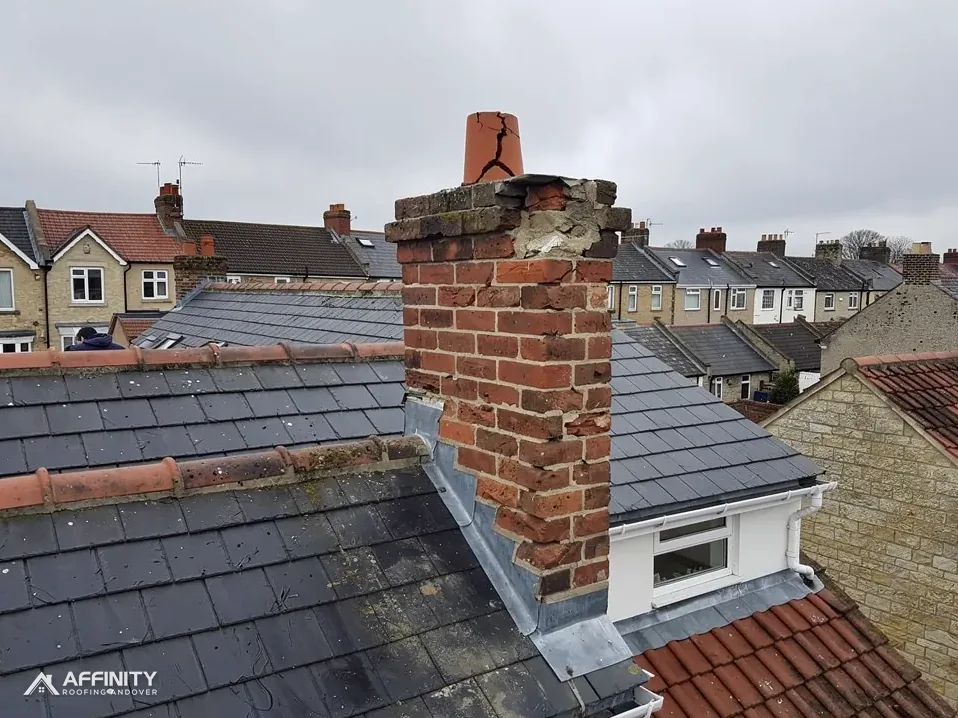
The wall matters too. Flashing is set into a slot cut in the brickwork and held with lead wedges, and the chase is then pointed. When the pointing crumbles, the flashing works loose, rain gets behind it, and the edge springs clear of the wall.
Finally, there is damage: a ladder leant on a flashing, foot traffic, falling branches, or a past repair that used sealant in place of lead. Rubbing from a chimney pot or aerial can wear through a thin spot over the years, and a loose aerial bracket is worth checking for the same reason. Each of these points to a cause that can be found and fixed.
Fixing the faults first
If a flashing is leaking, the question is whether the lead is sound and the surroundings are at fault, or the other way round. A survey answers it, and the answer is often more hopeful than the stain on the ceiling suggests. We check the pointing in the chase, the wedges, the fixing at the top edge, any splits or tears and the condition of the soakers or tiles beneath.
Where the lead is sound, the repair is often to the wall: raking out failed mortar, repointing the chase and dressing the flashing back into place. That costs far less than new lead and gets the flashing working again, so long as the metal is not cracked.
Where the lead has split or been thinned, a section can be let in, or the whole flashing replaced. A string of past sealant repairs is a sign that the underlying movement has never been dealt with, and our guide to why sealant is not a lead repair explains the reason.
We photograph each fault and show you what is wrong and what we propose, so you see the cause before you decide, and we price once the survey is done.
Never a promise, and the next step
Because the result depends on the fixings, the wall, the weather and what has gone on before, no honest roofer can give you a number of years for a flashing. What can be said is that lead rewards good detailing. A flashing in a suitable code, held so it can slide, with sound pointing behind it, has the material on its side.
If you are weighing up whether to repair or renew, look at the age and the history. A flashing with one crumbling joint in otherwise sound lead is a repair. A flashing patched many times, with splits at several folds, is nearly at the end of useful repair.
For wider context, the lead roofing page explains how leadwork is surveyed and renewed. For scale, MyJobQuote (Sep 2026) quotes £350 to £920 as a typical UK range for chimney leadwork in full, depending on scaffold.
If your flashing is old and still tight, leave it alone. Ask for a look once the roof is clean and accessible, and have any faults dealt with early, since a small repair now often avoids a larger one later. A yearly photograph from the garden makes changes easy to see.