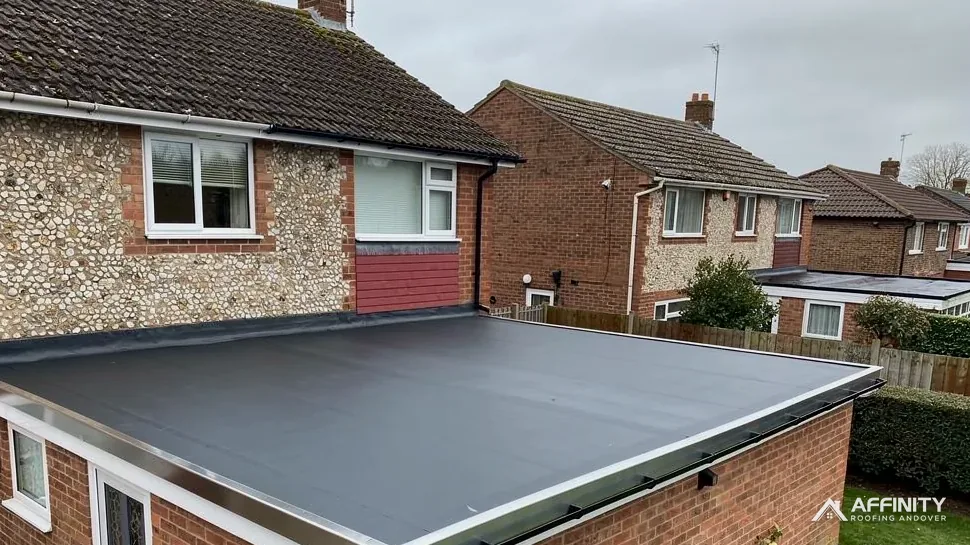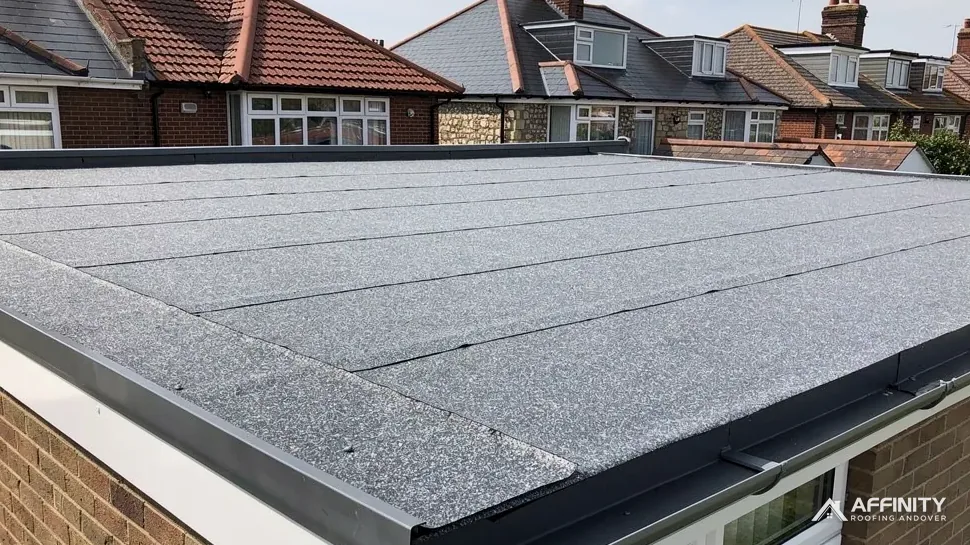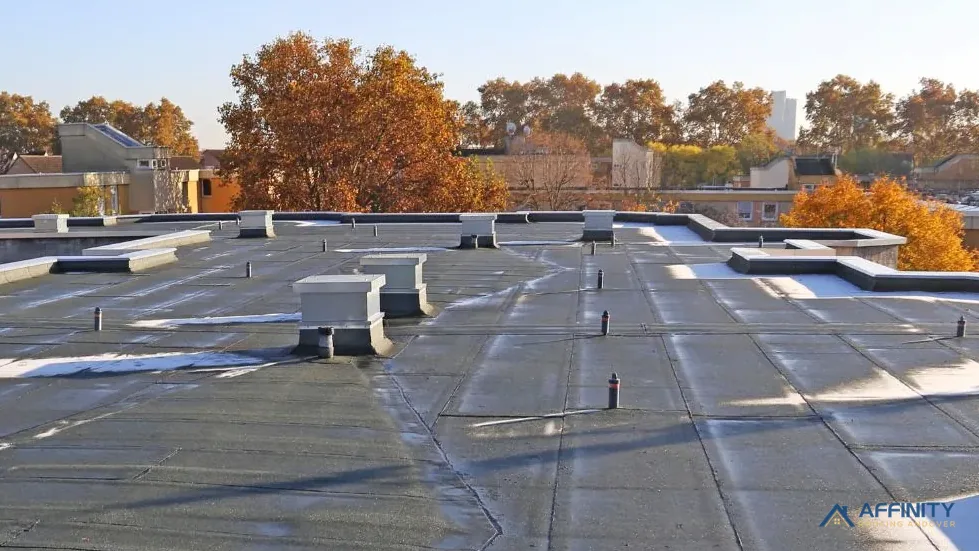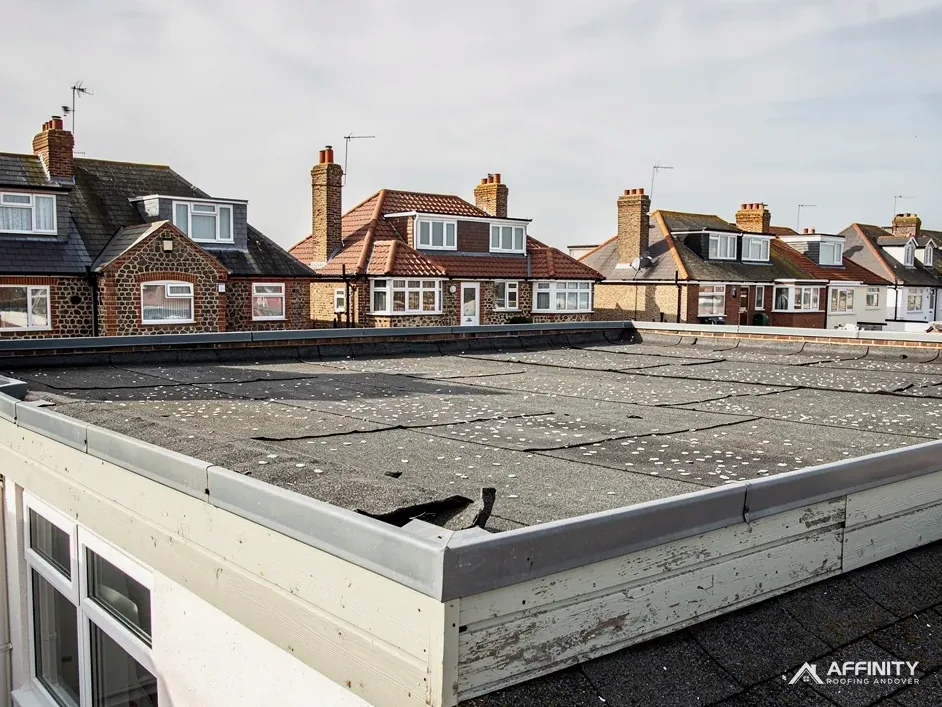
The question comes up whenever a flat roof starts to let water in. One camp says patch it and get another few years. The other says it is throwing good money after bad, and the whole thing should come off. Both can be right, depending on the roof.
A flat roof is a stack of layers: the deck at the bottom, perhaps insulation above or below it, and the waterproof covering on top. A leak is a symptom that something in that stack has let go, and the useful question is which layer, and how much of it. A split in a sound felt roof over a dry deck is a cheap job. The same split over a deck that has been wet for a winter is a sign that the roof's structure is going.
This guide gives you a way to judge between the two, using how old the covering is, how the boards are holding up and the pattern of the damage. It is written for owners of garage, extension and porch roofs in Andover and the villages round it. It also explains what a patch can honestly achieve, and how we price either option. Our flat roofing hub covers every covering we work with.
Start with the age of the covering
Age is not a verdict, but it is the first filter. Every covering has a typical range of years, and the nearer a roof gets to the far end of its range, the harder it is to justify spending on it.
Published lifespans
HomeBuilding (Sep 2025) gives felt 10 to 15 years, EPDM, a synthetic rubber membrane, 25 to 30 years, GRP, or fibreglass, 25 to 30 years, and lead 60 to 100 years. Less (Oct 2026) puts felt at 10 to 20 years, EPDM at 30 to 50 and GRP at 25 to 40. The two guides disagree at the top end for EPDM and GRP, so treat each range as a rough guide and not as a date in the diary.
How to find the age
If you moved in recently, ask the previous owner or your solicitor's paperwork for the date the roof was done. Otherwise a surveyor can usually judge it from the look of the covering. A felt roof with a crazed, grainy surface is older than one with a smooth finish. A rubber membrane that has gone hard, or a fibreglass topcoat chalking to the touch, is similar.
Age is a guide, not a rule
A 12-year-old felt roof with one split and a dry deck may repay a repair. A 7-year-old roof laid on damp boards can be past saving. Age tells you whether to look more closely, and the next two sections tell you what to look for.
Then check the deck underneath
The deck is the layer that decides the whole question, because a new covering is only as good as the boards it is stuck to.
Signs the deck is sound
Firm underfoot, no bounce, no dark staining on the ceiling below, no smell of damp. A roof that passes these checks can nearly always be repaired or recovered, depending on what the covering needs.
Signs the deck has gone
A spongy patch you can feel through the covering, sagging between joists, brown stains spreading across the ceiling, or boards that crumble when they are opened up with a screwdriver. These mean water has been in for some time. Rotten boards cannot hold nails, adhesive or fibreglass, so patching the covering on top will fail again. Our answer on rotten flat roof decking explains what a survey looks for.
How we check
During a survey we press along the roof with a flat hand, take moisture readings where we can reach them, and look at the underside from inside. If a section of covering needs lifting to see what is below, we do that, show you the result in photos and put it back or repair it. You do not have to take our word for what is under the felt.
The state of the deck is also the main reason one roof's price can differ from a neighbour's. Renewing boards adds to the cost of a covering alone, and you hear about it before the work is booked, with the photos to back it up. The price that matters is the one fixed after the survey.
How far the damage has spread
Where a leak is, and how many places there are, says as much as the age. Think of it as a map of the roof.
One place
A single split, a lifted seam, a cracked fillet at one wall or one failing pipe collar is a localised fault. A repair at that point restores the roof to what it was, as long as the area around it is healthy. This is the strongest case for patching.
Several places in one area
Two or three problems clustered together, such as near the downpipe or along one edge, often share one cause. Ponding water, a blocked outlet or a failed upstand might be behind all of them. Fix the cause and the repair holds; leave it and they come back. Our guide to the signs of a failing flat roof helps you read these patterns.
Everywhere
Blisters across the whole surface, splits in different places in each season, a surface that crumbles when scratched, and edges that have lost their bond all point to a covering that has nothing useful left to give. Each repair buys a few months and costs money that would be better spent on one proper job.
The cost of patching also climbs with each visit, because the scaffold, the access and the call-out are paid again every time. Three repairs in two years can come to more than the roof would have cost to renew.
What a patch repair can and cannot do
Repairs are worth doing when they suit the roof, and they should be described plainly: what is being fixed, and for how long it is likely to hold. A repair that is oversold does the owner no favours, because the leak returns and the trust goes with it.
What a repair buys
A well-made patch on a sound roof can add several years. For a roof that is near the end of its range, a repair might get you past a house sale, a planned extension or the next few winters, giving you time to save for the proper job. MyJobQuote gives around £650 as the average cost of a roof repair in 2026, a national figure for repairs in general and well below most replacement ranges.
What a repair cannot do
It cannot fix wet boards, cure ponding or stop the covering ageing next to the patch. Fresh felt or rubber bonded to old, dirty material rarely makes a lasting joint, so a repair to a failing roof can leak again at the edge of the patch. Over a wet deck the new material may lift within weeks, and nobody has gained anything from the visit.
Cold weather and temporary fixes
If a roof is leaking now, a temporary repair or cover can keep the water out until the weather allows a proper job. A flat roof covering needs dry, mild conditions to bond well. Our answer on replacing a flat roof in winter sets out what can and cannot be done in cold, damp weather.
A repair is only a good buy if it is described fairly. We tell you how long we think it should last, and where it is a stopgap.
When replacement is the sensible move
Replacement is the right call when the roof will keep costing money to keep dry, or when opening it up reveals problems a repair would only hide. Waiting past that point rarely saves anything, because damp boards and wet insulation are expensive to put right.
The checklist
A roof at the far end of its published range, a soft deck, a covering failing over its whole surface, a fall that leaves water standing and repeated repairs in different places all point to replacement. One of those alone may not decide it. Two or three together usually do.
What replacement involves
The old covering is stripped to the deck, the boards are inspected and renewed where needed, the fall is corrected, insulation is laid and the new covering is fitted with trims, upstands and outlets. Approved Document L treats a replacement waterproof layer as renovation of the roof, so insulation worse than the 0.35 threshold has to be improved at the same time, to a target of 0.16 W/(m2K) in Table 4.3, subject to feasibility.
Choosing the covering
The right covering depends on the roof's size, its shape and how it is used. Our guide to the cost of a new flat roof sets out the published ranges, and HomeBuilding's supply-only figures show the spread between materials. A larger roof with few details can take a single sheet. A small roof with many pipes may suit a liquid system.
Replacing at the right moment, rather than the last, saves the harm a long-running leak does to ceilings, insulation and furnishings, and it lets you choose the weather.
One total price, whichever you choose
Whether the answer is repair or replacement, the way we price it is the same, and it is worth knowing what to expect.
The survey comes first
We go up, or inspect from a ladder or tower where that is safe, and work through the checks above. We take photos of the covering, the deck and the underside, and explain in plain words what we found and what it means.
One written total
You then receive a single written price for the work we recommend. If a repair is enough, that is what we quote, with a plain note of what it will and will not achieve. If the roof needs replacing, the quote says so and names the covering and the insulation, and says if the old boards stay or go.
Your decision
If you are unsure, ask for the repair price and the replacement price side by side. Citizens Advice recommends getting at least 3 written quotes before you choose a trader, which holds for small repairs as much as for new roofs. It is fair to ask each trader what they assumed about the deck.
Where a job may count as re-roofing for Building Regulations, the Planning Portal asks whether less than 25 per cent of the building envelope and less than 50 per cent of the roof is affected. Before anything is booked, our survey answers that question.
Whichever road you take, the site is kept clear through the job and the waste goes with us.