Flat roofs do not announce themselves the way a slipped slate does. You cannot see most of them from the ground, you rarely climb up to look, and the first you hear of a problem is a drip or a brown patch spreading across the ceiling of the room below. By then the covering has usually been failing for some time, and the water has had a chance to reach the boards and the insulation.
The signs are there earlier, if you know them. Some are on the roof surface: splits, blisters, a surface that looks worn or dry, and pools of water that stay long after the rain has gone. Others are inside: stains, damp smells, paint that bubbles and a ceiling that feels soft. A few are in the gutter or the downpipe, where grit and granules show that the covering is shedding its surface.
This guide takes each sign in turn, explains what causes it, says which ones mean a repair and which mean replacement, and shows how to collect photos that make a survey quicker and more useful. Our flat roofing hub covers the coverings themselves.
What you can see on the surface
If you can reach a safe view of the roof, from an upstairs window, a ladder held by someone else or a neighbour's bedroom, these are the surface signs worth noting. Stay off any flat roof until someone qualified has confirmed it will take your weight. A weak spot gives way without warning.
Splits and cracks
A split in felt or a crack in fibreglass lets water through directly. Splits often run along the line of a seam or across a board joint, where the deck has moved. A single hairline in a topcoat is a different matter from a gap you can see daylight through, which is urgent.
Blisters and bubbles
A raised bubble under the covering holds trapped moisture or air. Small ones may be stable for years, but a blister that is splitting at its crown or growing is letting water in. Our answer on flat roof blistering explains the causes.
A tired surface
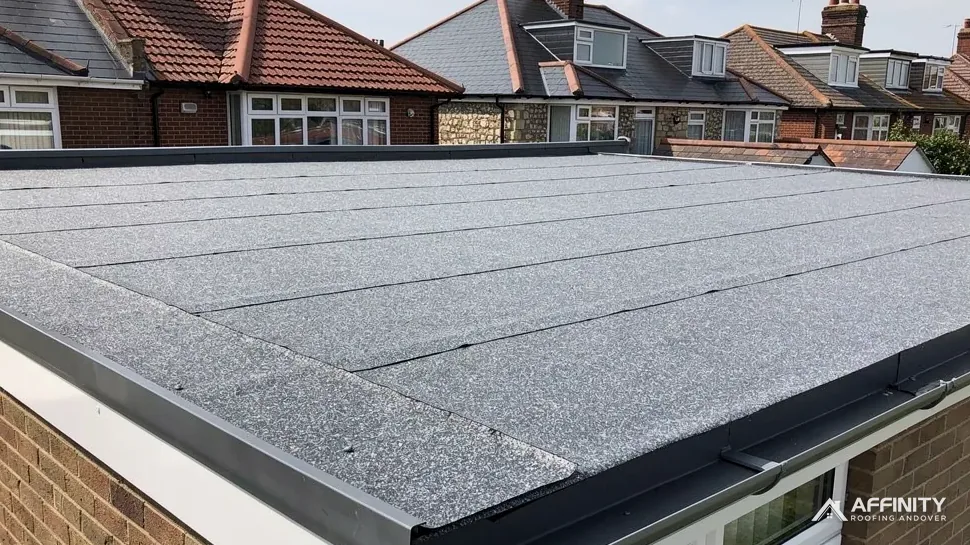
Felt that has lost its mineral chips, rubber that has gone hard and brittle, a fibreglass topcoat that shows the weave of the glass beneath: all of these mean the weather-facing layer is worn out. Check also for lifted edges, where the covering has pulled away from the upstand, and for open laps in felt.
Plants and debris
Moss, weeds growing in cracks, and heaps of leaves hold moisture against the covering and block the outlets. They are often a symptom of a roof that is not draining properly rather than the cause of failure.
Ponding, drainage and the fall
Standing water on a flat roof ranks among the clearest signs that something is wrong, and an easy one to ignore.
What counts as ponding
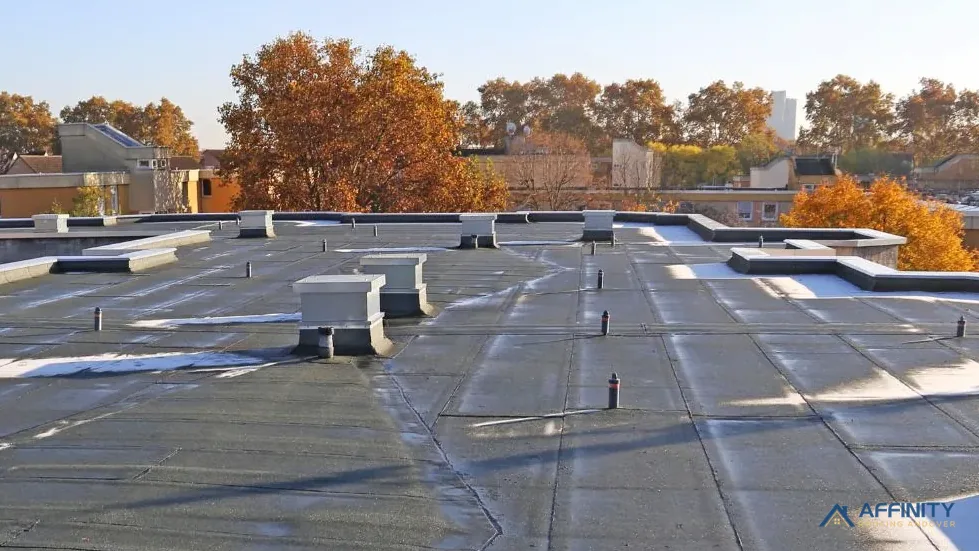
A damp patch that dries within a day is normal. A pool that is still there 48 hours after rain, or a dark ring left by water that has evaporated, is ponding. It shows that the roof is not falling to the outlet as designed. Under BS 6229:2025 the finished fall should be no flatter than 1:80, and IKO advises designing for 1:40. A roof that holds water has either lost its fall or never had enough of it, and the shortfall may be small: a few millimetres of dip across a deck is all it takes. Our guide to flat roof ponding explains the causes.
Why standing water matters
Water that lies on a covering wears it faster, collects grit and algae and gets into every flaw. In winter it freezes and expands, widening any crack. A pool is also heavy: a deck that dips in the middle holds more water, and the dip deepens.
Outlets and gutters
Look at the outlets, the gutter and the downpipe where the roof drains. A blocked outlet backs water up into a pool, and a gutter full of grit and granules shows that the covering is shedding its surface. Clearing a blockage is simple. Finding out why the roof keeps blocking is the part that needs a survey, because the cause may be the fall, a missing grating or a tree overhanging the roof that drops its leaves every autumn.
Soft, spongy or sagging decks
The deck is out of sight, but it tells on itself in ways that you can feel and see from below.
Spongy underfoot
A section of roof that gives under the foot, or feels as if it has a cushion beneath it, is a damp or rotten deck. This is a sign for a surveyor to check with a moisture meter and a probe, not for the owner to test by jumping on the roof. The risk of falling through, or of injuring a person standing below, is real.
Sagging between supports
A visible dip across the roof, particularly along a line where the joists run, means the boards or the joists beneath have weakened. Sometimes the dip is a result of long-term wetting, and sometimes it is a design fault, such as boards that were too thin for the span. In either case a new covering laid over a sagging deck will pond.
Black marks and mould
Dark mould on the ceiling below and a musty smell in the room mean that water or condensation is reaching the timber. Our answer on rotten flat roof decking goes through what a survey does about it.
Why this matters most
Of all the signs in this guide, a soft deck is the one that most reliably shifts the answer from repair to replacement. A new covering can only be as sound as the boards beneath, and those boards have to be replaced before the roof is recovered.
Signs inside the house
Many flat roof problems are found first on the ceiling below, not on the roof. Treat these as warnings whether or not the roof looks worn.
Stains and tide marks
A brown or yellow patch on a ceiling, usually with a darker edge, is the mark left by water that has dried and returned several times. A fresh, damp stain that grows after rain points to an active leak. Mark the edge of the stain with a pencil and a date so you can see whether it spreads.
Bubbling or peeling paint
Paint that blisters, plaster that crumbles and wallpaper that lifts at the edge of the room can show that damp is travelling along the ceiling from a leak somewhere else. Water often runs along a joist before it drips, so the stain is not always under the fault.
Drips and light fittings
Water at a light fitting is a safety issue. Switch the circuit off and call an electrician as well as a roofer. Do not use a switch that is wet or a socket that has had water running past it. A drip into a bucket tells you the hole is open, and a leak that appears only in strong wind-driven rain points to a flashing or upstand failure rather than a hole in the middle of the roof.
Condensation
Not every stain is a leak. Warm, moist air from a kitchen or bathroom can condense on a cold ceiling or deck and cause mould that looks like a roof fault. Our answer on condensation under a flat roof explains how to tell the two apart.
Which signs mean replace, and which mean repair
Not every sign is a cause for alarm. Weighing them is what a survey is for, but you can form a first view, and a fair one, from the pattern on your own roof.
Signs that usually point to a repair
A single split or lifted seam, one failed pipe collar, a blocked outlet, a small blister that is not splitting, or a cracked fillet at one wall. These are local, and the roof around them is healthy. A repair restores the roof for the cost of a visit and a small amount of material.
Signs that point to replacement
A soft or sagging deck, blisters spread over the whole surface, splits in several places that keep returning, a covering that crumbles when scratched and ponding over a wide area. Add a roof already near the end of its published life (HomeBuilding gives felt 10 to 15 years, EPDM and GRP 25 to 30 years, Sep 2025) and the case becomes strong.
The middle ground
Some roofs sit between the two. A middle-aged roof on a dry deck with a few clustered faults may take a repair now, with a plan to replace in a few years. Our guide on repairing or replacing a flat roof goes through the decision step by step.
Why not guess
Guessing wrongly costs money in both directions. Repairing a roof that needs replacing wastes the repair, and replacing a roof that needed only a patch wastes the roof. The survey, with photos, is how you avoid both.
Photos that help the survey
Good photos save a visit and speed up the answer, and they cost nothing to take. A phone is enough. If you can safely get a view of the roof, or of the ceiling, these are the shots worth sending.
From inside
The whole ceiling, so the shape and position of the stain are clear, and a close-up of the stain with a coin or a ruler beside it for scale. Add one of the loft hatch or the ceiling around any light fitting if water has appeared there. Note the date and what the weather was doing when it first appeared.
From outside
Stand back for the whole roof, then step in for the edges, the outlets and any pipes or rooflights. A picture taken from an upstairs window is often as useful as one taken from a ladder. Keep your feet on the ground or on a stable ladder; do not climb onto the roof to take a picture.
From the gutter
A shot of what has collected in the gutter or the downpipe, such as grit, granules or leaves, shows what the covering is shedding.
What happens next
Photos let us tell you what the likely cause is and how urgent it is before anyone has to visit. The survey itself then checks the deck, the fall and the details, and we send you photos of what we find on your own roof. Afterwards you get one total in writing for whatever we advise, be it a repair or a new roof. If you want to know how long a given fix should last, ask, and the answer will be given plainly.
If water is coming through near a light fitting or a socket, switch off the circuit and have an electrician check it before you do anything else.