Ask three people what a flat roof costs and you may get three answers that are each a few thousand pounds apart. That is not because anyone is guessing. A flat roof can mean a small garage lid, a kitchen extension or a long run over a row of shops, and the covering, the state of the boards underneath and the way the roof is reached all change the bill.
Size, access and the detail of the roof all move a price, alongside the choice of covering. So this guide starts with what the guides actually say, with their names and dates, then explains the parts of a job that move a price up or down. It also covers insulation, which a replacement often brings with it under Part L, and how to read a written quote when it arrives.
The figures below come from national cost guides as typical UK ranges; none of them prices your roof, and none is ours. The price of a particular Andover roof can only be set after someone has looked at it, which is why we survey first. Our flat roofing hub explains the coverings in more detail.
What the cost guides publish for a garage
The most useful starting point is a roof of known size, and Which? and Less both price a single garage.
The Which? figures
In November 2025 Which? surveyed 11 of its approved tradespeople and published a range for re-covering a single garage, 6m by 3m, with new felt: £1,400 to £3,500. For other materials, such as a PVC or EPDM single-ply membrane, or where new boards are needed, the range is £1,950 to £4,000. Which? states that its prices include labour and materials but exclude VAT. Neither range is a price for your roof, but both are a sensible yardstick to hold a quote against, provided the garage is about that size and the boards are in reasonable order.
Less and MyJobQuote
Less puts a garage roof of 15 m2 at £1,200 to £2,500 (Oct 2026). MyJobQuote gives flat roof replacement as between £1,500 and £6,000 (Oct 2026), a much wider spread that is not tied to a single garage or one roof size. Its page on rubber roofing quotes about £60 per square metre for EPDM and an average rubber roof of around £1,050 (Oct 2026).
Reading the spread
These sources overlap near £1,500 to £2,500, then part company at the top. The gap is not an error. A guide that assumes a straightforward roof and easy access ends lower than one that includes new boards, upstands and rooflights. When you hold a written quote up against these ranges, ask what it has assumed about the boards, the access and the insulation. A quote that says nothing about any of them has left a gap that someone will fill later.
Felt, rubber and fibreglass compared on material alone
Which covering costs least is a fair question, and the answer needs a clear view of what is being compared.
Supply-only costs per square metre
HomeBuilding's table of supply-only prices (Sep 2025) lists felt at £65 per m2, EPDM at £105, GRP at £110 and lead at £170. Supply-only means the material and nothing else. There is no labour, no deck work, no edge trims and no scaffold in those numbers, so they say how the materials rank, not what a finished roof costs. Multiplying one by your roof's area produces a number that bears little relation to a real quote.
Why the lowest-priced material is not always the lowest-cost roof
Felt costs least to buy and is also the shortest-lived of the group: HomeBuilding gives felt 10 to 15 years, Less 10 to 20. Both of them give EPDM longer, at 25 to 30 years and 30 to 50 years respectively. Spread over the years a roof is expected to last, the covering with the higher upfront price can be the one that costs less per year. Our torch-on felt guide sets out how that covering is built and where it fails.
Fitting the covering to the roof
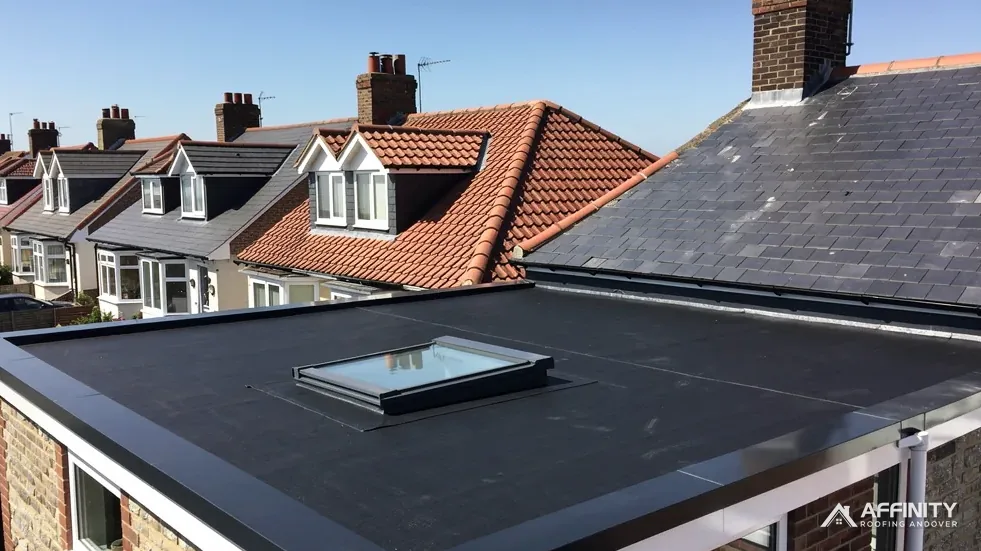
A small, awkward roof with many pipes and rooflights suits a liquid system that can be worked round them. A big, plain roof suits a single sheet. The survey decides which, and the choice moves the price as much as the material does. A felt roof laid in layers also needs more care near timber, because it is fitted with a flame, and that affects how the work is planned.
What moves the price of a new flat roof
Three roofs of the same size can end up at three prices. These are the reasons.
Access and scaffold
A roof that can be reached from a ladder at the back of the house is cheaper to work on than one three storeys up over a footpath. Scaffolding is not always needed, but where it is and it stands on the public highway, you need a scaffold licence from the highway authority, which for Andover is Hampshire County Council. On Hampshire County Council's page the application is made by the scaffold firm, not the householder, and we sort the paperwork out with them. Where scaffold is needed, the written quote includes it.
The deck
Old boards that are sound can be kept. Boards that are soft, damp or stained underneath need replacing, and that is one reason a final price lands near the top of a range. The higher Which? range covers jobs where new boards are needed.
Fall and drainage
If the roof ponds, the fall has to be corrected, which can mean tapered insulation or new firrings, the sloping timber strips that lift the deck to a fall. BS 6229:2025 sets a minimum finished fall of 1:80 for membrane roofs.
Details
Rooflights, vents, pipes, a parapet wall, a wall upstand and the length of edge trim all add time. A roof with a lot of details costs more than a plain one of the same area, because each junction has to be cut, sealed and checked by hand, and the work cannot be sped up by laying a bigger sheet.
Insulation and Part L on a replacement
Building Regulations shape the cost of a flat roof replacement, because Approved Document L treats a new waterproof membrane as renovation, and that can bring insulation with it.
What the regulations say
Approved Document L (Conservation of fuel and power, England) treats a replacement waterproof layer for a flat roof as renovation. Where a thermal element is renovated, the upgrade target in its Table 4.3 is a U-value of 0.16 W/(m2K), subject to the feasibility and payback tests in paragraph 4.13. A U-value measures how readily heat passes through a roof, and a lower number means a warmer roof. The 2021 edition applies now, and a new edition takes effect on 24 March 2027.
What it means for the price
Adding insulation means thicker build-up, taller upstands and sometimes new trims and window cills, so the price rises with the thickness. It also means the roof is more comfortable and cheaper to heat, which is why we cost it into the written price rather than leave it out. Our guide to warm deck and cold deck roofs shows how the layers are arranged.
Building control
Whether a job needs a Building Regulations application depends on how much of the roof is affected. The Planning Portal's test is less than 25 per cent of the building envelope and less than 50 per cent of the roof. Replacing a whole garage roof affects all of that building's roof, so check with your building control body before work starts, because they decide if an application is required and the roof may need inspecting while it is open.
How to read the quote when it arrives
A written quote is the main protection a customer has, and a good one is easy to read.
What a quote should state
It should name the covering and the make, say whether the boards are being kept or replaced, state the insulation, name the finish to the edges and the outlets, and say who disposes of the old covering. It should state one total, and say whether VAT and scaffolding sit inside it. VAT is 20 per cent on top of a net figure, which makes a total without VAT a sixth smaller than the total with it, not a fifth.
How many to ask for
Citizens Advice recommends collecting at least 3 written quotes from different traders before you choose. Give each one the same information, ideally the same set of photos, so they are pricing the same roof.
Low and vague
A low number with a short description is a risk, because it may leave out boards, insulation or scaffold, which then appear as extras. A fair price tells you what you are getting and why it costs what it does, and a good quote reads like a plain account of the job rather than a sales page. If a trader will not put the covering and the extent of work in writing, take your enquiry elsewhere.
Our approach
We survey the roof, take photos of the deck and the underside, explain what we found, and then give one written total. If the work changes because the boards are worse than they looked, we tell you before anything else is done.
When a repair is the better buy
The lowest-cost new flat roof is the one you do not need yet. Before paying for a replacement it is worth knowing whether the existing one can still do its job.
Signs a repair will do
A single split or a failed joint at a wall, on a roof with a dry deck and a sound fall, is usually a repair job. A patch costs a fraction of a replacement and can add some years. Our guide on whether to repair or replace a flat roof goes through the signs.
Signs it is time
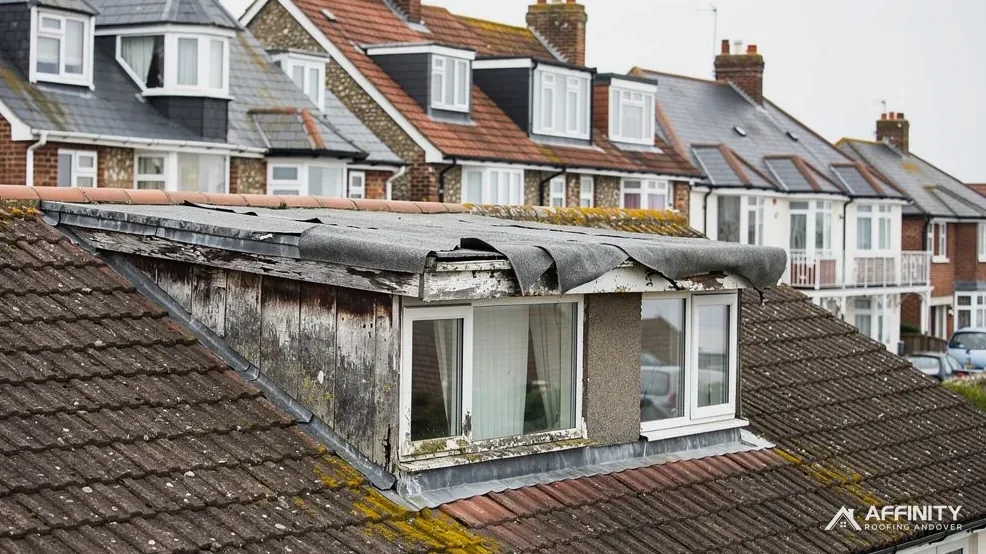
Soft boards, repeated leaks in different places, a covering that has blistered across its whole area or standing water over a wide patch all point to replacement. Patching those only moves the leak along.
Overlays
Fitting a new covering over an old one saves some labour, but it traps whatever is already wet and adds weight. Whether it is acceptable depends on the survey, and our answer on overlaying a flat roof explains the risks.
Planning the work
Flat roof work goes best in settled weather, and the sequence rarely changes: strip, inspect the deck, correct the fall, lay insulation, lay the covering, finish the edges. We tell you what happens each day and leave the site tidy, with the waste taken away. Ask any trader how long the job will take and what happens if rain is forecast halfway through, because a half-covered roof needs a plan.