The short answer
Usually, yes. Ridge tiles that are whole, free of cracks and not worn through can be lifted, cleaned of old mortar and laid again on a new batten with mechanical fixings. Clay and concrete tiles both come off intact more often than people expect. Cracked, spalled or chipped tiles are replaced, and a survey sorts the keepers from the rejects before any price is given.
When a ridge tile is worth keeping
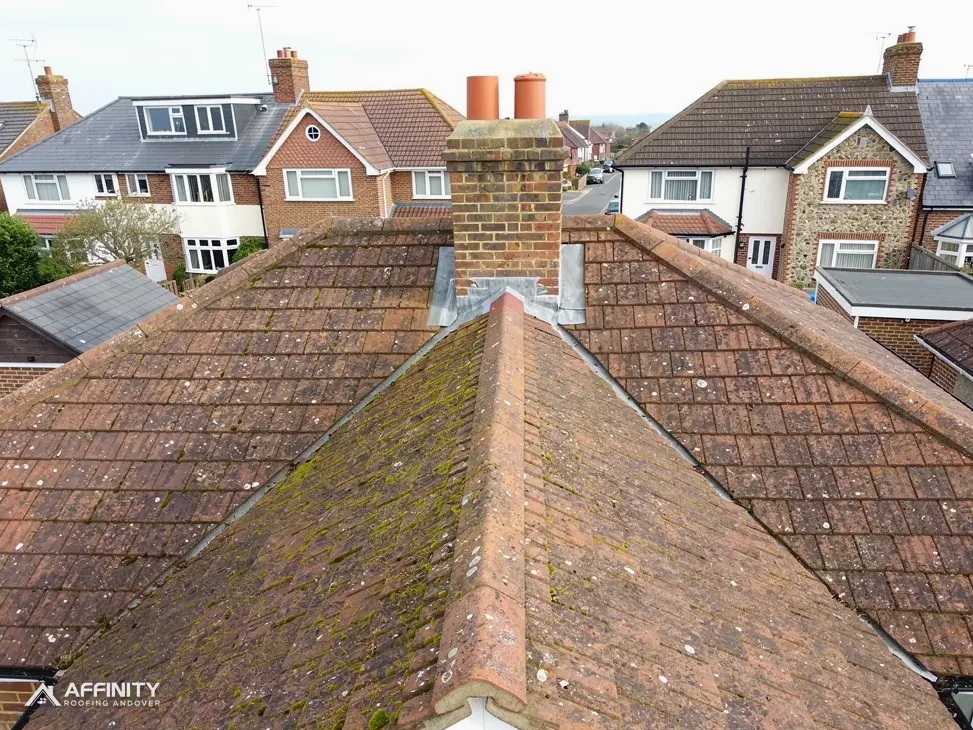
Ridge tiles are the curved caps that finish the crest of a roof. They are made for exposure, and many outlive the mortar that bedded them. When the bed fails, the tile above it may be perfectly good.
A tile worth keeping is whole, has no through-cracks, and keeps its shape along both edges and its end profile. The surface can be weathered, stained or covered in moss without that mattering, because the glaze or the colour coat is not what keeps rain out. The body of the tile is.
Reusing sound tiles has real advantages. The roof keeps its original look, which matters on an older house where a modern tile would stand out. Colour and texture match exactly, because they are the same tiles. There are fewer to buy, less waste goes in the skip, and nothing needs ordering and waiting for before the job can start.
The limit is quantity. A ridge line gives up a few casualties in the lifting, and a replacement has to match the rest. We count the sound tiles before the job is priced, so the number of new ones is known in advance. On a short ridge that count is quick. On a long one, with hips, it is worth doing carefully, because it decides how much of the quote is spent on new tiles.
Cleaning off the old bed
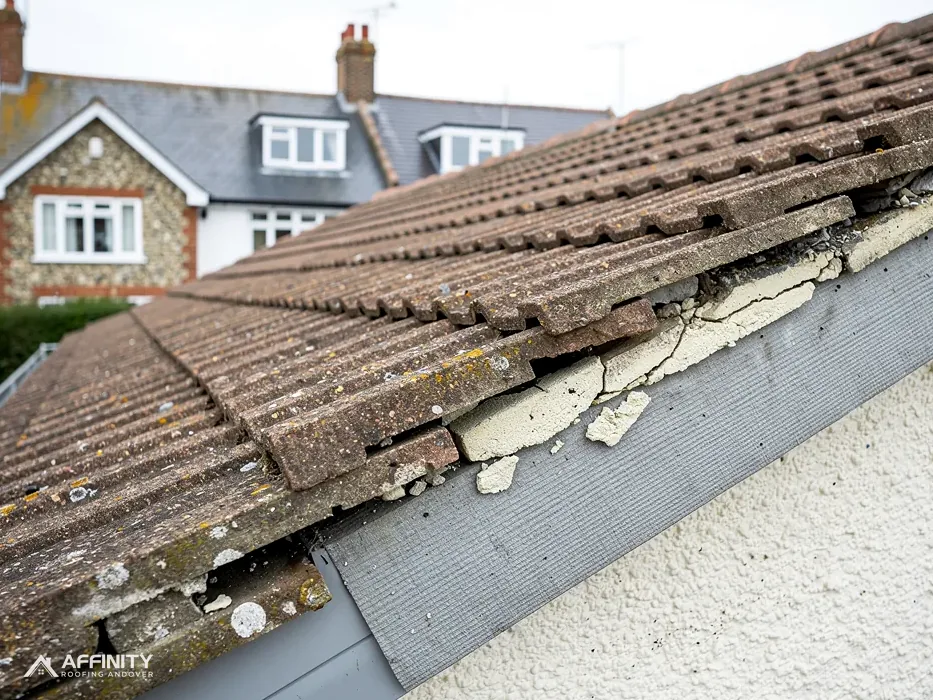
Reuse depends on getting the old mortar off. Each tile is lifted, and the bed is chipped away from its inside edges and ends with hand tools. Pressure is kept low, because the tile edge is the part most likely to chip and a chipped edge makes a poor seat for the new fixing.
Marley does not recommend jet washing roof tiles, warning that high-powered jets can damage a tile's surface and shorten its expected life considerably. For that reason the ridge tiles are cleaned with hand tools and a brush, not blasted.
Once clean, each tile is checked again in the light of day. Hidden cracks sometimes appear only when the mortar is off, along the underside or at the lip where the tile rests on the slope. A tap with a hand tool gives a clear ring from a sound tile and a dull note from a cracked one.
The tiles that pass are stacked in the order they came off. Laying them back in that order makes the run quicker and keeps the pattern even, with the most weathered ones staying beside their old neighbours rather than standing out among newer pieces.
Breakages that rule a tile out
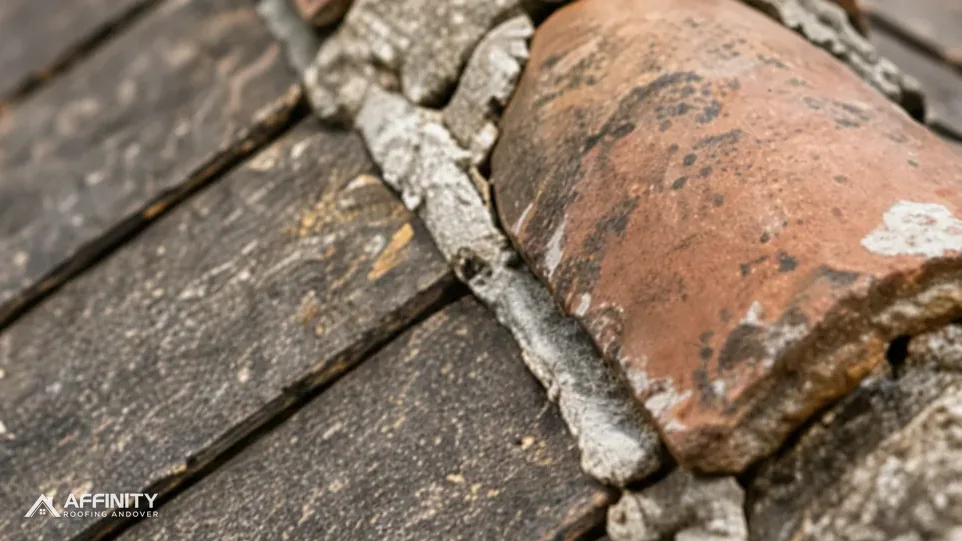
Some faults decide it at once. A tile cracked right through is out, because it can split further under a fixing or in a hard frost, and a split tile shed on the path is a hazard of its own. A tile that has lost its end profile, where it meets its neighbour, will not seal against it. Spalling, where the face flakes away in layers, means the tile body is giving up and will not last.
Chips on an edge may be acceptable if they are small and away from a fixing point. We judge them one by one, and where the choice is close, we err toward replacing, because a ridge is hard to reach and costly to scaffold twice.
For the replacements, an exact match is the aim. On some older roofs the right tile is no longer made, and a reclaimed tile of the same type may be the best fit. Our answer on cracked ridge tiles covers the single-tile case.
The survey photographs show every tile that is ruled out and why, so you can see the reasoning for yourself.
Laying them back, and the saving
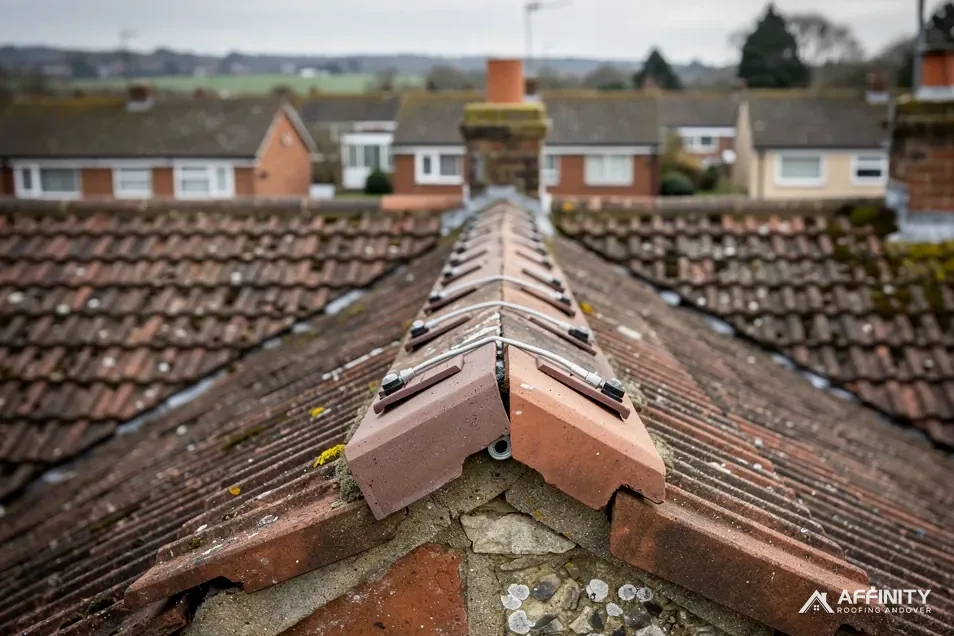
Reused tiles are laid on a sound batten, a timber strip along the apex, and fixed mechanically. The fixing matters more than the tile. Since the 2014 revision of BS 5534, Marley says, a mortar bed on its own has not been accepted as the hold for ridge and hip tiles, so every reused tile gets a clip or screw whatever it sits on.
The saving comes from not buying a full run of new tiles and not matching them. Which? lists a new ridge tile at £80 to £300 excluding VAT (November 2025), and MyJobQuote's guide of October 2026 gives £225 to £550 for a ridge. Where most of the old tiles go back, the cost of new ones falls away, which is where the saving comes from.
The dry ridge and verge page sets out the wider options. It is not always cheaper. If the batten has gone soft, or the tiles are mostly spalled, replacement is the honest answer, and we show you why.
Where a mortar bed goes back, our answer on the ridge tile mortar mix explains the mix.