The short answer
Mortar falls off ridge tiles because the bed has aged, moved or been worked on by weather. It is hard but brittle, so roof movement and temperature change crack it, and water then loosens the pieces. The crumbs are a warning that the tiles above have less holding them than they did. The sound repair re-beds the tiles with mechanical fixings, not another layer of mortar alone.
What the mortar is doing up there
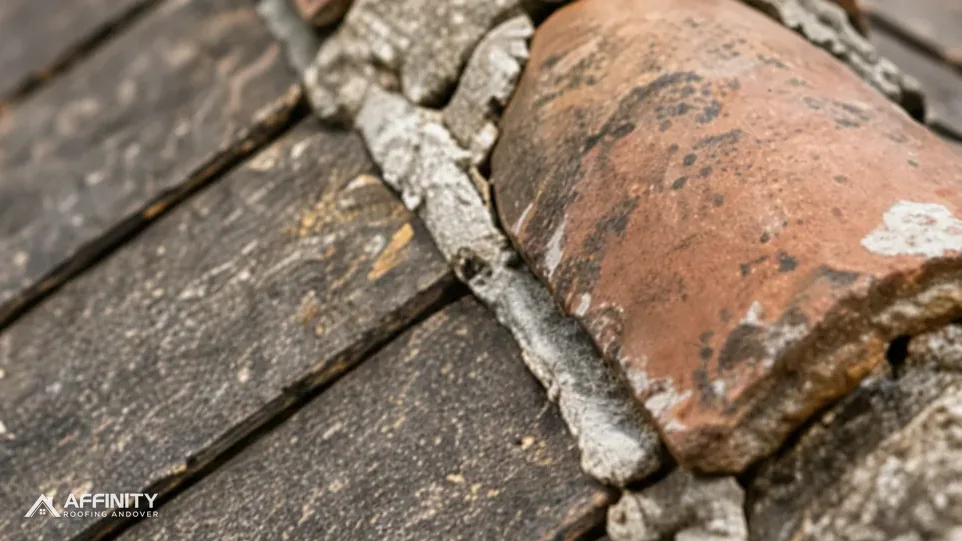
Curved capping tiles run along the crest of the roof, and that line is the ridge. Traditionally each one is bedded in mortar, with a band of it along both edges to seal the joint with the slope below. Roofers call the exposed band of mortar flaunching, and it is the part you see from the ground.
Mortar is rigid. It carries weight well and it resists being squeezed, but it does not bend, and it does not hold on when it is pulled. A roof is never quite still. Timbers swell and shrink with damp, the structure moves a little with the seasons, and the ridge line is exposed to sun and wind. Each movement is tiny, and each one opens a hairline crack.
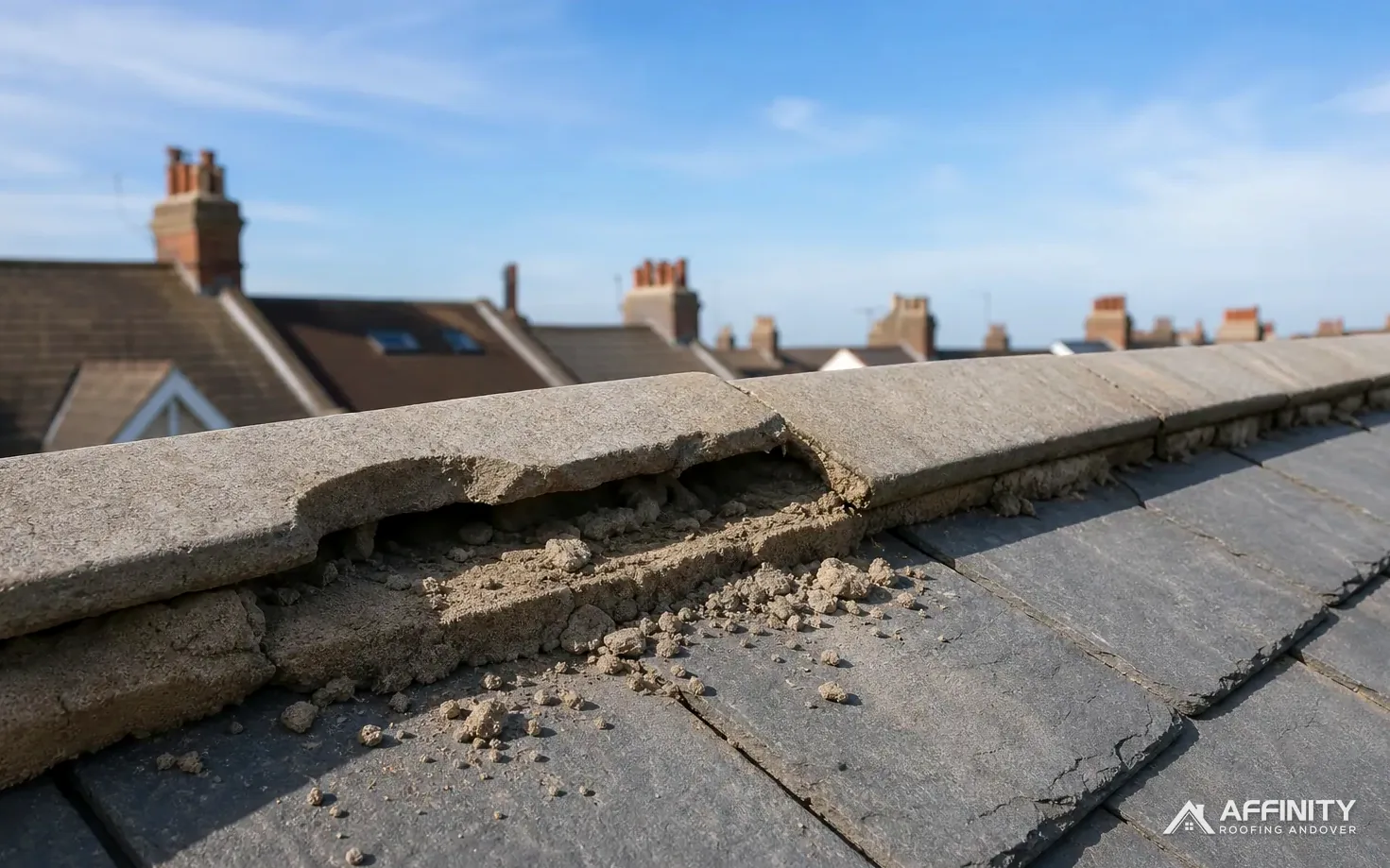
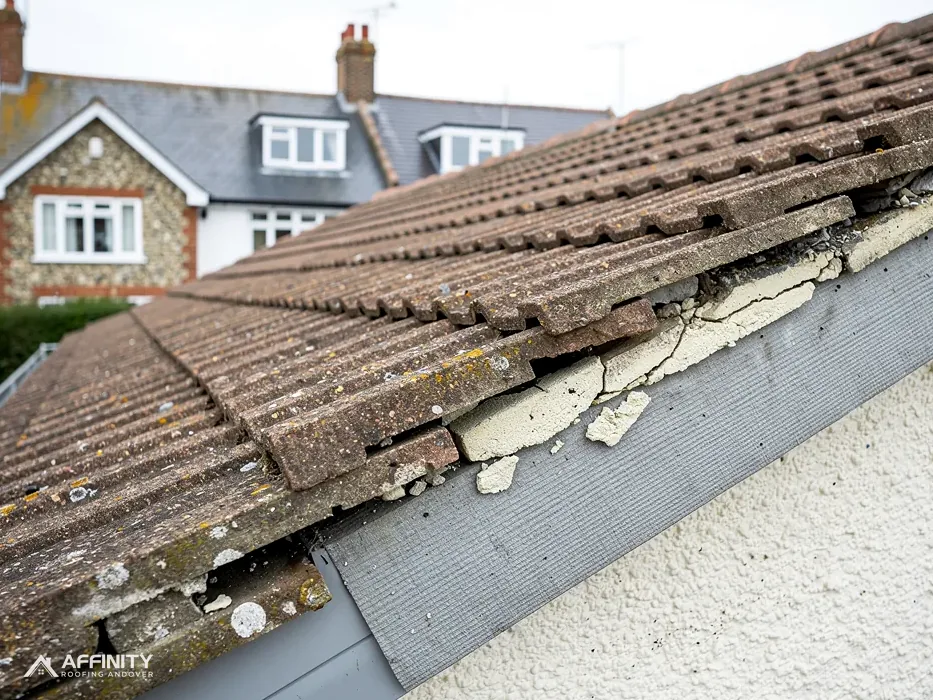
Once there is a crack, rain gets in, freezes and widens it, and the edges break away. Sections of flaunching then drop onto the roof below or into the gutter, which is usually when the owner first notices.
Marley explains that BS 5534 changed in 2014, and since then a bed of mortar has not been accepted as the sole hold on a ridge or hip tile. Good practice adds a mechanical fixing to every one.
Age, movement and weather
Older ridges fail for reasons that stack up. The mortar mix itself loses strength over time, particularly where it has been repointed on top of a decayed bed. A thin repair layer over crumbling material does not bond, and it comes away in sheets.
Movement is the second cause. A house that has settled, or a roof timber that has bowed, puts a steady strain along the ridge. The tiles shift a fraction and the bed cannot follow.
Weather is the third. Water enters hairline cracks and expands as it freezes. The mortar is also washed by rain, which lifts the fine part of the mix and leaves a sandy, friable surface. Moss and lichen then take hold and hold moisture against the joint.
None of these causes announces itself. A bed can look intact from the garden and still be loose underneath, while another with a visible gap can still be firm. That is why we try the tiles by hand during a survey, and photograph the ones that move.
Our answer on the cracked ridge tile covers what to do when the tile itself has broken.
When it becomes a risk
Crumbs on the ground are a nuisance. A loose ridge tile is a hazard. A tile that has lost its bed can lift in a gust, slide off the roof and land on a path, on a car or on someone passing. The longer the ridge goes without attention, the more tiles sit on a weakened bed.
Water is the other risk. Once the flaunching has gone, the joint between ridge tile and slope stands open. Rain can blow in under the tile and wet the batten and rafters near the apex. Staining on a ceiling below, or a dark patch up in the roof space, may be a late sign of this.
Please keep off the roof. A ridge is high, the tiles are slippery, and a loose one can move under a hand. A snapshot from the garden or an upstairs room is enough to start.
If a piece has already fallen, keep people clear of the area below, and look for loose tiles near it. A stretch where several pieces have gone is a stretch where the bed needs attention along its whole length, not just where the gap shows. A roof leak that appears afterwards is dealt with first by making the roof safe.
How the fix is done
The usual repair lifts the loose ridge tiles, clears the old bed back to a clean line, and checks the batten and the top courses underneath. Sound tiles are cleaned and kept, and broken ones are replaced to match. Our answer on reusing ridge tiles covers how the keepers are chosen.
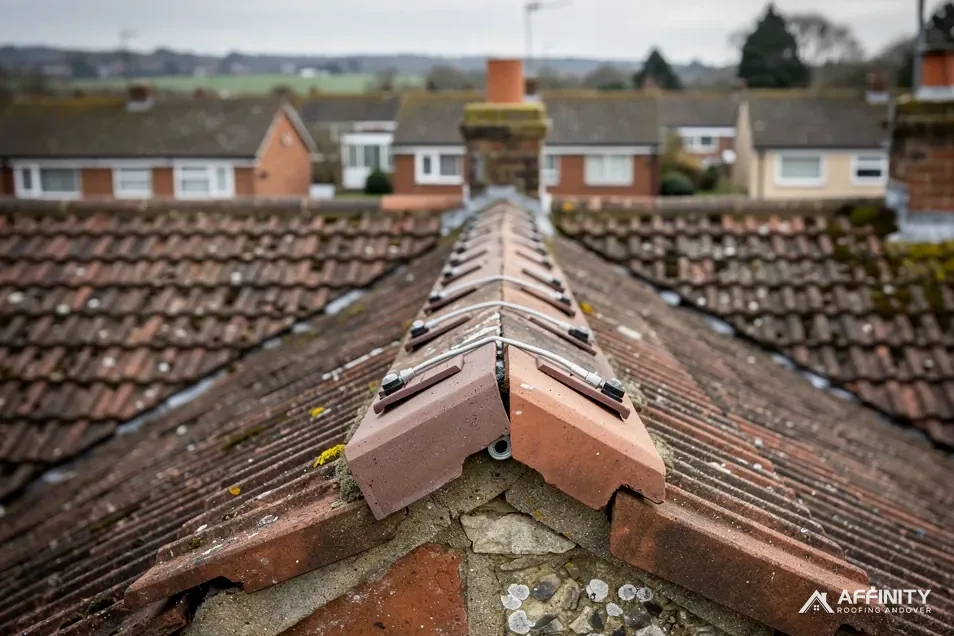
The tiles are then fixed in one of two ways. A mortar bed can go back, but with a mechanical fixing for every tile, so the mortar is not left as the sole thing holding it. Or the ridge can be changed to a dry-fix system, where clips or screws hold the tiles and a ventilated strip seals the joint, and no mortar is asked to carry any load. Our answer on the ridge tile mortar mix covers what goes into the bed if mortar is kept.
What we avoid is a skim of fresh mortar over the old crumbling bed. It looks tidy for a season and then lets go, because it has nothing sound to bond to.
Which? lists putting in a new ridge tile at £80 to £300 excluding VAT, from its November 2025 survey. Your own figure is set by how far the ridge runs, how it is reached and what turns up beneath the old tiles. You see the photographs first, and the dry ridge and verge page shows how the whole job runs.