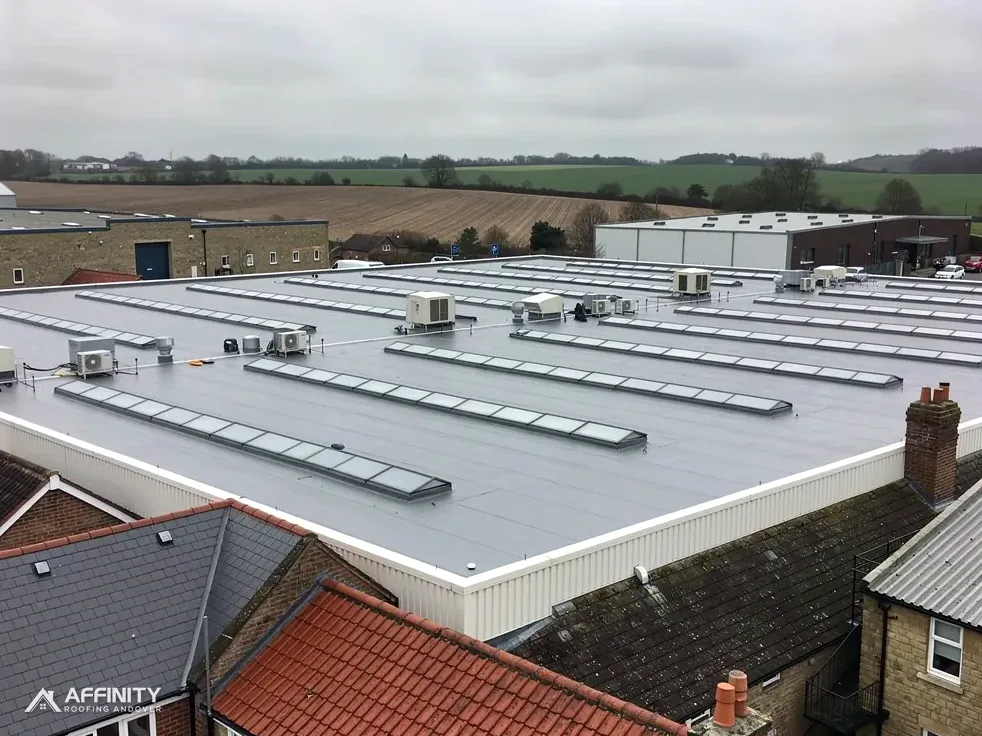
Roof lights are the windows of an industrial building. Rows of translucent panels let daylight onto the floor of a warehouse, a workshop or a farm shed, and they save on electric lighting for as long as they stay clear and watertight. They are also the first part of a metal roof to give up. Plastic yellows and goes brittle, seals perish, fixings corrode, and a light that once sat tight in its profile starts to let water past.
Replacing one sounds simple, because the old panel comes out and a new one goes in. In practice it is among the more hazardous jobs on a roof. The panel being removed may no longer carry weight. The sheets either side are cut open to reach it. The new light has to match the profile of the metal around it or it will leak, and if the building is old, the sheeting itself may contain asbestos.
This guide answers the first question, which is whether a roof light can be swapped in a metal sheet roof at all. It then covers why the old lights are dangerous, how profiles are matched, what the asbestos check involves, how the job is organised and what to expect from the written quote.
Yes, a roof light can be swapped, with conditions
In most metal sheet roofs a failed roof light can be taken out and replaced without touching the rest of the roof. The panels are made to fit the profile of the sheeting, and they are fixed through the same crowns or troughs as the metal sheets they sit between. A like-for-like swap does not require a redesign.
What the conditions are
First, the replacement has to fit the profile. Sheet profiles vary in the height and spacing of their corrugations, and a panel moulded for one will not seal against another. Second, the roof around the light has to be sound enough to take the new fixings. Corroded sheet edges or rotted purlin tops can leave nothing for new screws to bite. Third, the access has to be safe, since the panel being replaced is likely to be fragile, and the sheets beside it may be too. Finally, if there is any chance the roof is asbestos cement, work waits until that has been settled.
When a light is not the only problem
If several lights have failed along a run, or the sheeting around them is corroded, it often makes more sense to deal with the whole slope. Our guide to cut-edge corrosion on metal roofs shows how to tell whether the metal is still worth keeping.
For a single failed light in a sound roof, replacing it is the economical answer. The survey tells you which case you are in, and we show the evidence in photographs.
Why old roof lights are fragile
Fragile roof lights account for many serious falls, and the reason is partly the material and partly the way the roof looks from above.
Material and age
Many older lights are made of glass-reinforced plastic or of plain plastic sheet. Sunlight breaks these materials down. They go yellow, then brittle, then crack. A panel that carried a person's weight when it was new may fail under a hand or a boot after years in the sun. Wired glass in older buildings can also shatter.
Hidden from view
Moss, dirt and algae build up on lights as they do on the metal beside them, and a weathered panel can look much like its neighbours from a few steps away. Painted-over roofs, or roofs viewed in low light, hide the difference further. Someone who knows the roof is up there, but not exactly where the lights are, is at risk.
Why replacement raises the risk
Swapping a light means opening the roof. During that time there is a hole, a damaged edge and sheets that have been disturbed. The work has to be planned so that nobody ever stands on the panel being replaced, or on any other light nearby. Our guide to fragile roofs and working at height sets out the protection measures that apply.
For that reason we work from boards and platforms that spread load across the supports, and we cover neighbouring lights before the first fixing is undone.
Matching the sheet profile
A roof light only does its job if it laps and seals against the sheets either side. That means the profile has to match, and getting this right is the main skill in the job.
Reading the profile
Metal roof sheets are rolled with ribs or corrugations of particular heights, widths and spacings. On site we measure the pitch of the corrugations, the height of the crowns and the width of the sheet cover. We note the direction of the laps and whether the sheeting is single skin, a built-up system with a liner, or a composite panel with insulation between its faces. Each affects the choice of roof light.
Choosing the replacement
Lights are made in profiles that mimic common sheet types. Where an exact match exists, we use it. Where the original profile has been discontinued, we look for the closest equivalent that laps properly, or we propose a different approach, such as a flat-bed rooflight kerb, if profiled lights cannot be made to seal. A mismatch of a few millimetres in the rib height can leave a gap along the whole lap.
Fixings, sealing and laps
The new light is fixed through the crowns with the right screws, caps and sealing washers, with sealant or tape at the laps as the product requires. End laps are made in the direction of the fall so water runs over them and not into them. Our answer on replacing individual roof sheets describes how the same principles apply to the metal sheets around a light.
A panel that fits well at the first visit is a panel that does not need a second one.
Asbestos check before work begins
Before a screw is removed from a roof of any age, we ask whether the building might contain asbestos. For an industrial building the answer is often yes.
Why it matters on a roof light job
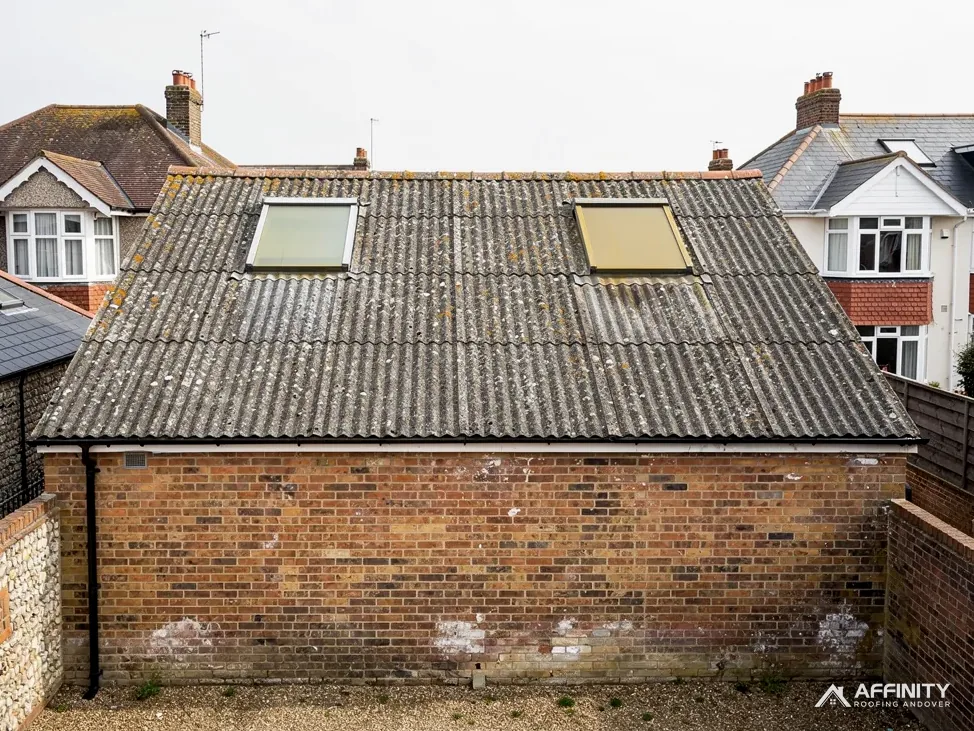
Corrugated asbestos cement sheets were widely used on factories, warehouses and farm buildings, and the lights in them were often glass-reinforced plastic profiled to match. Replacing a light in such a roof means working beside asbestos cement, drilling or cutting near it and putting loads on it. If the sheets are broken, fibres are released.
What HSE says
HSE's advice is to treat a pre-2000 building as containing asbestos until information says otherwise, and its A14 leaflet classes asbestos cement roofing as fragile in every case. That makes the check a safety step and a health step at once. Ask for the asbestos register. If there is none, a survey for asbestos goes first, and MyJobQuote gives a typical UK figure of around £325 for one (September 2026).
If asbestos is present
The work then depends on the type and condition of the material. Under HSE's categories, lifting asbestos cement out whole is non-licensed, while substantial breakage turns it into notifiable non-licensed work. Asbestos insulating board, which can be found in soffits and linings, is treated differently, and non-short-duration work on it can be licensable. We plan the job around what the survey finds, and any waste is double-wrapped and consigned correctly.
Our answer on whether you need an asbestos survey before roof work covers the point in more detail.
How a replacement is carried out
The steps follow a set order, and it is the order that keeps the job safe and dry.
Setting up
Access is established first: a mobile platform, a scaffold or a safe route with boards. Edge protection goes in where the working area is near an edge. Every roof light within reach of the work is covered or marked. Inside the building, the area under the light is cleared or protected, because glass, plastic and debris can fall.
Taking out the old light
The fixings are removed, the old panel is lifted off in one piece where it can be, and the sealing at the laps is cleared. The exposed purlins and the edges of the neighbouring sheets are inspected. If the purlin tops are rotted or the sheet edges have corroded, the survey notes are updated, and we explain what additional work is needed before the new light can go on.
Fitting the new light
The new panel is laid on a bed of sealant or tape, lapped over the lower sheet and under the upper one, and fixed through the crowns at the correct spacing. Sealing caps and washers keep the screw holes watertight. Side laps are checked so the water path runs clear.
Checking and tidying
When the light is on, we check the laps from above and from below. Offcuts, old fixings and the old panel are taken away, with the panel disposed of according to its material. Where the building stays occupied, we brief you on each day's work.
A full roof light row can be done in sequence so that no more than one opening is exposed at a time.
Quote, access and next steps
Replacement is priced after a survey, because the factors that decide the cost are on the roof.
What sets the price
The number of lights, their size and the profile all matter. So does the access: a unit with a mobile platform route is simpler than one with a hidden courtyard and a high eave. The condition of the sheets and purlins around the light, any asbestos found, whether the building stays in use and whether the lights can be done as part of a wider programme all change the total. Every roof differs, and the survey fixes the scope. Your quote is one written total after the survey.
Doing the lights with other work
If the roof needs other attention, such as edge treatment or gutter linings, doing it in the same visit usually costs less than separate trips, because the access is already in place. Our commercial roof condition survey guide describes how we record all of that at once.
Light and heat
New roof lights are an opportunity to review how much light the building needs. Some owners fit more lights to cut lighting costs. Others fit fewer, because a light is a weak point in the roof. If you are considering a change, tell us when you ask for the survey.
How to start
Give us the building's location, its type and a photo of the failing lights, ideally taken from the ground or from inside. We then arrange a survey. Our commercial roofing hub covers the other roof types we handle.