The short answer
A PVC roof membrane's life depends on its thickness, how well its seams are welded, how the roof drains, how much traffic it takes and how it is maintained, so no single number applies. For orientation, published ranges for other flat roof coverings run from about 10 to 50 years. Treat any figure as typical, not as a promise.
What PVC membrane is, and what decides its life
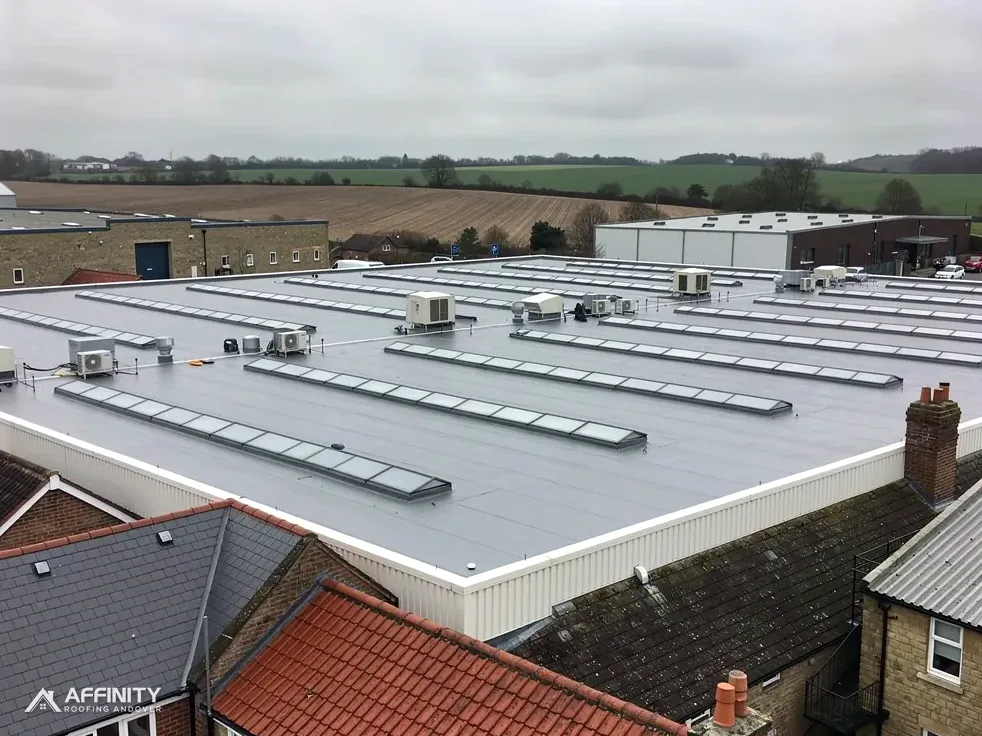
PVC, short for polyvinyl chloride, is a single-ply roofing membrane: a flexible sheet, usually strengthened by an embedded fabric or glass-fibre mesh, laid over insulation on a flat roof. Sheets are joined by heat-welding at the overlaps, which fuses them into one continuous layer.
Several things decide how long it lasts. The thickness of the sheet matters, since a thicker membrane resists punctures and wear. The quality of the welds matters more, because the seams are where leaks begin. Drainage matters because standing water ages any membrane, and UV, heat and chemical exposure add to wear over time.
The details are a further factor. Corners, upstands, outlets and penetrations are formed with preformed pieces and welded flashings, and each is a possible weak spot. A membrane with fine sheets but poor details will fail at the details.
How it is used completes the picture. A roof that is walked on regularly for plant maintenance, or one carrying heavy equipment, wears faster than a roof seen only by an inspector. Walkway pads and protection mats lengthen life. Our page on single-ply roofing compares PVC with the other membranes.
Reading a range sensibly
Lifespan figures are typical ranges published by cost guides and manufacturers. Cost guides show how widely they vary for flat roof coverings. HomeBuilding & Renovating (Sep 2025) gives felt at 10 to 15 years, GRP at 25 to 30 and EPDM at 25 to 30, while Less (Oct 2026) gives felt at 10 to 20 years, GRP at 25 to 40 and EPDM at 30 to 50.
Note the spread for similar materials. The sources disagree because the roofs they describe differ in thickness, installation and conditions, and because each author draws the line differently. A manufacturer will often quote a longer figure for a premium membrane, and independent guides tend to be more cautious.
So when you are given a number for PVC, ask where it comes from, what thickness it applies to and under what conditions. A figure that cannot name its origin is marketing. A range from an independent guide, given with a date, is a better basis for planning.
Use the range to budget, not to schedule. Plan for renewal in the latter part of any quoted range, and let regular inspections tell you whether the roof is ahead of or behind it. Our answer on commercial roof lifespan compares the systems.
Seams, welds and early warning signs
Because the seams are the weak point, they deserve most of the inspection. A good heat weld is continuous, even and uniform, with a small bead of melted material visible along the edge. A poor weld looks patchy, has gaps or lifts when probed with a blunt tool.
On an existing roof, we check each seam by eye and with a probe, looking for lifting edges, gaps at junctions and signs of water tracking underneath. Details are examined closely, since a failing upstand or collar is a common source of leaks.
Other early warnings are discolouration, a chalky surface, shrinkage at the edges which pulls the membrane away from upstands, small cracks near details, and ponding that leaves permanent marks. Each tells us something about the state of the roof and how long it may still serve.
Repairs are often possible. A split can be patched with compatible membrane and welded or bonded in place, and a failing detail can be cut out and replaced. Widespread problems point toward renewal. We show you the evidence by photograph, and the commercial roof maintenance page explains how planned visits keep small faults small.
Warranty, maintenance and renewal
A manufacturer's warranty on a PVC membrane is a contract with terms, not a forecast. It may cover defects in the material for a stated period, may depend on who laid the membrane, and may require maintenance and records. It does not mean the membrane will last that long in your conditions.
Maintenance is what moves a roof within its range. Clear the outlets and gutters, keep walkways protected, repair damage promptly, and have the seams and details inspected regularly. Keep each visit's notes and photographs together, so the roof's history is on file.
When the time for renewal comes, the options are an overlay on a sound existing system, a strip and re-lay, or a different covering. Which one suits turns on the deck, the insulation below and how the building is used. A survey with test openings shows whether insulation is wet and the deck sound.
We survey, photograph the seams and details, and tell you plainly whether the roof needs repair or renewal. The work you choose is priced as a single written total. See the commercial roofing page for the wider service.