The short answer
Yes, if the new sheet matches the old profile, thickness and fixing pattern, and the roof around it can bear safe access. Fragile sheets are a risk to anyone who steps on them, and an older cement sheet may contain asbestos. A survey comes first, because a single damaged sheet can be a sign of fixings or sheets failing across a wider area.
Matching the profile
A profiled sheet has a shape, a depth, a pitch of its ribs and a way of lapping its neighbours. A replacement has to match all of these, or it will not sit properly, will not lap correctly and will leak. Metal sheets come in many profiles, and a sheet that looks similar from the ground may have different rib spacing or depth.
Thickness and coating matter as well. A thinner sheet may deflect more, and a different coating will weather differently, so a new sheet can stand out. Old sheets fade, so a perfect match is rarely possible, though the new sheet should sit in the same colour family.
For older roofs, the original profile may be out of production. In that case a close equivalent is found, or a larger area is replaced so that the junction falls at a natural break such as a ridge or a bay line, not part-way across a slope.
The fixing pattern needs to match too. Fasteners pass through set points on the profile to the framing, each seated on a sealing washer, and a sheet fixed in the wrong place can leak or lift in wind. Our answer on composite roof panels covers the insulated alternative, which is replaced as a panel.
Fragile sheets and safe access
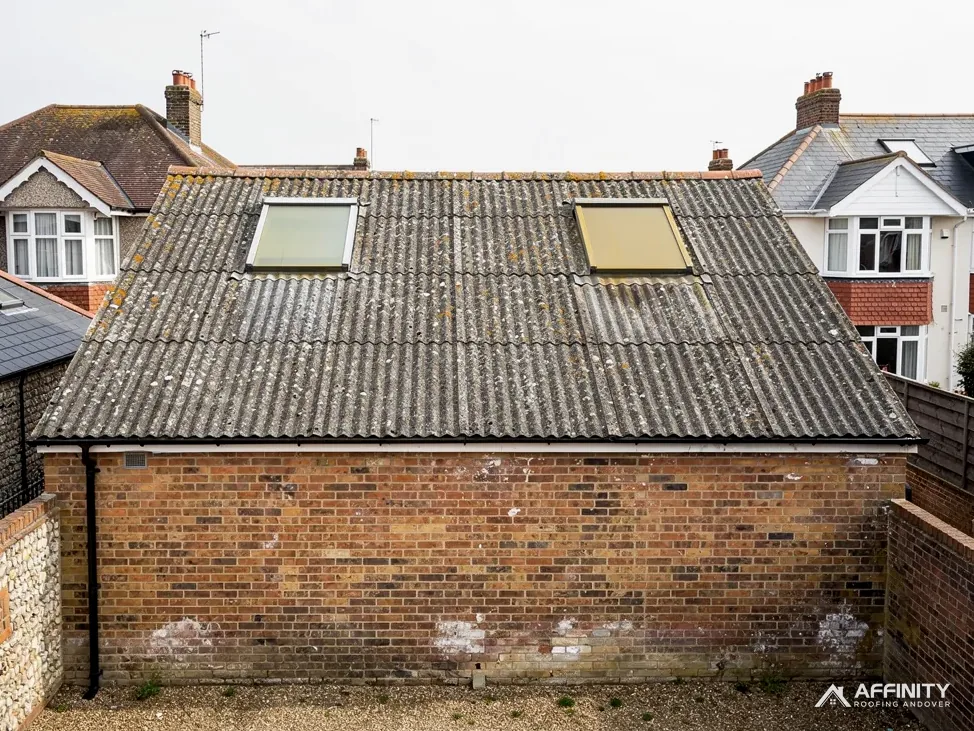
Replacing a sheet means getting to it, and that is where the danger lies. Old sheets, rooflights and weathered cement sheeting cannot be trusted to bear a person. HSE warns that asbestos cement roofs are always fragile, and the same caution applies to old plastic rooflights, which can be painted over or covered in moss so that they blend in with the surrounding sheets.
Safe access therefore means working from a platform, not stepping on the roof. That may be a mobile access platform from below, a scaffold with edge protection, or crawling boards laid across the purlins, depending on the job. Rooflights nearby are guarded or covered.
Nobody should ever stand on a sheet without knowing what it is and what holds it. Many serious falls come from just that. Our guide to fragile roof safety sets out the precautions in full.
Planning the access is part of the price. A single sheet high up on a big unit can cost more in equipment than in material, and it is better to know that before the work than to be surprised by it. We will tell you if it makes sense to deal with other defects in the same visit.
Asbestos cement sheets
On a roof built or refurbished before 2000, HSE advises assuming that asbestos is in the building until a survey shows otherwise. Corrugated fibre cement sheets are the best-known case, so a single damaged sheet on an older unit or farm building should be treated as a possible asbestos job.
HSE treats careful removal of asbestos cement, handled without breaking it up, as non-licensed work, and treats work that will substantially damage or break it up as notifiable non-licensed work. Cracked, weathered or brittle sheets are more likely to break, which is why a survey of their condition matters before a sheet is touched.
If a sheet does contain asbestos, the replacement is a managed job. The sheet is removed whole where possible, wrapped, labelled and disposed of as hazardous waste with a consignment note, and an open skip is ruled out. The duty holder keeps the register, as explained in our answer on the asbestos duty holder.
New sheets are then fixed to the purlins, avoiding drilling through the old ones where that would release fibres. The register is updated so that it shows what has changed.
Why that sheet failed, and what it costs
A single damaged sheet often has a cause: a failed fixing, a lap that has opened, impact from a ladder or a falling branch, a corroded edge, or a roof that is moving. Replacing the sheet without finding the reason invites the same fault next door.
At survey we examine the sheets around the damaged one, check the fixings and washers along the row, examine the laps and look at the purlins beneath. Photographs show you what we found. If the fault is local, one sheet is the answer. If it is widespread, we report that, and the choice moves toward repair of an area or renewal.
The price of a single-sheet job depends on the sheet, the access, the asbestos position and the sealing and flashing around it, and after the survey it reaches you as one written total. For a small job, access can take a big share of the price.
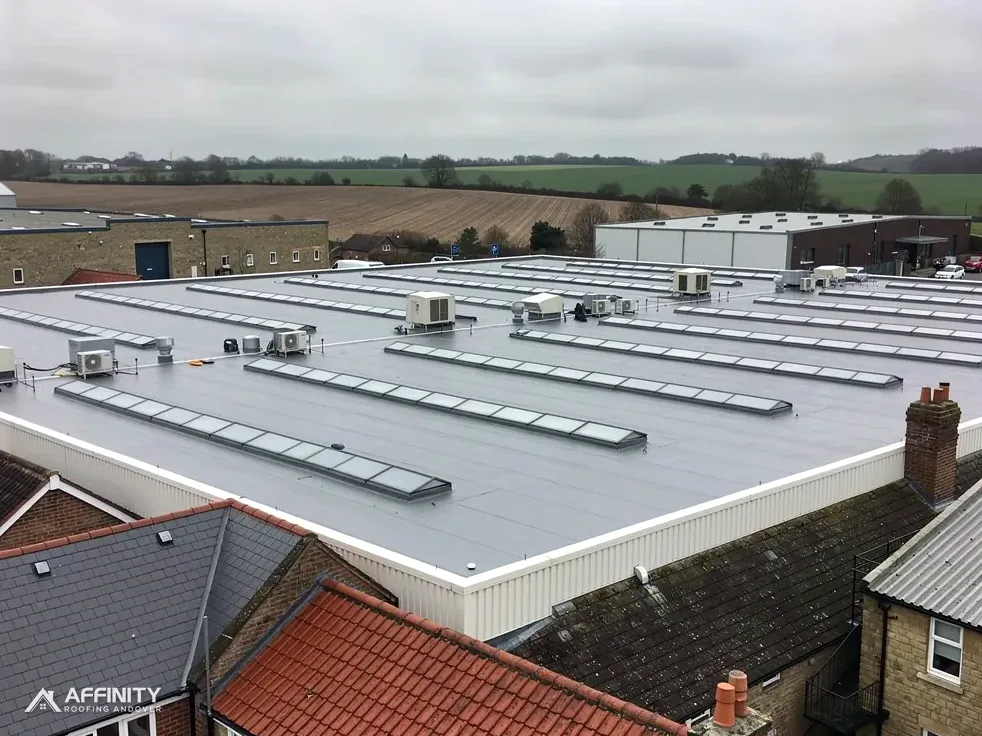
Where several sheets need replacing, doing them together saves repeating the access. The commercial roofing page gives the wider picture of the work we carry out on business roofs.