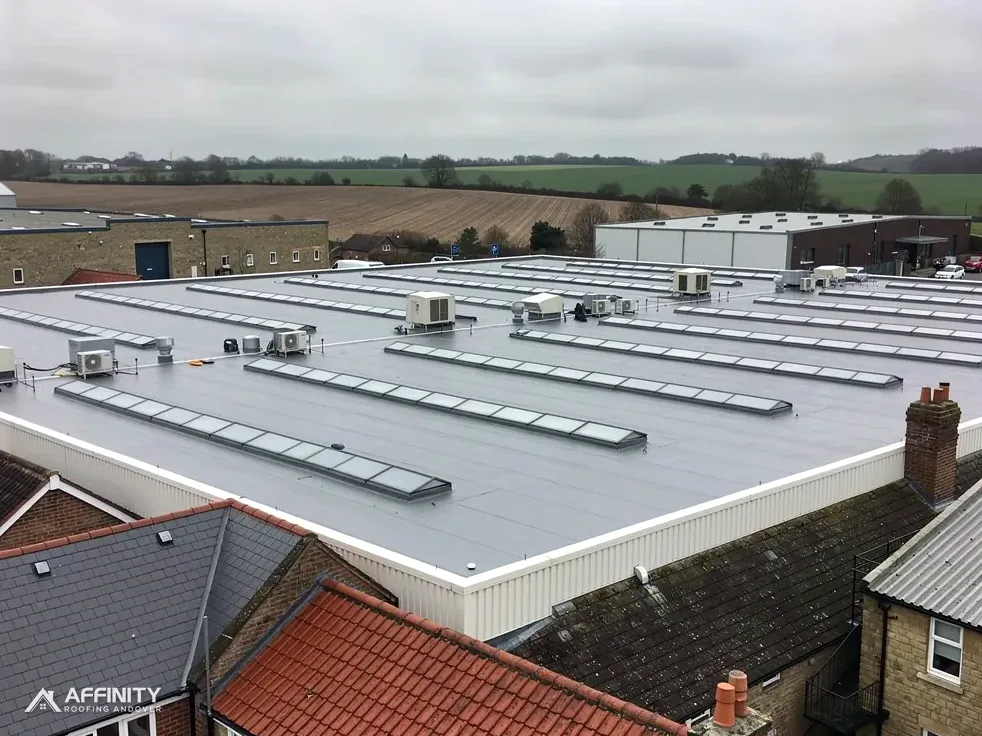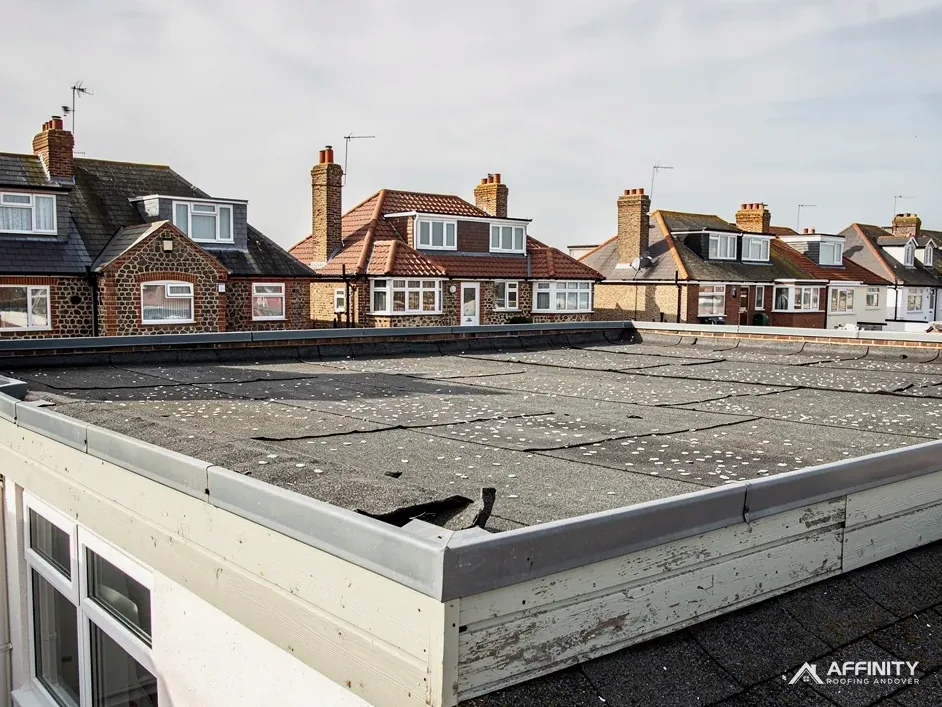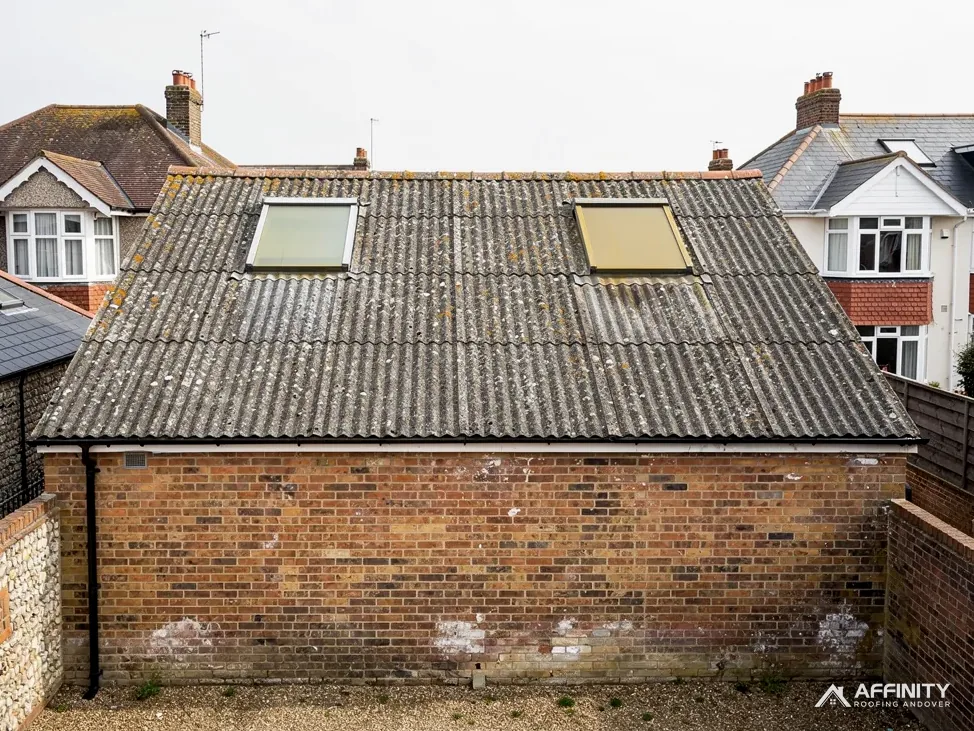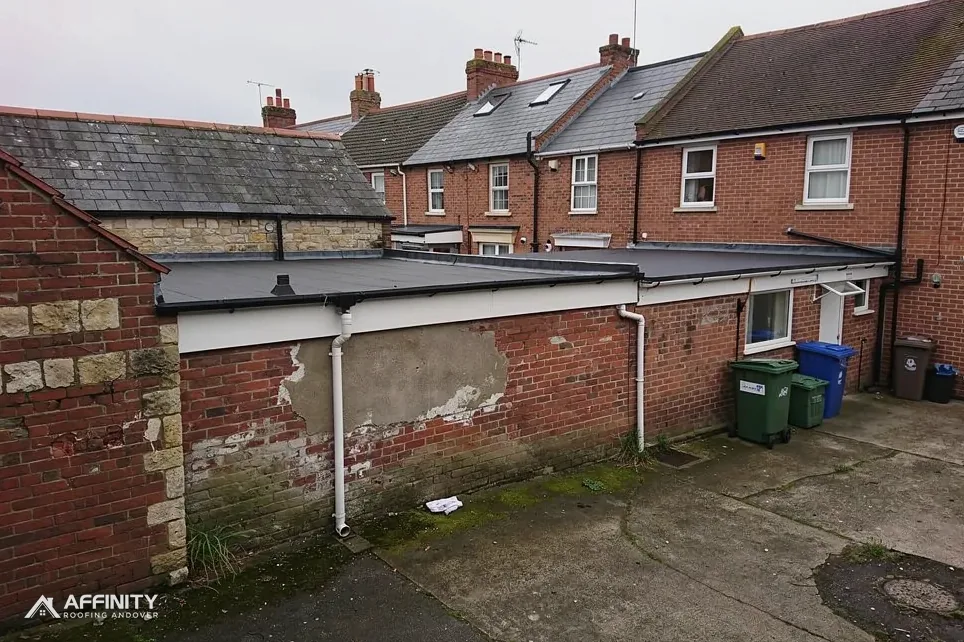
Roofs on commercial buildings are rarely seen close up. They sit above a ceiling void, behind a parapet or at the back of a unit, and the people who rent or run the building seldom have reason to climb up. An owner may first learn the true state of the roof when it leaks, or when a buyer's solicitor asks for a report.
A condition survey replaces that guesswork with a record. Someone who knows roofs walks the whole surface, looks at every junction and drain, notes what is sound and what is failing, and writes up what they found. The survey is useful before a purchase, when a lease is being agreed or renewed, ahead of a maintenance programme, and when a roof has begun to leak and the owner wants to know whether to repair it or replace it.
It is also the stage at which several decisions are made that are hard to reverse: whether the building needs an asbestos check before anyone sets foot on the roof, how the roof will be reached safely, and how the findings will be recorded. This guide covers all three and the survey cost range published for roofs.
What a condition survey is for
A condition survey answers a simple question: what is the roof like now, and what will it need? The answer has to be specific to the roof, with findings tied to locations, or it is no use for budgeting or for negotiation.
Common reasons to commission one
Buyers and their advisers want to know about hidden liabilities before exchange. Landlords and tenants want an agreed starting point, so that disputes about repairing obligations are not argued from memory. Facilities teams need the findings to plan expenditure over the next few years. Owners of a leaking roof want to know whether the leak is local or the sign of a failing covering.
What it is not
A survey is a record of condition, not a design and not a price for a new roof. It may recommend repairs, further investigation or replacement, but those recommendations are separate from the work itself. Our commercial roof maintenance guide shows how a first survey becomes the baseline for planned visits.
Scope before the visit
Before we go on site we agree what is being surveyed: which roofs, which areas, and whether the survey is visual or includes test openings. A roof with several levels, a canopy and a plant deck is more than one roof for survey purposes. The scope sets the time on site and the content of the report.
It also helps to bring any earlier reports, drawings, repair records and an asbestos register to the start. Anything that shows how the roof was built or has been mended saves time and reduces guesswork.
What we inspect on the roof
The survey follows the water. We look at how rain lands on the roof, where it travels and where it leaves, and at every point where the covering could let it in.
The covering
On metal sheeting we look for corrosion, loose or missing fixings, lifted laps and damaged sheets. On felt and single-ply we check laps and seams, splits, blisters and surface wear. On fibre-cement, we look for cracking and for the safety of the surface. A covering is only as good as its weakest joint, and the survey notes where those joints are.
Roof lights, vents and penetrations
Every opening in a roof is a place where the covering has to be cut and resealed. We note the condition of roof lights, smoke vents, flues, pipes and plant bases, along with the sealant and flashings round them.
Gutters, outlets and falls
Gutters and outlets carry the water away. We check them for blockage, for joints that have opened and for any sign of ponding, which shows where the roof is not draining. A box gutter that has failed shows itself as staining below and standing water above.
Edges, parapets and abutments
Copings, parapet linings and wall flashings are checked for gaps and movement. These junctions are where many commercial leaks start.
From the inside
We also look at the underside of the roof where it can be reached: stains on the lining, rusted fixings, daylight at the laps, wet insulation and damp on the structure. Inside evidence often shows a leak that the outside does not.
Asbestos survey first, then the roof
Before anyone walks on a commercial roof, the question of asbestos has to be asked. HSE puts the starting assumption simply: a building from before 2000, whether newly built or refurbished then, should be treated as containing asbestos. Older commercial roofs may be asbestos cement sheeting, and the soffits, linings and panels beneath may contain asbestos insulating board.
Why it comes first
Asbestos cement roofing is not dangerous while it is intact and undisturbed. It becomes a concern when it is broken up, drilled or disturbed, and walking on old sheets can break them. HSE's A14 leaflet adds that a roof of asbestos cement is fragile without exception, a second reason to pause and check before anyone steps out.
What is checked and what happens next
Where the register shows asbestos, or where there is no register and the building is old, an asbestos survey comes before the roof survey. External soffits are one place this board turns up, and by eye it looks much like board with no asbestos in it, so HSE advises caution. If asbestos is confirmed, the roof is surveyed from safe access without walking on fragile sheets, and any removal follows the HSE rules for its category. Lifting asbestos cement whole counts as non-licensed work in HSE's scheme, and substantial breakage moves it to the notifiable non-licensed category.
Cost of the asbestos survey
MyJobQuote gives an asbestos survey as costing around £325 (September 2026), a typical UK figure that varies with the size and complexity of the building.
Our answer on whether you need an asbestos survey before roof work deals with the question in more detail.
Getting onto the roof safely
Access is part of the survey, not an afterthought. A roof inspection that puts someone through a roof light is not an inspection at all.
Fragile surfaces
Roof lights, old fibre-cement sheets and corroded metal can fail under body weight. We identify them before stepping out, mark them out of bounds, and use crawling boards or cover systems where the route crosses them. Where access cannot be made safe, we survey from a mobile platform or from below and say in the report what was not reached.
Edge protection
A roof without a parapet needs edge protection, either permanent guardrails or temporary systems, and a route that does not run along an unprotected edge. We plan this in advance rather than on the day.
Planning under CDM
A survey that includes opening the covering is construction work, so CDM 2015 comes into play. Regulation 15(5) asks a lone contractor for a construction phase plan, and regulation 5(1) brings in extra appointments when contractors multiply. We set out the arrangements ahead of the visit.
While the building is in use
Staff, customers and stock remain below. We agree where we will be working, keep the area underneath clear when we are opening the covering for a test cut and report what we do at the end of each day. See our guide to fragile roof safety for the rules that govern working at height on a surface of this kind.
Photos and written findings
The report is the product. A good one lets a reader who has never seen the roof understand its condition and decide what to do.
What the photographs show
Photographs are tied to locations on a simple plan or description, so every image can be found again. They show each fault close up and in context: the split in the lap, the corroded edge, the blocked outlet, the sagging gutter joint. They show sound areas too, because a record of what is fine is as useful as a record of what is not.
What the written findings say
Each finding states what was seen, where, what it probably means and the remedy we would propose. We separate urgent faults, which need attention to stop water or protect people, from planned work for the next budget cycle, and from observations that need watching. We avoid jargon. If a technical word is needed, we explain it the first time.
Condition and remaining life
Where a covering has a published life range we give it, framed as a guide figure rather than a promise. HomeBuilding and Less, for example, publish different ranges for felt, 10 to 15 years and 10 to 20 years, so the report names a source whenever it quotes one.
Options and costs of the next step
The report sets out repair, overlay, coating or replacement as options with their trade-offs. It does not give a price for the work, because that follows a separate written quote. It does give the factors that will set that price, so you can prepare a budget.
Everything is delivered as one report with the photographs embedded.
Survey cost range and next steps
Published figures for roof surveys are national guides, and they cover roofs of many kinds. MyJobQuote puts an average roof survey at around £300, with its table rows running from £100 to £200 and £200 to £350 (October 2026). Those are typical UK ranges for a survey in general, not a price for a commercial building, and not our own fee.
What moves a commercial survey price
The size of the roof matters first, then the number of levels and roofs, the complexity of the details and the access required. A mobile platform, edge protection or a long walk across fragile sheets all take time. A survey with test openings takes longer than a visual one, and a report with a full plan and photograph key is a longer document. Our price follows the scope agreed before the visit.
What you get for it
You get a dated record of the roof, the photos and findings described above, and a recommendation you can act on or use to negotiate. The survey can also pay for itself by showing that a repair will do where a replacement was expected.
How to begin
Tell us the address, the type of building and what prompted the survey. If there is an asbestos register or an earlier report, send that too. We will agree the scope, arrange safe access and carry out the survey, then send the report. If repairs follow, you receive one written total price for them.
You can read about how surveys lead into a programme on our commercial roofing page.