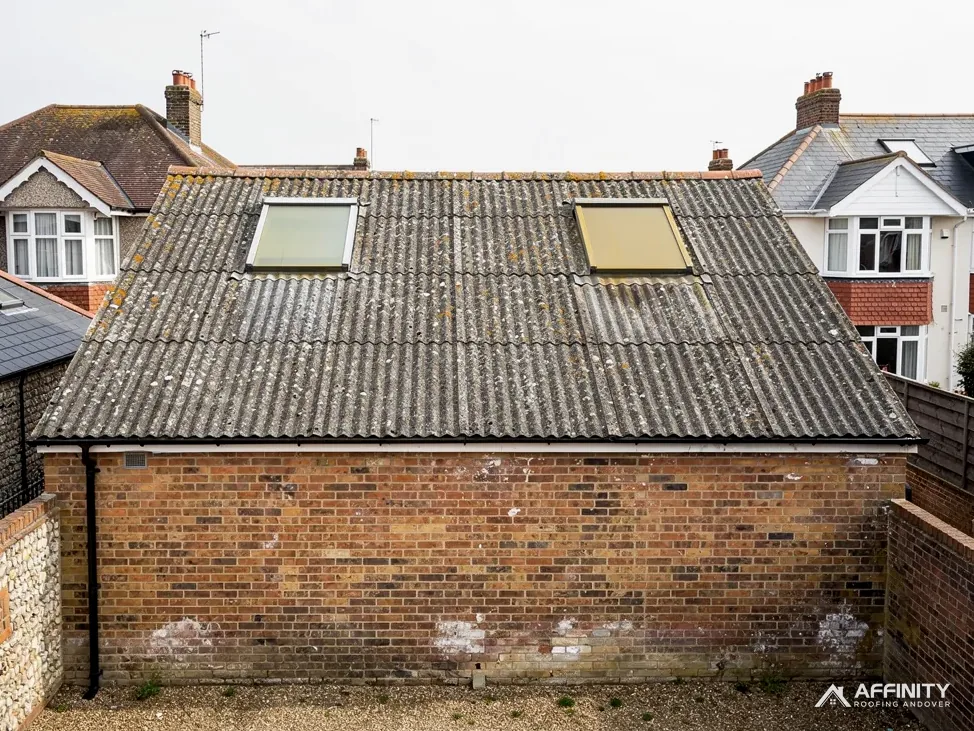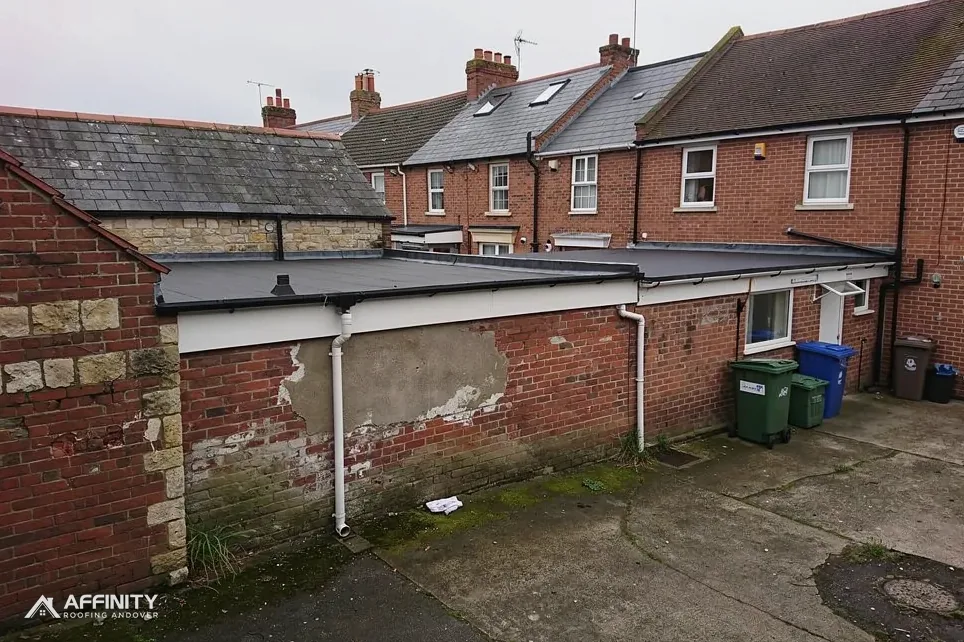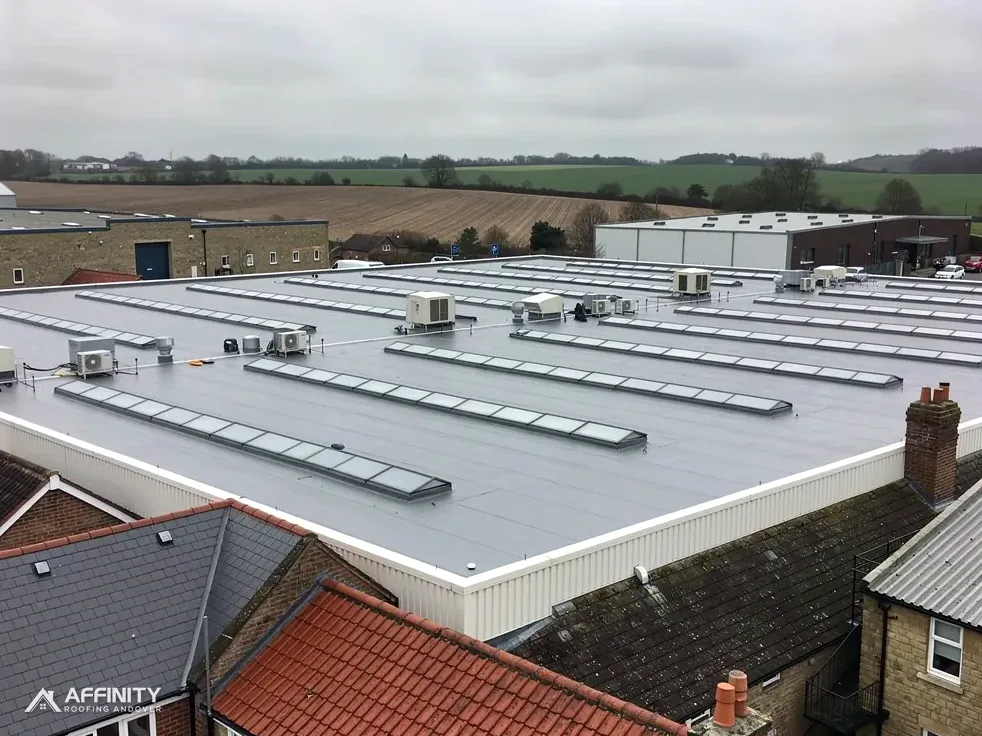
Walk around the back of a parade of shops or an older industrial estate and the roof you see from a first-floor window is very often felt. It is dark, slightly rough, sometimes dressed with a layer of stone chippings, and it has been keeping the weather out of the building for longer than anyone on site can remember.
Built-up felt roofing is exactly what the name says. Sheets of reinforced bitumen felt are laid in several layers on a flat or low-pitched deck, each bonded to the one below, until together they form a continuous waterproof skin. Because the layers overlap and fuse, the whole thing behaves as one membrane, and a well-laid system can go on for a good many years.
The same sheets are also what makes repair decisions tricky. A blister in the top layer may be cosmetic or it may hide a wet insulation board beneath. A split at a lap can be patched, or it can be the first hint that the felt is spent. A building owner or facilities manager has to choose between patching, laying a new layer over the old one, or stripping back to the deck. This guide sets out how we think that choice through.
What built-up felt actually is
The term covers any flat roof covering formed from more than one layer of bitumen-based roofing felt. The felt itself is a reinforcing fabric, usually polyester or glass fibre, that has been coated and saturated with bitumen, the dark, sticky petroleum residue that is the waterproofing. Rolls of it are unrolled across the roof, overlapped and bonded together.
How the layers are bonded
Older built-up roofs were laid with hot bitumen, mopped onto the deck and the previous layer before the next sheet was pressed in. Modern work usually uses torch-on felt, where a flame softens the underside of the roll so that it fuses to the layer below, or cold-applied adhesive on sites where a naked flame is a risk. The result is the same idea: a stack of bonded sheets with staggered laps, so that no joint in one layer sits over a joint in the next.
Where you find it
Felt suits low-pitched roofs and flat roofs of every size: the roof of a shop extension, a block of flats, a school corridor, a factory office wing, a canopy over a loading bay. It is also common as a repair material around older metal and concrete roofs. When we survey a commercial roof covered in felt, the first job is to establish what it is laid on, because the deck and the insulation underneath decide how the felt can be repaired.
Our commercial roofing page explains how felt sits among the other systems we work with, including single-ply membranes and liquid coatings.
The layers, from deck to surface
A built-up system is described by what sits where. The names vary between manufacturers, but the order is consistent.
Deck and insulation
The structural deck carries everything: timber boards, plywood, concrete or profiled metal. On a warm roof, insulation boards are laid above the deck, with a vapour control layer beneath them to stop moist air from the building rising into the insulation. The felt goes on top of that.
Base and intermediate layers
A first layer, the base, is bonded or fixed to the insulation or deck. Where the specification calls for it, a second layer follows. These layers do the bulk of the waterproofing work, and their laps are staggered so the joints do not line up.
The cap sheet
The top layer, the cap sheet, takes the weather. It is usually mineral-surfaced, which means its upper face is covered in fine granules that protect the bitumen from sunlight, or it is left smooth and then dressed with chippings. Sunlight is what ages bitumen most quickly, so the cap sheet's surface matters.
Upstands and details
Where the roof meets a wall, a rooflight kerb or a pipe, the felt turns up as an upstand and is finished with a flashing or a sealed edge. These details account for many of the leaks we are called to, far more than the open field of the roof itself.
Knowing which layer has failed tells you what repair to propose. A tear in the cap sheet over sound base layers is one job. Water through all the layers is another.
Lifespan as a range, never a promise
Published life figures for felt are ranges, and they come from guides that disagree. HomeBuilding gives felt, in its torch-on form, a life of 10 to 15 years (September 2025). Less gives the same system 10 to 20 years (October 2026). Both are typical ranges for felt in general, and neither is a promise about a particular roof.
What moves a roof along that range
The quality of the original laying counts for a lot. So does the fall, because a roof that holds standing water ages faster in the ponded areas. The standard for flat roofs with flexible coverings, BS 6229:2025, keeps a minimum 1:80 finished fall, and IKO advises designing for a fall of 1:40 so the finished roof still drains after movement and tolerance. Sunlight, foot traffic from maintenance staff and the way gutters and outlets are kept clear all play a part as well.
A warranty is not a lifespan
Do not confuse a manufacturer's warranty with a service life. A warranty covers a defined period under defined conditions. A lifespan is how long the material is expected to perform, and the felt you see may have been repaired more than once to reach it.
What the range means for planning
If your felt is inside the published range, you have a decision to make about cost. If it is past the top of it, expect more frequent repairs, and plan the budget for replacement sooner. Our answer on how many years a commercial roof lasts sets felt beside the other coverings.
Faults we find on felt roofs
Most felt problems announce themselves long before water reaches the ceiling, if someone is looking.
Blisters and bubbles
A blister is a pocket where the layers have lost their bond, often with trapped moisture or air beneath. A small, dry blister that has not cracked can be left under observation. One that has split, or that sits where foot traffic crosses, becomes a point of entry and needs cutting out and patching.
Splits and open laps
Felt moves as it warms and cools. Where the movement exceeds what the sheet can take, a split opens, usually along a lap or above a joint in the deck beneath. A split that runs through only the cap sheet can be repaired locally. One that runs through every layer means water reaches the deck.
Ponding
Standing water after rain points to a fall that is too shallow, a deck that has sagged or an outlet that is blocked. Ponding by itself does not always cause a leak, but it hastens the ageing of the felt beneath it, and it adds weight to a deck that may already be tired.
Failed upstands and flashings
Where a wall upstand has slipped or its sealing edge has cracked, rain runs behind the felt. We check all the junctions on every survey and show them in the photographs.
Surface wear
Granule loss on the cap sheet leaves bare bitumen exposed to sunlight. Patches of bare black are a sign the surface is ageing, even before the layers fail.
Repair, overlay or strip: how the choice is made
There are three honest routes with a failing felt roof, and the survey is what points to one of them.
Local repair
Where the damage is confined and the layers around it are sound and dry, we cut out the failed section, dry the area, bond new felt into place with staggered laps and dress the finish. This is the lightest option, and for a roof inside its published range it is often the sensible one.
Overlay
An overlay lays a new covering over the existing one, which is left in place as a base. It saves the cost and disruption of stripping, and it works when the existing layers are sound, dry and well bonded. It does not work when the old felt is wet, because the new layer then traps the moisture, and it adds weight to the deck. We take cores or test cuts to check what is under the surface before recommending it.
Strip and replace
When the layers are saturated, the insulation is wet or the deck is failing, the lasting answer is to strip the roof back, repair the deck and lay a new system. That is the biggest job, and the one that most needs a proper survey first.
Check for asbestos first
HSE guidance says to assume asbestos is present in a building built or refurbished before 2000 unless you know otherwise. Older flat roofs can sit on asbestos-containing boards or soffits, so the building's asbestos register or a survey comes before any stripping. The dutyholder has to supply that information.
Our guide to liquid roof coatings covers a different way of extending the life of a felt roof that is sound but weathered.
Surveying a felt roof and pricing the work
Every commercial felt job begins with a survey, and you see the same things we do.
What we look at
We walk the roof, safely, and record the condition of the cap sheet, the laps, the upstands, the outlets and the gutters. We look for ponding and for blisters. Where it is justified, we cut a small test opening to see the layers, the insulation and the deck. Inside, we look at ceiling stains and at the underside of the deck. Every finding is photographed, and the photos reach you with a short plain explanation under each.
What drives the cost
The total follows the area of the roof, the access and the work needed to reach it, how many layers have to come off, the state of the deck and insulation, the number of upstands and outlets, and whether the building stays in use. We do not quote square-metre rates, because a figure like that hides the deck and the details, which are where the cost sits. Our written quote is one total after the survey.
Working with the building occupied
Most commercial buildings cannot close for a roof. We plan sequence and access so staff, stock and customers are protected, and we tell you what is happening each day. Torch-on work needs a hot-work plan, and a naked flame near a roof edge or an old deck is a decision we make on the survey, not on the day.
Next steps
If your felt roof is leaking, ponding or blistering, send us the address and a few photos. We will arrange a survey, then recommend repair, overlay or replacement with one written price. You can also read about single-ply membrane roofs, a system chosen when a felt roof is replaced.