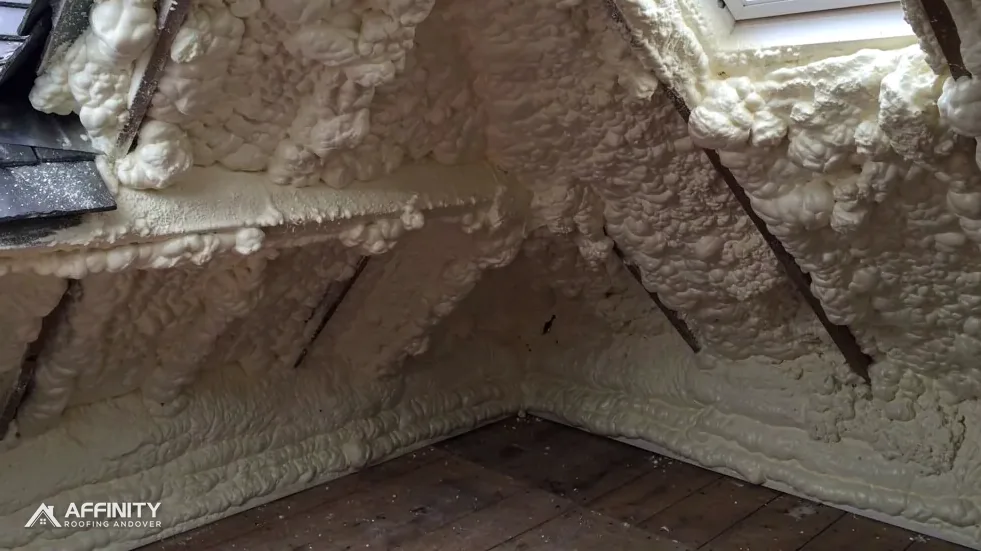
Spray foam insulation goes onto the underside of a roof as a liquid, then expands and sets, filling the spaces between the rafters and clinging to whatever lies behind. It has been sold as a way of insulating a loft in one visit. For some owners it has since become a problem at the point of sale, remortgage or equity release, when a surveyor notices it and a lender asks questions.
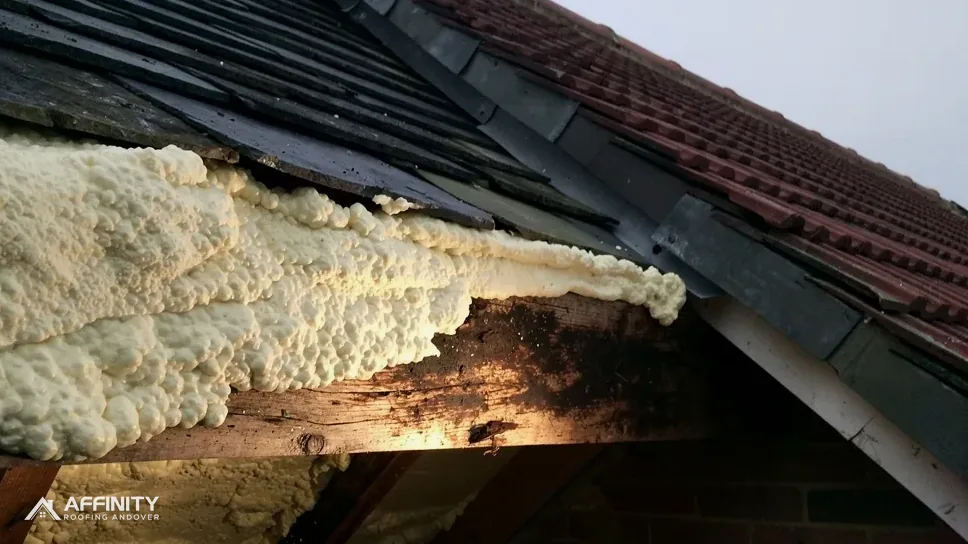
The reasons are practical. Once foam covers the roof timbers, nobody can look at them. If a tile slips, a nail corrodes or damp builds up behind the foam, the timber can decay without anyone seeing it. That is a worry for the owner as well as for a lender.
This post explains what the Royal Institution of Chartered Surveyors said in March 2023, what its guidance asks of you, how foam removal works in outline, and what a roofer inspects once the foam is gone: rafters, battens and the underlay layer. Foam does not always have to come out, and only your lender can say what it will decide about your house.
What RICS said in March 2023
RICS, the Royal Institution of Chartered Surveyors, issued a consumer guide on spray foam insulation. Its press release is dated 3 March 2023, and the guide itself shows a published date of 31 March 2023. The press release described the guide as impartial and explained why it was needed: worry had built up in particular corners of the mortgage market, equity release being the example it gave, and it was starting to affect lenders more broadly.
Read what that actually says. Nothing in it states that lenders refuse houses with spray foam. The practical reading is that some lenders, equity release providers first, have had concerns, and others may ask questions. Whether yours does is a matter for your lender's own policy.
The consumer guide gives advice that is easy to follow: check with your mortgage provider that it accepts these products at all. That applies before foam is installed, and it applies just as much when you are selling or remortgaging a house that already has it.
There is no single national rule here, and nothing in this post replaces a conversation with your lender or a surveyor. Terms differ between lenders and change over time. If you hold a mortgage and have foam in your roof, the safest first step is to ask the lender what its policy says.
Our guide on spray foam and equity release looks at the sector where the concern began.
Why hidden timber is the concern
A traditionally built roof can be looked at. You climb into the loft, study the rafters and battens, and judge whether they are dry and sound. Spray foam takes that away: the RICS guide points out that timbers buried in foam cannot be fully seen or checked.
That matters because timber in a roof is sensitive to moisture. The RICS guide adds that incorrectly installed insulation can negatively affect ventilation and result in moisture damage. Damp that is trapped against timber can lead to decay over time, and decay is the thing a surveyor and a lender want to rule out.
Open-cell or closed-cell, either type of foam hides the timber from view.
The Energy Saving Trust also gives a specific warning about foam sprayed onto a roof that already leaks: it does not recommend doing this. A leak behind foam is difficult to trace and can stay damp for a long time. The first step in any roof that leaks is to find and fix the leak, not to cover it.
None of this means that every foamed roof has damaged timber. What it means is that the condition is unknown, and unknown is what lenders and buyers dislike. A survey of the loft, a moisture check and a look at the timber at a few points can sometimes settle it.
A buyer of a foamed house is wise to make a survey part of the purchase.
What removal involves, in outline
Removing spray foam is specialist work, and it is slower and messier than putting it in. The foam bonds to timber and to the back of the roof covering, and it has to be taken off without harming either. The method depends on the type of foam, its thickness and how it was applied, and a contractor should be able to explain which they propose.
The job generally follows a set order. First comes an inspection to find out the type and extent of the foam, and to check the roof from inside and out. Next the loft is prepared, with protection for the floor and the rooms below and a way to deal with dust and waste. The foam is then removed from the rafters and battens and from the underside of the roof covering. Finally the timbers are cleaned, inspected and repaired, and the roof is re-insulated in a way that can be inspected.
Waste has to be handled properly, and you should ask where it goes. Removed foam and the debris from it are bulky and need a plan for disposal.
You may need to move out of the loft rooms and to protect belongings below. Ask how long the work is expected to take, and what condition the loft will be left in. Our guide to the spray foam removal process sets out the stages.
On cost, treat any figure you see online with care. The price depends on the area covered, the type and thickness of the foam, how it was applied, the access, and what condition the timber is found in. Because of that, the price follows an inspection and is given as one written total.
Remember that insulation put back afterwards is a separate matter, and may attract its own VAT treatment.
The roofer's check after the foam is gone
For the roof itself, this is the stage that matters most, and a roofer is well placed to carry it out. Once the foam is off, the timbers and the underside of the covering are visible for the first time, sometimes for years. That is the moment to look at them properly.
Rafters
The rafters are the inclined timbers that carry the roof. We look for decay, softness, staining, insect damage and any movement, and we probe suspect areas. Rafter feet at the eaves are checked with particular care, because they are at the wet edge of the roof.
Battens
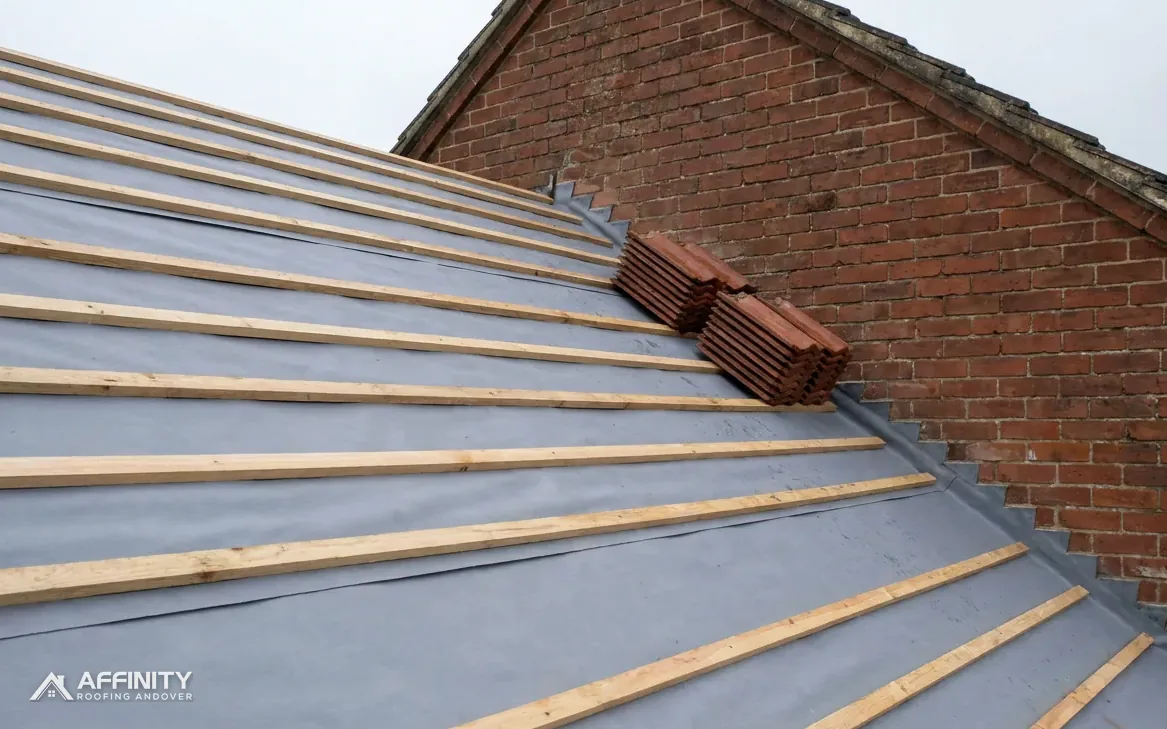
The battens are the narrow timbers the tiles or slates hang on. They are checked for rot, splitting and corroded nails. A batten that has been wet behind foam can be soft along its length. If the covering is nailed through the batten, the nail tips may also have rusted.
Underlay
The underlay is the membrane under the battens. Foam sprayed against it can bond to it and tear it when removed. We check for tears, brittleness and gaps, especially at the eaves, where the underlay should reach the gutter.
The findings decide what happens next. Sound timber can be treated or left and re-insulated. Damaged timber is repaired or replaced, and if the underlay and battens are widely affected, a section may need re-covering. Our guide to roof timbers after spray foam removal goes further.
We photograph each finding on your own roof, explain it in plain words, and put it in writing. That record is useful to you when you tell a lender or a buyer what was found.
Putting the roof right and re-insulating
Removing the foam is the start. A roof that has had its insulation stripped needs insulating again, and it should be done in a way that avoids the problems that brought the foam in question.
The standard is Approved Document L. When a roof is renovated, the guidance for existing elements sets a threshold U-value of 0.35 W/(m²·K) and an improved value of 0.16, and a thermal element that has been upgraded should generally not exceed 0.7. Your building control body, meaning either the council's team or a registered approver, can say whether an application is needed. The 2021 edition applies until 24 March 2027, when the 2026 edition takes over.
Ventilation is the second half of the answer. The code of practice on moisture, BS 5250, is in its 2021 edition. Marley's guidance for a cold roof with the non-breathable HR type of underlay asks for 25 mm of eaves ventilation along the eaves for pitches of 15 degrees or less, and 10 mm above that. Where there is a breather underlay and the ceiling is properly sealed, the arrangements differ. A roofer should say which applies to your roof.
VAT is a point to check. For energy-saving materials installed between 1 May 2023 and 31 March 2027 the VAT rate is zero, returning to 5 per cent from 1 April 2027. That concerns installing insulation, and whether it covers a particular job is something to ask the contractor to confirm in writing.
Grants may exist for insulation, and eligibility varies. Warm Homes: Local Grant can fund insulation for a household on an income that is usually £36,000 or less, and ECO4 runs to 31 December 2026. Neither is a promise, and you should check the scheme's own pages.
Keep the records of the removal and the inspection findings. They are what you show a lender, a surveyor or a buyer later.
Questions to ask before you commit
If you are weighing removal, or only worrying about what you have, a few questions help.
- Has my lender said what its policy is on spray foam, and will it put that in writing?
- Do I know the type of foam, the thickness and who applied it?
- Is there a survey that looks at the timbers through or under the foam?
- If removal goes ahead, who will do it, and how will the foam and dust be handled?
- Who inspects the rafters, battens and underlay afterwards, and will I see photographs?
- What insulation goes back, and does the work need a building control application?
If you are selling, talk to your estate agent and conveyancer early, because foam can slow a sale. A buyer should ask the vendor for the details and arrange an independent survey before exchange.
Be careful with unsolicited offers. A contract signed in your own home is an off-premises one, so the 14-day cancellation period gives you time to check. For advice on consumer problems, the Citizens Advice consumer helpline is 0808 223 1133.
The decision to remove is yours, and it should rest on evidence about your own roof, not on fear. A survey that looks at the timbers is the way to get that evidence.
Our spray foam removal service begins with an inspection, followed by a written report on the timbers.