
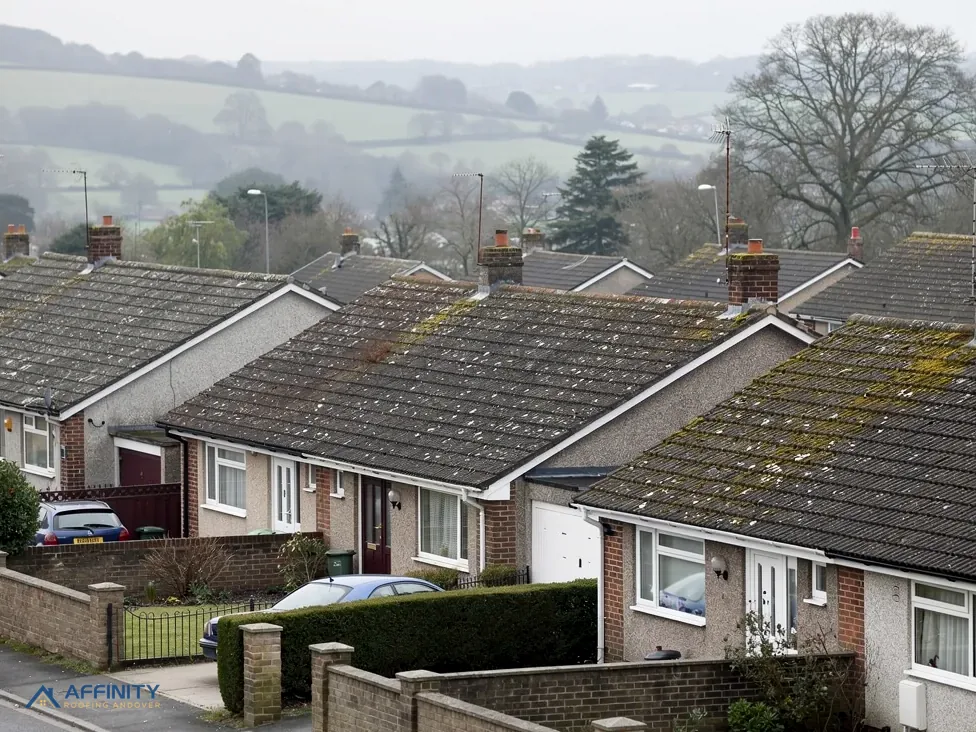
Roofers in Ludgershall
Castle, church and Butts Street roofs in a Wiltshire border town
Ludgershall sits in Wiltshire, not Hampshire, so a different council and different paperwork apply. We survey the roof first and explain, in plain words, which rules reach your house.
Ludgershall roofs beside the castle and the church

Houses near the castle
Homes within about 500 metres of Ludgershall Castle, a scheduled monument, where nearby work is best raised early.

Church of St James
The Church of St James, listed Grade I in 1964, whose neighbours are surveyed with the listing in mind.

Butts Street and Erskine House
Grade II listed buildings including Erskine House and the pairing of No. 6 and Lynton on Butts Street.
Ludgershall between Tidworth and Collingbourne Ducis
Perham Down and Tidworth lie south-west, Collingbourne Ducis north-west, Appleshaw and Thruxton south-east and Upper Chute north-east. Our roof work reaches every one.
- Distance
- 8.6 road miles north-west of Andover
- Planning
- Wiltshire Council
The Ludgershall roof report
Local editionLudgershall, WiltshireCastle, church and a Wiltshire rulebook
Ludgershall roofs: a scheduled castle, a Grade I church and a Wiltshire rulebook
Ludgershall is a town of 5,477 people just inside Wiltshire, with a castle ringwork and the Grade I church of St James in its centre. Read on for which council decides, what the listings change and how scaffold is licensed in the town.
Castle ringwork, church tower and Butts Street
Ludgershall Castle, a medieval ringwork and castle, is a scheduled monument within about 500 metres of the town centre (list entry 1009912). Scheduled monument consent runs separately from listed building consent, and it is for the Secretary of State to decide, not the council. A roof is not part of the monument, but the setting is a good reason for us to ask early about anything near it.
The Church of St James is listed Grade I (1036004, first listed 27 May 1964). Being Anglican and in use for worship, the church clears roof works by faculty, a process of its own, with the council playing no part. Its faculty comes from the diocese's consistory court, Ludgershall's St James included. A house close to the churchyard is not governed by the church's process, though the tower and slopes are the neighbours every nearby survey keeps in view.
Erskine House is listed Grade II (1036003, first listed 27 May 1965). So are No. 6 and Lynton on Butts Street (1035999) and the Queens Head public house (1036001). Historic England's list shows 16 listed buildings within about 900 metres of the town point, which is enough that a Ludgershall owner is likely to have a listed neighbour even when their own house is not listed.
Listed building consent applies to work affecting the character of a listed building, and it applies in addition to ordinary planning rules. For a listed Ludgershall house the application goes to Wiltshire Council. We prepare photographs of every slope, a description of the existing slates or tiles and a plain statement of what we would change, because an officer reading the file can only judge what the paperwork shows.
Ludgershall also has a conservation area, which council-supplied boundary data places within about 0.75 km of the town centre. Within that boundary, a change that would be seen from the street deserves a word with the council before pricing, and a matching repair is the safest first step. A slate swapped for a concrete tile, or a clay ridge for a dry-fix one, is exactly the sort of change that draws a question.
Our guide to planning permission for roof work explains where the national lines fall. What it cannot do is replace a conversation with Wiltshire Council about your own address, and that conversation is part of our job before a scaffold is ordered or a tile is cut. We note the date, the officer's answer and any condition attached, and send you the lot with the survey photographs.
Wiltshire Council is the one to ask
Ludgershall is in Wiltshire, which is a unitary authority. Wiltshire Council is therefore the local planning authority, the building control body and the highway authority all at once, with no county council above it and no separate borough below. Three questions that would go to three offices in a Hampshire village go to one in Ludgershall. That is simpler for the owner, though the rules themselves are Wiltshire's and not Test Valley's.
Building control is Wiltshire Council's own service, based at Monkton Park in Chippenham, which lists 0300 456 0113 for booking inspections and making payments. Owners who prefer a private route can appoint a registered building control approver instead. We name the route in the written price so that no one on the job is guessing.
Wiltshire Council also has an Article 4 area for Ludgershall. An Article 4 direction withdraws specified permitted development rights across a defined area. Only Wiltshire Council can confirm which rights this one removes, and we ask in writing whenever a job would alter a roof's outward appearance.
The edge of the North Wessex Downs National Landscape, formerly an AONB, reaches towards Ludgershall: the town point lies outside, but about 5 per cent of the surrounding 1.5 km box falls inside. The downs partnership has only an advisory role in planning, so Wiltshire Council remains the authority that decides. Repairs proceed as in the rest of the county.
For a re-roof the Planning Portal supplies the national test. A job on under 25 per cent of the building envelope and under 50 per cent of the roof seldom needs a building control application. A new covering weighing 15 per cent or more above the old does need approval, with a structural check. We apply both tests at survey and tell you which, if either, bites on your slope.
The practical gain from a single authority is speed of answers. When the planning officer and the building control surveyor work for the same council, a question about a heavier covering or a raised ridge can be put once and the reply covers both. We write each question down, record the date and the answer, and send you a copy with the survey photographs, so the file is complete if a buyer or a solicitor asks about the work later.
Whichever route applies, the survey record is the same: dated photographs of every slope, the covering as found and the faults seen, kept in one place so that the council, a buyer or a later contractor can read the same facts.
“Ludgershall answers to one council for planning, building control and scaffold, and that council is Wiltshire's.”
Source: Wiltshire Council
A Wiltshire scaffold licence, step by step
The Highways Act 1980, section 169, requires a licence for scaffold standing on a public highway, and in Ludgershall Wiltshire Council is the licensing body. Wiltshire Council's page names the firm supplying the scaffolding as the applicant, via the MiPermit portal, so the form never lands on your desk. Wiltshire Council also requires one licence per site, and says so in plain terms.
Wiltshire Council sets its fee by the notice given: £143.80 when more than three working days' notice is allowed and £164.70 when less. Each licence is valid for 28 days, and public liability insurance of £5 million must be shown to Wiltshire Council. Hoarding is licensed on its own, apart from scaffold, and a bay marked for parking has to be suspended too.
That structure suits a short job. A single-slope repair can be scaffolded, completed and struck inside one licence period, with the notice given in good time to keep the lower fee. For a longer re-roof we plan the weeks so the whole job sits comfortably inside 28 days, and we tell you early if it will not, and agree what to do about it before the scaffold is booked.
Where the scaffold can stand on private ground, there is no highway licence to obtain. A house set back behind a forecourt or a drive is a different case from one that opens straight onto the pavement, and the programme differs accordingly. We look at that on the first visit, because it changes both the programme and the cost, and we say which applies before you commit.
Ludgershall roofs need the plain, everyday services. Roof repairs deal with slipped tiles, failed flashings and cracked ridge pieces. Pitched roofing covers the slopes where battens and underlay need attention together with the covering. Chimney repairs cover stacks that need repointing or new flashings. One written total follows the survey, and it includes the licence and the scaffold hire.
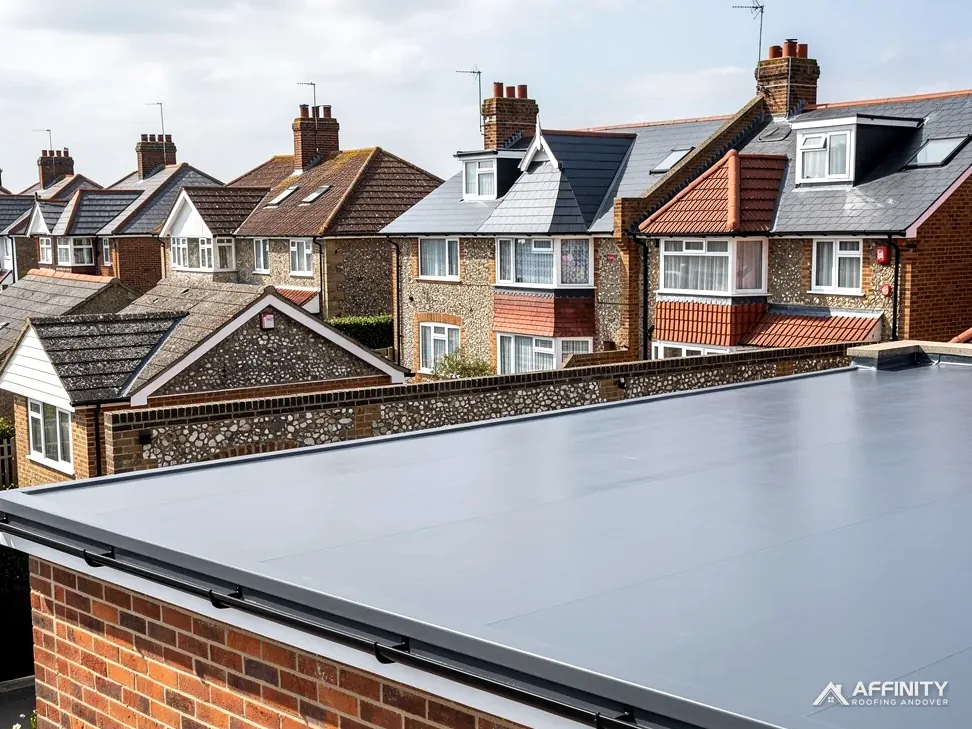
Flat roofs on extensions, garages and porches need a different eye. Water has nowhere fast to run, so ponding, split seams and blocked outlets are what we look for, along with the state of the upstand and the edge trim. A flat roof that is failing often shows itself first as a stain on the ceiling below, and we trace the stain back to its source before proposing either a patch or a replacement.
For a buyer, dated photographs, the council's answers and the written price make a useful file that shows the roof as found.
Roof jobs we handle in Ludgershall





Ludgershall roofs: castle, church, consent and scaffold
Does the Ludgershall Castle scheduled monument affect a house roof nearby?
Not directly. The Secretary of State decides scheduled monument consent, which protects the monument itself. A house within about 500 metres is treated under Wiltshire Council's ordinary rules. We still ask the council early about any change near the castle, so nothing surprises you later in the job or at the sale. Photographs go on your file.
Who checks a re-roof in Ludgershall for building control?
Wiltshire Council runs its own Building Control service, on 0300 456 0113, and a registered building control approver offers a private route. The Planning Portal's test is under 25 per cent of the envelope and under 50 per cent of the roof. We apply it at survey and write down the route that results, so you hold it before the work starts. The reply comes to you in writing.
What does the Article 4 area in Ludgershall mean for my roof?
Wiltshire Council has an Article 4 area for Ludgershall. Such a direction withdraws certain permitted development rights across a defined area, but which rights this one removes is Wiltshire Council's to confirm. We ask in writing before pricing any alteration that would show from the street, and keep the reply on file for you. You see the council's reply before any work is agreed.
How long is a Wiltshire scaffold licence good for on a Ludgershall job?
Wiltshire Council says all licence types are valid for 28 days. Wiltshire Council's fee is £143.80 with over three working days' notice and £164.70 with under, and the scaffolding company applies via the MiPermit portal. A longer job is planned to fit inside the 28 days, or the plan is explained first.
Have a Ludgershall roof looked at
Message the address with a photo. A survey follows, then a single written price that sets out the Wiltshire route.
10-year workmanship guarantee, in writing.