
Roofers in Tilehurst
The tile hill west of Reading, from Routh Lane to the valley
Tilehurst takes its name from tile, and Reading's own appraisal says brick and tile making were pre-eminent in the district. Each roof is looked over first, photographed, then priced once.
Tilehurst roofs, from St Michael's to New Lane Hill

St Michael's and Routh Lane
St Michael's has a tiled roof over a flint nave and sits in the Routh Lane conservation area.

Thatched cottage and neighbours
221 New Lane Hill is a 17th-century thatched cottage, Grade II, standing among much later housing nearby.

Roofs of the 1960s onwards
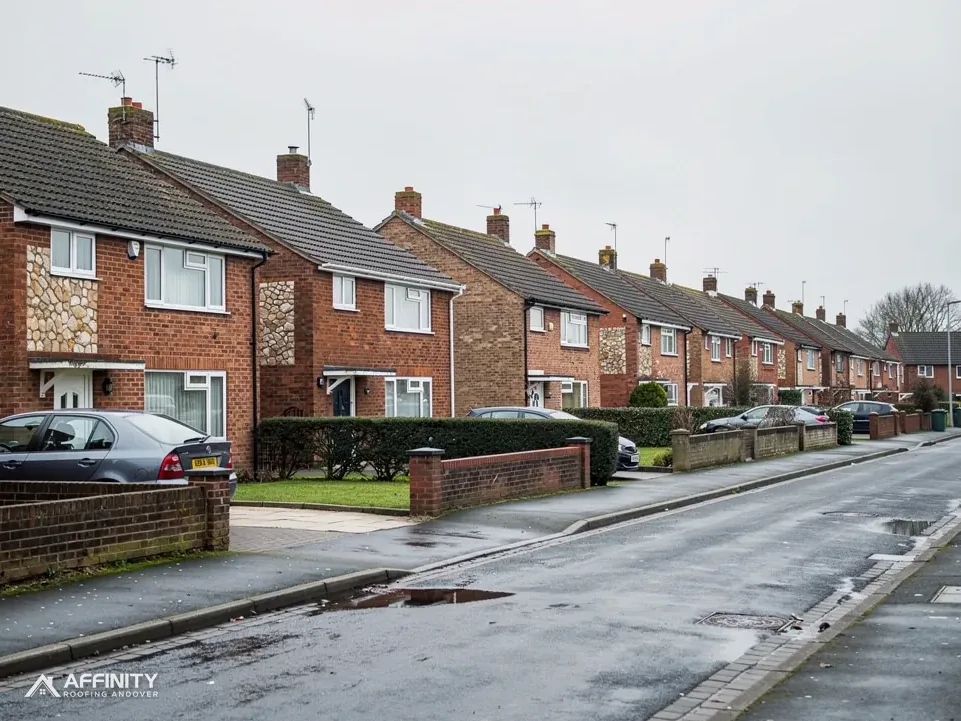
Many properties near Routh Lane date from about the 1960s, so extensions, garages and flat roofs are all common jobs.
Tilehurst above the Thames valley
Calcot lies to the south-west, Theale also to the south-west, Pangbourne to the north-west and Whitchurch-on-Thames beyond it. Our roofers work in all of them.
- Distance
- 29.1 road miles north-east of Andover
- Planning
- Reading Borough Council
- Council
- Reading Borough Council (unitary)
The Tilehurst roof report
Local editionTilehurst, BerkshireA district named for tile
Tilehurst means tile hill: what Reading's appraisal says about its roofs and rules
Reading Borough Council's appraisal of the Routh Lane conservation area traces the name Tilehurst to the Old English words for a tile and a wooded hill. This report sets that history beside the council and scaffold rules, and beside the published lifespans of tiles.
Reading for most, West Berkshire for a few
Tilehurst is a large district on high ground at the western edge of Reading, above the Thames valley. The greater part belongs to the Borough of Reading, a unitary council that grants planning permission, looks after the roads and runs its own building control service. A smaller part sits in the Tilehurst civil parish in West Berkshire, where inspections come through Building Control Solutions. Because the boundary runs through ordinary streets, the first job on any enquiry is to find out which council the address belongs to.
Either council can confirm it, and the check takes a minute. The result is worth having, since it points to one planning team, one set of inspectors and one scaffold licensing desk. The answer goes on your survey sheet beside the photographs, so nobody has to ask the question twice.
If your house is newer, check whether a warranty is still running. NHBC's Buildmark cover works in two stages: the builder answers for the first two years after completion, and insurance for certain defects follows for a further eight. Whether a roof defect counts depends on the policy wording, and dated survey photographs are the evidence you would want if you ever had to ask. A newer house is also more likely to have a flat roof over a bay or porch, which we check for falls and outlets.
For a re-roof, start with the Planning Portal's pair of limits: below 25 per cent of the building envelope and below 50 per cent of the roof, and building control is not normally needed. Reading has not published a figure that shifts those. Heavier materials are a separate question, because a replacement covering weighing 15 per cent or more extra needs Building Regulations approval, and the Planning Portal suggests a check on the structure before any order is placed. Some owners choose a registered building control approver over the council.
Reading's appraisal adds two useful facts: Tilehurst did not become part of Reading administratively until 1911, and many properties near Routh Lane date only from about the 1960s. A district of mixed age has roofs of many kinds and dates, so a Tilehurst survey records what each roof is actually made of before a repair is chosen.
Flats and maisonettes carry a caution of their own. The permitted development order treats a flat differently from a house, so an upper-floor owner should speak to the planning team before supposing that a roof alteration is routine.
Routh Lane, a flint church and a thatched cottage
The Routh Lane conservation area lies within about 750 metres of the middle of Tilehurst, and Reading designated it on 21 August 1987. The council's 2010 appraisal derives the name Tilehurst from 'tigel', a tile, and 'hurst', a wooded hill, and says brick and tile making have historically been pre-eminent in Tilehurst life. An owner meaning to alter the roof's appearance in that area should tell the council's planning team before ordering anything.
St Michael's Church has a brick tower of 1737 in red and grey brick in English bond. The rest dates from 1856, to designs by George Edmund Street, built of flint on a stone plinth with a tiled roof. The appraisal lists the church as Grade II, along with Iris Court, Goodwyns and 221 New Lane Hill. The Tilehurst War Memorial (1441573), listed Grade II on 10 February 2017, stands within 500 metres of the centre of Tilehurst.
221 New Lane Hill, known as Green Lea, is a 17th-century thatched cottage. Thatch is specialist work, so the first step is a thatcher's own description and written price. We can attend to any tiled sections, the stack and the gutters on the same property. The appraisal also records that many properties in the Routh Lane area date only from about the 1960s, so the cottage stands among much later neighbours.
St Michael's, on New Lane Hill, has its own page on A Church Near You, the Church of England's directory, and holds regular worship, so the faculty system, under which the diocese's consistory court grants a faculty, governs its roof. A house or cottage that is listed is different: altering its character calls for listed building consent from Reading, apart from any planning permission. Repairs follow the original tile, size and fixing as closely as possible, and a brief account with photographs goes to the officer.
In a district named for its tiles, matching is often the whole art. Salvaged tile from demolition yards comes with a weathered face that a new one lacks, so we look there first, measure for thickness and size as well as colour, and compare samples in daylight.
The appraisal is a public document written by the council's own officers, and it is worth reading before you commission work in the area. It names the listed buildings, describes the materials, and shows what the officers value. A repair that respects what the appraisal says is easier to put to the planning team, and the survey photographs show that it does. Not certain that your own house is listed? Ask the council or search Historic England's list by address before anything is ordered.
“Reading's appraisal says brick and tile making were pre-eminent in Tilehurst, a name that means tile hill.”
How long tiles last, and who licenses the scaffold
In a district named for tile, lifespans are a natural question, and published figures differ. For clay, the BRE's figure is a minimum life expectancy of 60 years, a number Marley says covers clay only, while HomeBuilding quotes 60 to 80 years. For concrete, Marley says its tiles are expected to last around 60 years while stressing that this is not a guarantee, whereas HomeBuilding gives 40 to 50 years for plain concrete. Fibre cement tiles are 30 to 40 years on HomeBuilding's table. All are typical ranges and none is a promise.
In practice that means a roof of 1960s concrete tile is reaching the age at which a survey pays for itself, while a clay roof of the same date may have decades left. We read the condition of each tile, the battens and the underlay, and say whether a repair buys years or merely months, with a photograph beside every finding so the reasoning can be checked. A wrong guess between patching and renewing costs far more than the survey that avoids it.
Roadside scaffold needs the permission section 169 of the Highways Act 1980 describes, and the body that gives it is the highway authority. For most of Tilehurst that authority is Reading Borough Council, and its scaffolding page says it only accepts applications from scaffolding companies, not from building contractors or residents. Reading's standard fee is £210 residential or £347 commercial for the first 4 weeks, then £160 per additional 4 weeks, and the minimum licence period is 4 weeks. Reading says you do not need consent to place scaffolding on private land, though a parking suspension may be needed. The scaffold cost forms part of the single written price.
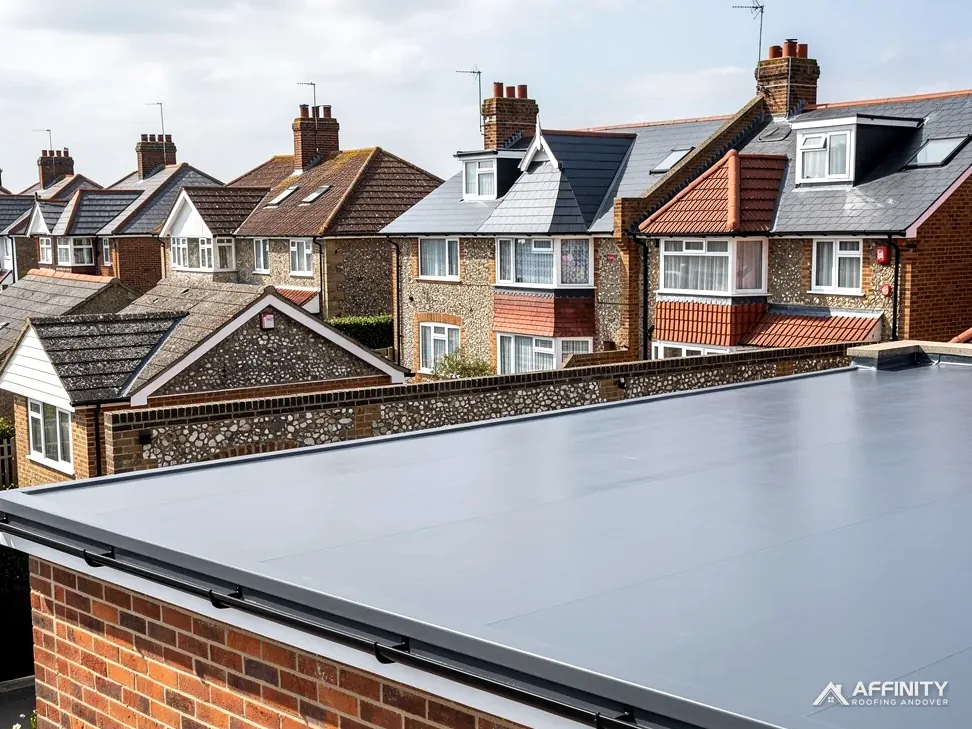
The usual jobs here are roof repairs for slipped tiles and failed ridges, flat roofing for extensions and garages, and guttering, soffits and fascias along the eaves. For scale, a Which? survey (November 2025) puts a single new ridge tile at £80 to £300 per job and a full gutter clear-out at £75 to £350, both ex VAT. These are national ranges and never our prices.
Modern extension roofs bring other metals. Zinc is one: VMZinc quotes the BRE Environmental Product Declaration as stating 100 years for the material. That is a manufacturer's figure and not a promise, and real life depends on falls, drainage and workmanship.
Every Tilehurst job is priced once, after the survey photographs have been shared with you, as a single written total. If a repair would be money wasted, the evidence goes in front of you, since the sensible answer is sometimes a full re-cover.
Repairs and re-roofs across Tilehurst





Tilehurst roofs: the boundary, the tiles and the thatch
Is my Tilehurst roof in Reading or West Berkshire?
Ask either council to confirm, because part of Tilehurst parish lies in West Berkshire. The result points to the right planning officers, the right inspectors and the right licensing desk. We run the same check at survey and file the answer with your photographs, so the correct office hears from us first and no time is lost.
How long do clay roof tiles last around Tilehurst?
Clay tiles carry a BRE minimum life expectancy of 60 years, and HomeBuilding gives 60 to 80 years. Concrete figures differ between sources, and none is a promise, so treat every number as a typical range. We examine tiles, battens and underlay and say, with photographs of what we find, whether repair or re-roof makes better sense.
Who can repair the thatched roof of Green Lea on New Lane Hill?
A specialist thatcher should do the thatch, and the owner should ask for a written description and a price. The cottage is Grade II, so changes affecting its character need listed building consent from Reading Borough Council. We can look after tiled parts of the property, the chimney and the gutters, if you wish.
Whose job is the roadside scaffold licence on a Tilehurst roof?
Reading Borough Council, the highway authority for most of Tilehurst. Its page says it only accepts applications from scaffolding companies, not residents, and its standard residential fee is £210 for the first 4 weeks, then £160 per additional 4 weeks. Scaffolding on private land needs no consent, and the cost is within your price.
Get your Tilehurst roof surveyed first
Tell us your address, with a roof photo if you can. Then come a council check, the survey and a single price.
10-year workmanship guarantee, in writing.