
Roofers in Bradfield
Brick, slate and tile roofs in the Pang valley, around Bradfield College
Bradfield lies wholly inside the North Wessex Downs and has 21 listed buildings near its middle. Each roof gets a survey and photographs before one written price is set.
Bradfield roofs, from the village street to the college

Cottages of brick and slate
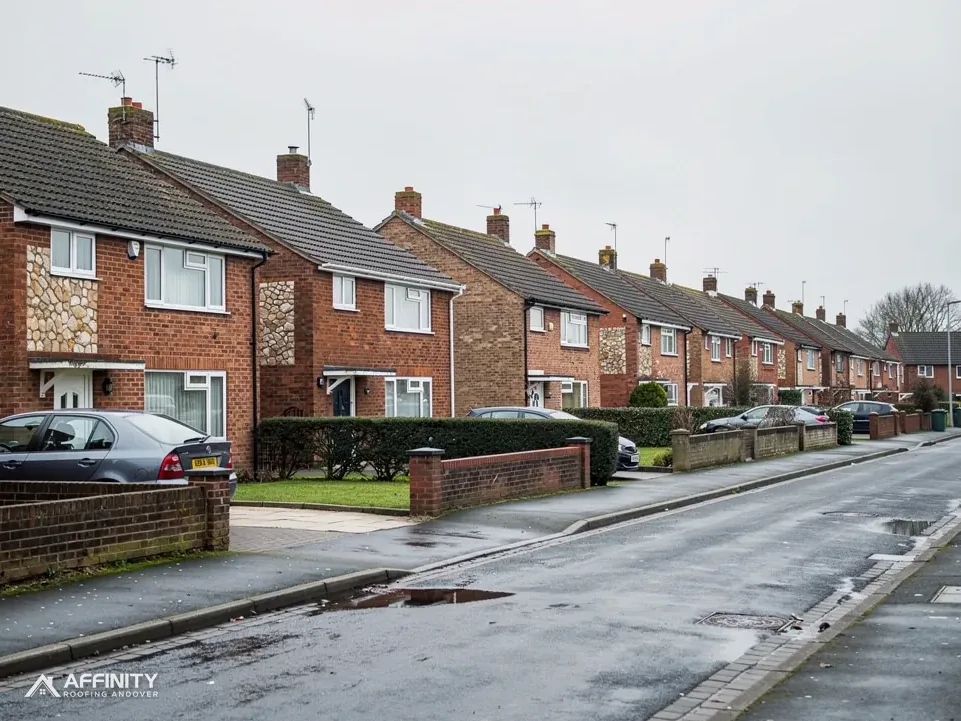
The VCH in 1923 found most village cottages brick with slate or tile roofs, repaired here to match.

Bradfield College buildings
Army House and B and C Houses are Grade II, so college roofs are judged against listed neighbours.

St Andrew's and the obelisk
St Andrew's is Grade II* and the Stevens Obelisk is Grade II, in the heart of the village.
Bradfield in the Pang valley
Beenham lies to the south, Theale to the east, Pangbourne to the north-east and Bucklebury to the west. Roofs in each of these places are within our patch.
- Distance
- 28.9 road miles north-east of Andover
- Planning
- West Berkshire Council
- Council
- West Berkshire Council (unitary)
The Bradfield roof report
Local editionBradfield, BerkshireA college village inside the Downs
A village inside the Downs with a college inside the village: how Bradfield roofs are decided
Bradfield is a West Berkshire village of 2,209 people, wholly within the North Wessex Downs and shaped by a college founded in 1850. This report covers the council and inspectors, the church that is no longer exempt from consent, and the weekly scaffold fee.
West Berkshire decides, whatever the Downs say
Bradfield parish had 2,209 usual residents at the 2021 Census. The village is in West Berkshire, a unitary council that is the planning authority and the highway authority, and its inspections run through Building Control Solutions, known as BCS, on 0300 790 0580. BCS is a partnership between West Berkshire Council and Wokingham Borough Council, which is why a Bradfield inspection can involve a team that also works across the border.
Every part of the area around the village lies inside the North Wessex Downs National Landscape, formerly an AONB. Within such a landscape planning decisions rest with the council, and the Downs partnership advises without any statutory power; Natural England is consulted. For a Bradfield owner this means one answer: ask West Berkshire. The designation influences how that council weighs a change of shape, but it does not take the decision.
The Planning Portal gives the first test for a re-roof. Under 25 per cent of the building envelope and under 50 per cent of the roof, and building control need not normally be told. West Berkshire has no figure of its own. Weight is the second test, and a covering 15 per cent or more heavier needs Building Regulations approval, and the Planning Portal recommends checking the structure beforehand. A registered building control approver may inspect in place of BCS.
Re-roofing also touches insulation. The Building Regulations count a new or replaced layer in a roof as renovation, and Approved Document L (2021) then asks for a threshold U-value of 0.35 W/(m²K), improved to 0.16 where that is technically and functionally feasible and meets a 15-year payback test. The 2026 edition applies from 24 March 2027. We photograph the loft insulation at survey so the inspector and you are looking at the same thing.
The College sets a second pattern. Bradfield College was founded in 1850 by the Rev. Thomas Stevens, lord of the manor, around an 18th-century manor-house, and its chapel opened in 1892, according to the VCH in 1923. Institutional roofs are bigger, flatter in places and managed differently, and a project with two or more contractors, under CDM 2015, needs a principal designer and a principal contractor named.
Before pricing either kind, we survey: wide photographs for context, close ones of each fault, and a note of the share of the roof a job reaches. If the survey shows a loft conversion or a heavy new covering in prospect, we say at once which approvals follow, and we agree with you who will contact the council, so nothing is left to the last week before the scaffold arrives.
St Andrew's: Grade II* and no longer exempt
Historic England's list records 21 listed buildings within 500 metres of the middle of Bradfield. The Church of St Andrew is Grade II* (list entry 1289580, first listed on 14 April 1967). The Stevens Obelisk, standing about 30 metres east of its north aisle chapel, is Grade II (1212321, listed on 29 November 1983), and Army House and B and C Houses at the College are Grade II as well.
Churches follow different consent rules, and this is worth knowing when one changes hands. A Church of England church in use takes the faculty route. Roman Catholic churches, Methodist and URC ones in use each run a consent system of their own, and Baptist churches use the Baptist Union's scheme, since Baptists have no diocese. Unitarian and Quaker buildings, closed churches and Churches Conservation Trust buildings all need listed building consent. Scheduled monuments need scheduled monument consent. The question to put first is always what the building is used for today.
St Andrew's has a particular status. It was bought by Bradfield College in 2021 for a learning centre and is no longer kept as a place of worship. That matters because the ecclesiastical exemption applies only to a church used for ecclesiastical purposes. A building that has left that use needs listed building consent from West Berkshire Council for work affecting its character, in the same way as any other listed building.
The Bradfield conservation area lies within about 750 metres of the village centre, on a boundary supplied by West Berkshire Council. A change that alters the roof's appearance from the lane deserves a call to its planning team first, and the same team can say whether an Article 4 direction applies. Our guide to planning permission for roof work explains where the limits fall for a dormer or a change of covering.
The VCH in 1923 found most of the village cottages of no great age, built of brick with slate or tile roofs, apart from two probably 17th-century half-timbered cottages at the north-west corner of the churchyard. It also noted that the hamlet of Southend to the south was made up mainly of modern suburban-type houses. Those are century-old descriptions, yet they explain why a Bradfield survey meets slate, tile and timber side by side, and why each is repaired in its own way.
Where a match is needed for slate or tile we look at reclaimed stock first, take a sample outdoors and compare it in daylight. A single wrong colour is visible across a slope for years, and the photographs go to the council with the proposal.
“St Andrew's at Bradfield is Grade II*, and since 2021 it has not been exempt.”
Source: Historic England list entry 1289580; Bradfield College purchase, reported January 2022
Weekly scaffold fees, flat college roofs and Flood Zone 3
Scaffold on the public road falls under section 169 of the Highways Act 1980, and West Berkshire Council grants the licence. The council puts the application in the hands of the scaffolding provider, never the resident. West Berkshire Council charges £125 plus £71 for each week of the licence, asks for 10 working days at least, and requires insurance indemnifying it to £10 million. Scaffold on a private road is outside the scheme.
Bradfield's centre sits in Flood Zone 3 on the Environment Agency's Flood Map for Planning. That is a statement about the map, not about any house, yet it puts rainwater goods high on the survey list. Blocked gutters, split downpipes and silted gullies are cheap to put right and costly to ignore, and each is photographed so you see what we saw.
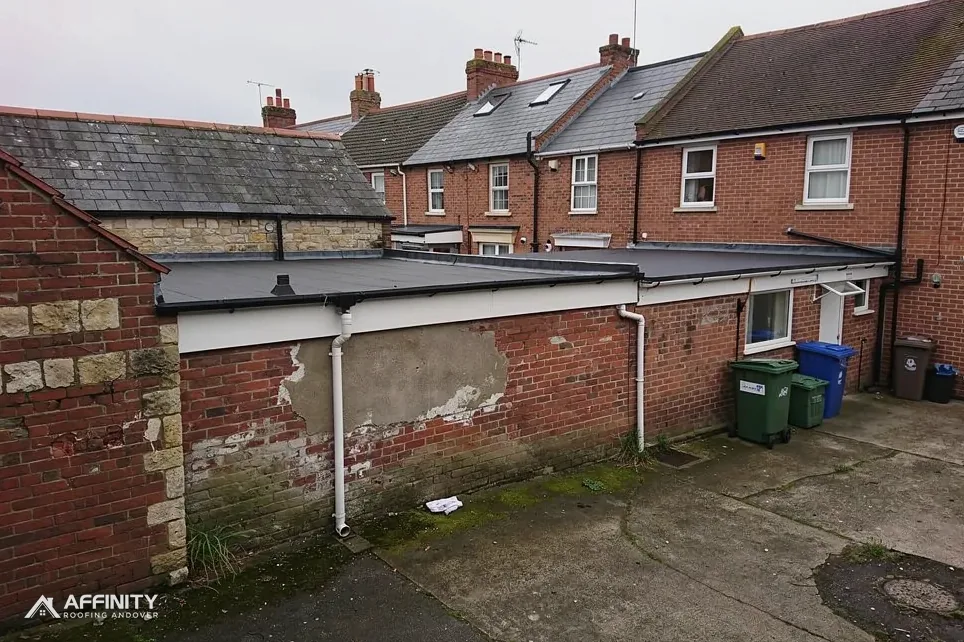
Larger buildings often carry flat sections. Felt, EPDM, GRP and single-ply membranes such as TPO each have a different life: HomeBuilding gives EPDM 25 to 30 years while Less gives 30 to 50 years, and neither is a promise. BS 6229:2025 sets a finished minimum fall of 1:80 on such membranes, and we measure what is there before suggesting a covering. Our commercial roofing work follows the same survey-first method as a house.
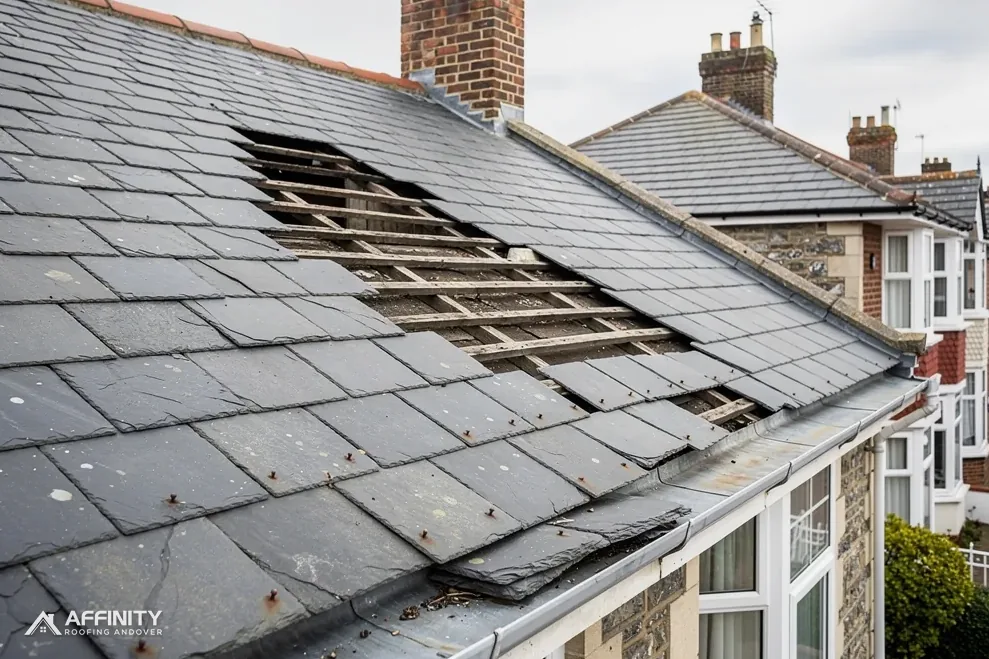
For houses the usual work is slate roofing repair and re-covering, roof repairs after a storm or a slipped tile, and chimney work for a stack with crumbling pointing.
Published guides show scale, though they are never our prices. MyJobQuote (6 October 2026) puts a fitted slate roof at around £7,800 on average and a typical 2026 roof repair at around £650. A Which? survey (November 2025) gives £75 to £350, excluding VAT, for clearing all the gutters front and back. Your own written price follows a survey and is one total, with the scaffold, labour, materials and clearing away included, and a slate roof with failing nails may need a full re-cover rather than patching.
A note on chimneys belongs here. On survey we photograph the pot, the flaunching, which is the mortar bed under the pot, the brick pointing, and the lead flashing round the foot of the stack. Water entering at a stack can show as damp on a bedroom wall and not as a drip from the roof, so the pictures trace its route from the top, and a stack that is sound is recorded as sound.
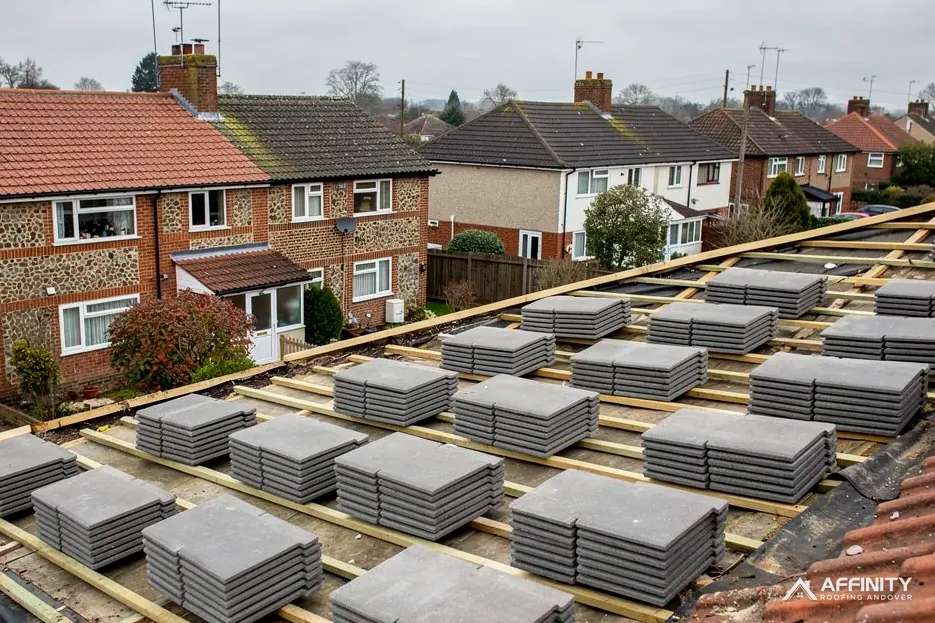
At the end the old tiles and slate leave with the team, the gutters are cleared, and the final photographs are taken from the spots used at survey.
Roof work we do in Bradfield



Bradfield roofs: the church, the College and the weekly fee
Does Bradfield's St Andrew's need listed building consent for roof work?
Yes. The church was bought by Bradfield College in 2021 for a learning centre and is no longer kept as a place of worship, so the ecclesiastical exemption does not cover it. Work affecting its character needs listed building consent from West Berkshire Council. Churches still in use follow their own denomination's system, so current use is the first question.
Can I replace slate on a Bradfield cottage with concrete tiles?
Ask West Berkshire Council's planning team first, especially inside the conservation area. A heavier covering also raises the Building Regulations weight test: 15 per cent or more heavier needs approval and a structural check. We would normally repair or re-cover slate like for like and photograph the roof before any proposal is made.
What does West Berkshire charge for scaffold in Bradfield?
West Berkshire Council charges £125 plus £71 per week, and asks for the application 10 working days at least before the scaffold goes up. The scaffolding provider submits it, not the resident. Scaffold on a private road is licence-free, and the survey notes where a frame can stand. We handle the dates with the scaffolder, and the cost belongs in your single written price.
Why does Bradfield's flood map matter for a roof survey?
The Environment Agency's planning flood map shows the middle of Bradfield in Flood Zone 3. That says nothing about any house, but it is a prompt to look hard at gutters, downpipes and gullies, since a roof that cannot shed water quickly shows its weaknesses first. We photograph every outlet we check, and note any that are silted or cracked.
Arrange a Bradfield roof survey first
Give us the address and a roof photo. A survey, a council check and one price follow.
10-year workmanship guarantee, in writing.