
Roofers in Calcot
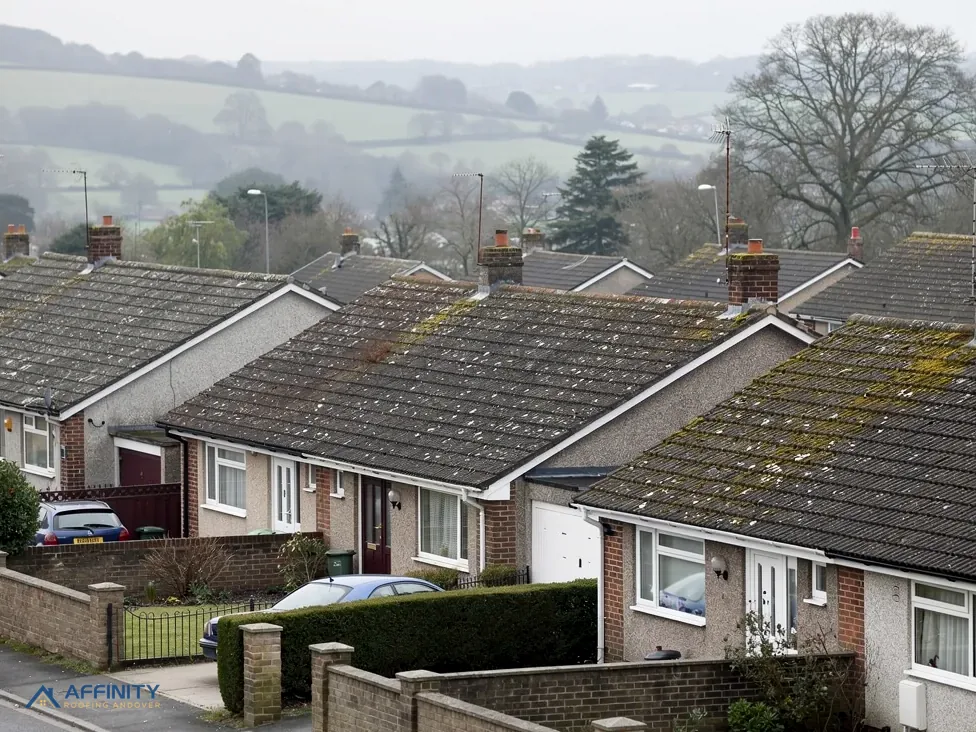
Suburban roofs on the western edge of Reading, by the Kennet valley
Calcot is a suburb on the Bath road, west of Reading, with an old house in a wooded park. We survey each roof, photograph it and give one written price.
Calcot roofs, from Calcot House to the suburban close

Calcot House and its roof
Described in 1923 as a red brick house in a wooded park, with 1755 on its lead rainwater heads and a later roof.

Beansheaf Farmhouse and granary
Farmhouse and granary are both Grade II, so repairs nearby are a matter of matching what is already there.

Suburban homes and extensions
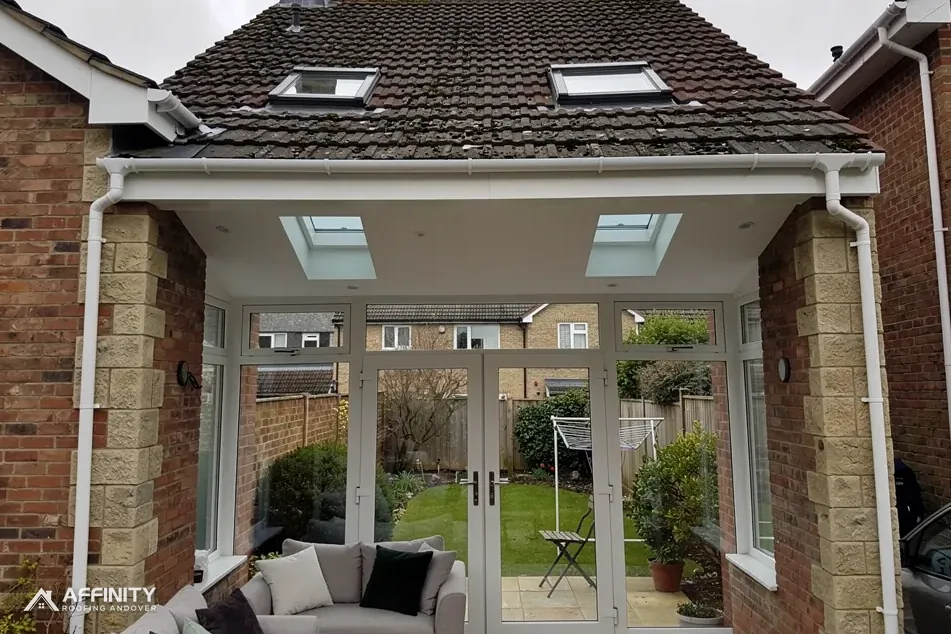
Houses along the Bath road and the closes behind it, where flat extension roofs and garages are common jobs.
Calcot between Theale and Tilehurst
Theale lies to the west, Tilehurst to the north-east, Burghfield Common to the south and Pangbourne to the north-west. We cover roofs in all of them.
- Distance
- 27.6 road miles north-east of Andover
- Planning
- West Berkshire Council
- Council
- West Berkshire Council (unitary)
The Calcot roof report
Local editionCalcot, BerkshireA Berkshire suburb and its paperwork
Calcot is West Berkshire, not Reading: which council, which inspector and which scaffold fee
Calcot sits on the western edge of Reading, close enough to the town boundary that owners sometimes assume the wrong council. This report explains who decides on roof work here, what the older houses add, and how scaffold is charged by the week.
West Berkshire Council, and a partner for inspections
Calcot is a suburb on the Bath road on the western edge of Reading, on the north side of the Kennet valley. It sits right beside Reading, but its roofs come under West Berkshire Council, a unitary authority. It grants planning permission and looks after the roads. For building control it works through Building Control Solutions, known as BCS, a partnership of West Berkshire Council and Wokingham Borough Council, which takes calls on 0300 790 0580.
The boundary with Reading Borough is close, so it pays to confirm the council before anything else. A quick check with the council settles it in a minute, and it matters because the planning team, the inspector and the scaffold licence all follow the answer. We make the check at the start of every Calcot survey and record the result on your file with the photographs.
For a re-roof, the national yardstick is the Planning Portal's. Where less than 25 per cent of the building envelope and less than 50 per cent of the roof is affected, building control normally need not be involved. A heavier covering, one 15 per cent or more above the weight of what it replaces, does need Building Regulations approval, and the Planning Portal advises a structural check beforehand. The council adds no percentage of its own to either test.
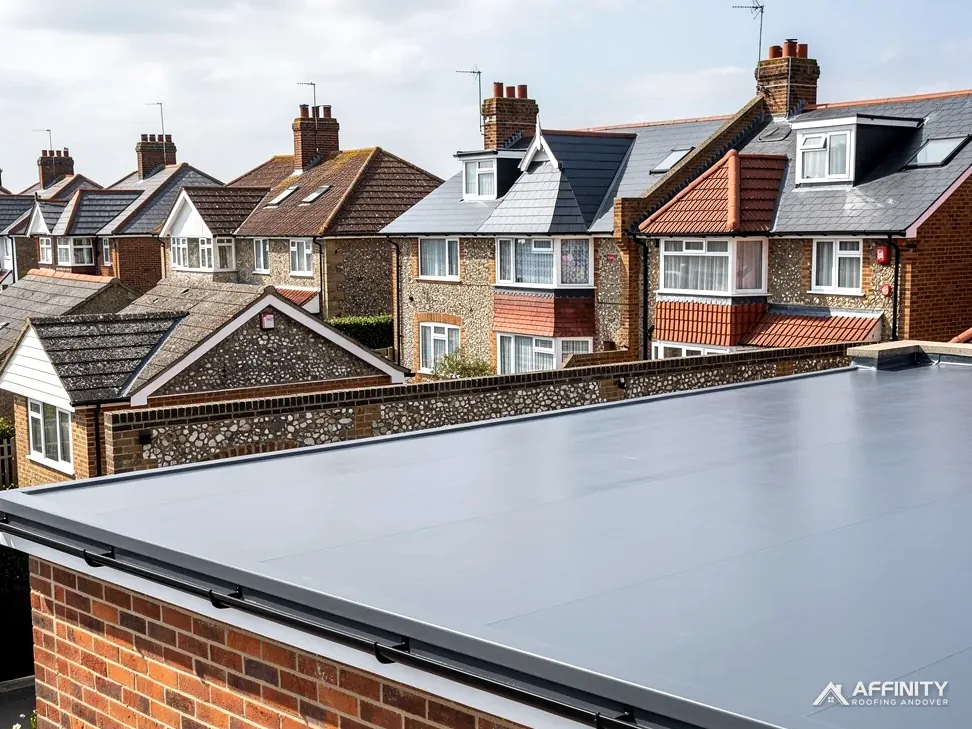
Many Calcot homes have had extensions, and an extension roof is often flat. A flat roof is not a lesser roof: it is judged on falls and drainage. BS 6229:2025 sets a finished fall of at least 1:80 across the main areas and the internal gutters, and designers aim higher, with IKO recommending a design fall of 1:40. We measure what is there, and the survey photographs show where water sits.
Lofts need air as well. Under BS 5250, a cold roof laid with HR underlay (the non-breathable sort) takes eaves ventilation of 25 mm along the eaves for pitches of 15 degrees or less and 10 mm for steeper ones, according to Marley's guidance. A breather underlay over a well-sealed ceiling can rely on the small gap that normal eaves construction leaves. We check the eaves on survey, because stained timbers above a ceiling usually point to trapped moisture. Pictures of the loft hatch, the eaves and the underside of the covering go on your file next to the outside views, so inside and outside tell one story.
You may use a registered building control approver instead of BCS, under rules that took effect on 6 April 2024. The route is settled before work is booked, and you receive it with the price.
Calcot House, 1755 and a roof raised later
One building with a documented history is Calcot House, described in the Victoria County History of Berkshire in 1923 as a red brick house in a wooded park. The date 1755 on its lead rainwater heads, the boxes at the top of a downpipe where a gutter discharges, marks when it was built. By 1923 its walls had been raised to enclose the top storey under a new roof. That sequence, an older house given a new roof, is common to buildings of every age.
Lead on a roof like that is sold by code. Lead sheet carries a code number from 3 to 8 that gives its thickness, and Royston Lead's brochure lists code 3 for soakers only, the small pieces that tuck under tiles beside a wall, and codes 4 and 5 for flashings, the strips that seal a roof against a wall or stack. Lead flashing can last for over 80 years (MyJobQuote), a floor rather than a promise, so a well-fitted detail may only need dressing back into place.
The same account records that in 1894 part of Calcot hamlet was taken out of Tilehurst parish and placed in the new parish of Theale, which then held the greater part of the hamlet. It explains why the place is not a neat unit on a map. Parish lines here have moved before, which is part of why checking the council is worth the minute.
Two listed buildings stand within 500 metres of the centre of Calcot: Beansheaf Farmhouse (list entry 1214865, listed Grade II on 23 December 1983) and the granary about ten metres south-west of it (1214867), also Grade II. Work on a listed building's roof needs listed building consent for anything that affects its character, whatever planning permission the job needs. We repair like for like, with matching clay or slate fixed in the original way, and we describe the work to the council in plain words with photographs.
Several conservation areas lie close to Calcot: Holy Trinity, Theale, Horncastle, Routh Lane and the Theale High Street area are all within about 2.5 kilometres. Ask West Berkshire Council's planning team whether your own address falls within one, and whether an Article 4 direction touches your street. Where trees overhang a roof, leaf litter fills gutters and hoppers sooner, so those are checked and cleared at every visit. About 4 per cent of the search area edges into the North Wessex Downs National Landscape, which is advisory only: the council is still the planning authority.
“Calcot House carries 1755 on its rainwater heads and a roof added later.”
Source: VCH Berkshire vol 3 (1923), Parishes: Tilehurst
A weekly scaffold fee, garage roofs and asbestos
Where a Calcot house stands on a road, a frame may need to occupy the public highway. Section 169 of the Highways Act 1980 requires a licence for that, and West Berkshire Council grants it. The council's own page says the scaffolding firm must be the applicant, with the resident left out of the process. West Berkshire Council charges £125 plus £71 per week, and it asks for the application at least 10 working days before the frame is due to go up.
A few details are worth knowing. The insurance West Berkshire Council requires has to indemnify the council up to £10 million. If an application is withdrawn, or made in error, before the licence is granted, the council can generally refund only 50 per cent, and it refunds nothing once the licence is in force. No licence is needed for scaffold standing wholly on private land. The scaffolder files the application, we coordinate the dates, and the scaffold is covered by your one written price. On the Bath road and the closes off it, we also note where a delivery lorry can stand, because a frame arrives on a vehicle and that vehicle needs somewhere to stop.
Suburban roofs bring garages, and older garages sometimes have asbestos cement sheets. HSE guidance is that asbestos cement is non-licensed work provided it is handled carefully and removed without breaking it up; breaking it up substantially makes it notifiable. The waste is double-wrapped and goes on a consignment note, never into an open skip and never into household waste. If your garage roof was built or refurbished before 2000, assume asbestos until a test says otherwise.
That is one reason a survey comes before a price. Our flat roofing work covers extensions and garages once the covering is identified, roof repairs cover leaks and slipped tiles on the main house, and guttering, soffits and fascias complete the roofline. We tell you what we have found before a figure is written.
One more point on the bill. The standard rate of VAT is 20 per cent, and the domestic reverse charge never applies to a homeowner, because it operates only between businesses inside the Construction Industry Scheme. Ask any roofer whether the figure includes VAT and whether the scaffold is in it. Citizens Advice advises getting at least 3 written quotes, and the ones that spell out the covering and the area are easiest to weigh against each other.




Calcot roofs: council, flat roofs and the weekly fee
How do I check whether my Calcot house is in West Berkshire or Reading?
Ask West Berkshire Council, or check its online maps, since the Reading boundary lies close to Calcot. The answer fixes your planning authority, your inspector and your scaffold licence. We run the check at survey and keep the result with your photographs, so the right council is asked from the very start of the job.
What fall should a flat roof on a Calcot extension have?
BS 6229:2025 keeps a finished minimum fall of 1:80 for the main roof areas and internal gutters, and IKO says a roof should be designed for 1:40. We measure the fall at survey and photograph where water stands. A roof that ponds may need new falls or a new covering, depending on what is there, explained in plain terms.
How is scaffolding charged on a Calcot road?
West Berkshire Council charges £125 plus £71 per week for the licence, and wants the application at least 10 working days ahead. Its page says the scaffolding provider applies, not the resident. Scaffold standing wholly on your own land needs no licence. The scaffolder files, we coordinate the dates with them, and the cost sits within the one written price you receive.
Can I just break up an old asbestos cement garage roof in Calcot?
No. Careful removal of asbestos cement without breaking it is non-licensed work, but breaking it up substantially makes it notifiable, and the waste must be double-wrapped and carried on a consignment note. HSE advises assuming asbestos in buildings built before 2000. We identify the material at survey, before any removal is planned or priced, and we say plainly if a specialist is needed.
Have your Calcot roof surveyed first
Send the address and a photo of the roof. We will survey it, confirm the council and write one price.
10-year workmanship guarantee, in writing.