
Roofers in Rownhams
A parish formed in 1897, with a listed house, stables and church
Rownhams has four listed buildings near its centre, among them Rownhams House and its stables. We climb, photograph and explain before any figure is set.
Rownhams roofs, from the House to the church

Rownhams House and stables
The house and its stables, each listed Grade II, where roof work on the main building and outbuilding follows consent.

The church of St John
A Grade II listed church, with houses around it where a neighbouring roof may be protected too.

Homes in a young parish
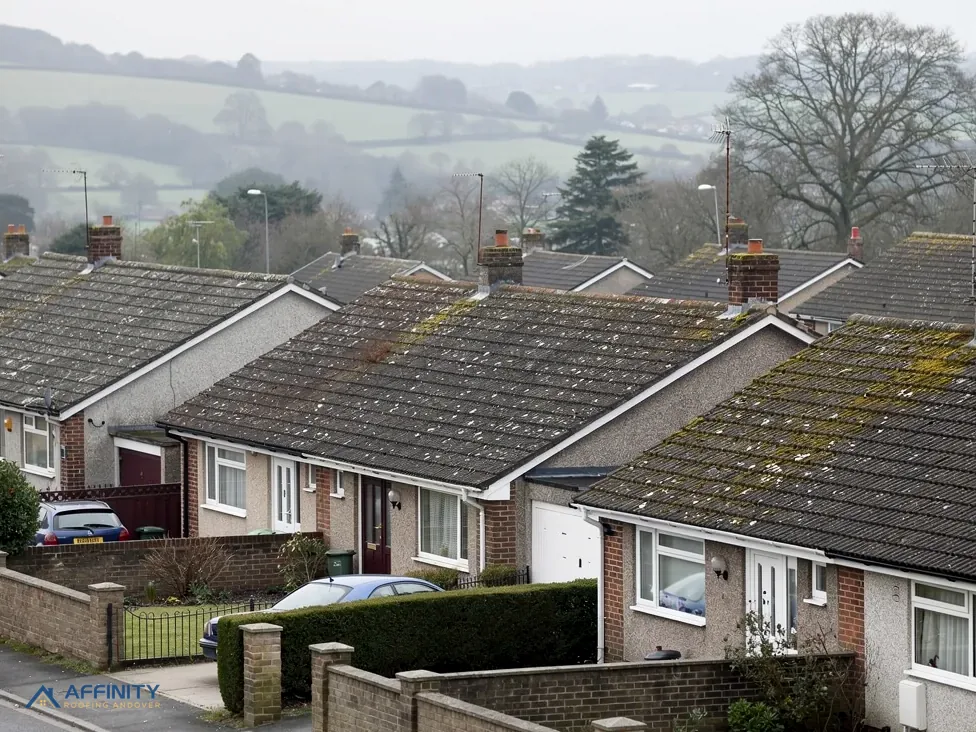
Houses across a parish that the 1908 Victoria County History recorded as formed from parts of three older parishes.
Rownhams between Romsey and Totton
Nursling lies just to the south-west, with Totton and Marchwood beyond it to the south. Romsey is north-west, with North Baddesley, Chilworth and Valley Park further out to the north-east.
- Distance
- 21.3 road miles south of Andover
- Planning
- Test Valley Borough Council
- Council
- Test Valley Borough Council and Hampshire County Council
The Rownhams roof report
Local editionRownhams, HampshireA listed house, stables and a young parish
Test Valley's southern parish: who decides on a Rownhams roof, and what its stables and church ask
Rownhams is 21.3 road miles from Andover, a parish created in 1897 from parts of older ones. Below: which council decides what, how a listed house with stables changes a repair, and how the Hampshire scaffold fee is set.
A parish stitched together in 1897
Parish boundaries around Rownhams are younger than most. The 1908 Victoria County History records that in 1897 Rownhams became a civil parish of its own, cut from a detached piece of North Baddesley and slices of Romsey Extra and Nursling. The lesson for a homeowner is practical: go by the address and the council's own records, because a village name and a parish line do not always agree.
The councils that count are Test Valley Borough Council, which decides planning, and Hampshire County Council, which looks after the road. Rownhams is 21.3 road miles from Andover, and the two names are the same as for a roof in the town itself. The parish of Nursling and Rownhams had 5,968 usual residents at the 2021 Census.
For building control we say your building control body, and we find out which team deals with a Rownhams address before you commit to a re-roof. We put your roof to that team, and its reply reaches you with the price. Prefer a registered building control approver? That private route is regulated since 6 April 2024, and our survey notes go to whichever body you pick.
Planning and building control ask different things. Planning looks at how a roof will appear: material, colour, shape and the setting of listed buildings. Building control looks at whether the roof will stand and perform: weight, fire behaviour and structure. A job can raise one question, both or neither, and we sort which at the survey, in plain terms, with the evidence from your own roof.
Whether an Article 4 direction touches a Rownhams address is for Test Valley Borough Council to confirm. The council hears the question, with your address, ahead of any quotation, and its reply sits beside the pictures. If the answer changes what you can do to the roofline, you will know before the quote, and the design can adapt.
The weight rule is worth knowing even if it never applies to you. Heavier is different: if the new covering would weigh 15 per cent more than the old, Building Regulations approval applies, and the Planning Portal suggests a structural check first.
Before the first tile is lifted, the survey sheet names the covering, its slope, the way in and any listing, along with the departments involved and the dates that hang on them. It runs to one page. Anyone who has tried to find out afterwards why a roof was done in a certain way will see the value of that page.
Rownhams House, its stables and St John's
The National Heritage List records 4 listed buildings within about 500 metres of the centre of Rownhams. Rownhams House is listed Grade II (list entry 1268431). The stables north-east of the house are Grade II as well (1093632, first listed on 29 May 1957), and the Church of St John is Grade II (1093673, first listed on 17 November 1986). Each of the four is named on the list, so a Rownhams owner can look the house up by name.
A stable block is a useful reminder that listing reaches beyond the main house. An outbuilding may be protected on its own account, or may count as part of the surroundings of the house beside it, and in both cases its roof is subject to the same consent rules. We ask the council about the outbuildings as well as the house, since a barn or garage roof can be the one that turns out to be listed.
Anything that changes a building's special character, such as a new covering material, a different roof profile or an extra opening, needs listed building consent. Repair using matching materials is where discussions with the planners begin. Our guide to listed building roof repairs sets out the steps, and Test Valley Borough Council's planning team decides each application.
A church is a separate case. If St John's is an Anglican church in use, its roof goes to the faculty system; a Catholic or Methodist church has its own scheme, and a Quaker or Unitarian one needs consent. A church that has shut, or is held by a trust, is treated differently again. Anyone responsible for a church roof should tell us which applies when booking.
Chilworth Old Village and St James Road are conservation areas within about 2.5 km of Rownhams. Neither is shown inside the village itself, but that tells you nothing certain about your address. Test Valley's map decides the question for any one house, and we look at it before quoting.
A listed building's setting is a planning idea as well. A new roof on an unlisted neighbour can matter if it is seen beside the listed one. We mention that to owners whose houses face the church or the stables, so a new colour or material is discussed with the council before it is ordered.
On a stable or barn roof we record the timber structure as well as the covering: trusses, purlins and wall plates tell us how the building has moved, and they decide whether re-covering is sensible or the frame needs work first.
“Rownhams was made a parish in 1897, but the council paperwork is the same as Andover's.”
Source: Victoria County History, Hampshire vol 3 (1908)
Hampshire's fee by the fortnight, and the work we price
If scaffolding must occupy the highway in Rownhams, the licence comes from Hampshire County Council under section 169 of the Highways Act 1980. Hampshire County Council's charge is £211.90 on application for the first 2 weeks of the licence and £72 for each additional 2-week period, so a job that runs to three weeks pays for the first fortnight and one further period.
Hampshire County Council receives the application from the scaffolding firm, and the earliest start is 10 clear working days after it. There is no tacit consent and no extension. That makes the job's length a decision to take early: too short a licence means a fresh application, and too long a one pays for days nobody is working.
Private roads need no licence, and a stable block or a property reached along a private lane may never put a pole on the highway. We establish this on the survey, and the price then reflects whichever applies. Where a licence is needed, the dates are fixed with the scaffolder only after the materials are confirmed.
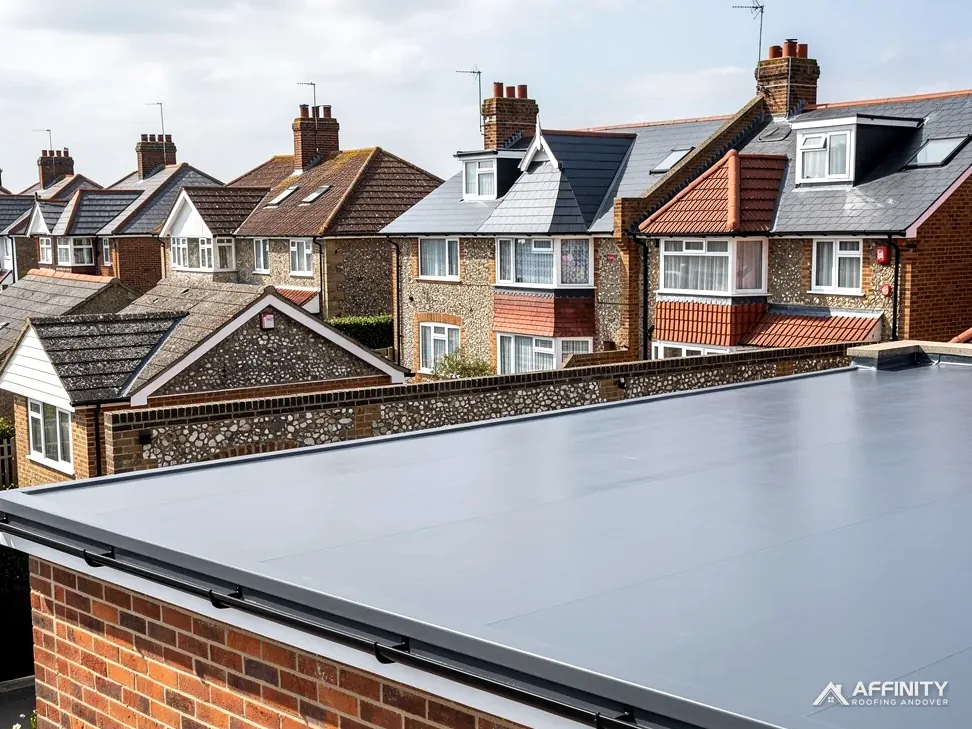
Services for Rownhams roofs cover every roof on the property. Roof repairs deal with slipped and broken tiles and failed flashings. Slate roofing is the work for older roofs where slates have slipped or nails have rusted through. Flat roofing covers porches, garages and extension roofs, where a blocked outlet is often the whole story.
Outbuildings need the same care as houses. A roof on a stable block, a garage or a store carries rain like any other, and the structure under it often receives less attention. Outbuilding gutters clog with leaves and quietly stop draining, leaving the wall beneath damp. A look from a ladder costs little, and the photographs make the problem obvious.
After the survey you receive one total price in writing. It states what the work covers, whether scaffolding and its licence sit inside it, and what happens if hidden damage is found, so a surprise has a procedure and not an argument. A start date goes out once licence, consent and materials are all in hand, and the date is written down.
Where chimneys stand on older roofs, the flashings and flaunching are checked at the same visit. A stack that leaks looks like a roof that leaks, and the cure differs, so the photographs separate one from the other before any repair is chosen.
Before comparing two quotes, ask whether each covers the scaffold and its permit, waste removal, VAT, and a stated way of handling rotten timber found under the covering.
Pitched, flat and roofline work in Rownhams





Rownhams roofs: stables, church and the county fee
Does the listed stable block at Rownhams House need consent for a new roof covering?
It can. The stables are listed Grade II, and a different covering material would change the building's special character, which calls for listed building consent. Matching repairs are the usual starting point. Ask Test Valley Borough Council's planning team, and we will record the existing slates or tiles in detail for the application.
Is the church of St John in Rownhams covered by listed building consent?
The answer turns on its denomination and use. The Church of St John is listed Grade II. An Anglican church in use goes through the faculty system instead, and Catholic or Methodist churches have schemes of their own. A closed church or one owned by a trust needs listed building consent. Tell us which situation applies.
Does a Rownhams roof job pay Hampshire's scaffold fee by the fortnight?
Yes, where the scaffold stands on the highway. Hampshire County Council charges £211.90 on application for the first 2 weeks, then £72 for each additional 2-week period. No extensions are offered, and the company supplying the scaffold applies to Hampshire County Council well ahead. A private road or drive lies outside the scheme, so check which case your house falls into.
Why do Rownhams and Nursling appear together in the Census figures?
The 2021 Census counts them as one parish, Nursling and Rownhams, with 5,968 usual residents. Rownhams was formed as a separate civil parish in 1897 from parts of North Baddesley, Romsey Extra and Nursling, so its parish lines have moved before. For roofs, the council that matters is Test Valley Borough Council, wherever the parish line runs.
Rownhams and the parishes beside it
Book a Rownhams roof survey
Request a Rownhams survey with the address and a roof photo. Test Valley's rules are checked, then one total price.
10-year workmanship guarantee, in writing.