
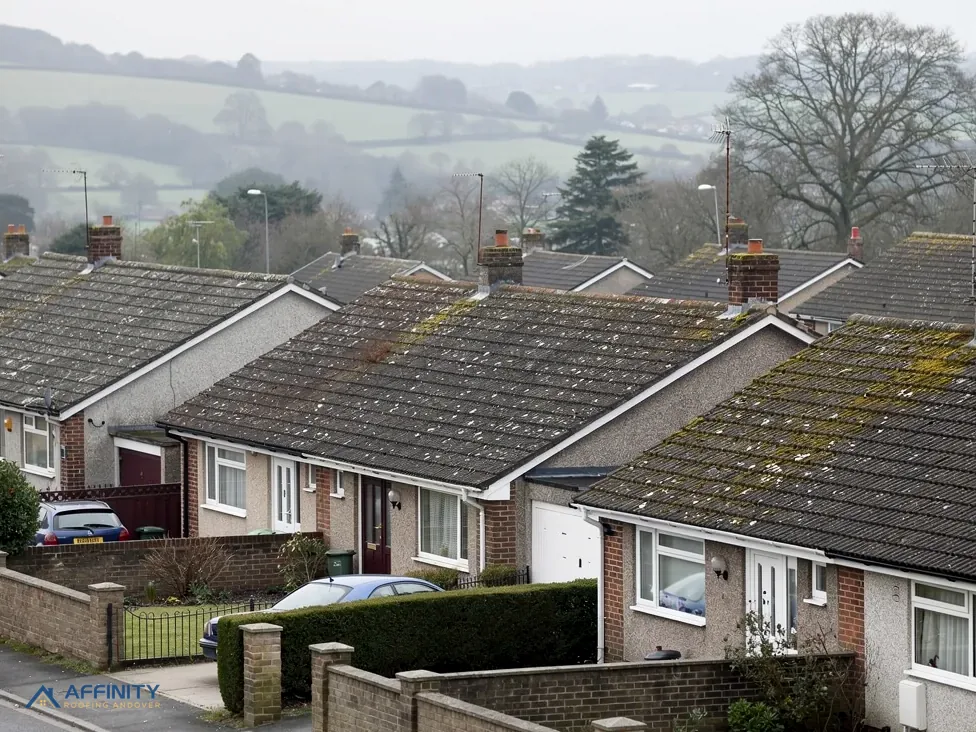
Roofers in Pewsey
St John the Baptist, Court House and the Vale of Pewsey's roofs
Pewsey stands inside the North Wessex Downs, with two conservation areas and a Grade I church close to its centre. Each roof is inspected and the findings explained plainly.
Pewsey roofs around St John's

Streets by St John's
Houses near the Grade I Church of St John the Baptist, listed on 27 May 1964, among 40 listed buildings.

Court House and Manor Farmhouse
Court House and Manor Farmhouse, both Grade II, where repair details are judged against the listing.

Wilcot Road homes
Houses in the Pewsey and Wilcot Road conservation areas, where the roof's appearance is the council's business.
Pewsey, between Upavon and Burbage
Upavon lies south-west of Pewsey and Burbage to the east. Marlborough is north, Collingbourne Ducis south-east and Netheravon south, with Great Bedwyn further east.
- Distance
- 18.7 road miles north-west of Andover
- Planning
- Wiltshire Council
The Pewsey roof report
Local editionPewsey, WiltshireInside the North Wessex Downs
Inside a National Landscape: how a Pewsey roof is cleared and who decides
Pewsey is 18.7 road miles from Andover, in Wiltshire, with its village point inside the North Wessex Downs National Landscape. This report covers what that changes, the 40 listed buildings nearby and the council's scaffold permit.
St John the Baptist and 40 listed neighbours
Pewsey parish had 3,790 usual residents at the 2021 Census, and Historic England's list records 40 listed buildings within about 500 metres of the centre. Leading the list is St John the Baptist's church, Grade I (list entry 1035703), first listed on 27 May 1964. Coachman's Cottage (1035702) is Grade II, listed on 4 June 1952, and so are Court House (1035705) and Manor Farmhouse (1035720). Two conservation areas lie within about 0.75 km of the centre: Pewsey, and Pewsey Wilcot Road.
Forty protected neighbours in so small a radius means that many roof jobs here brush against somebody's listing, even where the roof itself is unlisted. A ladder, a skip or a shared gutter deserves the same courtesy as a repair to the listed building. Should your house be listed, listed building consent is needed ahead of any work that alters its character. Our guide to listed building roof repairs shows how that application is made.
St John's is still used for worship as a Church of England building, so faculty rules govern it. A scaffold pole or ladder resting on churchyard stonework needs the parish's agreement, and owners of houses beside the churchyard do well to raise it early.
Wiltshire Council draws both conservation-area boundaries. Which of the two, if either, takes in your house is a map question that we settle at the survey and record in the note. Wiltshire's data also names Article 4 areas in places nearby, among them Upavon and Marlborough; what each covers is the council's to explain. Ask its planning team whether any touches your road, and keep the answer.
Upavon is 3.7 miles south-west, Burbage 4.3 miles east and Marlborough 5.8 miles north, and all three are in Wiltshire. A roof job anywhere along that stretch follows the same council's pages. That is the practical benefit of working in the Vale: once the route is clear for one house, we know where the next question goes and who is likely to answer it.
Surveying an older village roof is a slow job done properly. Slate and tile sizes, thicknesses and colours are recorded, with the fixings and the ridge bedding, and every valley, hip and flashing is photographed. In the loft we look at rafters, battens and underlay for earlier repairs and for damp.
When tiles must be replaced, reclaimed ones that match come first, because a new tile beside an old one shows from the street.
For owners who are selling or buying, the dated photographs and the written note make a useful file.
The Downs designation, Wiltshire and the weight of a roof
Pewsey sits inside the North Wessex Downs, a National Landscape that used to be called an AONB. Does that move decisions to a downs body? It does not. The partnership advises. Wiltshire Council decides, and Natural England is consulted by right, though that is the council's step, not yours. A plain repair therefore goes through the council alone.
The designation does change something: the care worth taking over appearance. Anything that changes a roof's shape goes to the planners as a question before we quote on it, and the answer comes to you in writing. Putting back the same covering, in matching materials, is the simplest case to make.
For Building Regulations, Wiltshire Council has its own Building Control service, with an office at Monkton Park in Chippenham. Registered approvers offer a private alternative; their register opened on 6 April 2024. Either works for a roof, and once we have seen yours we say which we would choose.
Two Planning Portal numbers decide most re-roofs: 25 per cent of the building envelope and 50 per cent of the roof, each measured on the work you propose. A job that touches less than each of them does not normally go to building control for approval. A third figure overrides them. A covering that weighs 15 per cent more, or beyond, needs approval and a structural look at the timbers first. Concrete laid over what was plain tile or slate is the swap that catches people out.
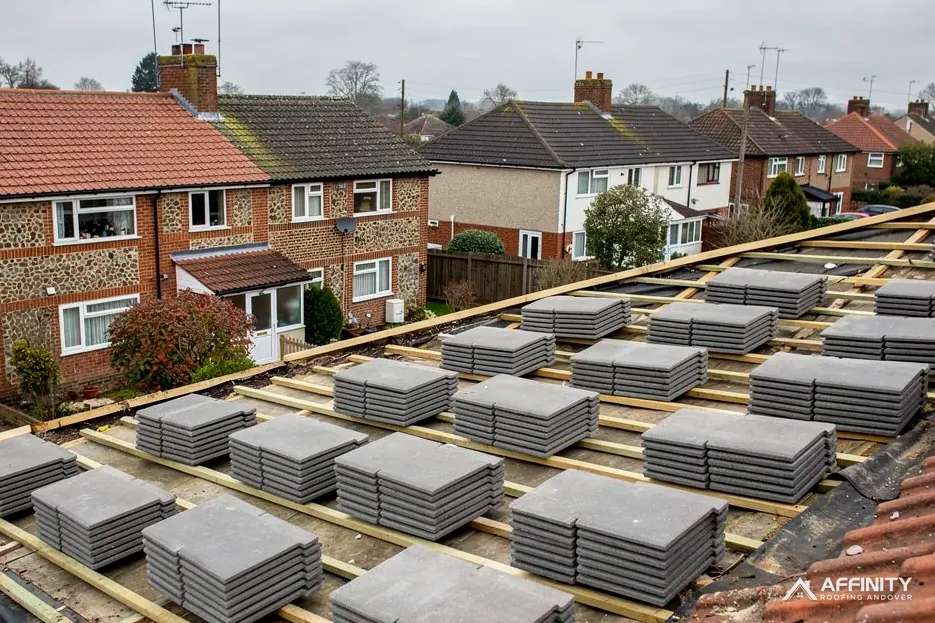
Picture a three-day repair on a Pewsey house with a tiled pitch. On the first day the frame goes up and the damaged tiles are lifted, so that the battens and underlay beneath can be inspected and photographed. On the second the rotten battens are cut out, new ones fixed and fresh underlay laid. On the third the tiles go back with matched replacements, the ridge is rebedded and the gutters are cleared. Each day ends with the roof closed to the weather. A sheet weighted over any open area does that job overnight.
The Environment Agency's mapping puts the centre of Pewsey in Flood Zone 3. The label has no bearing on how a roof is mended. What it does remind us is that roof water must be carried clear, so gutters, outlets and downpipes get close attention on every survey here.
If a re-roof adds insulation or a roof window, Part L of the Building Regulations may apply, which is something the survey flags.
You receive it all together: photographs, a short note on each fault, the consents that apply and one written total.
“Pewsey's roofs sit inside the North Wessex Downs, among a crowd of listed buildings.”
Wiltshire's licence for scaffold in the Vale
Where a Pewsey house stands on the road edge, poles set in the public highway need a licence under section 169 of the Highways Act 1980, and Wiltshire Council issues it. Wiltshire Council looks to the scaffolding supplier to apply on MiPermit, one licence being issued for each site. The homeowner does not apply.
Wiltshire's fee depends on notice: £143.80 for an application with more than 3 working days' notice, £164.70 for one with less. All its licences are valid for 28 days. A hoarding is licensed separately, and any parking space painted on the carriageway has to be suspended by separate arrangement. The council also charges a late fee for scaffold erected without a licence, one more reason to book in good time.
Treat the 28 days as a working budget. Materials are ordered first and the frame follows, with the strike day settled when the scaffolder is booked. If rain halts work, we cover what is open and go through the new dates with you.
Plenty of Pewsey roofs never reach the highway. If the garden or drive is big enough, the entire frame may rest on your property, and a low roof can be worked from a tower. The plot is assessed during the survey, and the note says whether any permit belongs in the timetable.
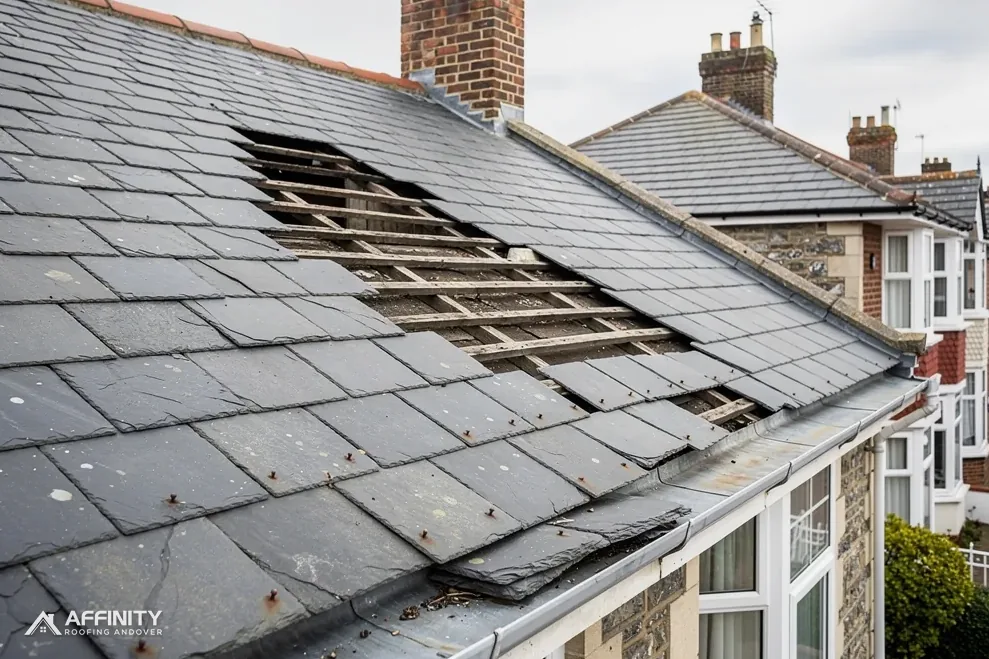
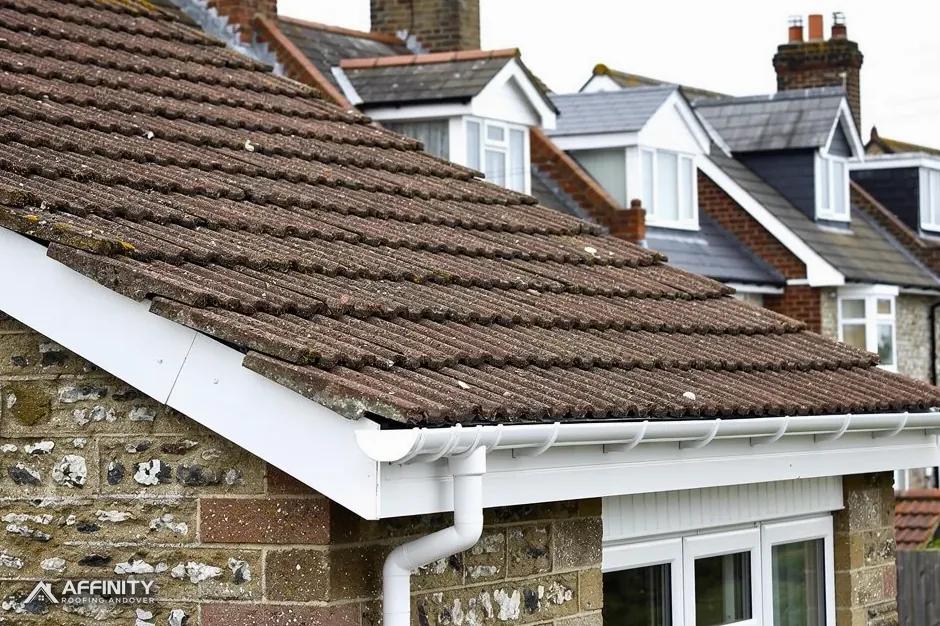
Pewsey roofs call on three services in particular. Roof repairs deal with the small faults: a few tiles shifted, a ridge piece cracked, a flashing lifted. A slate roof gets its nails inspected along with its slates. Guttering, soffits and fascias make up the roofline; the gutter hangs from the fascia board, and beneath the eaves a soffit board lines the overhang.
Four questions are worth putting to any roofer, here or elsewhere. Who applies for the scaffold licence? Is the price one written total? Will the roof be photographed so that you can see what is found under the covering? What happens if more is uncovered than expected? A good answer to each is clear and specific, and it arrives before work starts and in writing.
Not every faulty roof is an old one. Newer houses suffer from poorly bedded ridge tiles, lifted flashings and blocked valleys, and the survey treats them the same way. Blocked valleys are a common hidden fault. Every roof is examined closely, from outside and from the loft, with photographs of each fault.
Next door hears before the frame arrives, deliveries and the skip have agreed positions and the site is made safe each evening. On the last day, the rubbish has gone and your photographs are with you.
Ways we look after Pewsey roofs


Pewsey roofs: the listings, the Downs and the permit
Can I re-tile my Pewsey house without asking the council?
Possibly, if you are putting back the same covering on an unlisted house, but check first. The Pewsey conservation areas and the Downs designation make appearance a council matter. Ask Wiltshire Council's planning team about your address, and about any Article 4 direction. If the house is listed, listed building consent is needed first, and we can help prepare the application.
Does living inside the North Wessex Downs add a second planning step to a Pewsey repair?
No. The partnership advises and Wiltshire Council decides, so the council is still the only body you apply to, whichever side of the village you live on. A change to a roof's shape is worth putting to the council first, while a matching repair needs no extra form because of the Downs. We can ask the council for you.
What will Wiltshire charge for scaffold outside a Pewsey house?
Wiltshire Council charges £143.80 with more than 3 working days' notice and £164.70 with less, and each licence lasts 28 days. The scaffolding company applies to Wiltshire Council through MiPermit. Where the frame stays inside your boundary there is nothing to license, so the plot is checked before anyone is booked, and the survey note records the answer for you.
Is Pewsey's flood zone a problem for a roof repair?
In the Environment Agency's mapping, the centre of Pewsey falls in Flood Zone 3. That is a planning category, not a roofing one, and the repair method is the same either way. We pay particular attention to gutters, outlets and downpipes, so roof water is carried clear of the building, and we note any that are undersized, loose or choked with moss.
The Vale of Pewsey: neighbouring places
Have your Pewsey roof checked first
Tell us the lane and attach a photo. Survey, consents, then a written total.
10-year workmanship guarantee, in writing.