
Roofers in Marlborough
High Street houses, Grade I landmarks and the North Wessex Downs
Marlborough has 267 listed buildings within 900 metres of its centre. Every roof is read slope by slope and photographed, and the repair is matched to how it was built.
Marlborough roofs between the High Street and the Common

High Street frontages
142 and 143 High Street are listed Grade II*, so work that changes their character needs listed building consent.

St Mary's and C House
The Parish Church of St Mary and C House are both listed Grade I, first listed on 18 July 1949.

Homes in the downs
Marlborough lies within the North Wessex Downs National Landscape, where new dormers need planning permission.
Marlborough between Ramsbury and Pewsey
Ramsbury lies east, Aldbourne north-east, Burbage south-east and Pewsey south. Our surveys reach each of them, each address checked on its own terms.
- Distance
- 22.2 road miles north-west of Andover
- Planning
- Wiltshire Council
The Marlborough roof report
Local editionMarlborough, WiltshireOne council and a crowded heritage list
Marlborough's High Street roofs: one council to ask, and a crowded heritage list
Marlborough is a Wiltshire town of 9,128 residents inside the North Wessex Downs. This report sets out how a single council covers planning, building control and scaffold licences here, and what the heritage list and the downs change.
Wiltshire Council answers all three questions
Marlborough parish had 9,128 usual residents at the 2021 Census, and it stands in Wiltshire, which is a unitary area. One council therefore does the work that is shared out between a district and a county elsewhere in our patch. Wiltshire Council takes the planning decisions, employs the inspectors at its Building Control service in Monkton Park, Chippenham (0300 456 0113), and licenses scaffold as highway authority. For a homeowner that is simpler on paper, because you deal with one body, even though three different teams reply.
The downs add a layer without adding a decision-maker. Marlborough sits within the North Wessex Downs National Landscape, the label that replaced the old Area of Outstanding Natural Beauty, and the partnership behind it only advises. Its role in planning is advisory, so Wiltshire Council remains the authority that decides, with Natural England holding a statutory consultee role. A homeowner never has to apply to the partnership, and a plain repair involves neither body.
For re-roofing, the Planning Portal gives the national rule of thumb: a building control application is normally unnecessary where under 25 per cent of the building envelope and under 50 per cent of the roof is affected. That national test is where we start for a Marlborough address. A repair confined to one patch of a slope sits far inside it, and a whole-slope re-covering needs a closer look at both numbers.
Weight is a separate test. Should the replacement weigh 15 per cent or more above the old covering, Building Regulations approval comes into play, and the Planning Portal advises having the roof structure assessed before the work. Natural slate giving way to large concrete tiles is the sort of change we flag early. It is a Building Regulations question and has nothing to do with planning permission, so it goes to building control, not the planners.
The survey notes the ridge (the crest where the two slopes join), the hips, the valleys and the soakers, which are small folded pieces of lead or zinc sealing the place where a slope meets a wall. We lift a tile where access allows and photograph the battens beneath, so the proposal and its cause arrive together and you can judge both.
Anyone preferring a registered building control approver may use one in place of the council's own team. Whichever you choose, the route is recorded and sent with the price, ahead of any scaffold, so the paperwork keeps pace with the work. If the council has asked for anything, the answer is attached. The survey photographs go with it for any later buyer.
The High Street, St Mary's and C House
Historic England's list holds 267 listed buildings within about 900 metres of the Marlborough town point, so a Marlborough survey starts by reading the list for the house and its neighbours. St Mary's is the Grade I parish church (list entry 1034302), and C House (1273163) is Grade I as well; both went onto the list on 18 July 1949, as did 142 and 143 High Street. Numbers 142 and 143 High Street are listed together at Grade II* (1034234). The list reaches so far across the centre that checking a house against it is the first thing we do on any Marlborough enquiry.
Where work would affect a listed house's character, listed building consent is needed in addition to any planning permission. Matching the existing materials is the starting point. The application lists the covering, the ridge, the verge (the sloping edge beside a gable wall) and the chimney detail, which lets the officer judge the extent of any change without guessing. If the council raises a point, the answer is already on file.
The Marlborough conservation area adds a second question for unlisted houses, because any change to a roof that shows from the street is a conversation with the council before it is a booking. Wiltshire Council also has an Article 4 area named Marlborough 2. What it covers, and whether your street falls inside it, is for Wiltshire Council to say, so we ask before quoting, and the answer goes into your file. Our guide to planning permission for roof work sets out the wider picture for a dormer.
A scheduled monument is on the town's list too: the Earthworks on Marlborough Common, within about 500 metres of the centre (list entry 1005635). Works carried out on the monument itself need scheduled monument consent. A roof on a house in town is a different matter, and where a house sits near the Earthworks, the scheduled area shown on Historic England's map is compared with the plot.
Because the designations overlap, the photographs matter. They show the planning officer the tiles, slates, lead and mortar actually on the building, and they give you a record to keep with the house deeds. Where older material needs replacing, we look for reclaimed tile or slate to suit, matching size, colour and texture to what remains on the roof, and noting the source of the material for the file. On a street like this the neighbours see every roof each day, so a repair that blends in is the aim, and a patch that stands out is a fault.
“In Marlborough the question is rarely which council, and nearly always which designation.”
Scaffold on the High Street, and our jobs
Scaffold across a footway or carriageway comes under section 169 of the Highways Act 1980, with the licence granted by the highway authority. In Marlborough that authority is Wiltshire Council. Under Wiltshire Council's scheme the scaffolding firm files on the MiPermit portal, a licence being issued for each site, and no form comes to the homeowner.
Wiltshire Council's fee turns on how much warning it gets, not on how long the scaffold stays. Wiltshire Council's price is £143.80 if the application is lodged over three working days ahead and £164.70 on shorter notice. Every licence is valid for 28 days, and the scaffolding firm has to show Wiltshire Council its public liability cover. A marked parking bay outside the house also needs a parking bay suspension, which is a separate request.
A licence valid for 28 days is plenty for a repair and a squeeze for a full re-roof along a long frontage. We plan the sequence so the scaffold stands only as long as it is needed, and for a re-roof we tell you at the survey whether one licence is likely to cover the whole job or whether the programme needs adjusting. Weather, delivery dates and any consent condition all go into that plan. The scaffolder is asked for the earliest realistic start before the licence is requested, not after.
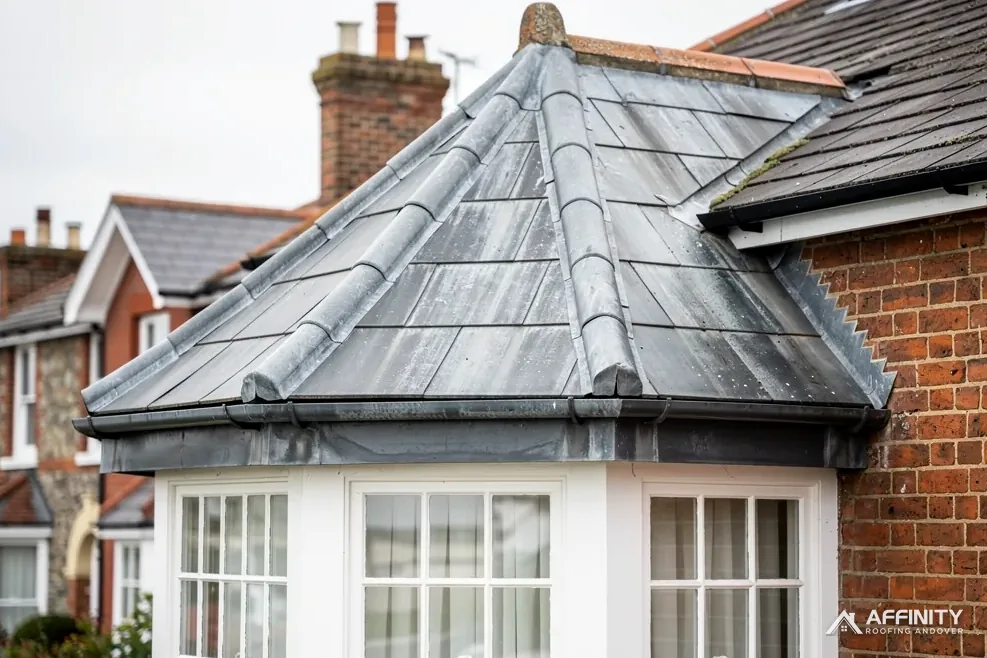
The work in a town like this runs from small fixes to complete re-coverings. Roof repairs deal with slipped and cracked tiles. Chimney repairs cover stacks that have lost mortar or flashing. Older buildings often have lead roofing in valleys and around parapets, and that needs careful renewal with lead sized for the job.
Where a whole slope has failed, the survey sets repair against replacement in plain terms. If the battens are sound and the tiles are the problem, we recommend repair. If the fixings have gone across the slope, replacement is the better buy, and the photographs show exactly why. Either way you hold the evidence before you agree anything, which is how a roof decision on a listed street ought to be made. We would rather you wait a day for a clear answer than agree a job on a hunch.
Ramsbury to the east, Aldbourne to the north-east, Burbage to the south-east and Pewsey to the south all lie within reach. Each one is checked for its own planning position, because a National Landscape boundary or an Article 4 area can change from one village to the next. A house a mile apart can sit under different rules, and the survey notes record which.
Services for roofs in Marlborough





Marlborough roofs: listings, the downs and scaffold
Can a High Street roof in Marlborough be re-covered without consent?
It depends on the building. A listed house needs listed building consent before any change of character, and a conservation area adds a conversation with Wiltshire Council about the roof's appearance from the street. We photograph the existing covering, propose a matching one and put the question to the council before any date is booked.
Does the North Wessex Downs partnership approve roof work in Marlborough?
No. The partnership is advisory only, and Wiltshire Council remains the planning authority, so there is nothing separate to file. The designation matters most for changes to a roof's outline, because new dormers need planning permission on this land. The designation does not make a repair or matching re-cover harder, though a listed or conservation area house brings its own rules.
Who applies for a scaffold licence in Marlborough, and what does it cost?
The scaffolding firm applies through Wiltshire Council's MiPermit portal, so the homeowner never fills in a form. Wiltshire Council charges £143.80 when notice exceeds three working days and £164.70 when it is shorter, and every licence lasts 28 days, which suits a repair and can stretch to a staged re-roof. The scaffolder handles the application, and any cost sits inside your one price.
Does the scheduled monument on Marlborough Common affect a house roof?
Consent for works on a scheduled monument is a separate regime, and the Earthworks on Marlborough Common are scheduled within about 500 metres of the centre. A repair to a house roof in the town is a separate matter altogether. For a house near the Common, the plot is set against the scheduled area at survey and the result noted in your file.
Tell us about your Marlborough roof
Share your address and a photo with us. We book the survey, then quote one written price for the work.
10-year workmanship guarantee, in writing.