
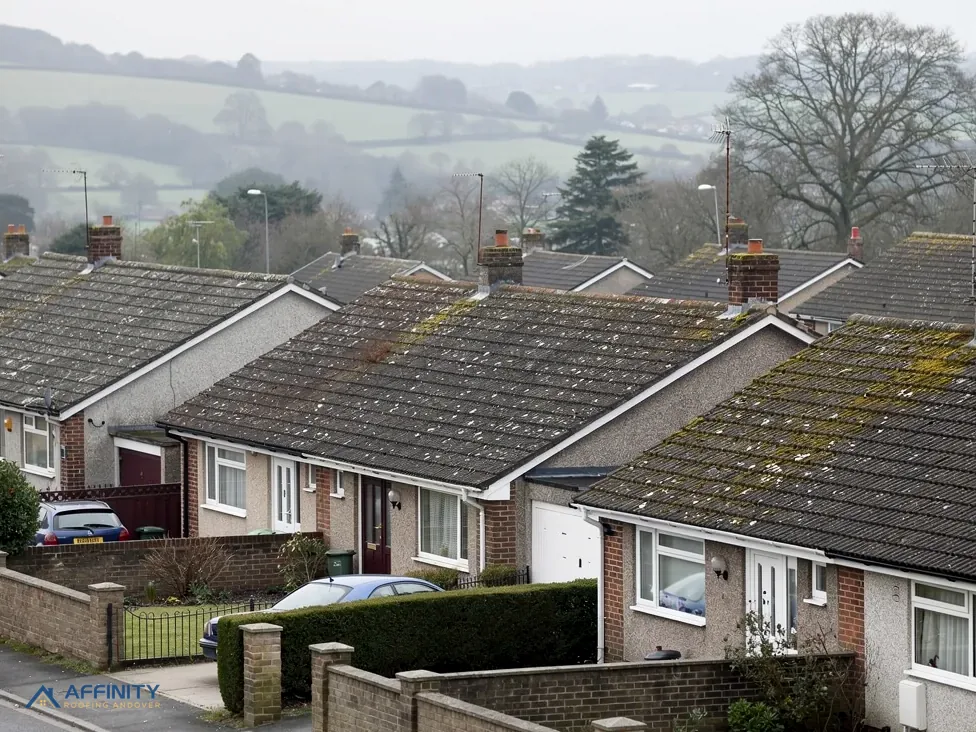
Roofers in New Alresford
A market town rebuilt after the fire of 1736, with 128 listings
New Alresford has 128 listed buildings within about 900 metres of its centre and a conservation area at its heart. Every roof is examined and photographed before a price.
New Alresford roofs, from Mill Hill to West Street

Mill Hill terraces
3, 5 and 7 Mill Hill are listed Grade II*, in a street where the Design Statement notes some thatch.

Town-centre houses
Houses in the streets rebuilt after the 1736 fire, many of them within the conservation area.

St John's church and Langtons
The Church of St John the Baptist and Langtons, both Grade II*, with 1 and 3 West Street nearby.
New Alresford among the Itchen-valley villages
Ropley and Four Marks lie to the east, Medstead to the north-east and West Meon to the south-east. Winchester and Kings Worthy are to the west, Micheldever to the north-west.
- Distance
- 21.8 road miles south-east of Andover
- Planning
- Winchester City Council
- Council
- Winchester City Council and Hampshire County Council
The New Alresford roof report
Local editionNew Alresford, HampshireA market town rebuilt after a fire
Rebuilt after the 1736 fire: how a New Alresford roof is cleared, and what its old streets ask
New Alresford is 21.8 road miles from Andover, a market town rebuilt after a fire in 1736 that ran along thatched roofs. Read on for who decides on a roof, what 128 listed neighbours and a Design Statement change, and how the Hampshire licence works.
A town that burnt and rebuilt on its own lines
The Victoria County History of 1908 records that a fire in 1736 began in a brewhouse and spread quickly along the thatched roofs of New Alresford. With the help of relief funds the town was rebuilt on the lines it still followed when the VCH described it in 1908. In 1753 the new London road was made, and the town became a great posting centre, which it stayed until the railway came. The streets that a roofer sees now are therefore those of that rebuilding, with later alterations.
Fire explains something practical about modern rules. When a new roof covering is chosen, Building Regulations ask how it behaves in a fire, and the Planning Portal names a new covering with a quite different fire behaviour from the old as a reason for approval. Replacing slate with a synthetic product in a close terrace deserves a question to the council first, and we put it before a price is written.
The council is Winchester City Council, which rules on planning and also runs its own Building Control service. The service's page describes its functions as dangerous structures and demolition, fire safety, building regulations and pre-application advice, and the council can be reached on 01962 840 222. Hampshire County Council is the highway authority. At the 2021 Census, the New Alresford parish counted 5,337 usual residents.
Weight is the other trigger. Tiles or slates that add 15 per cent to the roof's load call for Building Regulations approval, with a structural check first. The Planning Portal's threshold for lighter jobs is less than 25 per cent of the building envelope and less than 50 per cent of the roof, below which an application is not normally needed.
Whether an Article 4 direction touches a New Alresford street is for the council to say. We ask with your address before any quote that would change what a roof looks like, and the reply goes into your folder beside the survey pictures. You can use a registered building control approver instead, a private route regulated since 6 April 2024.
In a town of this age, a roof job rarely begins with a blank page. The survey records what is there first, because the next step depends on it.
Terraced houses share walls, and a repair at a party wall can touch a neighbour's property. Party wall questions go to a party wall surveyor, not to the council or to the roofer, and a notice in writing is part of that process. We flag the shared junctions on the survey so the paperwork can begin early.
128 listings, a Design Statement and a Grade II* church
The National Heritage List records 128 listed buildings within about 900 metres of the centre of New Alresford, a very large number for a small town. 3, 5 and 7 Mill Hill is listed Grade II* (list entry 1095230, first listed on 5 December 1955), and Langtons is Grade II* (1095229). 1 and 3 West Street is Grade II (1095197). St John the Baptist's church is Grade II* (1156507, first listed on 5 December 1955).
The New Alresford Design Statement of 2008 says that the majority of the houses in the conservation area are Grade II listed buildings. It also describes the town's roofs as a mixture of red tile and slate, with some thatched properties still in Mill Hill. Thatch is a thatcher's trade; the tiled and slated roofs, the chimneys and the roofline are where we work.
Listing protects what makes a building special, and a roof is a large part of that. Changing the covering, the pitch or the openings needs listed building consent before work begins, and like materials are the opening position in any talk with Winchester's planners. Our guide to listed building roof repairs covers the steps.
St John's is an Anglican parish church still in worship, so its roof goes through the faculty system and not through listed building consent. Catholic and Methodist churches keep schemes of their own, and a closed church needs listed building consent. If you look after a church roof, name the denomination and use when you book, and the survey will be written for the route that applies.
The New Alresford conservation area is on Winchester City Council's map. With a majority of its houses listed, the sensible assumption is that any roof near the centre needs a conversation before work, and that is a talk for Winchester City Council's planners. We read the map and the list entry together, then write down what each says about your roof.
On a survey in a street of this kind we photograph slates and tiles close up, record their sizes and fixings, and note the lead work at chimneys and party walls. Slate sizes vary with the quarry and the century, and a record taken now makes a match possible later.
The Design Statement is a document about the town's character. How much weight it carries in a planning application is for Winchester City Council to say, so we read it as guidance on what the town values, and the council's planners decide how it applies to your roof.
“New Alresford was rebuilt after a fire in 1736, and its listed streets still set the rules.”
Source: VCH Hampshire vol 3 (1908), The liberty of Alresford
River-meadow drainage and the Hampshire licence
Environment Agency maps put parts of the land within about 250 metres of the centre of New Alresford in Flood Zone 3, and the town stands on the River Alre. A roof cannot change that, but every roof sends water somewhere. Gutters, hopper heads and downpipes should deliver it into a sound drain well clear of the walls, and in a town of close terraces a blocked downpipe can wet a party wall for months before anyone notices.
For that reason, every survey traces the water from the ridge to the gully. We photograph the hopper heads, lift a section of gutter where we can, and note any joint that weeps. In an older street of brick walls and slate or tile roofs, damp that comes from the roofline can look like rising damp, and the pictures separate one from the other.
Hampshire County Council licenses scaffolding on the highway under section 169 of the Highways Act 1980, and it asks for signing and guarding proposals so passers-by can pass safely. Hampshire County Council's fee is £211.90 on application for the first 2 weeks and £72 for each additional 2-week period, and the licence cannot start until 10 clear working days have gone by.
The county takes the application from the scaffolder and not the householder, and no extensions are available. A scaffold in a private yard or behind a gate is outside the scheme. In a town with so many listed fronts, the dates also wait for any listed building consent, because an idle scaffold in front of an untouchable roof is money wasted.
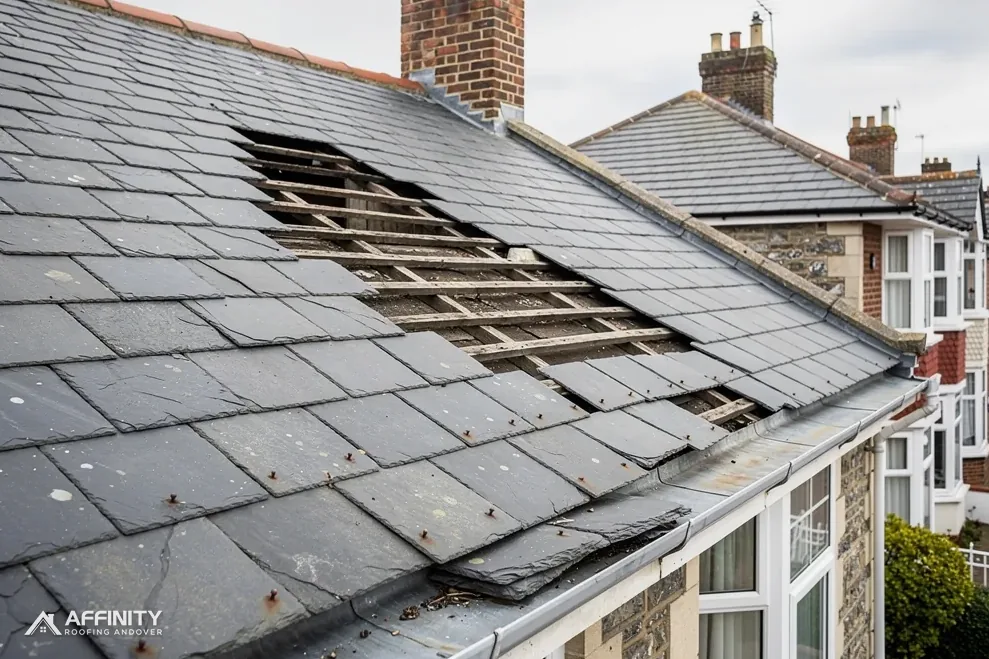
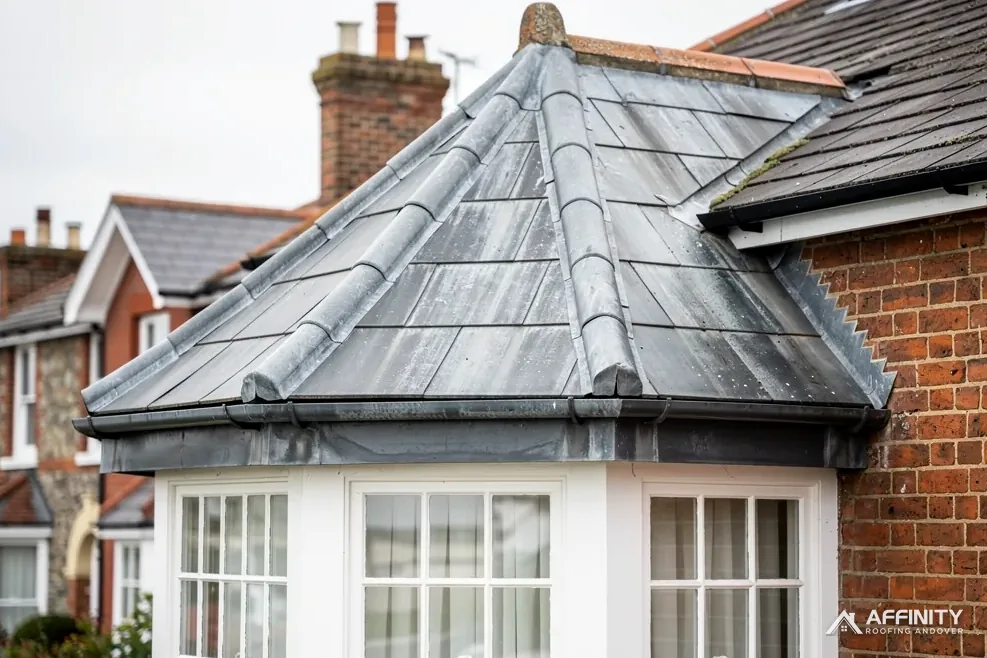
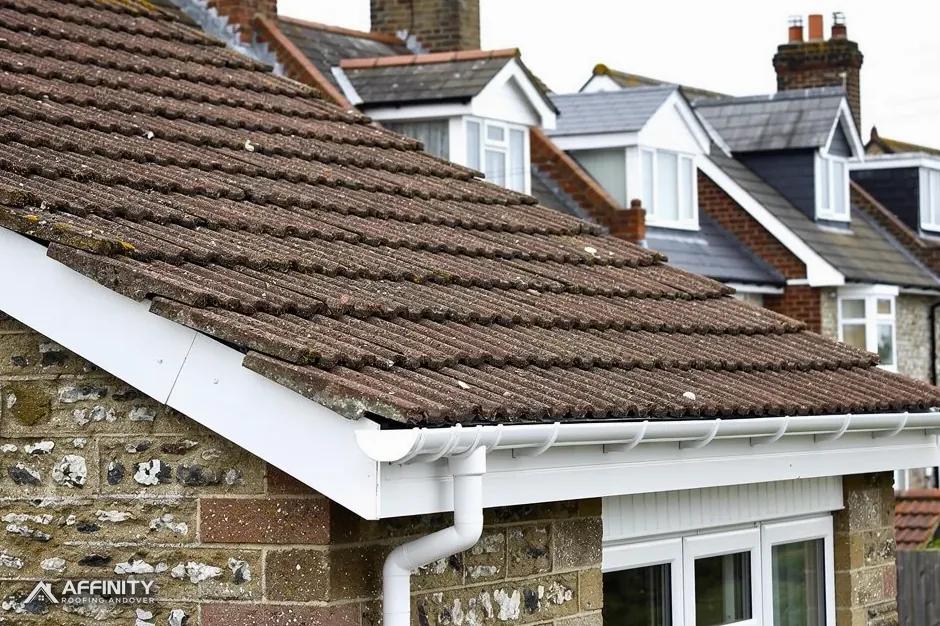
New Alresford roofs suit the traditional services: slate roofing where nails have rusted and slates have slipped, chimney repairs where pointing and flashings have failed, and roof repairs on tiled roofs. Every one begins with photographs taken on the roof.
If water is coming in, the roof is covered first, and the lasting fix is planned from what the photographs show. A bucket in the hall is a poor basis for deciding how to repair a roof, and the same photographs serve your insurer if a claim is in prospect.
Compare any two quotes on scope as well as total: scaffold and licence, waste, VAT, and what is done when rotten timber appears with the covering off. Roofs of this age conceal a lot, and a price that answers each point is one to plan around.
New Alresford homes: our roof services



New Alresford roofs: listings, fire history and the licence
Can I swap slates for a different material on a New Alresford terrace?
It would need care. A listed house needs listed building consent for a change of covering, and the Design Statement describes a mixture of red tile and slate. Even for an unlisted house, a covering with different fire performance or extra weight raises Building Regulations questions. Ask Winchester City Council before ordering anything.
Do the thatched houses in Mill Hill affect roof work next door?
They can. The Design Statement notes some thatched properties still in Mill Hill, and 3, 5 and 7 Mill Hill are listed Grade II*. Thatch is a thatcher's trade, while we survey the tiled roofs, chimneys and gutters beside it. Where a chimney or flashing meets thatch, the two trades coordinate.
What does Hampshire's scaffold licence involve on a New Alresford street?
Hampshire County Council licenses scaffolding on the highway and asks for signing and guarding proposals. Hampshire County Council's fee is £211.90 on application for the first 2 weeks and £72 for each further 2-week period, and 10 clear working days must pass first. Whoever erects the scaffold applies to Hampshire County Council. A private yard needs no licence.
Who checks building regulations for a New Alresford re-roof?
Winchester City Council's own Building Control service, reached through the council's main number, 01962 840 222, unless you choose a registered building control approver. It looks at weight, structure and fire performance. A covering 15 per cent heavier needs approval, and the usual threshold is under 25 per cent of the envelope and under 50 per cent of the roof.
Itchen-valley neighbours of New Alresford
Have a New Alresford roof read first
Book a survey with an address and photo. Winchester checks come first, then one total price in writing follows.
10-year workmanship guarantee, in writing.