
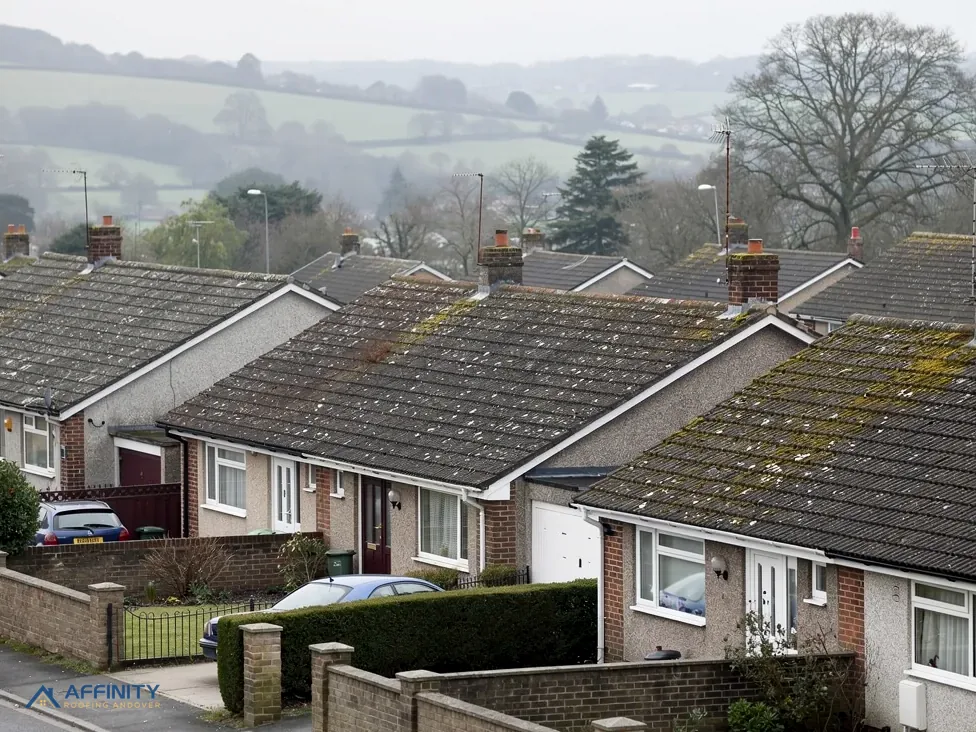
Roofers in Grateley
Cottage, farmhouse and church roofs in Grateley's own conservation area
Grateley has its own conservation area and a Grade I church at its heart. Before any quote, we survey the roof, photograph it and check which rules reach your house.
Grateley roofs around St Leonard's

Grade I church setting
The Church of St Leonard, listed Grade I in 1984, with neighbouring roofs surveyed with that listing in mind.

Listed cottages
Jasmine Cottage and Rose Cottage, listed Grade II on 24 October 1984 like the church, where matching materials count.

Manor Farmhouse and Grateley House
Two larger Grade II listed houses with long ridges, several slopes and chimneys that call for careful survey work.
Grateley between Amport and Over Wallop
Amport and Monxton lie north-east of Grateley, Over Wallop and Nether Wallop south, Thruxton north and Shipton Bellinger north-west. Our roofing work covers each of those villages.
- Distance
- 8.9 road miles west of Andover
- Planning
- Test Valley Borough Council
- Council
- Test Valley Borough Council and Hampshire County Council
The Grateley roof report
Local editionGrateley, HampshireA Grade I church, a village of 662
Grateley under St Leonard's tower: what a Grade I church means for the roofs around it
Grateley is a village of 662 with a Grade I church and its own conservation area. This report covers what the listings change, which council answers for a roof, and how a scaffold licence is arranged on a Hampshire road.
St Leonard's and the nine listed neighbours
St Leonard's church holds a Grade I listing (list entry 1093259, dated 24 October 1984). Grade I sits at the very top of the national list, so a roof near it is surveyed with more than the usual caution. Historic England's records show 9 listed buildings within about 500 metres of the centre of Grateley, a good number for a village with 662 residents at the 2021 Census.
Jasmine Cottage and Rose Cottage share one listing (1093261), which carries the church's own listing date. Manor Farmhouse (1156640) and Grateley House (1156679) are Grade II as well. We name them because their roofs set the tone of the village, and any survey on a neighbouring house starts from what they show of local slope, covering and ridge. Looking up from the lane, you can judge a good deal about how roofs here have been repaired.
St Leonard's is an Anglican church in use, which puts it under the Church of England's faculty system and outside listed building consent. Its faculty comes from the diocese's consistory court, Grateley's church included, and a roofer's part is the survey evidence. A house beside the churchyard is dealt with under the council's ordinary planning rules, plus listed building consent if the house itself is listed.
Listed building consent from Test Valley Borough Council is required where work touches a listed house's character, alongside whatever planning or building control the job needs. Our application is built from slope-by-slope photographs, a brief note on the covering as it stands and an outline of the repair, so an officer can read the whole case without a site visit.
Grateley also has its own conservation area, which lies within about 0.75 km of the village centre, on Test Valley Borough Council's own line. Within that boundary, changes that alter how a roof looks deserve a question to the council before pricing. A repair in matching material is the safest place to start.
Old roofs reward patience, and Grateley has several. On a farmhouse or manor house the covering has often been patched over generations, so a single slope can contain three different tile sizes. We map them on the photographs and decide whether to match the dominant one or to bring the whole slope back to a single type.
You get that record whether or not you go ahead with us, and the pictures belong to you to keep, share or hand to a buyer. It shows what is there, where the weak spots are and what a repair would involve, and a future buyer of the house will find it useful too.
Test Valley rules, read from Grateley
Grateley lies in Test Valley Borough, the same borough as Andover, so planning is Test Valley Borough Council's responsibility, with Hampshire County Council above it as the county. Hampshire keeps its two tiers for now, because the plan to replace its councils with new unitary authorities was withdrawn in September 2026 while the government reviews its approach.
For building control we use the phrase your building control body, and we mean it literally. The choice is between local authority building control and a registered building control approver, a private route regulated since 6 April 2024. Which one fits your job is settled before the scaffold is booked, and you are told in writing.
Re-roofing thresholds come from the Planning Portal, not from the borough. A job that stays under 25 per cent of the building envelope and under 50 per cent of the roof normally never becomes an application. We check each slope against both numbers, and if a job sits near a limit we ask your building control body what it expects.
Weight is a separate trigger. Where a replacement covering weighs 15% or more above its predecessor, the job needs Building Regulations approval plus a structural check of the roof. Natural slate swapped for concrete is the textbook example, and we look for it whenever an old Grateley roof is being re-covered.
Whether an Article 4 direction touches a Grateley address is for Test Valley Borough Council to say, and we raise the question in writing with the address attached. The answer lands in your file next to the photographs. Our planning permission for roof work guide sets out the national position.
Many Grateley jobs are modest. Slipped tiles after a gale, a cracked ridge piece, a gutter dropped at one end: these are repairs, and the thresholds above do not come into play. Our roof repairs page describes how we price and carry them out.
Larger jobs get a fuller conversation, with the pictures to hand. A re-roof is planned slope by slope, with a view on timber, battens and underlay recorded before the new covering is chosen. You see that view in writing and in pictures, so you can judge whether the whole roof is really failing or only one corner of it.
Old and new materials need thought where they meet. A new tile is chosen for size, thickness and colour, and the fixings are sized to the batten, so a patch that looks right now still looks right after a season of weather.
“Grateley has 9 listed buildings within 500 metres, so we ask the council before altering a roof.”
Source: Historic England list entries for Grateley
Hampshire's scaffold rules, applied in Grateley
Hampshire County Council licenses scaffold that obstructs a highway, under section 169 of the Highways Act 1980. The borough, as a district, issues none. The county's page spells out the demands on the firm that puts the scaffold up: public liability insurance of £10 million, a design to BS EN 12810/12811 or the NASC guidance TG20:13, and a plan at 1:500 with signing and guarding proposals.
Hampshire County Council gives no tacit consent, so silence from the council is never permission. It also offers no extensions, which makes planning the length of a job important. Hampshire County Council's application fee is £211.90 for the first 2 weeks, and each further 2-week period costs £72. If hoarding is wanted as well as scaffold, the county charges an extra fee.
Hampshire County Council expects the scaffolder to apply for you, with a ten-working-day lead before the licence is meant to start, so a Grateley roof job needs its dates planned early. When a listed building consent decision is still pending, the licence application waits. Starting it too soon could run the clock out before the work begins.
Private ground changes everything. Hampshire's page says no licence is needed to place scaffold on private roads, and the same logic holds for a drive, a yard or a garden. Many Grateley houses stand back from the road, and for those we simply reach the roof from the property, avoiding the highway entirely.
Gutters are the other job on a roof that is out of sight. Guttering, soffits and fascias carry water off the roof, and a loose bracket or a blocked outlet can wet a wall and undo a good repair. We check falls and joints on the survey and include any work in the same single price.
Chimneys on older houses need a closer look. A stack in the wind takes the weather from all sides, and a failed flashing lets water in below the roofline. Our chimney repairs page describes what we check, from pointing to the lead that seals the stack.
The survey ends with one written total. It names the route for consents, allows for the scaffold and its licence, and sets out the order of work, so you know what happens on which day. Waste is taken away as the job goes along, and the site is left tidy at the close of each working day, with the scaffold boards cleared of debris.





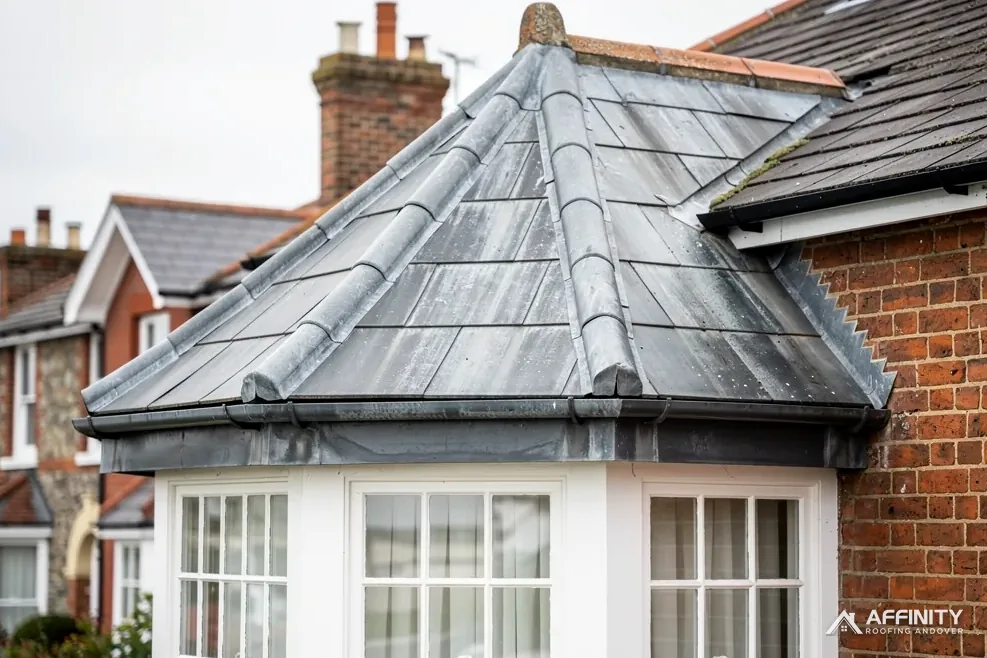
Grateley roofs: the church, the listings and the licence
Does a house beside the Grateley church need special consent for roof repairs?
Only where the house is itself listed. The church follows the faculty system, which does not extend to its neighbours. An unlisted house beside the churchyard falls under ordinary rules, and a listed one needs listed building consent from Test Valley Borough Council for work touching its character. We check the listing before the first visit and tell you the result plainly, with the list entry number. You receive the answer in writing.
Can Jasmine Cottage and Rose Cottage keep their original tiles?
Both are listed Grade II, so work affecting their character needs listed building consent. We would begin with repair in matching material and photograph the roof before proposing anything. Finding tile that matches in size and colour is slow work, so the hunt starts alongside the paperwork and not after it.
What does Hampshire's scaffold licence cost for a Grateley job?
Hampshire County Council charges £211.90 on application for the first 2 weeks and £72 for each additional 2-week period, and says hoarding adds a fee. Hampshire County Council's rules have the scaffolding firm apply, with ten clear working days of notice. A scaffold on private ground sits outside the licence, and any licence cost is part of your written price. It is arranged for you.
Is Grateley's conservation area a barrier to re-roofing?
Not a barrier, but a prompt to ask. Re-covering a roof is normally judged as it would be elsewhere, while a change that alters how the roof looks gets a closer look in a conservation area. Test Valley Borough Council can confirm whether an Article 4 direction applies, and we put that question first. The reply goes in your file.
Have a survey done on your Grateley roof
Message us the address and a photo of the trouble spot. We survey, then return one written price and the consent route.
10-year workmanship guarantee, in writing.